Pages

Showing posts with label Appalachian folklore. Show all posts

Thursday, February 1, 2018

Groundhogs, Pagans and Saints: From Groundhog Day to Imbolc to St. Brigid

Happy St. Brigid's Day! Re-posting this from 2009. That was my 1100th post on this blog. Today this makes post #3400. I am a chatty thing, aren't I? 

--------------------------------------------------------------------------------------------

There's a song I use at many performances that has a verse about groundhogs. Once, while telling at a state park, a gentleman came up and wanted to talk about groundhogs.
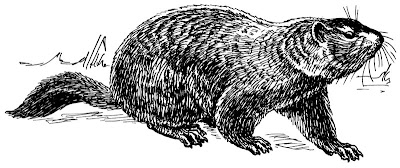

He said, “You ever eat groundhog?”

“No sir,” I told him, “I can’t say I ever have.”

“You sure about that?” he asked.

“Pretty sure,” I said.

“Well, I’m betting you have,” he said. “Not only that, I bet you’ve ate it more than once.”

“I don’t think so,” I assured him.

He grinned at me and asked, “You ever ate sausage? What’s that but ground hog?”

Groundhogs are good for other things too--like making a banjo head ( although the sound isn't very good, so I hear) or cutting the hide into strips for shoe laces.

Brian Fox Ellis has a good groundhog story on his website.

Urban Legends offers a wealth of links to more groundhog information that most of us are interested in reading.

If you prefer print media, Don Yoder's well-researched book Groundhog Day provides the European background of the holiday, along with weather folklore and much more.


February 2nd is also known as Candlemas Day (a Catholic holy day), Imbolc (to the early pagans) and it is Brigid's day (later transformed from a celebration of the Celtic fertility goddess Brigid to the feast day of St. Bridgid or Bridget on February 1). Both of these have their own celebrations and rituals far removed from the groundhog.

Candlemas Day is the celebration of the purification ceremony for Mary 40 days after the birth of Christ. It is celebrated by many with the lighting of candles. It is also one of the traditional days for taking down the Christmas decorations (January 6th is another) so if you're still putting it off, you have a good reason for it!

Brigid's day was commemorated with rituals to encourage fertility in the fields, and was considered to be the first day of spring in Ireland. Farmers soaked bread with cider or spirits and buried it in a turned furrow; signs of Spring could be found even though winter still held a grip--lambs might be born, sprigs of green might be found in the gardens.


In County Kildare, you can visit Brigid's well, one of over 3000 holy wells that once existed in Ireland. If you can't visit Dave Walsh offers a slide show of his photos online. Like our Vietnam Veterans memorial, visitors leave offerings of all kinds at the well.


Many poems and ancient tales of Brigid are collected on Conrad Bladey'ssite; Conrad offers information from his years of research on all topics Irish. At Chalicecentre, this poem is cited without a source:

Brighid's Arrow:
Most Holy Brighid, Excellent Woman, 
Bright Arrow, Sudden Flame;
May your bright fiery Sun take us swiftly 
to your lasting kingdom.

The name Brigid (also spelled (Brigit or Brighid) is said to mean "fiery arrow" by many sources. In some parts of Ireland, small effigies of her are carried house to house, much like Wassailing, and small coins and oatcakes are given to the groups. Other sources give the meaning of her name as "exalted one," and cite her as the goddess of fire, poetry and wisdom.


For more about St. Brigid, Anna Egan Smucker's book is an excellent and beautifully illustrated source.


Other good sources:

Candlemas: Feast of Flames by Amber K


Answers.com provides information about the name, the legends and mythology in a well-written article.


Background about St. Brigid's cross is offered on Cross and Crucifix.


You can learn to make a cross on YouTube, from an Irishwoman who gives great instructions and clearly displayed.


Of course there is customary food to celebrate Brigid's Day! Colcannon, Oaten Cake and Boxty Cakes are offered at fisheaters.com along with more information and lore about Brigid.

Here is the recipe for oaten cakes from that website:

St. Brigid's Oatcakes (serves 4)

2 cups uncooked, old-fashioned rolled oats (not instant)

1 1/4 cups buttermilk

2 1/2 cups sifted bread flour1 teaspoon baking soda

1/2 teaspoon baking powder1 teaspoon salt

Vegetable oil spray

A day ahead, combine the oats and buttermilk in a small bowl.
Blend thoroughly, cover and refrigerate overnight.
The next day, preheat the oven to 350 degrees F.
Remove the oat mixture from the refrigerator.

Combine the bread flour, baking soda, baking powder, and salt in a large bowl. Slowly add the oat mixture and stir with a wooden spoon 20 to 30 times, or until you have a smooth dough.

Grease a baking sheet with the oil spray. Turn the dough onto the baking sheet, and use your hands to form a round, cake-shaped loaf about 1-inch thick. Use a sharp knife or pizza cutter to cut the dough into 4 quarters.
Move the quarters apart slightly, but keep them in the original round shape.

Bake until the cakes are light golden brown and firm to the touch, 30 to 35 minutes.

Cool slightly on a rack, and serve with butter and jam or preserves. Makes 1 loaf (in quarters).


I started with the groundhog and traveled to the holy ground of Brigid. This seems to happen frequently when I begin to wonder about a bit of folklore that I took for granted--looking for the history behind these things is a fascinating journey.

There is still time, if you are so minded, to prepare a different kind of celebration for February 2. Instead of waiting around on a media-blitzed groundhog, why not light your home with candles, clean your hearth and start a new fire, make some oaten cake, and go outside to see if perhaps the crocus and snowdrops are peeking through the snow?

Copyright Susanna Holstein. All rights reserved. No Republication or Redistribution Allowed without attribution to Susanna Holstein.

Friday, January 5, 2018

Witch Balls and Gazing Balls


I am slowly taking down Christmas on this Old Christmas Eve, and as I was sorting a box of decorations that I hadn't used I discovered a couple of glass balls I'd forgotten about. I bought them last summer at a yard sale and a thrift shop and never got them hung.

So now they grace my wintry views.


As I was hanging them, I got to thinking about witch balls--which is what many people call these colorful baubles. Some witch balls have strands of glass running through their centers. Mine do not, and some people call these plain ones friendship balls. But history reveals that early witch balls were like mine, just plain round glass balls.

According to Wikipedia, the belief that glass orbs would repel evil spirits began long ago. To determine if a person was a witch, the accused would be stripped to undergarments, bound hand and foot, and tossed into the water. Here is a description of the process:

Although the belief in trial by water can be traced back to the third millenium BC, the official use of 'swimming' in English law dates back to King Athelstan (928-930), where trial by water, termed 'indicium aquae', was a general test for all crimes. It ceased to be an official Law in 1219 under Henry III's reforms. For the next six hundred years it was popularly, but unofficially, supposed to be infallible in discovering the guilt of witches and those suspected of subscribing to the black arts.

It was believed that water rejected servants of the devil and that if a suspected person floated and refused to sink when placed in water it was proof of guilt.

The ordeal of 'swimming' was endorsed by James I of England, who stated in Daemonologie (1597) "that God hath appointed ... that the water shall refuse to receive them in her bosome, that have shaken off them the sacred Water of Baptisme, and wilfully refused the benefite thereof."

As described by Sir Robert Filmer (1653) a suspect would be stripped naked and then tied up - the right thumb to the left big toe and vice versa. In this position she was then secured by ropes and thrown into a deep stream or pond three times. If she sank (and often drowned) she was deemed as innocent - if she 'fleeted' (floated) then she was 'guilty'. Often men with long poles were employed to push her under the water, while others, holding the ropes could drag her to the surface again. It became well known that, if the poor victim was laid out 'flat on their back and [holding] up their feet with a string' then 'the forepart will not sink' (Thomas Ady 1656) Foxearth and District Local History Society.

Some sources say that witches were believed to have rejected baptismal water, so therefore the water or swimming test was considered as a second baptism, and a witch would be rejected.

So how do glass balls fit into this? Glass balls have been used for centuries to float nets, and people saw this as the water rejecting the glass ball. So a ball that had floated in water was somehow viewed as a talisman against evil, and people would hang balls that had been used as floats in their homes to ward off witches and other evil spirits. Ir seems an odd twist, doesn't it, and yet there it is.

Many floats were made of blue and green glass, and these became the traditional colors for witch balls although today they can be found in almost any color or combination of colors.

Today glassblowers in the US and probably other countries continue to make witch balls; some who buy these glass orbs probably have no idea of their history. Others, like me, buy them because of that history.

My gazing ball, 2012
A spinoff of the witch ball is the glass gazing globes that many of us have in our gardens. Most of these have a mirrored surface.

According to lore, witches, on seeing their reflection in a mirror, will be frightened away (which is why people often had a mirror on the outside of their house). I suspect that again, many who have gazing globes in their gardens would be surprised at this connection.

Witchballs were not always glass. Some were made from human hair and grease formed into a ball, or with animal hair, as in this funny, flatulent story from North Carolina called The Witchball:

Once there was a poor boy who wanted to marry a girl, but her folks didn't want him. Hs grandma was a witch an' she said she'd fix it up. Sh made a horsehair witchball, an' put it under the girl's doorstep. The girl come outside, passin' over the witchball, an' went back in the house. She started to say somethin' to her mother, an' ripped out (crepitus ventris), an' every time she spoke a word, she'd rip out. Her mother told her to stop that or she'd lick her. Then the mother went out for somethin' an' when she came back in, she broke wind too, every time she spoke. The father come in an' he did gthe same thing.

He thought somethin' was the matter. so he called the doctor, an' when the coctor come in over the doorstep, he started to poop with every word he said. and they were all atalkin' and apoopin' when the ol' witch come in, and told them that God had probably sent that on them as a curse because they wouldn' allow their daughter to marry the poor boy. They told her to run and git the boy, 'cause he could marry their girl right away, if God would only take that curse offa them. The ole witch went and got the boy, an' on her way out, she slipped the witchball out from under the doorstep. The boy an' girl got married and lived happily ever after. (from The Encyclopedia of Superstitions--a History of Superstitions. M. and E. Radford, Rider & Company, London; probably first published in Journal of American Folklore 47, October-December 1934, "White Folktales and Riddles" by Ralph Steele Boggs.)


Want to know more? Try these online articles:

The dunking test.

Swimming and other strange tests for witches.

10 Tests For Guilt at the Salem Witch Trials.

History of the Gazing Globe.

Copyright Susanna Holstein. All rights reserved. No Republication or Redistribution Allowed without attribution to Susanna Holstein.

Wednesday, January 6, 2016

Gone to the Dogs: Superstitions, Folklore, Stories and More

My dogs howl. Long, loud and mournful. Usually it is the howling of coyotes that set them off, but sometimes they just sit and howl at the moon, literally. They're not hounds, either.

Photo from last winter. Remember when
we had real snow??
We have two black labs and a yellow lab--maybe there is a little hound dog in one of them, but the other two are pretty close to being pure bred. Their singing last night made me wonder if people attached any meaning to this wailing. So this morning i've been reading up on the topic, and have found that yes indeed, people were spooked by the mournful sound all right.

The most common belief seems to be that dogs howling at night means death is on the way. Some clarify this with the stipulation that they must be howling at a rising moon, so there is a little leeway for those of us who hear the hound-song in the morning or after moon rise.There is no indication of which listener will see the Grim Reaper although the Irish attach the misfortune to anyone who is in their sickbed when the dogs howl.

The ancient Romans thought the sound indicated the coming of evil, and noted that dogs do not howl at ghosts--they growl. The Canidae website's blog says that "In Ireland, folklore claims that dogs howl when they hear the universal phantom pack of hounds. These mystical hounds are said to lead their riders on a wild, barren hunt through the sky gathering the souls of the dead." And in his blog Appalachian Lifestyles, Matthew Burns reported that "if a dog howls while looking at the ground, he senses death is very near." Poor dog--or maybe it's not his own death?

Then there are the hellhounds, those mythical beasts of bad omen found in cultures around the world and hailed by a wide variety of names. Wikipedia says that in the British Isles "many names are given to the apparitionsModdey Dhoo of the Isle of Man, Gwyllgi of Wales, and so on (see Black dog (ghost))."

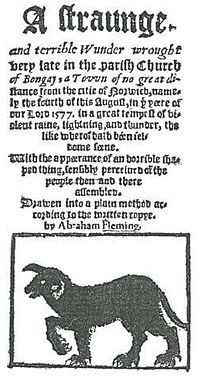
Title page of the Rev. Fleming's
book, from Wikimedia
My mother grew up in the region of England called East Anglia, and there, Black Shuck is a fabled demon dog to be avoided at all costs. One account of the terror the dog evoked: "This black dog, or the divel in such a linenesse (God hee knoweth al who worketh all,) running all along down the body of the church with great swiftnesse, and incredible haste, among the people, in a visible fourm and shape, passed between two persons, as they were kneeling uppon their knees, and occupied in prayer as it seemed, wrung the necks of them bothe at one instant clene backward, in somuch that even at a mome[n]t where they kneeled, they stra[n]gely dyed." (from Wikipedia, excerpt from  A Straunge and Terrible Wunder by Rev. Abraham Fleming in 1577). You can hear some of the stories about Black Shuck on YouTube.

Across the ocean, in my own county in West Virginia, there is a ghostly story about a headless dog. Ruth Ann Musick included it in her book, The Telltale Lilac Bush. Listen to the tale, read by Jason McKinney for the WV Network on Youtube:


But there are some good things about dogs in folklore too. The Scots believed that a strange dog coming to your door means a new friend is on the horizon. Of course, in our case, the new friend is often the dog! Native Americans believed that seeing a white dog was good luck, although there was that movie To Dance with the White Dog that had a different interpretation. In England, it was the black and white dog that meant good fortune was on the way, and a gold-colored dog meant prosperity. Well, I have a gold dog, but I can't see any wealth on the way for me, sadly. 

Another golden dog story is the eerie Golden Dog of Quebec. The mystery of this cut stone, which can be seen over a door in the old city, is as yet unsolved. The dog is chewing on a bone, over a verse in French which reads: 


"I am a dog that gnaws a bone,
I crouch[sic] and gnaw it all alone,
The time will come which is not yet,
When I'll bite him by whom I'm bit."

What does it mean? To what person or event does it refer? No one knows.

We use the word "dog" to describe a lot of less-than-pleasant experiences, expressions, and people. For example:

A dirty dog= cheater, thief, someone underhanded in their dealings.
A man might refer to a woman he thinks is ugly as a "dog." When a man is called a dog by a woman, however, she usually means a "dirty dog" as defined above.
Dog-faced=shame-faced.
Dog-eared=torn, tattered, worn.
Dog-tired=worn out, exhausted.
Dog someone=follow them relentlessly.
Call off the dogs=quit following, bothering, nagging, etc. Quit "hounding" someone.
Going to the dogs=not doing well financially, socially, or personally.

...and many, many more! Check out the Idioms Dictionary for a long list of the ways we malign our favorite animal with the phrases we use. We should be dog-faced about it. 

For more "black dog" superstitions and lore, check out the Villians Wikia.

Sacred Texts has a good article on Irish dog myths and lore as well as English dog lore.

Dog ghost stories? Try Ghost Dogs of the South.

A slobbery dog? Yes indeed, in Margaret Read MacDonald's book about a British legend.

Well, doggone it, I think that's enough for today ,although I've only touched the tip of the dogpile of stories, legends, myths and superstitions from all over the world about our canine friends.

Oh, and keep an eye on your dog. He or she might be trying to tell you something.

Copyright Susanna Holstein. All rights reserved. No Republication or Redistribution Allowed without attribution to Susanna Holstein.
Related Posts Plugin for WordPress, Blogger...