Pages

Showing posts with label frugal living. Show all posts

Friday, April 8, 2022

Sticker Shock

46 this morning, cold and rainy. Which basically describes this whole week.

So this evening I went into the grocery store for the first time since the beginning of March, and I was stunned by the rise in prices. We haven't needed much as we were pretty stocked up, but I was low on a few things. Larry has been running in to pick up milk and a few things here and there, but this was my first time to actually see for myself how prices have gone up. Wow.

Here's what I bought--and it cost me just over 90.00:
  • 3 loaves of bread at 1.50 each
  • 3 dozen canning jar lids. 3.99 a box, so almost 12.00 just for those.
  • 1 gallon of milk
  • 3 gallons of water
  • 1 pound of butter
  • 1 can of spray olive oil and a large bottle of Canola oil
  • 12 pack of toilet paper. 10.00 right there.
  • Produce: Celery, lettuce, tomatoes, and cherry tomatoes--3 packs because we eat them for snacks; apples, oranges, bananas, 3 pears, grapes, broccoli. The produce was the bulk of our costs, at close to 40.00.
  • A box of ice cream sandwiches, a quick treat some afternoons--2.49
  • a pack of bacon
  • a pack of sausage--so sad that we're out of our own bacon and sausage.
  • kielbasa. These few meats cost about 10.00. Cannot imagine how people afford more expensive meats. I feel so grateful for our freezer full of venison, I can tell you, and for all the frozen and canned turkey I put up when the price was low.

And that was it. We've always shopped frugally, and now we have to be even more so. As I look over this list, I guess we could have done without the ice cream, bacon and sausage. Our well water has iron in it so we buy drinking water; maybe we need to look into a way to make our own more palatable. But what else on this list can I cut? I refuse to cut back on fruits and fresh veggies, although I bought less than I'd have liked this time. I can make bread, of course, but I think the cost might be close to what I just paid for the marked-down loaves of decent bread. I've gone on an off breadmaking as life gets slower or faster, but looks like it might be time to be back on it, although online sources put the cost of a loaf of homemade bread at around 2.00--and that's probably not considering the recent price hikes.

Next time we need groceries, we're going to try Aldi's, which I know is more reasonable. It's a good 45 minute drive from home though, so will the savings be worth the time and cost of the drive? I'm not sure.

Copyright Susanna Holstein. All rights reserved. No Republication or Redistribution Allowed without attribution to Susanna Holstein.

Tuesday, January 20, 2015

Dryer Lint and Old Candles=?

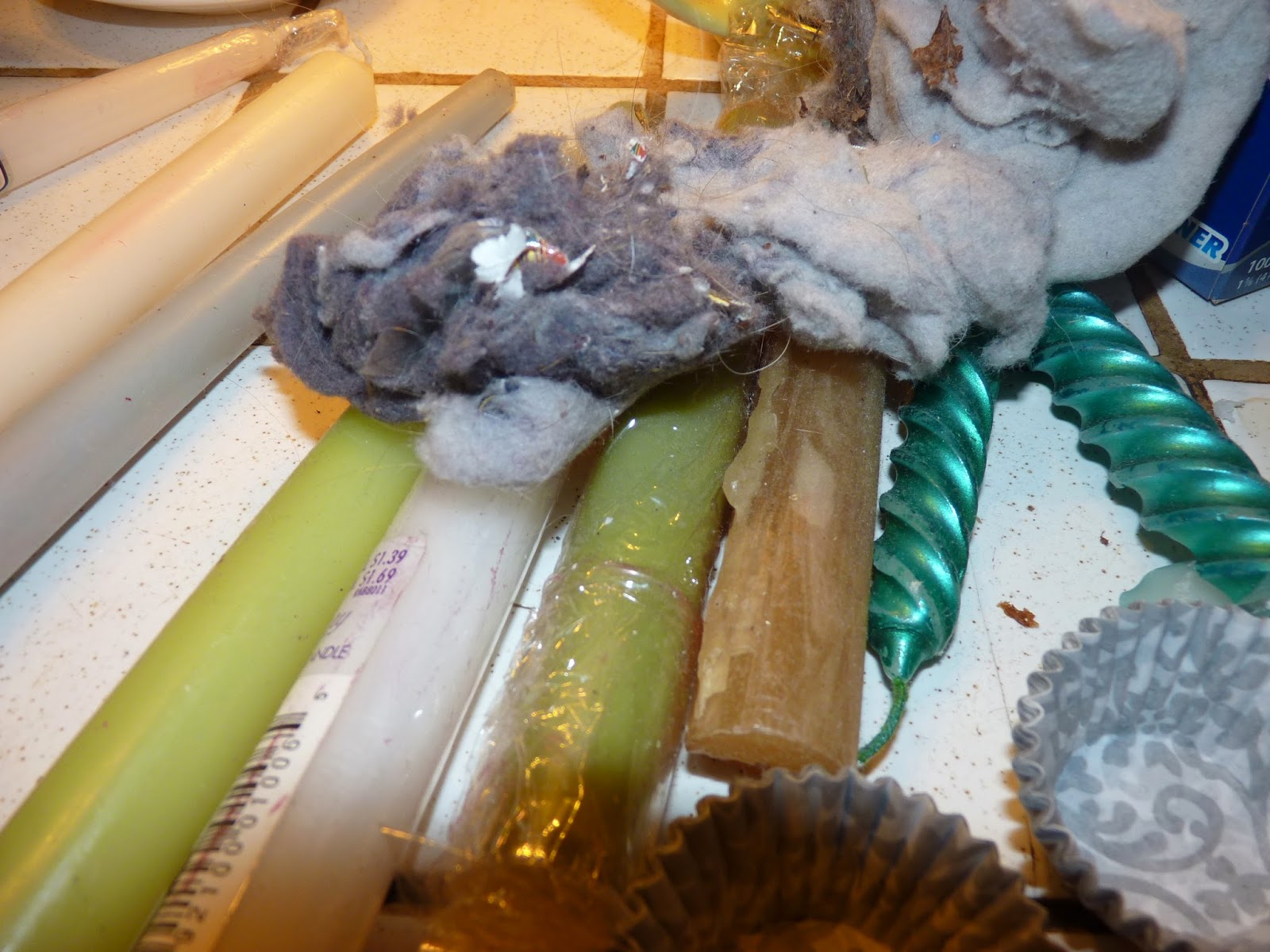
Most people might answer that lint and old candles are trash, and they're right, to a point. But they can have a second life, offering themselves up as a sacrificial victim to fire.

Well, that's dramatic, isn't it?

Here's what I mean, really: old candles and your dryer lint can be used to make firestarters. Our state parks in West Virginia have something similar available to people who rent cabins: a cake of wax with what looks like sawdust mixed in, waiting in a basket on the mantel for quick and easy fire starting. I found out how to make a slightly different version on Facebook, and it really does work--and uses two things I would otherwise toss in the trash.

The process is simple. First, plan ahead by saving dryer lint and your old candles, or find used candles at thrift stores and yard sales. I got a bundle of about 20 candles for $1.00 last summer. Most of them weren't nice enough for using in the house, but they were perfect for this project.

1. Melt the candles in a double boiler or other pan. Remove the wicks and toss--or you can use them as I did, cutting them into short lengths to use as lighting wicks for the firestarters.

2. Use cupcake liners in a muffin tin, or use cardboard egg boxes to hold your starters. Fill the liners or the egg box compartments with dryer lint, packing it down firmly. If you want to use the wicks, place the short pieces you cut into the lint with the tip sticking up, just like a candle.

3. Carefully pour the melted wax over the lint until the liner or egg box compartment is full.

4. Let the wax firm up, then remove the cupcake liners from the muffin tin or cut apart the egg box so that each compartment becomes a single firestarter.

5. Clean up your mess! Wax is tricky to clean off utensils and pans, but try putting them in the freezer until the wax is hard, then take out and let them sit for a bit. The wax will usually peel right off.

It's that simple. I  made 24 the other day in about 15 minutes, using the egg box method. Before Christmas I made them for gifts using the small tart-size cupcake liners and putting the cakes into old blue quart jars with zinc lids.

Now I'm on the hunt for more old candles. I have plenty of starters made for the fireplace, but it will soon be firepit season, you know!

Copyright Susanna Holstein. All rights reserved. No Republication or Redistribution Allowed without attribution to Susanna Holstein.

Friday, January 25, 2013

Winter Jam Recipe: Pineapple-Orange Conserve

In this cold weather, who thinks about making jam? And yet, this is a good time for canning because we can all use the extra heat in our homes, and we tend to have a little more time on our hands at this time of year. And if we're canners, we also have some empty jars that can be filled again to restock the shelves.

I had some oranges in a basket that were looking pretty sorrowful--you know how they get after a week or so. The skins lost their luster and were beginning to look shriveled. I hate to throw away something I paid good money for (I wonder about that saying-what is bad money anyway?). I had a can of crushed pineapple left from the cheesecake I didn't make over the holidays, so I decided to make pineapple-orange jam. Only I thought it needed a fancier name, so I'm calling it Pineapple-Orange Conserve. It just sounds better, doesn't it?

Ingredients: 5 sorry oranges, 1 20-ounce can of crushed pineapple, 3/4 cup water, 1/4 cup boiling water, 2 TBSP dried orange peel, 1 box dried pectin. (You could substitute the grade rind of your oranges if your oranges are fresh.)

To make this recipe, I had 5 pitiful oranges, the 20-ounce can of crushed pineapple, and some orange peel I'd dried earlier in the winter. I try to dry it whenever I can because dried orange peel is so useful in recipes like scones, cookies, and jams. I poured 1/4 cup of boiling water over 2 tablespoons of the dried peel and let it set for about 10 minutes to soften. If my oranges had been nice and fresh, I could have simply grated their rind but these oranges were beyond that point, so the dried were a good substitute for the fresh.

I put the pineapple, juice and all, into my big jam-making pot (a 6 quart stainless steel dutch oven). Then I juiced the oranges and added the juice and whatever pulp also came loose into the pineapple. I stirred in the soaked peel and one box of dried pectin, then added another 3/4 cup of water and turned the heat on high. I stirred until my mixture reached a good boil, then added 3 1/2 cups of granulated sugar. I cooked it until it came to a rolling boil and timed it for 1 minute, stirring constantly. I turned off the heat, set the timer to 5 minutes, and stirred occasionally as the jam cooled. This step is necessary for jam, but not for jelly--it prevents the fruit from floating to the top of the jam.

When the timer dinged, I ladled the jam into hot, sterilized jars, put on the lids and bands, and turned the jars upside down for about 10 minutes to help the seal take hold; then I tightened the bands again and that was that. Most authorities recommend putting jams and jellies into a water bath canner for a short period of time. I don't do that, so check your cookbooks for the recommendation time.

End result was a very pretty, and completely delicious jam that is not too sweet--a cross between orange marmalade and pineapple preserves. It was a good use of the oranges, helped warm the house, and looked right pretty in the bargain.

And you know, it was delicious on the Orange-Cranberry-Walnut scones I made too. I'll share that recipe tomorrow.


Copyright 2012 Susanna Holstein. All rights reserved. No Republication or Redistribution Allowed without attribution to Susanna Holstein.

Sunday, January 20, 2013

A Frugal Life and Toothpaste

I never really think about the fact that we live a frugal life. It has been a lifelong habit, looking for savings, comparing prices, buying at thrift stores and cooking from scratch. I suppose it's not surprising since I grew up in a large family where nothing was wasted because money was always tight. But for me, it's nor need necessarily that makes me look for bargains. It's the hunt, the score, and the satisfaction sometimes of putting something once useful back into service.

Which leads me to toothpaste. Not that I make my own; I don't. But I have found that toothpaste is one useful cleaning tool for things besides teeth. For example, you can use toothpaste to smooth out the scratches on a DVD or CD. Simply rub the toothpaste in small circles over the disc, rinse it clean, dry with a soft cotton rag (t-shirts or old hankies work great), and that's it. If you have a DVD that sticks (it happens a lot with movies we check out from the library) this may well cure the problem.

Toothpaste is also great for cleaning white leather tennis shoes. Scrub it in with a brush, rinse and dry. Then use whatever product you like to condition the leather again. It's awesome around the soles; I keep an old toothbrush to scrub the creases and seams.

I use toothpaste to remove stains on cloth too; it's my desperation measure and it sometimes works. I wet the item rub in the toothpaste and scrub gently. Then wash as normal. It also works on stains on glass and china items.

I bet there are uses for toothpaste that I have yet to discover. Do you know any?

Copyright 2012 Susanna Holstein. All rights reserved. No Republication or Redistribution Allowed without attribution to Susanna Holstein.

Wednesday, September 12, 2012

And the Other Stuff

Of course storytelling isn't the only thing going on around here. It's still canning time. Applesauce, beets and salsa have been the recent additions to the cellar. I'm having to buy jars now, 6 dozen so far and the end not yet in sight. I swear I think they evaporate in the dishwater! Still to do: more apples and cider, the pears, more salsa and vegetable soup. Then I will be finished. This is the downhill slope for canning though, the major work is behind me and this is really more fun.

Then there is the cabin project. I need to get some photos posted, I know. My big computer has decided for some reason not to go online these days and it will be taking a vacation to the shop as soon as I finish taking all my documents and photos off of it. That's where the cabin photos are. But to update, Larry has about 75% or more of the logs in place. He'll need help getting three big ones up where they need to be, and then he will start on the roof. I had hoped we would have the roof on by the end of September but the current goal is the end of October. As long as it's done by winter, that's all we need. It can wait then until we have time and money at the same time (how rare is that!) to do the chinking and work on the interior.

I will be opening another booth in an antique mall in Spencer next week if all goes according to plan. I've been wanting to do this for a while but there hasn't been time and the new one in Marietta needed a lot of attention for a while. It's off and running very well now, and next week I can see some clear days so we'll focus on getting the Spencer booth in place. I am pleased with the way this little side business is going; another small income stream adds to our retirement income and that's a good thing.

I'm back to selling on eBay after taking the summer off for the most part. I'm doing some things a little differently, though, using more Buy It Now and free shipping. That means figuring pricing that includes enough to cover the shipping and still make a little money. It's been working very well--I listed 3 items Monday and all three are sold. I've cut down the listing fees by listing only when it's free and I am meeting eBay's new requirements for one day shipping and a return policy so I get a good reduction on their fees as well as a break on postage. It means staying on top of sales, which was so difficult in the summer when I was so busy. Now I'm home more it's doable. I've actually bought items at antique malls and resold them on eBay for a good profit! Sometimes dealers don't take time to look things up and that's when you can find a bargain--like the $10 candlesticks I sold for $100, the Heisey piece I bought for $3 and sold for 21, the pattern glass vase bought for $6 and sold for $30, etc. Those dealers probably made a profit when they sold to me so they're happy, I'm happy and my buyers are happy.

Even with all this busyness, we still have time for evenings by the firepit, junking and auction trips and visits with friends along with the routine household chores. When what you do is what you enjoy, it never feels like work.

Someone recently asked me, "so are you making as much money as you were when you were working?" The answer is heck no--we're living on about a third of my former income and yet we seem to be living as well now as we were then. Funny how that works, but I have always heard that people will manage on whatever money they have and it seems to be true. I suppose part of that is expectations; we didn't expect to take long trips or buy lots of new stuff (rarely do I buy anything new to tell the truth) but we didn't do those things when I was working anyway. Paying off our bills when I retired was a sound decision because now the biggest expenses we have are gasoline and health insurance, not mortgage and credit payments.

So that, as Paul Harvey used to say, is the rest of the story, with a few meandering thoughts along the way. Now,  back to work to list a few things on eBay and get ready to head down to my uncle's assisted living place to tell stories.


Copyright 2012 Susanna Holstein. All rights reserved. No Republication or Redistribution Allowed without attribution to Susanna Holstein.

Tuesday, January 24, 2012

Quick Fix: Homemade Mayonnaise

It's one of those days when you seem to be out of everything you need. Like mayo. Chances are, though, that you have everything you need to make it right in your cabinet. When I was a new housewife, lo those many years ago (about 40 or so, to be more precise) I found the recipe for mayonnaise on the side of a can of dry mustard. I tried it and it was so easy that I made my own for several years. We moved, time passed and I just forgot all about it. Then recently I was looking for a recipe and there was my mayonnaise recipe, stained and wrinkled.

I pulled it out, and gave it a try. The process was just as easy as I remember. Now, note that my recipe uses raw eggs. Websites today recommend using pasteurized eggs. I have no idea where to find pasteurized eggs, but if you worry about raw eggs, then I'd recommend looking at this recipe with instructions on how you can pasteurize eggs at home.

Ingredients:
1 egg
1/4 teaspoon salt
1/4 teaspoon dry mustard
2 tablespoons cider vinegar
1 cup cooking oil, maybe a little more (that's what my recipe says!)

To make:
Beat the first four ingredients with a wire whisk (I used the whisk on my Kitchenaid mixer, using speed 4) until completely blended.

Add the oil in a slow steady stream as you continue whisking the mixture. The mayonnaise will thicken slowly, but the entire process of making it takes about 5 minutes.

That's all there is to it! There are several other ways to make mayonnaise, as this article from the UK's Guardian shows.

The finished product is thick, slightly yellow (my chicken's eggs have dark yolks, and that affects the color), with a nice tangy flavor.

It's just delicious and so much better than what is in the jars at the store.
I use this just as I would use store-bought mayonnaise. I store it in the coldest part of my fridge and make sure I use it up in two weeks.

It can be mixed with sour cream, parsley, dill (if you have it) and green onions plus a little milk or buttermilk to make an excellent ranch dressing, too, if you have some ranch dressing addicts at your house. Just grind up the herbs, garlic (or garlic powder), green onion (or use onion powder) and garlic in the blender, add the sour cream, and mayo, and add milk until it's the consistency you like.

Tuesday, January 10, 2012

Quick Fix: Chair Re-Do

This is the little chair I bought at a yard sale in October for less than a dollar. I had no place to put it until I did the bedroom rearrangement on Monday. Now it has a corner in my bedroom between the new chest and my old dresser, sharing the space with the clothes hamper. The yellow paint doesn't go with my room at all and I didn't want to get into painting it yet, so I came up with this quick fix:

First, I added a flowered cushion, then

I used a crocheted bedpillow cover to slip over the back.

I used a placemat (that matches the one I used on top of the dresser yesterday) to toss over the pillow cover, and a sweet little sachet I've had for a while to dangle from one corner, and the quick makeover was complete:


The little chair looks right at home in my room, doesn't it?

Wednesday, January 4, 2012

Making Tea...Bags

I posted something on Facebook about making teabags and got a few questions, so I thought I would show the process here. It's very simple really:

1. Dry your herbs for your tea. I was making peppermint bags from peppermint I dried last June. Then decide what combinations you might want to put together. I like peppermint, rose hips and orange peel, but this time I just did plain peppermint because that's what Larry likes. You could also make individual size mulling spices with cinnamon sticks, whole cloves, allspice and orange peel to spice up your apple juice, cider or wine. Another possibility is buying bulk loose tea and bagging it yourself.


2. Purchase sealable teabags. I buy mine from the San Francisco Herb Company. They offer a wide selection of teas, herbs, spices and supplies for reasonable prices. The only hitch is that your order must total $30 and that is a lot of stuff! Get out your iron.


3. When your herbs are ready, crush them to the size needed to fit in your bags. Fill the bags,


then seal with an iron set on the "Cotton" setting and NO steam.


4. You're done!

Thursday, December 8, 2011

Vintage Thursday: This Week's Finds

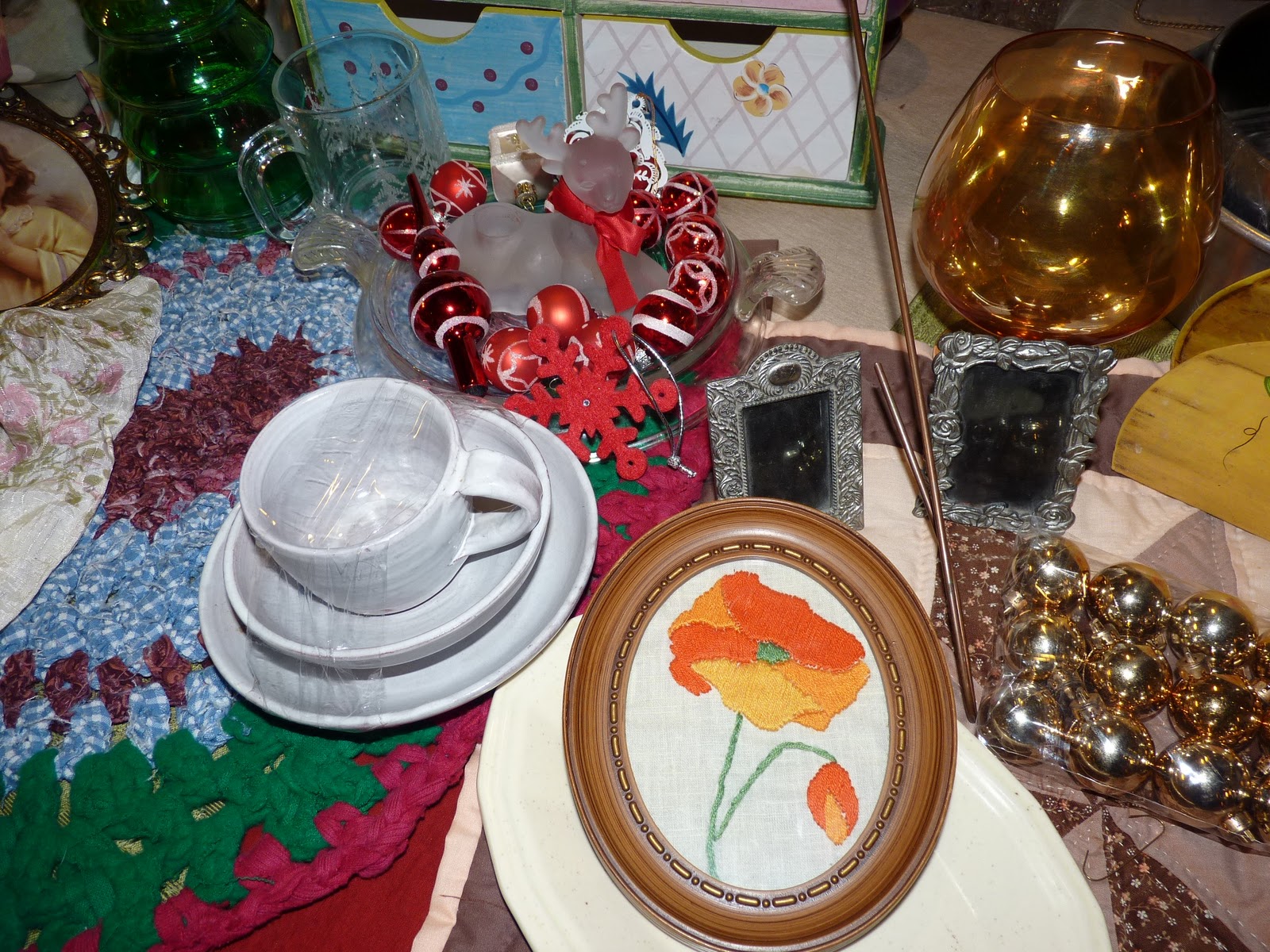
Some of you have said you like seeing photos of the things I find when I go out exploring, so here's a few from my recent forays. Some might show up in the next giveaways, some will be for sale on eBay and some will stay right here in my house :)

These are Tuesday's finds. Tuesdays are a good day to go looking in this area because seniors get 10% off at the grocery store and at Goodwill! There are a couple of thrift stores in the area that open on Tuesdays too. And since our writers group meets on Tuesday mornings now, I know I'll be in town, for all sorts of good reasons. (I still laugh when I think that I qualify for a senior's discount because I don't think of myself that way, but the calendar says otherwise.)


Here's a closer look:

Tiny pewter frames, a tole-painted and signed napkin holder, hand-stitched quilted wall hanging, an iridized glass brandy snifter, set of stainless steel mixing bowls, and you can just see the edge of a pack of small Christmas ornaments, and the handle of a Fire-King casserole stand (found for 25 cents--someone had been using it as a candle stand so I had some wax to clean off); and

A crewel-work picture, small white platter, hand-braided small rug, a handmade cup, saucer and plate that have the name "Suzanne" on them (anyone know a Suzanne?), a glass mug with white trees frosted on it,


cute wooden cabinet (needs to be repainted, but still, a wood shelf with wood drawers for a quarter?!), green glass tree jar, frosted deer candle holder, tiny glass ornaments, red and green votives  a pretty pink tea cup and white china teacup (I have a saucer for it), a stained glass garden spike,
a gold wedding jar candy dish, two brass framed pictures, tiny made-in Japan salt and peppers in a basket, 2 pairs of lovely floral curtains (handmade and like new), a soft pastel-flowered dresser scarf, and a silk, signed scarf. A few other things didn't make it to the photo.

Last Tuesday I went to Wheeling, WV and came back with a carload. Here's a little of what I found on that trip:

Wexford juice goblets, made by Anchor Hocking in the 60's. There is still a lot of this around for a reasonable price, and it's certainly a nice addition to a table.

Large pink Depression glass fruit or salad bowl with cute ball base--I haven't been able to identify the maker of this bowl, or the patter although it looks very like the Queen Mary pattern by Anchor Hocking.

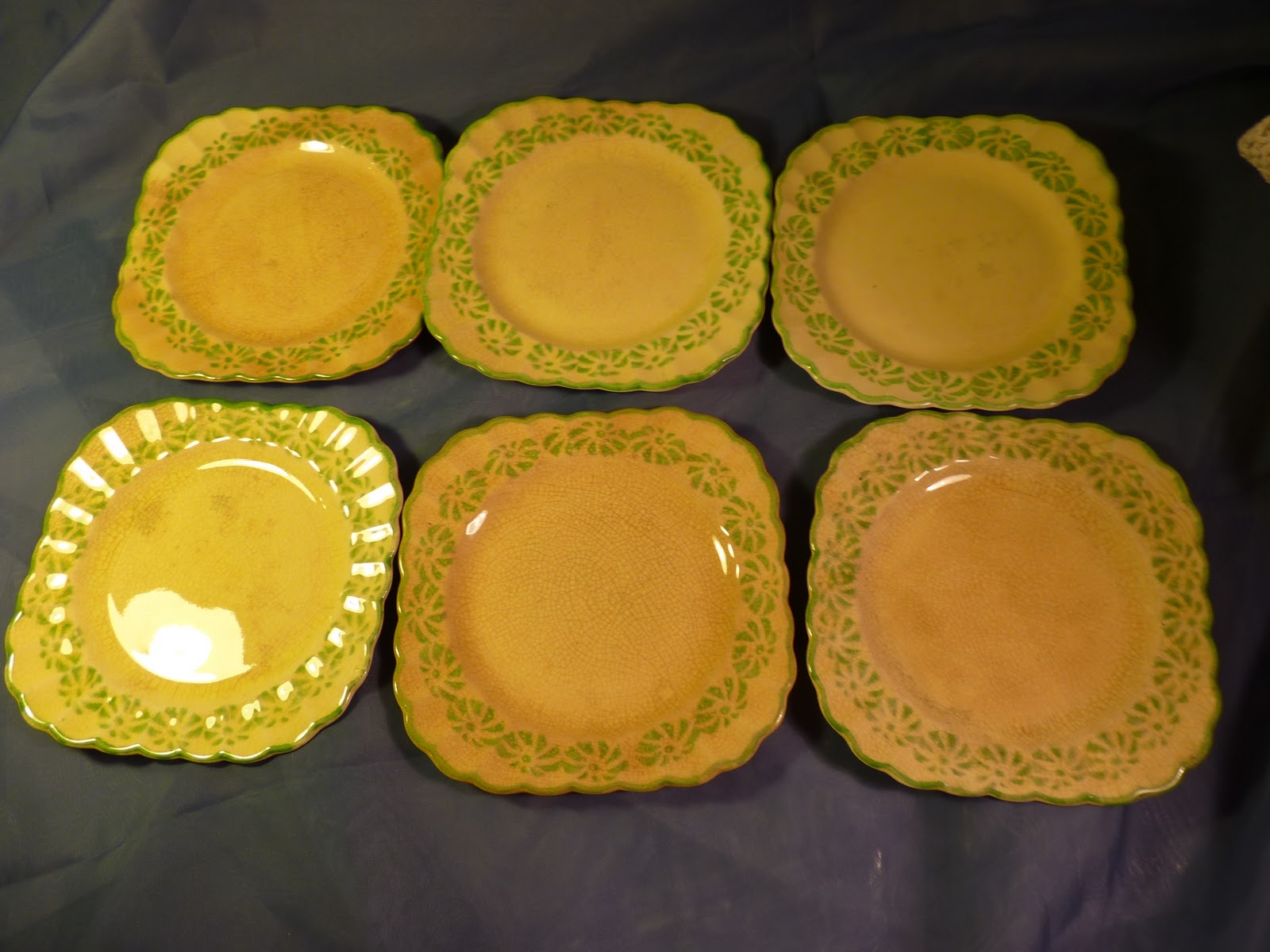
Beautifully aged yellow and green plates. I have been unable to find out anything about them but I really like them, even with all the crazing and staining.


This beautiful jam jar is just stunning. It has a little crack near where the slot for the spoon is but even with that, it's a beauty.

So that's some of my recent finds. Have you been out junking this week? What did you find?

Wednesday, December 7, 2011

Wildcrafting, Part 2: Moss Gardens

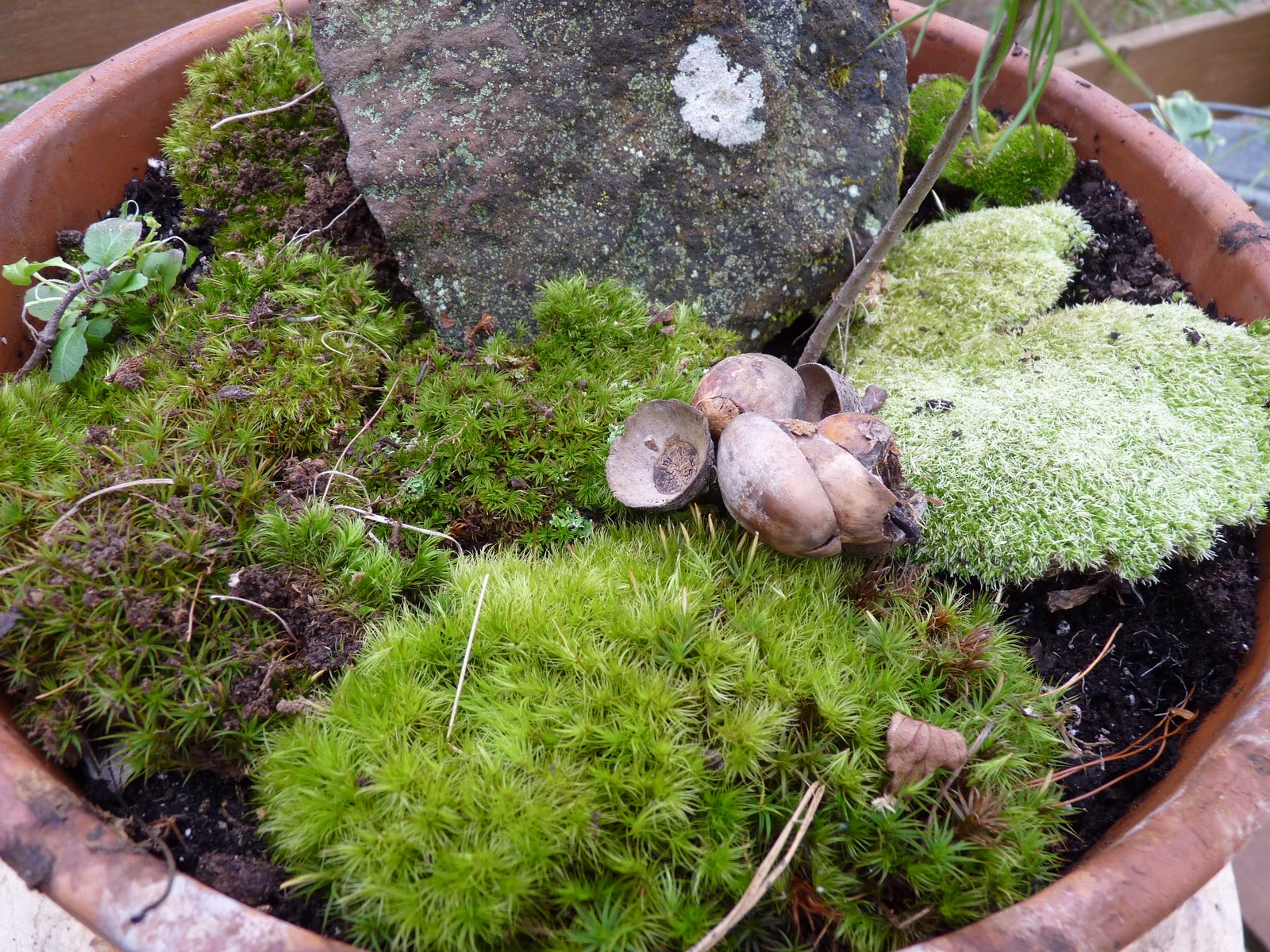
When I have time in late fall or early winter, I like to make a moss garden or two to provide a spot of green in the cold, dark months. My critters went with me, apparently thinking I needed escort service.


Moss is so pretty with its endless shades of green and even its shapes. I know there are people out there who can tell me that names of the various kinds; I've never attempted to learn them but I do enjoy looking at moss and lichen. I found a selection of odds and ends to add to the gardens, too--a moss-covered stick,


a lichened rock, 

different colors of moss

and a few plants.


I pulled up the geraniums and lobelia even though the plants were still thriving, even this late in December. I've never had flowers so late in the year! I put the geraniums in the cellar, to replant in the spring. Then I arranged the moss and other items in the flower pots.


You can click on each picture for a closer look at the mosses. 

This is a great project to do with children, too--they can find the mosses and the different items to add to their gardens to create a little moss world. 

I have one more wildcrafting project to share tomorrow. All of these took very little time--or as much time as I wanted to spend. The gathering process can be a lingering one as you see things in the woods and meander from place to place looking for the "perfect" items for your project. Gathering combines several pleasant and necessary activities: exercise from walking and bending, relaxation through contemplation of nature, and mindfulness from close attention to surroundings and the smaller things that make our forests so lovely.

Friday, March 11, 2011

Cheapskate!

Regular readers know I try to be frugal. I've never thought of myself as a cheapskate exactly, but just as someone who prefers not to spend her money wastefully and to be mindful of how I spend. Along with that, I also am aware of my impact on the environment. The two together, apparently, put into a new category of frugality: I'm a green cheapskate.

I had never heard the term until Wednesday, when the original green cheapskate came to give a talk at the library. It was a lunchtime program so I took my lunch and headed up to listen. The title of the program didn't tell me that I would be so entertained! Jeff Yeager, who is so cheap, apparently, that his wallet is filled with dust, was funny, intriguing and engaging. And made me realize that there are a lot of other people who live the same way we do, buying used, watching prices, being careful at the grocery store and trying limit our impact on the environment by making good choices.

He made us laugh when he said that while millions of people have read his book, they all check it out at the library or read it in the back of the book store. And I would bet that many of you who are also mindful of how you spend are already thinking, "Gee, I ought to go down to the lbirary and check his book out!" I might actually part with some cash and buy a copy, if the information in it is presented in as lively and interesting a way as Mr. Yeager's presentation.

One good example of how he and his wife save on groceries: he doesn't buy any food that costs more than $1.00 a pound. That means he eats a lot of chicken and turkey, and maybe pork when it's on sale. He doesn't eat out of season either, so while tomatoes are over $2 a pound right now, he's probably eating salads without them. Apples are probably on his shopping list now, but berries and nectarines? Probably not. He admitted that he does occasionally splurge on a steak or other meats but it's a rarity.

If you're into saving money and living responsibility on the planet, you might want to check out Yeager's  books and his blog, The Daily Green.

Tuesday, February 22, 2011

I Used to Buy Bananas

...along with a few other things that are no longer on my shopping list.

While the economy has had many ups and downs in the last 2 years or so, the price of food has climbed and climbed. Have you noticed the impact on your budget? I doubt many of us have missed it. I hear rumblings that food (even chocolate) will continue to increase in cost, and I look at my shopping cart and wonder what else will not go in it in the coming year.

Bananas used to be a staple on my table. We ate them fresh, and when they started turning brown I used them to make banana bread or banana cake. Sometimes I would find a large bag, maybe ten pounds or more, marked $1.00. I would have a baking frenzy then, making loaf after loaf of banana bread for the freezer. Now, with the price at 55 cents a pound, bananas have joined the luxury list at my house. When you consider that you throw away almost a third of the weight with the peel, the price per pound becomes even more out of reach.

I suppose I should not fret over bananas; after all, they are one fruit that actually contains fat and I can do without that. And I suppose I can get the potassium bananas are so rich in from some other source. There is nothing that will replace those golden circles on top of my cereal, however, or the creamy smoothness of the first bite into a banana at perfect ripeness.

Being on a diet means not only are we losing weight, we're gaining money. The grocery list is shorter--no cheese, no bread, no pasta, a lot less butter and sugar and other things. Still I am appalled at the cost of even the small amount of food I buy, and I wonder how a family with small children manages the hit to their wallet each time they enter the store. Are they cutting back, not buying the little treats children love, going for the generic instead of the brand names? Or are people just sucking it up and closing their eyes as they swipe their debit card?

It will soon be garden time and some of the pressure of food prices will relax as we start eating our own produce. Last year more Americans than ever planted gardens, and some even ventured into backyard poultry. I wonder if this trend will continue, or if, tired of trying to do it themselves, Americans will lapse back into the convenience of ready-made and pre-packaged.

What's going on at your house? Are you still buying bananas or have they ended up on your do-not-buy list too? Have you cut back in other areas, and are you planning to grow a bigger garden this year, or maybe even your first garden? How is the increase at the grocery store affecting your life?

Monday, August 23, 2010

Thirty-five years ago, give or take...Recipe for a House

Browsing in my recipe files a few days ago, I found my list of the items we bought to build our house, carefully written on yellow legal paper in my handwriting of my mid-twenties. (how young I was then!)

This was how much it cost to build our house in 1975-76:

$2836.00 for the excavation, foundation and framing materials.

$5,366.00 for the roof, windows, insulation, etc.

Another $2658.00 for plumbing, fittings, the dry well we drilled and then the installation of the spring for water.

Then there were a few additional items, like the milling bill for the oak siding cut by a neighbor, paint, trim, etc that added $361.00.

Total cost: $9,096.00.

This was just for the basic house of course. Over the years we added a bathroom, electricity, a deck and later an even bigger deck, replaced the roof and added new rafters, added the log room and stone fireplace and a few other improvements. But this list is the basic cost of the house when we moved in. The house was 1,092 square feet and we added another 400 with the log room. So cost per square foot was about $8. The log room, added in 2003-2004, cost an additional $5000--prices went up a bit in the intervening 30 years. And the other improvements over the years have added $$$ to the actual cost.

I wish I could describe how it felt to look at this fragile paper all these years later and see my careful tabulations. I wonder if I knew that I would one day share this list with the world at large? I don't remember, but apparently I thought it was worth recording, and worth keeping--as a recipe, perhaps, for how to build a house.

Sunday, November 29, 2009

If it could always be like this...

Since we no longer use a dishwasher and seldom use the dryer, our electricity use has dropped significantly. The power company continues to "estimate" our usage at the old level so every other month we get a high bill, followed the next month by a bill from the actual meter reading.

This month was the best yet:


Not only do we owe nothing, we have a credit! Now that is cool. I will be calling them to suggest they lower their expectations of our usage.
I looked for a past bill to see the trend in our use. You'd think this would be available online, but if it is I could not find it. Here is July's usage chart:

We took out the dishwasher last November, and started hanging most of the laundry on the clothesline in April. Almost all light bulbs in the house are the new energy-efficient ones. We also started using a smaller coffeepot; we waste less coffee, have more fresh coffee and it doesn't run as long. The impact of these changes in our lifestyle is apparent in the estimates and actual use.
The other not-so-measurable impact of these changes is that we get outside a little more, get a little more exercise (bend and stretch!) and our sheets and towels smell heavenly. In the kitchen, we enjoy the companionship of washing and drying dishes with someone when company comes--which leads to some good conversations. Even when doing the dishes alone, there is something relaxing and reflective about standing at a sink full of suds and hot water and looking out the window into the woods. And now I don't worry about Larry putting my wooden spoons, cast iron and delicate glassware into the dishwasher to be ruined forever.

This has me wondering what other changes we could make that might lower our bill even more. We still have an electric range and electric hot water heater; both of those will leave when the gas line gets put in. What other changes can we make to drive this bill down further? That's my new challenge. Any suggestions? I'm not into buying more things to make a change--that seems counterproductive. But perhaps there are more things we can do?

Friday, November 6, 2009

Squirrel and Leeks

Last night I planned to make squirrel gravy, but instead opted to try something a little different.

Larry had been squirrel hunting recently and brought a couple home. Now I know many people cannot envision eating squirrel, but for those who have tasted it, you know it's an amazing meat, tender and tasty and better for you than many other meats.

We have plenty of leeks in the cellar. Leeks are a member of the onion (allium) family and they grow tall, like an extreme version of a green onion. Their growing season is long too, so they are in the garden a long time. After looking into various storage/preserving options, we decided to simply pull our leeks and put them in the cellar. So far they are keeping well. I'd like to try drying some too and may give it a try this weekend.

I started this recipe on Sunday, actually, by cooking the squirrels. I put them in a pan, cover them with water and add bay leaves and an onion. I let them simmer until the meat would come off the bones, about 2 hours, I think. By then I was too tired to make the rest of the dinner! So we put the cooked squirrels in the fridge and Larry de-boned them for me.

I started cooking last night by putting a couple tablespoons of canola oil in an iron skillet and adding the sliced leek (I only needed one leek for this recipe--remember I said they're big) and some canned mushrooms (the only ones I had on hand--fresh would be better).


After the leeks were soft, I added the squirrel meat and cooked until the meat was heated through. By this time the kitchen was smelling pretty nice.

We had a pot of red-skinned potatoes cooking too, to make mashed potatoes, and some green beans as a side.


When the meat was hot, I added the liquid from the mushrooms, some Worchestershire sauce, red pepper and water. I let the mixture simmer for about 10 minutes, then added 2 tablespoons of corn starch mixed with water into a paste so it would not lump up. I continued to simmer until the sauce was thickened.


Then, over the mashed potatoes on my plate!

Simple and good. And no, I could not eat all that was on my plate--my husband has eyes bigger than my stomach and he did the dishing up.


Related Posts Plugin for WordPress, Blogger...