Pages

Showing posts with label ballads. Show all posts

Friday, November 13, 2020

Covid Journal, Day 5: Foggy Tales Continued

Colder this morning at 48f, but the day cleared up to be a beautiful one. 

Continuing the thread of yesterday's post, I thought I'd share some stories in which fog and/or mist plays a role.

In Italy, in the Po Valley region, there are tales of a terrible creature called the Borda. The Borda is seen at night, and on foggy days, and eats little children who misbehave. A cautionary tale indeed! A grisly lullabye about the Borda goes like this:

Lullaby, the Borda
binds beautiful children with a rope.
With a rope and a cord,
binds the beautiful children and then holds them,
with a rope and a string,
binds the beautiful children and then kills them.

And from the website, American Folklore comes this tall tale:

"Fog: A Maine Tall Tale  retold by S.E. Schlosser

You can talk 'til you're blue in the face about the thickest of fogs in ye merry olde England, but I'm tellin' you now, sure as I'm standing here, that England's fogs don't hold nothing over them thick fogs which roll in over the Bay of Fundy here in Maine. These ain't your little pea soupers, you can betcher life. These fogs is so thick you can drive a nail into them and hang yer hat on it. It's the honest truth.

One of my neighbors works a fishing boat, but he can't do nothin' when a Maine fog comes rolling into the bay. He always saves up his chores for a foggy day. One day, the fog came rollin' in overnight, and my friend knew there wasn't to be no fishin' that day. So he decides his roof needs shingling. He got started at the shingling right after breakfast, and didn't come down 'til dinner.

"Maude, we got a mighty long house," he told his wife over supper. "Took me all day to shingle."

Well, Maude knew right enough that they lived in a small house. After all, she'd been cleanin' it for nigh on twenty years, so who would know better? She went outside to take a look. And I'll be jiggered if she didn't discover that my neighbor had shingled right past the edge of the roof and out onto the fog!"

At Niagara Falls, you might have ridden on the boat The Maid of the Mist, that takes you under the Falls. I remember my trip on the boat vividly; it was exhilarating. 


The boat gets its name from an old Native American legend. According to the story, a young widow was so bereaved that she tried to commit suicide by riding her canoe over the falls. However, her courage failed her when she heard the roar of the water passing over the falls, and she prayed to Heno, god of thunder, to make her journey less painful. The god took pity on her and rescued her, taking her down under the falls to live; Eventually she married Heno's son, but she yearned to see her own people again. Heno told her that a great snake had come down the river and poisoning the water, and would soon destroy her people. She begged to be allowed to warn them, and Heno agreed to let her go for one hour. She went, and after the agreed upon time, Heno came to take her back to their home under the Falls.

The people heeded the warning and left, moving to higher ground. When the serpent arrived, expecting to eat the dead bodies of those poisoned, he was enraged to find not a single one. The snake turned back upstream, but Heno released a lightning bolt and killed the snake. Unfortunately, the snake's body floated down the river and blocked the falls over Heno's home. So Heno and his people left for a new home in the clouds, where they continue to watch over people on earth. An echo of his mighty thunder can still be heard in the roaring of Niagara Falls.


One more fog story. This story was told to me by a boy in Clendenin, WV, many years ago. Here's his story as I recall it:

"My Dad and I were coming home from the store. We were driving along Route 4, along the Elk River. It was a terrible foggy night, and no moon, so Dad was going real slow. We couldn't see anything. I was so scared, but I tried to help my Dad by watching the white line on the edge of the road on my side and telling him if he got too close to the edge. 

All of a sudden Dad hollered, "What the ...??? Look at that!" He was looking in the rear view mirror, and his eyes were real big. I looked back and saw these big red eyes coming right at us. Dad floored it, not even caring about whether he stayed on the road or not. But that thing swooped right up behind us, and went over our car. Dad hit the brakes and we stopped dead in the road. We could see the reflection of its red eyes in the fog ahead of us. Then it was gone. We just sat there for a while before Dad's hands quit shaking enough to drive."

Finishing up this post with a ballad about mist from the Max Hunter collection at Missouri State University. To hear it sung, click here. I wonder about the origin of this ballad--more research needed if I want to find out.

Rained a Mist

VERSE 1
It rained a mist, it rained all day
Two little boys went out to play
Went out on th grass to play, play, play
Went out on th grass to play

VERSE 2
Th first ball tossed, it was to high
Th next 'un was to low
Th next 'un was in a jewels room
Where no one's allowed to go, go, go
Where no one's allowed to go

VERSE 3
Out stepped a Jew all dressed so fine
Come in, come in, she called
Come in, come in, you brave little lad
An' you may have your ball, ball, ball
An' you may have your ball

VERSE 4
I won't come, I'll not come in
I won't come in your hall
For he who passes thru your hall
Will never get out at all, all, all
Will never get out at all

VERSE 5
Th first she showed 'im was a gold ring
Th next 'un was gold pin
Th next she showed 'im all fine things
To invite th little lad in, in, in
To invite th little lad in

VERSE 6
She taken him by his little hand
An' led 'im thru th hall
An' down in cellar dark an' deep
Where no one heerd him call, call, call
Where no one heerd him call

VERSE 7
She pinned a napking o'er his face
An' pinned it with gold pin
Then called for a vessel of gold
To catch his heart blood in, in ,in
To catch his heart blood in

VERSE 8
Go dig my grave both long an' wide
Go dig my grave for me
An' when my playmates calls for me
Tell them that I do sleep, sleep, sleep
Tell them that I do sleep

VERSE 9
Go place my songbook at my feet
My Bible at my head
An' when my parents calls for me
Tell them their little boy's dead, dead, dead
Tell them their little boy's dead

A few other links on this topic:

An interesting discussion of the origin of the word "fog".

Hecate, the Greek goddess, is often associated with mist and the night. 

A book that might be worth looking into: Varner, Gary R. (2007). Creatures in the Mist: Little People, Wild Men and Spirit Beings Around the World: A Study in Comparative Mythology. New York: Algora Publishing. ISBN 0-87586-546-1.


Copyright Susanna Holstein. All rights reserved. No Republication or Redistribution Allowed without attribution to Susanna Holstein.

Wednesday, April 22, 2015

Love, Murder and Mystery: Talking about Appalachian Ballads


Soon after returning from Florida I was presenting a program for West Virginia University on the Appalachian ballads. Ballads as you probably know are really storytelling in song, so it's easy to see why I was attracted to them. I had heard ballads re-done in the 60's and 70's during the "folk revival," by people like Bob Dylan, the Grateful Dead, Joan Baez and others but it didn't click with me then that these were actually very old songs with a very different sound than what the rock musicians gave them.

So in 2000 when I actually heard a field recording of a traditional ballad singer, I was blown away by the simplicity of his style and the subject matter of the songs. These were stories! A man who leaves his love to go to war, and she dresses like a man and goes out to the battlefields to find him, a sinking ship and a crew driven to cannibalism in their lifeboat, a girl who commit suicide because her love has left her, jealousy and murder between two sisters, someone boiled in lead, pregnant girls murdered by the boyfriends...my word! It was like a heavy dose of TV news--but beautifully phrased and with haunting melodies.

For the past 15 years I have been studying the ballads that traveled from Britain to the Appalachians, along with some homegrown ballads and some that were never collected here by those great songcatchers of the early 20th century.

with Jason Burns, who organized the program
My repertoire has grown slowly and yet I had plenty to fill two hours of presentation at WVU, and with some to spare. It's a rare pleasure for me to talk about ballads and to sing them for those who appreciate this old music. I sing in the traditional style, unaccompanied by any instrumentation. Singing this way allows me to set the pace I want, to stress certain notes and so the timing is not what is needed when an instrument is playing along. Just as in speaking we have no set rhythm but go faster or slower, louder or softer, pause, etc to suit whatever we are saying, so it is with traditional ballad singing.


One of the high points of the WVU program was when I asked the audience if anyone sang ballads. A young man raised his hand and said he knew a version of The Two Sisters. I persuaded him to come onstage and share it with us. What delight to find there are young people into these old songs! Two young women in the audience also sing ballads, more encouragement that the old songs will not soon die out.

Click on the orange arrow to hear me singing Pretty Saro, the first ballad I learned, and still my favorite.

Copyright Susanna Holstein. All rights reserved. No Republication or Redistribution Allowed without attribution to Susanna Holstein.

Sunday, April 14, 2013

Singing, Telling and Gathering in the Mountains


 The weather was perfect. The place was exactly right. The people were fine. The singing was superb. In other words, the weekend was about as excellent as I could have possibly imagined it to be.

We left early Friday afternoon after I finally finished up and e-filed our taxes. I was determined to not come back to that task waiting for me! We packed quickly and headed once more across West Virginia, our destination this time the gorgeous and homey Brazen Head Irish Pub and Inn in the mountains of Randolph county. Of course, I could not make the trip without stopping at a junk shop along the way, and so this rode with us into the mountains:

I wasn't sure what to expect of this trip. I had heard from a friend that a group of folksingers from the Washington DC area gathered each spring at the inn to sing for a whole weekend. I thought it sounded like heaven, but each year it seemed we had a conflict and could not attend. This year, however, the stars combined to make it possible and I grabbed the opportunity even though it meant yet another long trip this week. Our friend Jeff met us when we arrived and we quickly met several other attendees. Then we settled in for an evening of music.

And such music it was! Songs from the Civil War, silly children's songs, plaintive love ballads, country songs, parodies, and more. Everyone sang, and everyone sang along with everyone else. This group could pick up a melody and chorus faster than ice melting in boiling water! I loved every minute. I had to laugh when someone sang the country song "Crystal Chandelier"--little did they know there was an actual chandelier right outside in the parking lot! I gave up and went to bed around 1:00 am, and regretted it as soon as I was under the covers because I could hear the most amazing yodeling downstairs. Too tired to dress again and go back down, I laid there and listened, and finally drifted off.

Morning brought more singing for me, and ramp digging for Larry.You might remember my discussion of ramps in these posts.
Larry is like a kid at Christmas when ramp season arrives, and can't wait to get into the woods to find them. He returned with a huge bag full, which he shared with anyone brave enough to take them. We still brought back plenty for our own use.

I heard stories, too--the story of a mother who witnessed her son being taken to jail during the Occupy movement, the story of a tragic death, stories of World War II from a Jewish man who had been a child in London at the time of the war, stories behind songs and about singers. I believe that in order to be a good storyteller, I must first be a good listener, and I will remember the faces and the voices telling me stories I will not forget.

That evening was, guess what? More singing! I heard so many songs that I have never heard before, sung by  people who all shared a love for the old songs. I was invited to tell a ghost story, so I  told the story of Eaton's tunnel and then the one about Ikie's tomb. I went to bed filled with music and voices.

We woke this morning to a heavy frost coating the ground and the smell of sausage, coffee and blueberry pancakes wafting up from the kitchen. Will Fanning was the chef for the weekend--he is also the owner of the Brazen Head  and along with his wife Jill ensured we had everything we needed for a comfortable stay, and kept things running smoothly for us all weekend.

Our return trip included two more pleasures: the first was a visit I have been wanting to make for two years. We had stopped once at a fascinating country store called Sharp's Country Store, not far from the inn. During that visit the owner, Tom Shipley, told us some of his family's story, and also told me a strange tale about the death of a young woman in the family. The story remained with me, and I wanted to go back and hear more. Larry stopped the day before to see if Tom would have time for a visit, and was assured that we'd be more than welcome. So we once again stopped to see Tom, and he told me the story with more detail about the people involved that included a lot of his family history.

The tale also included a gravestone, and Tom asked, "Would you like to see it?" You know I did! So we all hopped into my little Buick and headed up a steep mountain road to the cemetery, which was located on the very top of the mountain.

We learned that his family owns about 1400 acres there, land that has been passed down from generation to generation. Tom is working hard to preserve that family history and the heritage he values.

When we came down from the mountain I realized what a gift I had been given--not just the story, but Tom's willingness to share his family with us. Such generosity is rare, and I treasure it.

I jotted notes quickly in my journal as we continued our way home across WV 150, otherwise known as the Scenic Highway. Remains of winter's snow still filled the ditches along the road that travels through the high country and offers breathtaking views of the valleys below.

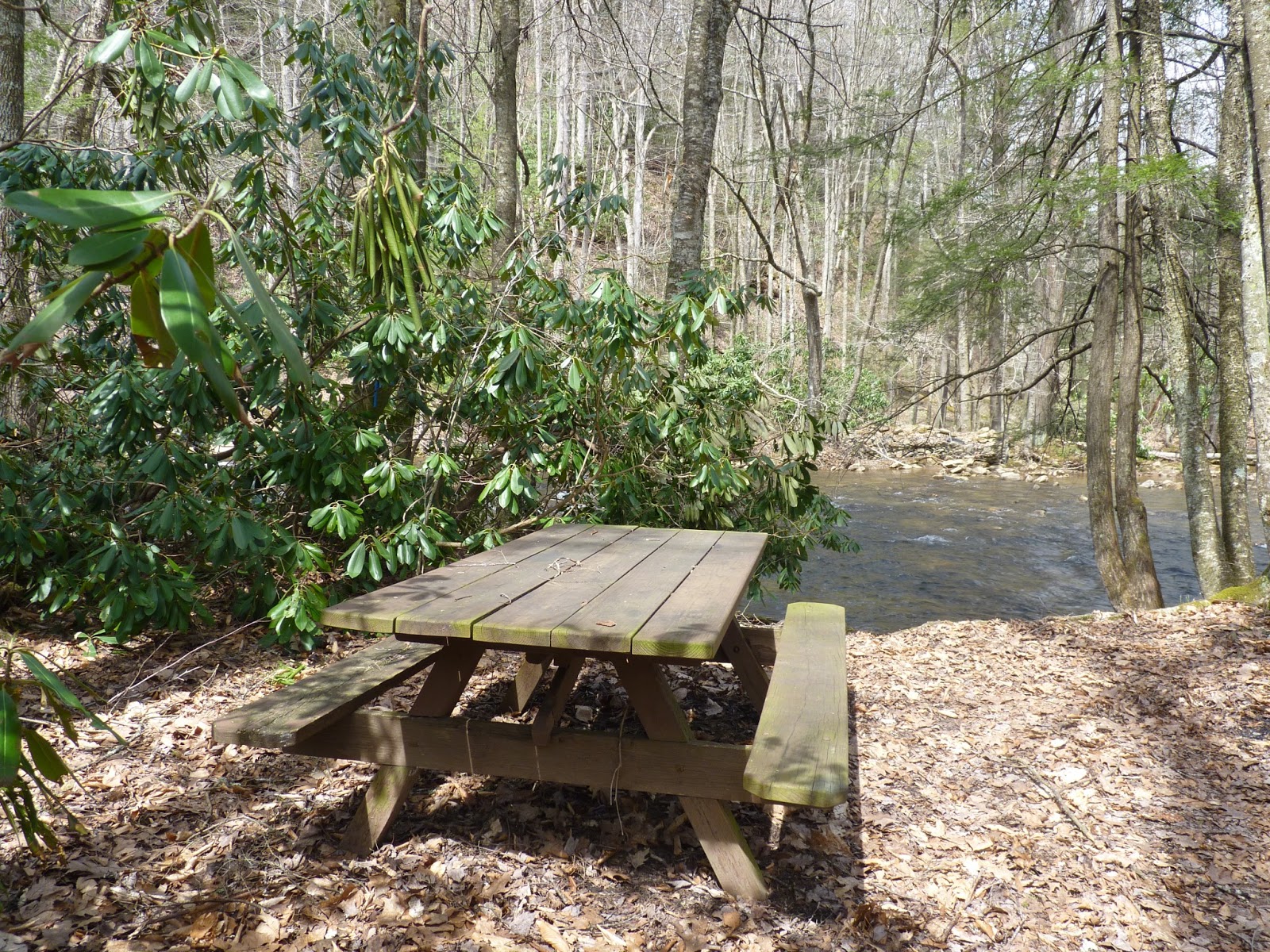
When we eventually reached the highway, it was not long before we also reached one of my favorite places, a small picnic ground in this national forest area along the banks of the Cherry River. We had the place to ourselves; the park service had not yet officially opened it and the debris of winter's fallen limbs and trees still littered the place, but that was no problem for us.
We made quick sandwiches at a table beside the river, and speculated about the large cave-like opening in the hillside on the opposite side of the river. Was it a bear's den? I do believe it was, but did not take the footbridge across for a closer look!

And then, finally, we were home once again, greeted by happy pets, nodding flowers and the comfort of familiar things. We have rested this evening, but tomorrow we will begin getting ready for our visitors who will arrive on Friday, for next weekend's performance at the Parkersburg Celtic Festival with my friend, storyteller Lorna Czarnota, and for the house concert for her that we are giving here next Sunday. Life is never dull, and I am glad of it.

Copyright 2012 Susanna Holstein. All rights reserved. No Republication or Redistribution Allowed without attribution to Susanna Holstein.

Monday, October 24, 2011

Ghostly Songs for the Ghostly Season

It's the time for softly haunting old songs, isn't it? The night creeps slowly in, reminding me of this ballad about something else that creeps slowly in:


Sweet William's Ghost (Child Ballad #77)

There came a ghost to Margaret’s door,
With many a grievous groan,
And long he twirled at the pin,
But answer made she none.

‘Is that my father Philip,
Or is’t my brother John?
Or is’t my true-love, Willy,
From Scotland new come home?’

'Tis not thy father Philip,
Nor yet thy brother John;
But ’tis thy true-love, Willy,
From Scotland new come home.

‘O sweet Margret, O dear Margret,
I pray thee speak to me;
Give me my faith and troth, Margret,
As I gave it to thee.’

'Thy faith and troth thou’s never get,
Nor yet will I thee lend,
Till that thou come within my bower,
And kiss my cheek and chin.’

‘If I shoud come within thy bower,
I am no earthly man;
And shoud I kiss thy rosy lips,
Thy days will not be lang.

‘O sweet Margret, O dear Margret,
I pray thee speak to me;
Give me my faith and troth, Margret,
As I gave it to thee.’

'Thy faith and troth thou’s never get,
Nor yet will I thee lend,
Till you take me to yon kirk,
And wed me with a ring.’

‘My bones are buried in yon kirk-yard,
Afar beyond the sea,
And it is but my spirit, Margret,
That’s now speaking to thee.’

She stretchd out her lilly-white hand,
And, for to do her best,
‘Hae, there’s your faith and troth, Willy,
God send your soul good rest.’

Now she has kilted her robes of green
A piece below her knee,
And a’ the live-lang winter night
The dead corpse followed she.

‘Is there any room at your head, Willy?
Or any room at your feet?
Or any room at your side, Willy,
Wherein that I may creep?’

‘There’s no room at my head, Margret,
There’s no room at my feet;
There’s no room at my side, Margret,
My coffin’s made so meet.’

Then up and crew the red, red cock,
And up then crew the gray:
‘Tis time, tis time, my dear Margret,
That you were going away.’

No more the ghost to Margret said,
But, with a grievous groan,
He vanishd in a cloud of mist,
And left her all alone.

‘O stay, my only true-love, stay,’
The constant Margret cry’d;
Wan grew her cheeks, she closd her een,
Stretchd her soft limbs, and dy’d.


There is another version which I like very well; same story, slightly differently told:

Willie-O

As Mary lay asleeping slowly there came a-creeping
and said so soft and low
Mary dear come open your door
I am your darling Willie-O

So she got up put on her clothing
and opened up her door
and there she saw her true love standing
his face as white as any snow

Willie dear where are your blushes
that I knew some years ago?
Mary dear, the clay has changed them;
I am the ghost of your Willie-O.

They spent the night in deep conversation
about their courtship years ago.
They kissed shook hands and then they parted
just as the cock began to crow.

As they ended their conversation
the tears all down her cheeks did flow.
Mary dear now I must leave you,
for I am the ghost of your Willie-O.

Willie dear when will I see you again?
When the fishes they do fly
and the sea run dry
and the rocks melt in the sun.

Such sad, tender lyrics! There are many other versions of this ballad, and of course many different melodies and titles. That's the fun of ballads, so many choices and ways to sing them.

And for this time of year, so many with a ghostly theme.

Here are some others:

Molly Vaunder: in this ballad, a ghost comes back to save her lover from the scaffold.

The Unquiet Grave: begging a lover to return from the grave doesn't usually have good results.

The Holland Handkerchief: I have found this as both story and ballad; I believe it to be the original vanishing hitchhiker story!

The Cruel Ship's Carpenter: the ghost comes back and revenges her death on her murderer. This is the early basis for Pretty Polly.

And many more! You can find many of this on YouTube. You can also find Pretty Polly and The Cruel Blacksmith, my original ballad based on the story of the Greenbrier Ghost, on my CD Beyond the Grave, available from me or from CD Baby or WV Book Company. And you can also get them as mp3's by clicking here.

Happy listening!

Friday, September 16, 2011

Tom Dooley, Guilty or Innocent?

Many of you remember the ballad about Tom Dooley  (actually it's Dula, but you know how we Appalachians like the "e" ending on names ending in A) , made famous by the Kingston Trio in 1958.

The version I like best was sung by North Carolina native and folk musician Frank Proffitt, who said he learned the somg from his grandmother who had heard Dula singing it while in prison. Frank Proffitt's voice is perfect for the song; he's one of my favorite of the old-time ballad singers for his renditions of so many of the Child Ballads and other mountain songs. Proffitt passed away in 1965, but his voice lives on in his recordings.

But about Tom Dula and Laura Foster: Tom Dula was born and raised in Wilkes County, North Carolina. Wilkes County is still rural, located in the Blue Ridge Mountains and about just as pretty a place as you'll likely ever see.

 Location of Lottie Foster's cabin

Tom lived a couple miles from the home of a prostitute named Lottie Foster.


Site of Tom Dula's home, which was torn down some years ago and a new house built on the property

 
Lottie had a daughter named Anne. Tom and Anne were sweethearts from an early age, even before reaching their teen years. Anne Foster got married when she was 14, but not to Tom. Instead she married James Melton, a man about 7 years older than she was, with a respectable career as a cobbler, a home and a farm.
 Only known photograph of Anne Melton.

Anne's marriage did not stop her relationship with Tom, however; they continued to see each other and according to many accounts, slept together while Anne's husband was in another room. Odd.
Site of Anne Melton's home just across the road from her mother, Lottie Foster, and about a mile or less from Tom's home.

Dula and James Melton signed up for the Confederacy during the Civil War. Tom became a drummer, but was often sick and in and out of Confederate hospitals. Eventually he was captured and sent to prison at Point Lookout, Maryland. Melton was a prisoner in the same camp at the same time. They were released eventually and at the end of the war they both returned to Wilkes County.

At this point things begin to get complicated. Tom, possibly jealous of Anne's continued marriage to Melton, began courting Anne's cousin, Laura Foster. Another cousin, Pauline (pronounced Perline) came from Caldwell county to live with Anne and James as a servant. Pauline apparently had the "pox," or syphilis; Tom, Anne and Laura also had the disease, either catching it from Pauline or, as some speculate, from Tom who may have returned for the war with the illness (is it possible that this accounted for his many illnesses and hospital stays during the war?). Anne was, by some accounts, jealous of Tom's ongoing affair with Laura, and Pauline also had a crush on Tom.

Eventually Laura got pregnant. At this point, versions of what happened veer into the land of conjecture. What is fact is that Anne and Tom were at a party the night before Laura disappeared, and both were very drunk. Laura went missing the next day; her horse was found but it took 3 months to find her body. The day Laura went missing, Anne was seen in bed in the middle of the day, with a pile of muddy clothes and shoes beside her. Tom was seen along the road with a mattock very near where Laura's body was later found--he said he was fixing the road. Some time later Anne and Pauline got into a terrible argument and Pauline threatened in front of others to tell something bad about Tom and Anne. Pauline disappeared soon after that fight.

Laura's body was eventually found and it was evident that she had been murdered-- she had been stabbed with a knife and buried in a shallow grave. Tom Dula left the county soon after the discovery, perhaps because word had gotten around that Laura had told a woman she met on the road the day she disappeared that she and Tom were running off that day to get married. Suspicion had already swirled around him anyway.

Tom was captured in Tennessee and returned for trial. Because of things Pauline and Anne had said, they were also arrested and held for murder. Tom Dula was tried and convicted; the verdict was thrown out by the North Carolina Supreme Court and he was retried and again convicted. Pauline turned state's evidence and charges against her were dropped. Tom gave a written statement exonerating Anne so charges against her were also dropped. Tom always said he was innocent, and on the gallows he repeated that claim vehemently.

So what really happened? Did Anne murder Laura out of jealousy, and engage Pauline to help her bury Laura? Did Tom actually meet with Laura and argue with her, and in the course of the argument kill the young woman? Or did Pauline do the murdering at the instigation of Anne, or both Anne and Tom? No one will ever know the truth. Anne died insane a few years later; Pauline disappeared from history. Anne is said to have made a dying statement to her husband and her doctor, but neither ever revealed what she said.

Two recent books have opened the discussion again, over 100 years after the murder. In Wilkes County, however, the discussion has never truly ended. Every person seems to have an opinion about the matter; most believe that Tom was innocent and went to his death to protect Anne Melton. I went to Wilkes county this week to attend a seminar given by Sharyn McCrumb as part of the book release celebration for her book The Ballad of Tom Dooley, the latest addition to her "Ballad Series." Her conclusions, which I will not reveal here, are surprising and a new twist to the story. Karen Reynolds' book, Tom Dooley: The Story Behind the Legend, which was published this past spring by Little Creek Books, has yet another possible solution and her version is the basis for the outdoor drama performed in Wilkes County each summer.

After reading about the case and visiting the sites where much of the story took place, I've formed my own opinion, which is not one likely to be favored by Tom's proponents. One of the oddities in the story is that while Laura was supposedly running off to Tennessee with Tom, she told him to meet her at a place that was a mile in the opposite direction. Why would she do that? And the meeting place was located next door to Anne Melton's house; if Anne was as jealous as legend claims, surely that was foolhardy of both Tom and Laura?

I think this is a possible scenario: Laura told Tom she needed to talk to him. She may not have told him yet that she was pregnant. He knew he would be staying with Anne that night so he suggested meeting at the Bates place which was close by. Or perhaps Laura had told him about her pregnancy and he had said meet me and we'll figure something out. Maybe he asked Anne for money to "buy off" Laura. He would have chosen the Bates place as somewhere out of sight but close enough for him to not have to travel far after a wild partying night.

Laura was confident that the only solution Tom could propose was to marry her, and quickly. So that was what she told the woman she met on the road that morning. When Tom arrived he found Laura expecting to run off and get married; he was not at all expecting that and may have argued with her. Tom was one who liked the ladies and being tied down with wife and baby doesn't seem like something that would be attractive at all to him--and he was still deeply involved with Anne.

Laura might have gotten angry and physical--she might have pulled out a knife (in ballads it seems many women carried them!) and in the struggle he took it from her and stabbed her, or perhaps she fell on it. After he realized what he'd done, he ran off, leaving Laura's body on the ground. He ran back to Anne's and told her what he'd done. Anne seems to have been a calculating, planning kind of person and it's likely that she told him what a fool he was. Then she got Pauline and the three of them returned to the scene, dragged Laura's body a good distance away from the Bates place and dug a quick grave and covered the body. They would have been exhausted which would explain the muddy clothes and Anne being in bed in the middle of the day. It would also explain Tom being in the road with a mattock near the grave site.

My version also explains why Tom claimed innocence--Laura attacked him and it was her own knife that killed her.

So there you have yet one more possible solution to the unsolved murder that is almost 150 years old. The ballad will continue to be sung as it was written, books will continue to be written and people will continue to argue about Tom's guilt or innocence. And in the end, we will never know for certain just who killed little Laura Foster.

This time tomorrow, reckon where I'll be
I'll be way down yonder
hanging on a white oak tree

Tom Dula's grave is on private property and the landowner does not allow visitors. People go there anyway, and the gravestone is badly chipped by souvenir hunters. Laura Foster's latest stone was purchased by Zsa Zsa Gabor, who became interested in the story. Tom Dula's home is no longer standing; neither are the homes of Anne Melton or Lottie Foster. But if you visit Wilkes County, you can purchase a listening tour that leads you to the main sites of the story and see the places where it happened. Then you can form your own opinion of the truth.

Friday, June 10, 2011

Tom Dooley: The Story Behind the Ballad

If you grew up in the 1950's, you will remember the Kingston Trio's hit song, Tom Dooley. For many of us it was our introduction to the story of a man, a romance, and a murder, but in the 1860's this story captivated the nation. Even now there is disagreement about Dula's (pronounced Dooley) involvement in the crime.

Hang down your head Tom Dooley, hang down your head and cry.

Hang down your head Tom Dooley, poor boy you’re bound to die.

I met her on the mountain, there I took her life.

I met her on the mountain, and stopped her with my knife.

Hang down your head Tom Dooley, Hang down your head and cry.

Hang down your head Tom Dooley, Poor boy you’re bound to die.

This time tomorrow, reckon where I’ll be

If it hadn’t been for Grayson, I’d been in Tennessee

Hang down your head Tom Dooley, hang down your head and cry.

Hang down your head Tom Dooley, poor boy you’re bound to die.

  Banjo Solo (chorus melody)

This time tomorrow, reckon where I’ll be

Down in some lonesome valley hangin’ on a white oak tree

Hang down your head Tom Dooley, Hang down your head and cry.

Hang down your head Tom Dooley, Poor boy you’re bound to die.

This time tomorrow, reckon where I’ll be

Down in some lonesome valley hangin’ on a white oak tree

Hang down your head Tom Dooley, Hang down your head and cry.

Hang down your head Tom Dooley, Poor boy you’re bound to die.

(The lyrics above are ballad singer Frank Proffitt Jr.'s version of the song that he said his grandmother heard Tom Dula singing bits of in his jail cell.  There are counter claims as to the authorship of the ballad, but I like Frank Proffitt's singing of the song so I choose to believe his story.)

As a ballad singer, I knew the story of Tom Dula in song and assumed his guilt was proven beyond doubt. Reynold's story and her afterword notes made me realize that Tom Dula is still on the minds of North Carolinians, historians and folklorists and that the murder of Laura Foster is, to many people, still unsolved. Tom hung for it and he cleared Ann Melton from his jail cell; he also swore on the scaffold that his hand had no part in Laura's death. So who was the murderer? Was it really Tom, or was it his longtime lover Ann Melton, her cousin Pauline, or one of Laura's other suitors? Is the answer that more than one person was involved?


Karen Reynolds offers a fictionalized account of the story, tracing the origins of the tragedy back to the birth of Ann Foster Melton as an illegitimate child of a mother who was a societal outcast. Growing up nearby was Tom Dula anAs a ballad singer, I knew the story of Tom Dula in song and assumed his guilt was proven beyond doubt. Reynold's story and her afterword notes made me realize that Tom Dula is still on the minds of North Carolinians, historians and folklorists and that the murder of Laura Foster is, to many people, still unsolved. Tom hung for it and he cleared Ann Melton from his jail cell; he also swore on the scaffold that his hand had no part in Laura's death. So who was the murderer? Was it really Tom, or was it Ann, Pauline, or one of Laura's other suitors? Is the answer that more than one person was involved? d his brothers and sister and the children were often playmates, along with Laura Foster, Ann's cousin. As very young teens a romance developed between Tom and Ann, a romance that would withstand her marriage to another man, Tom's service in the Civil War as a Confederate soldier and even his involvement with other women. Indeed, after his return from the war Tom apparently  slept with Ann in her husband's home while her husband was there. It seems the James Melton knew of the liaison but did nothing to intervene.

Love triangles are not infrequent at any time in history, but Dula's was complicated by his involvement with Laura Foster and his alleged meetings with another Foster cousin, Pauline. According to some sources, Pauline gave Tom syphilis and he passed the disease on to Ann and Laura. Sources disagree on whether Laura was pregnant and on the involvement of Ann, Pauline Foster and others in Laura's murder. It is a complex story with many possible solutions, almost a choose-your-own-ending kind of a tale. for an author there are many possible ways to present the people, the community and its mores, and even the murder and subsequent trials.

Reynolds tackles the complicated personalities of Tom Dula and Ann Foster admirably, presenting both their strengths and flaws in a story that weaves between them, their families, and the twisted relationships that pulled all involved into a net of jealousy, deception, infatuation, betrayal and tragedy. Dialogue is crisp and the story's threads are capably handled by Reynolds as tensions and intrigue become knotty with inter-relationships and mystery.

I read this book in one sitting; the story is morbidly fascinating and strangely touching. After all, a love that withstood so much adversity is surely a rare find in this world, although in the end it also proved to be the undoing of the lovers. While I could not like Tom Dula, still I found him a compassionate character as he dove deeper into the darkness of his obsession with Ann. Of all those involved it is Dula's mother who touched my heart most strongly as she stood by her "only remaining boy."

Karen Reynolds is no newcomer to the tale, drawing some of her story from family history and her research as the author of the play Tom Dooley: A Wilkes County Legend that is in its eleventh season of production. Her list of characters at the end of the book is useful to explain relationships and provides the basis for Reynold's version of the story.

We may never know who killed little Laura Foster. The story will live on, and others will write their own endings, but few will match Karen Reynolds' tight, well-written story with its depth of characters, sense of place and rich dialogue.
Related Posts Plugin for WordPress, Blogger...