Pages

Showing posts with label wild foods. Show all posts

Saturday, September 19, 2020

Journal, Day 183: Mushroom!

45  this morning, downright chilly! But a sparkling, beautiful day. 

This was a lovely fall day. Crisp and bright, no humidity, heavy morning dew. The kind of day that makes you feel like getting things done.

The things on my to-do list weren't the most fun, however. We spent several hours yesterday at our booths in Ravenswood, and today I had to do catch-up work--laundry, sweeping, mopping, and so on. I listened to the radio as I worked, all the tributes to Ruth Bader Ginsburg and the conflict over her replacement. I can't believe people were wrangling over that before she was even cold. How heartless we've become, when a nation does not even take the time to properly mourn one of its greatest justices before the dogfights begin. I am so sad for our country, and worried over where we are headed. It does not look good to me.

But. There was music, there was bright sunshine, good coffee, and lots to do at least in this small, still-sane corner of America. And there was this giant mushroom we found on the way home yesterday.


This thing was right near the top of our driveway, and I knew it was edible as soon as I saw it because a couple years back we had one similar on another tree. That one was a chanterelle, this one is Chicken of the Woods, but they look very similar. And both are edible. I checked with some knowledgeable friends and with an online mushroom group just to be sure, and then looked for ways to cook it. 

A site called The Chopping Block offered a lot of good information, and a recipe for something called duxelle that used the tougher parts of the mushroom. Then I found information on canning them--I knew it could be done because several friends have done it, but I wanted to be sure to do it right. First step was cleaning the mushroom, washing each piece and patting them dry. Then I chopped it up, separating into three piles: one for eating for dinner, one for canning, and one for the duxelle. This one is the "eat now" pile of the tenderest part, the very outer edges of each piece.


I found canning recipes on two sites--listed below--and both offered about the same recipe, with only a slight variation in the processing time. I opted for the longer time just to be safe. Canning was a simple process: put the cut-up pieces in boiling water for five minutes, pack into sterilized jars and cover with the cooking liquid, add a little salt to each jar, put the lids on and process in a pressure canner for 40 minutes at 10 pounds pressure. I ended up with one pint and 7 half-pints. I will use these just as I would the canned mushrooms from the store.

Before pressure canning:


And after.


The duxelle was a little more complicated. You can find the recipe here. Basically, the pieces are chopped fine in a food processor, then sauteed with garlic and onion until the pan is almost dry. Then white wine, salt and pepper are added and the mixture is cooked for quite a long time, until the mushroom bits are tender, adding water as needed and cooking until all the liquid is cooked out. I added rosemary, thyme and parsley too, and loved the taste of the finished product. This will be used to stuff chicken breasts or pork chops. I put it into plastic bags and froze it for later use.

The finished duxelle:


I decided to use the pieces kept for eating in an alfredo sauce over pasta. I sauteed the mushroom pieces, onion, celery, zucchini and yellow squash, then made the sauce as usual, in the pan with the veggies. It was delicious. Best part is there was plenty, so we'll have leftovers tomorrow.

So pretty. This was at the beginning of the saute:


I am hoping we can get into the woods tomorrow and look for more chicken of the woods. This one provided a LOT of mushroom; it would be great to get another one and add to my stockpile. We usually only hunt for the morel mushrooms in the spring, but now we have another wild food that we will definitely be on the lookout for.

These are the two sites with canning information:


There are many other recipes online, for making fried "chicken" fingers, pickled mushrooms, and others. I was happy with my experiments today, and hope to be able to try a few others if we find more wild gold.


Copyright Susanna Holstein. All rights reserved. No Republication or Redistribution Allowed without attribution to Susanna Holstein.

Saturday, March 21, 2020

Covid Journal, Day 7: Foraging and Flowers

42 at 8am, much colder than yesterday. Gray, overcast skies, looks like rain although this was supposed to be a sunny day. We shall see what develops.

We're into our 3rd stay-away-from-people day today. We've been mostly away from people for a week, although we had to go out for the first part of the week just to get ready to not go out. Strange. We stay in touch online with friends, and online and by phone with family. So far everyone is well, although the worry seeps through all conversations. My oldest son the banker is working hard to be sure all his staff can work at least part time and continue to be paid. He's dealing with borrowers too, as you can imagine, and the many other issues of banking in these strange days. Some of them are things that had not occurred to me. This morning he was making homemade granola as we talked, something he has been doing for several years. His daughter is completing her senior year of college online. Strange days.

My grandson in California tells me his job is considered essential so he is still working. He works in the cannabis industry--go figure. But joking aside, medical cannibis probably is a necessity in some treatments. Granddaughter Cassie is trying to figure how to manage now that her job vanished, and granddaughter Hannah is home from work, with pay thankfully, with her little baby boy. My grandson in the Navy is shipboard but gets to return home to his new wife off and on; he's not off on a mission or whatever it's called in the Navy yet. Another granddaughter who is a teacher is planning her lessons as an online class, a different kind of challenge. I will be touching base with the rest of the grandchildren soon to see how they are managing and how we can help, if needed. I spoke with one of my sisters who is also homebound and worrying about the workers in her place of business, since sales have dropped to near nothing and buyers are asking for extended terms, It is a crazy, difficult time for so many people. I know we are fortunate here, sheltered as we are and with no one we are directly responsible for. It is hard to think about so many who are worried, stressed, and not knowing what to do.

But yesterday was such a nice day, and a relief from being inside and thinking about all of this. The temperatures were in the 70's, with no rain after a little early morning sprinkle. So we were able to get out and do some things. Like gather creasy greens (wild mustard, wintercress).


There is a bumper crop along Joe's Run this year. And as you can see, social distancing at its best--not a house or car in sight. Two vehicles did pass us. Usually on our road, people will stop to say hello, or ask if we're broke down, or what we're doing. This time both went by, with their windows rolled up. I understood completely. These days a wave is all that is needed.


We ended up with three large grocery bags stuffed full; today we will clean them up and get them into the freezer.

We wandered along the road for a while, just looking and enjoying seeing spring springing up. Little Spring Beauties were everywhere.


A groundhog lives here. He has a good place, near plenty of creasy greens which groundhogs like, my husband says.

This one stopped me in my tracks. I thought it was a headless eagle! But no, it's a plastic rooster that has been decapitated. The trash people toss along the road is astonishing and sad.


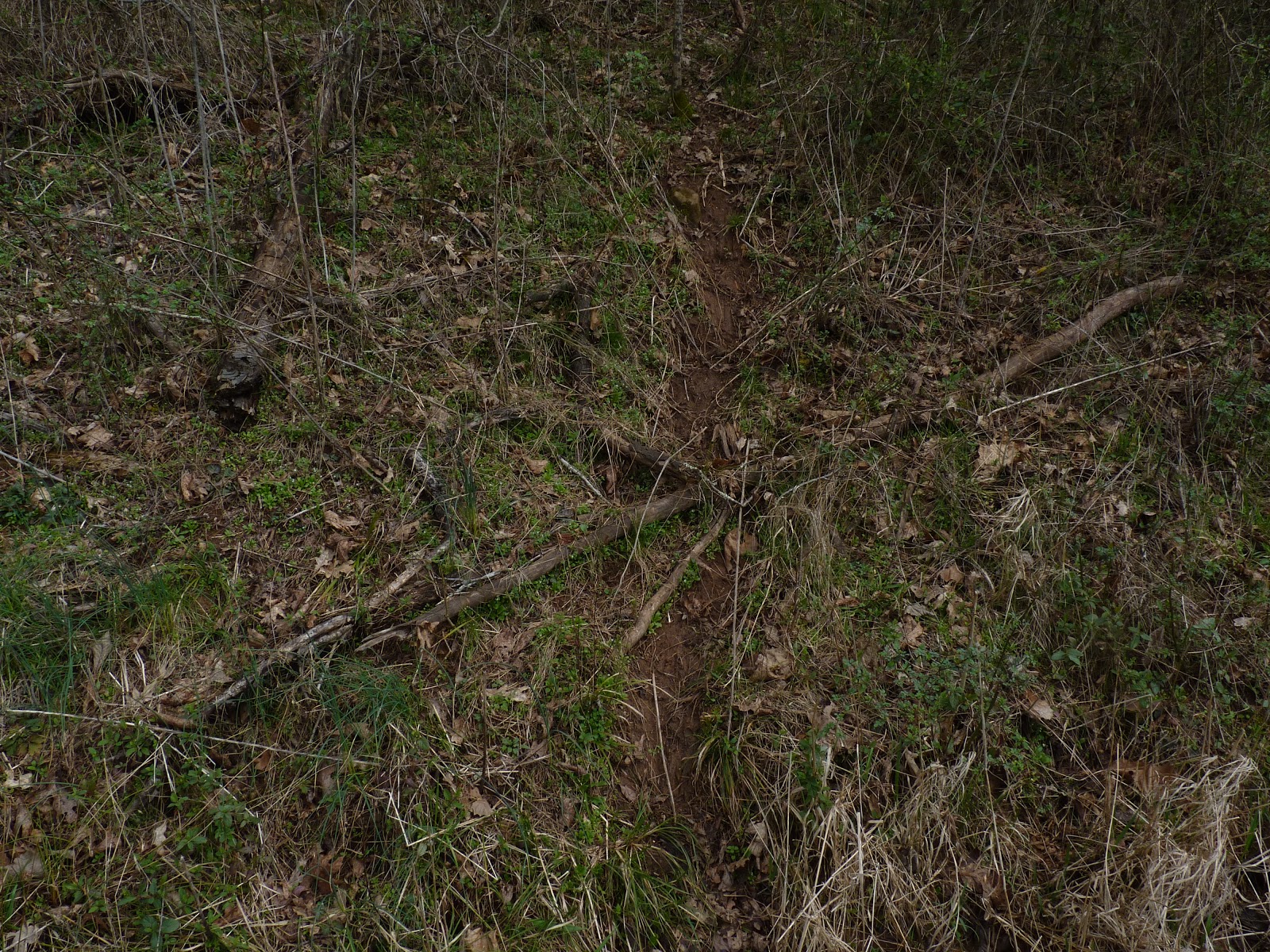
A deer path goes straight up the hillside.


More little Spring Beauties.


What do you think? A muskrat hole?


Pretty Henbit in bloom along the roadside ditch.


Someone else's home, not sure whose.


Larry went fishing for a while in the evening, and came home with 4 nice bluegill. So there's part of today's supper--fish and greens. I'll add a butternut squash to the meal, and some applesauce.

Back home again, I found that all the rain had caused some of the daffodils to fall over from too much quick growth and watery stems, I suppose. They made a nice bouquet for the house, and a sunny end to a good day.


Copyright Susanna Holstein. All rights reserved. No Republication or Redistribution Allowed without attribution to Susanna Holstein.

Thursday, April 19, 2018

Ramps Lady

We had hoped to get to the higher mountains this month to find ramps, that highly flavored wild member of the onion family. But time got away from us, and neither of us felt like our knees were in good enough shape to hike the hills.

So today I stopped in town when I saw this sign:


That chance stop led to an interesting conversation with the ramp's seller, Shonna.

I mentioned that we still had plenty of dried ramps from last year.

"I guess I'm a traditionalist," Shonna said. "I think it best to eat foods in season. Ramps and dandelions and milkweed in the spring, that's when we should eat them, and not put them up for other seasons. Because then they lose their specialness, and we don't have it to look forward to."

She has a point. In our world where almost all foods are available year-round, even the specialness of strawberries has waned. We can get them anytime of the year now, where once they were a May-June treat. But, like most people, I am glad to have them whenever I want them, and I do love the ability to add the unique flavor of ramps to foods when I think it will add a new dimension to the taste.


"How do you cook your ramps?" she asked, and then went on to say, "Here's something you need to try: put some oil or grease in a pan, add a little sugar and a little vinegar, then "melt" the ramps in that. You won't believe the flavor." It sounded a lot like wilted lettuce to me, and that's a delicious dish. So I will give her recipe a try.

I asked her about milkweed. "People mess up because they don't parboil and throw the water out. You got to do that or they taste bad." Very similar to cooking pokeweed, I asked? Exactly, she said.

And then she asked, "Do you ever eat dandelions?"

"Do you mean dandelion greens?"

"No, the flower. Here's what I do. I pop the flowerheads off, and remove ALL of the stem, but leave that green part under the flower. Then wash and shake to make sure all the ants and stuff are out of them. Then roll in a batter and fry them. They taste a lot like mushrooms (meaning morels)."

"When I make my mushrooms, I soak 'em in beer, not salt water like most people do. Then I dip them in batter and fry them. Talk about good!"


I tucked my bag of ramps in the van and waved goodbye. I sure hope I run into this lady again. She's full of nature lore and wildcrafting information, not from books but from family passing it down and personal experience--a rare person these days.


Copyright Susanna Holstein. All rights reserved. No Republication or Redistribution Allowed without attribution to Susanna Holstein.

Thursday, May 1, 2014

Please Pick the Flowers

I wonder how many of us got into trouble with our mothers when we were children because we snapped off the flower buds of her tulips and daffodils? I certainly remember an occasion or two when I felt my mother’s wrath after handing her a bunch of unopened buds. I also remember some short-stemmed bouquets given to me by my young sons, their face beaming because they’d brought me flowers. Trying to get those poor stems into water was futile and all a mother can do in such situations is smile, hug her children and grieve silently for the gorgeous flower bed she will not have that year.

In some cases picking the flowers can be a good thing. Consider the violet, that lowly but lovely early spring blossom that turns shady corners of yards and roadsides a deep purple when in full bloom.  Violets are a tasty addition to salads, lending color, crunch and an unusual flavor. Violets were thought to mean modesty and tender love in Victorian “floriography,” which assigned meanings to the names of flowers. White violets were said to mean truthfulness, and if you dream of violets good fortune is coming your way.

Then there is the redbud, the shrub-like tree that graces our hills with its branches full of tiny purple-red blossoms to provide a fine contrast to the white dogwood. Did you know that redbud flowers can be made into jelly? I tried it two years ago and it was delicious, tart and sweet with a very distinct flavor. The flowers can be eaten and are crunchy in texture with a tart lemony taste. The redbud is sometimes called the “Judas Tree” because Judas supposedly hanged himself from its branches.

Later in the season roses come into bloom. Rose petals can be harvested for rose jelly, dried for potpourri, or scattered on a salad. Rose water is easy to make and is a refreshing spritzer. Red roses signify love while yellow roses mean happiness (although I have also heard exactly the opposite), white means purity and pink roses mean admiration, according to the Victorians.  

Daylilies, or tiger lilies as they are often called, come into bloom about the same time as roses and are excellent when dipped into an egg batter and fried. I like to take each petal individually, batter-dip and fry them, then serve with a salsa dip. The buds can be mixed into soups and stews, and if you are quick enough in early spring, the young daylily shoots can be added to salads. They’re crunchy and sweet. The ancient Chinese believed that daylilies were a symbol of filial devotion and thoughtfulness.  Elderberry flowers can also be eaten—they make a fine jelly, and can be used in cooking or prepared like the daylilies to make fritters. The elderberry plant was considered to have magical and not altogether friendly properties by the ancients; it was considered unlucky to break off a branch. Consider yourself warned! 

Later in the summer, nasturtiums add a peppery flavor to salads and squash and pumpkin blossoms can also be harvested and prepared like daylilies, batter-dipped and deep-fried.  Nasturtium and squash must be too lowly  for notice since no significance was attached to either in the world of flower meanings.  

As with all wild foods, do your homework and exercise care to be sure you have identified the plants correctly. There are many books that give accurate photos and descriptions of the edible wild plants, as well as websites with excellent information. But after tasting some of these flowers you may find yourself telling your children, “Yes, please pick the flowers!”


(Repost of my April 2012 article for Two Lane Livin' Magazine) 

Copyright Susanna Holstein. All rights reserved. No Republication or Redistribution Allowed without attribution to Susanna Holstein.

Thursday, July 11, 2013

Roadside Weeds: Hazelnut


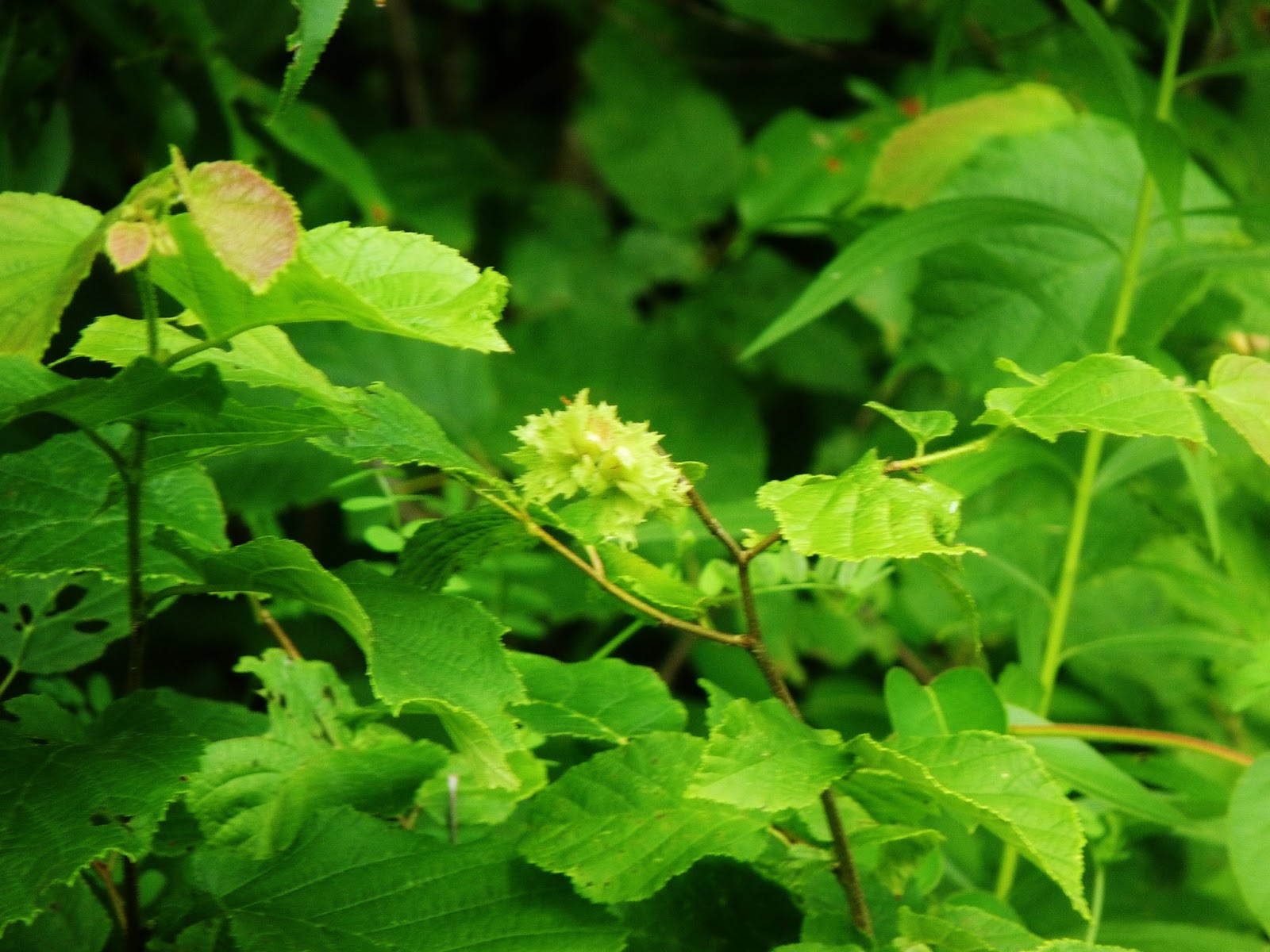
Wild foods are abundant and easily found in West Virginia, and indeed throughout the Appalachians. Today's story is a prime example. When I stopped to take photos of wildflowers for this blog the other day, I found a hazelnut bush growing right behind the flowers.

Wild hazelnuts (or filberts) bear exactly the same nut as the cultivated variety, although the wild ones are usually smaller. The nuts are born in clusters on the end of branches; hazel blooms in late winter to very early spring with male and female flowers on the same plant. The nut clusters are called burrs and the best way to pick them is to pick the whole burr and get the nuts out later.

We used to have many hazelnut thickets on our land because we when bought this place the land, which had formerly been pasture, was overgrown with brush like blackberries, wild plums, hazelnuts, etc. All perfect for the wild food forager! As time passed, the trees grew taller and shaded out the lower-growing brush, so we have only a few places where the hazelnuts still grow. I have not harvested any in years,  but I like knowing they're out there for the wildlife. I might have to get some this year, as the patch by the road reminded me of the fine taste of these nuts.

Hazelwood has a long history in folklore. The early Celts believed it to be a magical wood holding wisdom. One story tells that nine varieties of hazel grew around a pool; as the nuts dropped into the water they were eaten by the trout, and thus the trouts also gained wisdom--the number of spots on the trout indicating how many nuts they'd eaten (1). If getting wisdom were only so easy!

The Irish hero Finn Mac Cumhail, or Finn MacCool as he is also called, is said to to have accidentally eaten some of the Salmon of Knowledge when he was cooking the fish for the old Druid with whom the child Finn was living. A bubble of oil on the fish burst, splashing Finn's fingers. He instinctively put his fingers in his mouth, and that action transferred the wisdom of the salmon to Finn--wisdom he used many times in his career (2).

In the story of King Arthur's Cave (3), a hazel stick is said to be able to be used as a witching stick to find gold beneath the ground, just as many use a peach branch to divine or witch for water (I've tried this myself and watched in amazement as the forked peach stick was pulled to the ground). Hazel staffs were a favorite of the Druids and for simpler folk as a walking stick (4). Most of the hazel in my area is too small for such uses, growing more as a small shrub and not as a tree. Thin hazel branches can be used to weave wattle fences, and hazel is also believed to offer protection from venomous snakes, according to a Grimm's fairy tale (5).

THE HAZEL BRANCH

One afternoon the Christ-child had laid himself in his 
cradlebed and had fallen asleep. Then his mother came to him, looked 
at him full of gladness, and said, “Hast thou laid thyself down to
sleep, my child? Sleep sweetly, and in the meantime I will go into
the wood, and fetch thee a handful of strawberries, for I know that
thou wilt be pleased with them when thou awakest.” In the wood
outside, she found a spot with the most beautiful strawberries; but
as she was stooping down to gather one, an adder sprang up out of
the grass. She was alarmed, left the strawberries where they were,
and hastened away. The adder darted after her; but Our Lady, as
you can readily understand, knew what it was best to do. She hid
herself behind a hazel bush, and stood there until the adder had
crept away again.

Then she gathered the strawberries, and as she set out on her way
home she said, “As the hazel bush has been my protection this
time, it shall in future protect others also.” Therefore, from the
most remote times, a green hazel branch has been the safest
protection against adders, snakes, and everything else which 
creeps upon the earth.


Today the hazelnut is a humble shrub growing where it can along the edges of fields and roads. It is sad, isn't it, to see a shrub with such an illustrious past reduced to such circumstances. I think I might have to dig a start in the spring and see if I can give this plant a respectable home in my garden. Maybe some of its magic will rub off on me in the process. I can hope, anyway.

1) From Trees for Life
2) From Encyclopedia Mythica
3) Griffis, William. King Arthur's Cave, in Welsh Fairy Tales
4) From Growing Hazelnuts in Food Skills for Self-Sufficiency
5) Grimm, Jakob and Wilhelm. The Hazel Branch.


Copyright 2012 Susanna Holstein. All rights reserved. No Republication or Redistribution Allowed without attribution to Susanna Holstein.

Monday, November 5, 2012

Weekend Work, a Booth Update and Squirrel Gravy

We got busy this weekend with catch-up work: cleaning out the gardens (still in progress, actually), getting vehicles winterized and getting the booths restocked and rearranged. I took only a few photos and only at one booth, and those in a rush because we were pushing against time at each visit. Isn't it funny how even being retired there are still appointments and obligations that keep us tied to a clock at times?

Friday I made a round of some of my favorite junk shops that I had not visited in quite a while. The results were disappointing for the most part but I managed to find a few things. Then we took off to Charleston to look for a door for the cabin room. We had no luck at ReStore--last time we were there they had several nice exterior doors, but not this time. Since we were in town, we stopped at another usually good junk shop. Again, no real good finds. Bummer! After a little discussion we decided to stop at Lowe's and price a door. We bought one (ouch) along with the wire Larry needs to put between the logs before he adds the chinking.

Saturday we were up and out by 9:00am. Our goal: restock the Ravenswood booth and remove a cabinet that had not sold, restock at Marietta and be back by 2:30 because I needed to change clothes and be ready to MC the awards reception for the writing contest at the library by 4:00pm.It was tight but we made it.
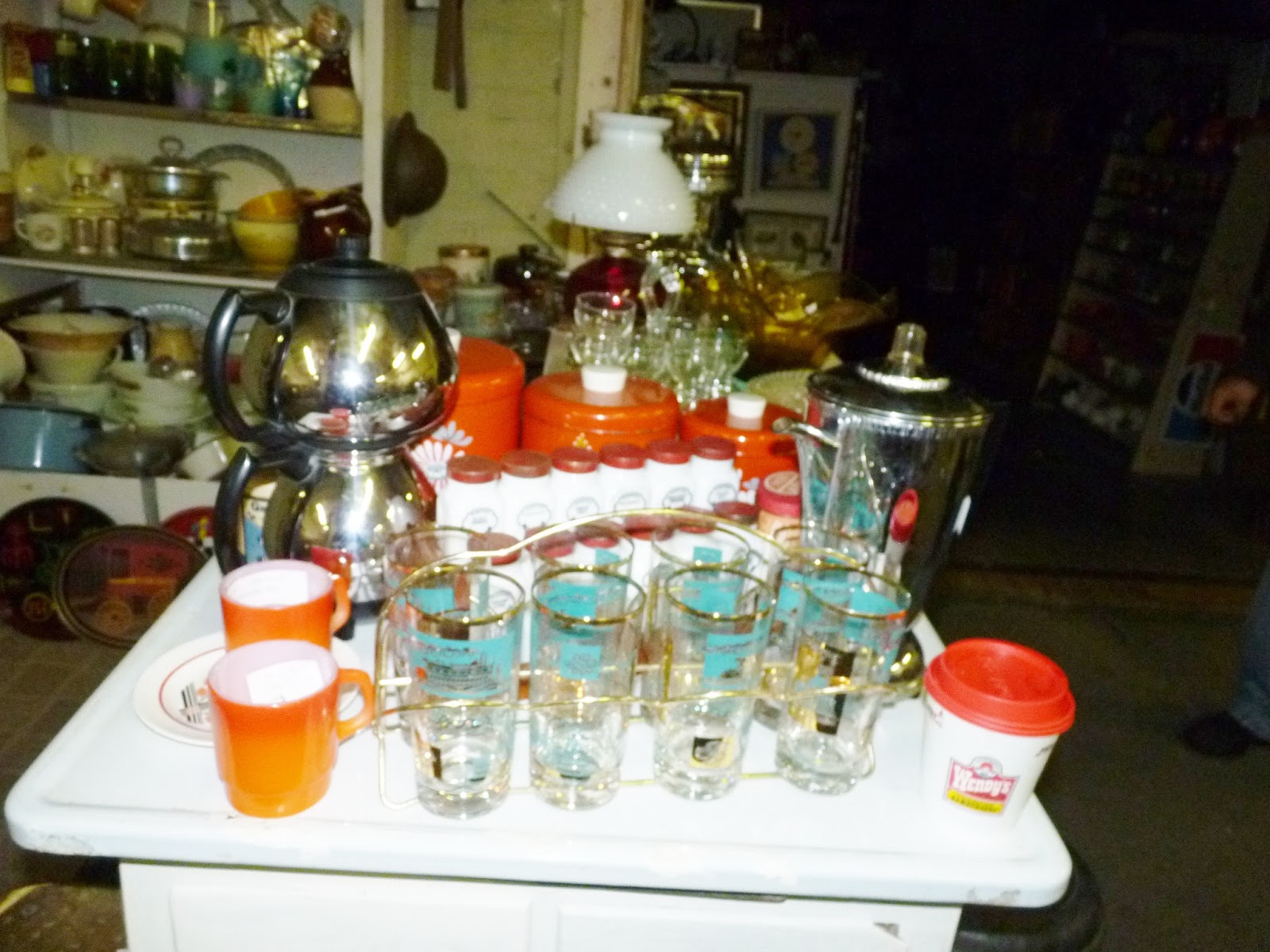
I added some barware this week as there seems to be a demand for vintage items in that category, and my favorite--the purple glass eggplant, made by Blenko! I found it at a yard sale and thought it was the coolest thing. I also added a green Depression glass cake plate, a Morgantown Glass pitcher, some Noritake sherbets...and lots more. I needed to get some things out as my room at home is overflowing with stock that I was not able to get into the booths in October.

Some retro red! I bought the Ransburg canister set to replace my own just like them since mine are very, uh, vintage looking (meaning beat up!). But then I figured I'd be rough on these too so I'm reselling them. The percolators are another recent demand item so I've picked up several different styles. Griffith's spice racks usually a good price as do the aqua retro tumblers in a rack.(The Wendy's coffee cup isn't for sale--at least I remembered to trash it before we left!)  I also added the red and milk glass kerosene lamp this week.

We made it home with just enough time for me to change and get back out the door. The reception was fun, lots of great stories and nice people and happy winners. This is the third year for the contest, and it keeps growing. I had several favorites among the winners: a young man's poem about the Crucifixion really stood out, and an essay about early days of moving to the country was hilarious and reminded me of my own experiences when we moved here in the mid 1970's. Another favorite was the story of an elderly man and his pumpkins; it was touching and unusual and I am still thinking about it. There were many others, all well written and so creative. I love the writing contest because of the encouragement it give our local writers. Seldom is there a place for them to showcase their work and this provides an opportunity to do that as well as meet other writers. Again, no photos--my camera got left behind in the rush.

Sunday we took it a little slower. We did a little work in the yard to get things ready for winter and Larry pressure-washed the cabin logs. He'll be treating them for termites this week, and then he can begin chinking. Work on the room will slow down now because this is a do-it-as-we-have-money projec. Now that it's under roof we can breathe easier. The door will go in this week and he may get to some chinking, or he may stucco the chimney if the weather holds.

I cleaned out flower beds and the herb garden, put away yard decorations and straightened up inside the root cellar to make room for the food we could not fit in there earlier. I love cleaning out the herb garden, although it is sad in a way to say goodbye to the sweet-smelling plants.


 I came inside redolent of rosemary, parsley, sage and lemon balm. There was more room on the cellar shelves than I thought which was a good thing because the apple butter and later canning was piled in boxes in the floor waiting for space to be cleared. Larry usually carries out the jars I can, and he's not as finicky as I am about how to put them on the shelves. By stacking smaller on top of larger, I found a good bit of space. I still have two boxes to be put on the shelves, as soon as more space becomes available.


There is nothing as beautiful to my mind as a full cellar. Mine still has bushels of apples and pears for me to can (they won't keep all winter), a basket of tomatoes wrapped in newspaper so they will hopefully ripen before they rot, hot peppers hanging from the rafters to dry, and soon I'll be adding geraniums hung to dry for replanting in the spring.

I cooked squirrel gravy for dinner, along with some fresh broccoli from the garden, and brown rice. Here's my recipe for squirrel gravy (which is really a sauce and not a gravy).

Squirrel Gravy

Cook the cleaned squirrel in water with 2-3 bay leaves and a chopped onion. Cook until the squirrel is tender (time varies based on the size of the squirrel, how many you're cooking, and how old they are--older takes longer).

Cool the squirrel and remove the meat from the bones. Reserve the cooking liquid.

In a skillet, saute chopped onions, celery and sliced mushrooms. When the onions are clear and tender, add rosemary leaves to your taste, diced garlic, and dried ramps if you have them. Add the squirrel meat, salt, pepper and Worchestershire sauce to taste and the reserved cooking liquid. Heat over medium heat to a boil; reduce heat and simmer.

Remove some of the cooking liquid (or use warm water) and put it in a bowl or liquid measuring cup. Add some corn starch and stir until it dissolves. Then add this mixture back to the skillet, pouring it in slowly and stirring constantly so that it does not lump.

Simmer until the mixture comes to a boil; continue to simmer, stirring often,  until the broth is thickened.

This has a wonderful aroma and flavor, and seems to remove any "wild" taste. I used the same basic method sometimes with venison and the result is rich and delicious.

(As for eating squirrel: when I mentioned this on Facebook, there were some surprised reactions. How cold anyone eat such cute little critters? I have no issue with it; I never fed squirrels or regarded them as a tame animal although I know that some people who live in more populous areas do. To me squirrels are like deer--also a beautiful creature but one that supplies the bulk of our winter meat. I have always managed to stay at an emotional remove from any animal we have raised for food, as I think most country dwellers do. And I believe that this wild meat is healthier than anything I can buy in a store, and better for us if we are to eat meat. And I have never been able to eat rabbit! I think that is because we raised them once and they became pets. The barrier was removed--ack! Each of us has to make our own decisions as to what we eat and be comfortable with our choices.)


Copyright 2012 Susanna Holstein. All rights reserved. No Republication or Redistribution Allowed without attribution to Susanna Holstein.

Tuesday, April 10, 2012

For Sale: Good Taste, Mountain Style

Many of you asked about ramps--what they were, how they tasted, and how to use them. I dried the ones we harvested a couple weeks ago, and thought perhaps I would sell some since I ended up with quite a lot.

Ramps are renowned for their virulent, long-lasting aroma, but once dried they become an intriguing new flavor to add to favorite dishes. Try them mixed into fried potatoes in the last few minutes of cooking; stir some into soups and stews; add to pot roasts, tomato sauces, goulash, stir-fry and all kinds of other dishes.

You might even want to make this traditional Spring ramp dinner--scrambled eggs, applesauce, ham, fried potatoes and ramps, brown beans and cornbread. Too delicious.


Consider using dried ramps in any recipe that calls for garlic, onion, or onion/garlic salt. Add a spoonful to hamburger as you make it into patties for a really different taste. The possibilities, as you can see, are endless.


Each jar contains about 1 ounce of dried ramps, but there that is a LOT of ramps-- over 1/2 cup to be exact. That is enough to last through many, many recipes. The jars will be labeled so the postman--and your family-- doesn't get suspicious about what the green stuff might be :)

Price for per jar is $7.00 and includes all shipping and handling and can be paid for through Paypal or by check. To buy a jar, email me at susannaholstein@yahoo.com and I will send you payment information.


Add a little taste of these wild West Virginia mountains to your cooking!

Sunday, April 1, 2012

Ramp Hunting!

We got a wild notion today and heading to the high mountains of West Virginia to seek the elusive ramp (or rampion or rapunzel, depending on your preference). Totally tired tonight, but totally satisfied too. Here's one of the photos I took today--more coming tomorrow.

Larry posed with a nice bunch. He did most of the digging--I had a lot of trouble getting down the very steep bank to the ramp patch and when I did find a place that I thought I could manage, it was about a half-mile from the ramps. Those mountains are steep in Webster County! Of course, I was a bit distracted by the wildflowers...

It was an awesome day, and even coming home to find the water was not working didn't ruin it. The big ol' storms that rumbled through this evening didn't either.

I'll post more tomorrow. Right now, it's time for bed. Night, all!

Saturday, September 24, 2011

Good Neighbors

Good neighbors. They show up at your door with warm biscuits, ripe peaches and three squirrels ready to be dressed out.

For those of us who live in the country and who enjoy wild meat, squirrels are a real treat, a delicacy that when fixed properly rivals anything a chef can prepare. For us squirrels are not furry little friends who come out to play, although we do enjoy watching them as much as anyone. Our meat however is mostly homegrown or harvested from the woods around us, so we look at wildlife a little differently than people in the cities and suburbs. Bringing in our own meat is a fact of life here.

Our good neighbors knew I'd been down with a cold. So on this windy rainy evening they bundled up and traveled up the ridge to see how I was getting on. We added some homemade jam to the biscuits, made coffee and poured sassafras tea for Delmar because he doesn't drink coffee, and had a little feast. The squirrels will wait until tomorrow to be cooked for dinner.

Good neighbors. They're worth their weight in gold--and squirrel meat.

Friday, May 6, 2011

Poke!

As we were traveling across the ridge the other day, I happened to look at the roadside and saw...


Poke! That most delicious of wild greens was thick in a most unexpected area. I usually look for it in places where the soil has been recently disturbed or a building torn down, but this was happily growing right beside a little-traveled road. We made a note to come back for it later in the day. (And we remembered, an amazing thing in itself.)


We were working away when an SUV with a young woman at the wheel pulled up. "Yall picking ramps?" she asked.

"No, we're getting poke," my husband answered.

"What's that?" she asked.

"Well, it's a wild green, tastes a lot like spinach, only better," Larry explained.

The girl wrinkled her nose. "I think I'll pass," she said with a grin as she pulled away. We continued to pick,


ending up with two large, stuffed bags of gourmet greens.


That young woman doesn't know what she's missing. Prepared properly, poke is about as good as it gets when it comes to greens. BUT...

There are many websites with preparation instructions, including this one. There are also abundant warnings about poke's poisonous properties which should be well heeded before attempting to gather or cook this wild plant. I'm serious--this is not a plant to mess with if you don't know what you're doing.


I first learned about poke from a book by Euell Gibbons called Stalking the Wild Asparagus. Fortunately, Mr. Gibbons gave very careful instructions for preparing poke and I followed that advice then and now. I usually wash the plants, strip the leaves from the stems and boil in at least 3 waters before eating. Most poke recipes call for cooking it with bacon grease; I don't. I boil it in 3-5 waters, drain and add butter, salt and pepper. That's all. It's delicious.

There is some research now into poke's medicinal uses for such things as HIV and cancer. I hope the researchers find that this beautiful plant can be used for such purposes.

As children, we called poke "inkberry" and used its berries and a stem of grass to write secret messages. We knew even then that the berries were poisonous to eat and never were tempted to try them, thank goodness.

Native Americans believed that poke had magical properties and used it as a purge. They also used it as a dye for feathers, body paint and clothing. According to Dave's Garden, pokeberry ink was used to write the Declaration of Independence, but official government sites state that the document was written using iron gall ink, which I would think may or may not have been made using pokeberries for dye. It seems that the folklore about the Declaration's writing may have begun with a Wikipedia article since a lot of website quote verbatim the same language (which immediately makes their information suspect in my book), but I have not been able to find that source article. If you know of a site that can confirm this legend, I would like to know about it.

Another website details one blogger's experiment making her own pokeberry ink. I'm not quite ready to try that but it does sound interesting.


For now, I'll be content to gather poke where I find it, cook it carefully and enjoy its tender taste.


Ink and other uses can wait. Poke fresh scrambled eggs and iced sassafras tea--now that's a dinner.

Wednesday, March 23, 2011

Creasey Greens

It's the season for creasy greens in our area, and that means delicious fresh greens, the first of the season, have been gracing our table.


As we were driving home Sunday afternoon, I spotted a large patch on the side of the road in Calhoun County. you know what I said--"Turn around!" Larry was willing because he likes greens as well or better than I do.

We parked on the side of the road by a little creek, and Larry was soon picking greens. I was too, although what I was picking wasn't creasy greens, it was daylily shoots. I am sure that people passing by laughed at me and thought I was picking the lilies thinking that they were ramps. But I knew what I wanted--the juicy, tasty young shoots taste marvelous in a salad. The tubers are also supposed to be edible but I have never tried them. I like the young shoots and leaves chopped up in salads, and the flowers batter-dipped and fried; I have also heard that the flower buds can be eaten and I plan to try them this summer.

Larry picked for quite a while, and he said there were plenty of greens left when he was finished. It's always a good thing to leave enough of a wild plant to re-seed and re-populate an area for the coming years.


Creasy greens generally prefer damp, rich places to grow so this hillside seems odd in a way. But they are prolific and will grow pretty much anywhere, even in poor soil. In 15 minutes Larry had filled his bag.


Dark green, rich in nutrients and with a flavor like spinach, creasy greens are a real springtime bargain.


We knew we needed to clean the greens as soon as we got home to preserve the best of their flavor and nutrients. Larry washed them and I cut off the bottom of the clusters (too much dirt hides in there) and checked to be sure all grass, leaves and debris were removed. Then I put them into a pot of boiling water for about a minute (long enough to wilt them thoroughly), drained, rinsed with cold water and bagged them up for the freezer.


We ended up with 4 packages that are just the right size for the two of us for a meal.
 
And of course we kept out enough to have for our supper that evening. Creasy greens and scrambled eggs--a perfect springtime meal. A lot of people like to drizzle bacon grease on their greens, and that's good but bacon grease just isn't on our diet these days.
 

I hope we can get out and pick some more of this delicious free food before they get too big and get bitter. Although when the flower buds form, those can be cooked and eaten like broccoli, so there's a "second season" coming for anyone who wants to give them a try.
Related Posts Plugin for WordPress, Blogger...