Pages

Showing posts with label Cornstalk. Show all posts

Saturday, August 5, 2017

River Towns: Point Pleasant, West Virginia

Point Pleasant, West Virginia is one of my favorite West Virginia towns. It's not far from where I live, and its location, slow pace, and friendly people make it a great place to visit. There is plenty to see and do in Point Pleasant: the mural painted floodwall and bordering walking path, the haunted Lowe Hotel, the Mason Jar Antique Mall, the Mothman Museum and the River Museum, Fort Randolph, Tu-Endi-Wei State Park, lovely old homes, and of course the Ohio River. The town has a long history: Indian wars, floods, and a tragic bridge collapse intertwine with folklore and legends to create a unique and fascinating story.

The area was first claimed in 1749 by the French explorer Pierre Joseph Celeron de Blainville, who set a plaque on the riverbank declaring all the territory in the region for the King of France:

"In the year 1749, in the reign of King Louis XV, we, Celeron, commander of a detachment sent by Commander de La Galissonière, Commander General of New France, for the restoration of peace in various untamed villages in the region, have buried this plaque at the confluence of the Ohio and Tchadakoin [Rivers] (Kanawha River) this 29th day of July near the fine river bank, to commemorate the retaking into possession of the afore-mentioned river bank and all the surrounding lands on both river shores back to the river sources, as secured by previous kings of France, and maintained by force of arms and by treaties, specifically the Treaties of Rijswick, of Utrecht and of Aix la Chapelle."

A grand and sweeping statement, is it not? But the French lost their claim when the British defeated the French in the French and Indian War.  In 1770 George Washington explored the Ohio Valley for the British, and noted the abundance of game and the wide, fertile bottomland in his reports. He later received over 10,000 acres in the region for his war-time service.

One section of the mural wall
Fort Randolph was established at Point Pleasant as a safeguard against Indian attacks, which were numerous in the area. Ongoing and escalating hostilities between settlers and Indians led to Lord Dunmore's War in 1774 which was a successful effort to drive the Shawnee and Mingo back across the Ohio River. The deciding battle in this conflict occurred at Point Pleasant. (Both my family history and that of my husband say we had ancestors in the fighting.) The Indians were soundly defeated; afterward, one of the most powerful Shawnee leaders, Cornstalk, became an advocate for peace between whites and Indians. On a peace-keeping mission to Fort Randolph in 1777 Cornstalk was taken hostage by the commander of the fort. Cornstalk, his son and two other Indians were later murdered by soldiers seeking revenge for the death of a militiaman at the hands of the Shawnee. Cornstalk was buried at the Fort. His body has been moved at least three times, and is now in its hopefully permanent home at Tu-Endi-Wei State Park. The murder of Cornstalk and the other Indians enraged the Shawnee who began a series of murderous attacks against settlers along the river that last over 20 years.

Local legend claims that before his death, Cornstalk laid this curse on the area:

“I was the border man’s friend. Many times I have saved him and his people from harm. I never warred with you, but only to protect our wigwams and lands. I refused to join your paleface enemies with the red coats. I came to the fort as your friend and you murdered me. You have murdered by my side, my young son. For this, may the curse of the Great Spirit rest upon this land. May it be blighted by nature. May it even be blighted by its hopes. May the strength of its peoples be paralyzed by the stain of our blood.”

Historians question the veracity of this story, doubting that Cornstalk ever said these words, and I have to say it does seem unlikely. However it is true that Point Pleasant has seen its share of disasters over the years, from raging Ohio River floods, to fires, the terrible collapse of the Silver Bridge in 1967,

and the strange sightings of a creature dubbed "Mothman". Click the link to read more about paranormal activity in the area, and click here to read my other blog posts  on this topic.

Stories of hauntings abound in this town; many people report seeing and hearing strange things at the historic Lowe Hoteland the places where Mothman was sighted attract many visitors. Others believe that the spirit of Cornstalk also haunts the area because of the repeated disturbance of his remains.

Another intriguing story says that Samuel B. Clemens, grandfather of Samuel L. Clemens (better known as Mark Twain)  was a settler in Point Pleasant, and was killed in 1805 when a log fell from a cabin he was helping to build. I have not been able to verify this, and have found another claim that repeats the story of the falling log but says the elder Clemens was killed in Madison, Boone County, WV.

on the banks of the Ohio at Point Pleasant, WV
With its location at the junction of two powerful rivers and its faascinating history, it would seem that Point Pleasant would be a thriving city, but development never took off here, and it remains today a picturesque small town hugging the banks of the mighty Ohio.

Copyright Susanna Holstein. All rights reserved. No Republication or Redistribution Allowed without attribution to Susanna Holstein.

Saturday, February 18, 2017

Traveling West Virginia: Tu-Endi-Wei, The Place Between Two Waters

 This small park--possibly the smallest of West Virginia's state parks--encompasses only four acres, but packs a lot of history into its square footage.

I've visited here before, once as a storyteller, and once with some of my granddaughters. I supposed I've stopped in here and there in between, but all of my visits seemed to be short and packed with other things to do. So this time, I took my time.

Because I had some things I wanted to see. I had explored most of the sites and stories surrounding Mothman, the area's strange phenomenon that appeared, according to the stories, in 1962 and led to many more sightings and the appearance of "Men in Black" (this was the first time the term was used). But I wanted time to see things like the Merci Train French Oaks. I wrote about the trees in a post about five years ago .

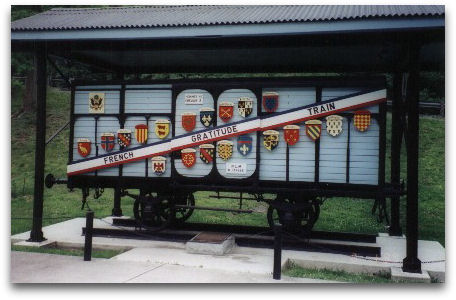
The West Virginia boxcar from the Merci train is on display
in Welch, WV. For information, call  (304) 436-3803
or (540) 297-4946


The trees were grown from acorns sent in the Merci Train from France--a gift from the grateful French people to the people of the United States for their aid during World War II. Just standing near the trees gave me such a sense of...what? History? Of a time when the world was unified? When the US was unified? I felt sad and at the same time hopeful. The park's superintendent, Doug, happened to be there while we were at Tu-Endi-Wei and he told me he'd set out a few young trees from the seed of the old trees so that the French oaks will continue to be a reminder of history.


Tu-Endi-Wei park (the name means "place between two waters") is also the home of the oldest hewn-log structure in Mason county, WV. The house is in good repair considering it was built in the late 1700's. It is referred to as the "Mansion House" because at the time of its construction it was considered huge for a home on the frontier.

Another monument on the grounds commemorates the gravesite of men who were killed at the site during a battle of Lord Dunmore's War, a conflict between the British and Native American tribes in the area. These men were buried in the magazine, a structure used to store ammunition. The most tragic aspect of this battle was that soon afterwards, Chief Cornstalk came in peace to the fort at the site, and was murdered. Legend has it that he placed a curse on the area which has prevented Point Pleasant from thriving as it seems like it should, with its prime location at the juncture of the mighty Kanawha and Ohio rivers. Both Larry and I had ancestors who were present at the Battle of Point Pleasant: Stephen Holstein on my husband's side, and a doctor in my family line who lived in Rowlesburg, VA (now WV) at the time of his service. (It is interesting to find that there are descendants of my maternal great-grand-mother in West Virginia, none of whom I have yet met).

A petroglyph, found in Mason county, stands behind protective fencing.


A barge passes by the monument to Chief Cornstalk. You can read his "curse" here.
Tu-Endi-Wei is a fine place to view passing river traffic, and even the passing barges call history to mind. Imagine the dugout canoes, the flatboats, keelboats, steamboats and other watercraft that have passed by this lovely site. Imagine the natives, cooking their fish on the riverbanks, the settlers poling their way to a new life, the smoke and excitement of the steam era, the horrendous noise of the tragic collapse of the Silver Bridge just a few hundred feet north. So many lives have been touched, both by good and by bad, at this place.

Copyright Susanna Holstein. All rights reserved. No Republication or Redistribution Allowed without attribution to Susanna.
Related Posts Plugin for WordPress, Blogger...