Pages

Showing posts with label EAPG. Show all posts

Saturday, December 19, 2020

Covid Journal, Day 275: Old Glass at Work

28, cloudy, with a red sunrise, so I suppose some kind of wet weather is on the way.

Old glass isn't just pretty, it's useful too. 

As most readers here know, I have a love affair with Early American Pattern Glass. It's all over my house and I have become very strict with myself about what I buy now. No more chipped or cracked pieces, or pieces missing their lids. I have even--gulp--purged several such pieces in my recent cleaning. I only have so much space, after all, and I don't want my home to begin looking like a hoarder's house. Sometimes I feel like it's teetering on the brink anyway, at which time I have another cleanout.

For years I couldn't buy pretty things. Raising 5 sons and for most of that time living on a near-minimum-wage income, there wasn't money for extras. Sometimes I bought things at yard sales, and cherished each and every one. I grew up with my mother's china cabinet, remember, that was filled with beautiful glass and china. I well remember the crystal pieces, and still have one of her pitchers. She had many English porcelain cups and saucers too, so you know where my love of those came from. About 8 years ago I found my own china cabinet at a yard sale, and it's now full of beautiful old glass. 

I like to use this antique glass, especially for holidays and special occasions. I'm content to just look at it on shelves and in cabinets, but it's nice to have it on the table too. So this week I got out some of the spooners and other pieces for our table.


The spooners are a pattern called Red Block, or Captain Kidd, made by Fostoria Glass around 1890. The little sugar bowl I use for preserves is Derby, by Westmoreland Glass, around 1904. I can't remember the pattern of the tray, but I think it is later, probably 1920's, and was a dresser tray that would have held perfumes, powder jars and the like. Also never identified the salt and pepper, yet. Maybe one day I'll get to them.

I use my glass for seasonal decorating too, changing the colors with the season. Here is some of this year's glass on display on the buffet.


The cake stand under the tree was a recent ebay gift to myself. For once, I actually paid retail value but I decided I had earned it after a stellar month of selling. The ruby goblet is a reproduction, made by Fenton for LG Wright glass, in a pattern called Strawberry and Currant. The green spooner on the left is called Croesus by Riverside Glass, circa 1894, and the little glasses are, I think US Glass's Mirror and Fan. The date on these is vague as the pattern was made as late as 1962. The green hobnail I think is probably a recent piece, but it's green so in the display it goes.


The red plate--actually amberina, with shades of orange in the ruby--gives a nice glow here. I think it's also a newer piece, but handmade. Maybe Blenko? The sugar and cream set is called Arched Ovals, US Glass, circa 1904. The tray they're on I have not yet identified, but I believe it is from the American Brilliant Period cut glass. The green compote is the Shoshone pattern by US Glass, about 1898. It's also called Victor and Blazing Pinwheels. The goblet on the right is Paneled Daisy and Button, and has pretty amber panels between clear glass sections.


Let's see--the compote on the left, is, Regal, also known as Paneled Forget-Me-Not, by Bryce Brothers, around 1883. And the large compote in the center is Plume, by Adams, around 1889. The tall green vase is also EAPG, but I can't recall the maker. And the red goblet in the background is reproduction Fenton. In front of the tall compote is an amber and clear spooner called Victoria, by Riverside glass, circa 1889.


And more glass--the ruby plate is new, I think, but I've not been able to find one like it. The spooner on top of the cake stand is called Petticoat, an apt name because it has the prettiest base. It was made by National Glass circa 1900. The cake stand is called Fashion--don't you love it? Made by Imperial Glass around 1908. The green bowl is Pride, by Model Flint Glass, 1898 or thereabouts. The goblet inside it is Rising Sun, by US Glass about 1908. Behind the green bowl is a compote called Block and Fan, made by Richards and Hartlet about 1888, and inside it a green spooner named West Virginia Optic by West Virginia Glass, 1894. In the back, a tall green vase in the States pattern "Delaware" by US Glass, C. 1899. And last, the big lidded compote called New Grand, by Bryce, Higbee Glass, about 1888.


So, more about glass than you ever wanted to know, right? If you want to identify your antique glass, there is a fantastic online database maintained by the EarlyAmerican Pattern Glass Society that has several ways to help you find your piece: by motif --pinwheels, ovals, flowers, etc; by maker, by shape--compote,spooner, etc; or by name. I began my journey about 8 years ago by joining the Facebook group Early American Pattern Glass Society, a large group of knowledgeable experts and beginners alike. It's a friendly, polite group of good people who will help anyone who wants to know about their antique glass--and if your glass isn't within their pervue, they can usually direct you to a good source. 


Copyright Susanna Holstein. All rights reserved. No Republication or Redistribution Allowed without attribution to Susanna Holstein.

Thursday, March 5, 2020

30 degrees, and partly cloudy. Frost on the vehicles but not much frost elsewhere. Woodpeckers and blue jays woke us this morning. And yes, we heard peepers down the holler yesterday when we went out. Nice!

We had a seriously busy day yesterday. We drove about 25 miles to a nearby town to pick up things from our pickers. Made a stop at a watch shop to see if an Accutron watch we got in an estate sale was worth fixing (it was, only needed a battery), and browsed a thrift to see what we might find. Then lunch, picked up onion sets and seeds at our favorite place for plants and such (they serve a dynamite lunch too). Back home to unload the van and load up a bike and the washtubs and a couple totes, 2 small tables and a child's rocker to take to our Ravenswood booth. Restocking the booth took a couple hours, then we had to stop at the AT&T store to get my old phone set up for Larry to use. Nice young staff there took care of several other things with my new phone too. We still needed to get gas and go to the library. By then it was well past dinner time, so we stopped at our favorite pub for a bite and a glass before finally coming home.

Today I'll be back at the booth, taking in a lot of costume jewelry which will take a while. Then I have a meeting at the library to discuss setting up a WV Writers series there this coming year. I've already packed my ebay and taken care of housework, so time to get going.

But first, I wanted to share this pretty find from yesterday, that I almost missed. I was walking out of the second thrift we stopped at when I spotted this Early American Pattern Glass spooner. It was made by Riverside Glass in Wellsburg, WV, around 1895. Isn't it pretty? I collect spooners so I was doing a happy dance when I got home and identified it. This pattern is Victoria.


Copyright Susanna Holstein. All rights reserved. No Republication or Redistribution Allowed without attribution to Susanna Holstein.

Tuesday, April 23, 2019

Recent Finds


I thought I'd show some of the interesting things I've found lately. All of these are either listed on ebay or sold.

First, this paperweight. It's millefiori (Italian meaning millions of flowers, I think). I thought it was interesting when I picked it up at the thrift store, but was surprised to learn that it was made here in WV at the turn of the century, in the Morgantown area. The glass company was John GentileGlass, and these paperweights were one of their specialties. His wife was probably the first female paperweight maker in the US.


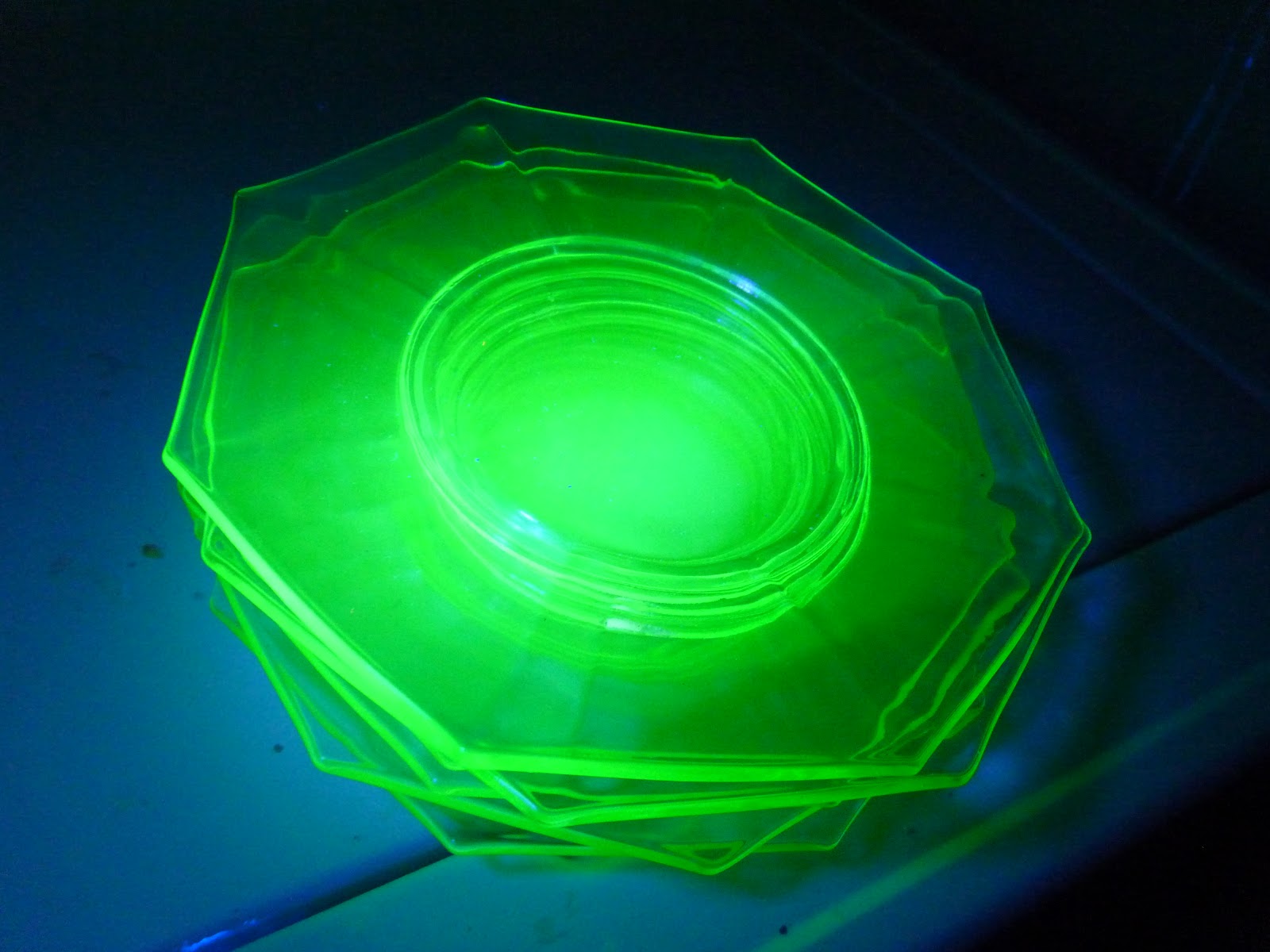
I got these green Depression glass plates from a local picker. The second photo shows what's cool about them.


Put them under black light, and they light up! This is due to the tiny amount of uranium used in the glass to make these, back in the 1930's.


 I don'e know if you can see it in this photo, but this is a Frigidaire advertising piece, showcasing their "decorator colors" for appliances. It's also a measuring cup. This was in an auction lot.


These beautiful glasses are also old--over 100, actually. I found these one at a time at a local thrift store. They are Early American Pattern Glass, so each pattern has a name. Front is Captain Kidd (aka Red Block), back left is Dakota, and right is The Hero.


A complete "table set" as it was called: butter, creamer, sugar and spooner, by Imperial Glass, c 1904.
No nickname for this one. Most EAPG has both a common name and an OMN (original manufacturer's name). The OMN for this one is just No. 4. )On the glasses above, I've given the names the pieces were generally known by--sometimes these were the same as the OMN, sometimes not).


I have 5 of these, still unidentified. Picked up at an antique mall for $1 each. I haven't listed them yet, as I don't know the pattern or maker.


This sweet pitcher sold within minutes of listing, for $150. I found it for $4 at a local thrift store. It's very old, and unusual in that it has a metal bottom and a lid. Salt-glazed pottery.


Copyright Susanna Holstein. All rights reserved. No Republication or Redistribution Allowed without attribution to Susanna Holstein.

Tuesday, August 2, 2016

New Glass, Old Glass: Two Nice Finds

I had a doctor appointment today, which pretty much took up my whole day. But there was time to go do a little thrifting afterwards, and I found two things I wanted to share.

First is this gorgeous Blenko pitcher. Those who have been readers for a while know my love of Blenko glass, which is made right here in West Virginia. Their clear colors and clean lines just really speak to me, and in front of a window? Heart-stopping. This pitcher was made around 1990 in the color Blenko calls Dusty Rose.


Each of their designs are given a number. This is 9027-S (for Short, I suppose, since the 9020-L is 4 inches taller). It's heavy, and at 8 1/2" a nice size.

The second piece is another love of mine, Early American Pattern Glass. It's completely at the other end of the spectrum: ornate and old, dating to 1870-1914. This particular piece is a compote in the Job's Tears pattern, made about 1880-1890 by Adams & Company.


It's heavy, the one thing it does have in common with Blenko glass. Most of what I have found in the old glass is in crystal; although there are some colors they are harder to find and generally more expensive. I seem to be getting quite a collection of compotes without really trying--I believe I have 15-20 of them now.
It's the same story as the Blenko; I started with one piece, learned about the glass and got hooked.

So even though going to the doc isn't fun, I did end up having a pretty good day anyway!

If you are interested in glass, there are quite a few groups on Facebook that are invaluable resources. The Blenko Collectors group has excellent files, friendly experts and even a few of the glass designers as members. The Early American Pattern Glass group is also welcoming and knowledgeable. The only caution to joining either is to be prepared to do your homework before asking for help! Read their pinned posts, look at the files and become familiar with the resources they offer before jumping in with a piece to identify. You'll save yourself some embarrassment and you'll save time for all the busy group members. I've certainly learned a lot by being a member of these groups, even if I am often just the fly on the wall, reading and learning from the excellent posts of other members.

Copyright Susanna Holstein. All rights reserved. No Republication or Redistribution Allowed without attribution to Susanna Holstein.

Thursday, March 31, 2016

Niagara

Last September I visited my storyteller friend Lorna Czarnota in Buffalo, NY, and while there we went to see Niagara Falls once again. I've been there several times but never can get enough of the power of that water. It's a stunning place that drives home the reality of how small we humans really are in the natural world, and how easily that world can just take us out. We are so sure of our dominance, and yet so fragile.

Less than a month later, I found a large platter at a local thrift shop and picked it up, thinking the pattern looked like Niagara Falls, but was that really what it was?


As it turned out, yes it was--the platter was made by an unknown company around 1898 and depicted a scene of the Falls. It's apparently a fairly rare piece so I was thrilled to have found it for $2.00. It reminded me of being at the Falls, and of being with my friend, so I put it on display on my buffet.


I love the detail in this platter.


A month or so later I was at an antique mall and came upon this picture in a nice vintage metal frame.


I bought it to re-sell, but you know, once I got it home...well,  it went on the table by the couch. And then, a few weeks later, I found this:


Now Niagara is beside me in my favorite reading place every day. 


What is it about this place that it keeps coming into my life? I do not know, but I am happy to welcome reminders of one of our country's most beautiful places, a natural wonder of the first order. I may have to start a Niagara collection--I saw on eBay that there are cups and saucers and other pieces that match my plate!

I hope I will see the Falls again sometime soon, but until I do, I can always just enjoy the pieces I've found, and the stories in my friend Lorna's book, Wicked Niagara.


Copyright Susanna Holstein. All rights reserved. No Republication or Redistribution Allowed without attribution to Susanna Holstein.

Sunday, October 4, 2015

On a Different Topic: Finds

Believe it or not, I still have a couple posts to write about Ireland, but today I thought I'd show a few things I've found lately for my booths and for home. I've cut back a lot on buying the past few months, trying to reduce the stockpile I already have! But this gets into your blood, and stopping altogether doesn't see possible.

Especially when you see something like this: a lovely green Hazel Atlas marked bowl.


Then there was this, marked $125. Well, it looked better in the shop, really! We took the drawers out and the mirror off to move it. I was going to pass it up but the dealer offered it to us for $50, so what could I do? Larry is already at work fixing the drawers.

 Here's the top. The debate now is paint or strip? Paint is faster and sells better, but this is oak...


and look at this mirror! stripping means a lot of work to strip the mirror frame with all those details (there are more in the harp that supports it) and it would paint so beautifully. I'm torn on this one. Yes, those are my red shoes--I love them :)


Then this dressing table was pointed out to me by a friend...


with it's mirror, and again we got it for a lot less than the posted price.


At a thrift shop, I found this heavy crystal lamp and a shade to go with it...


and a tea cart that needs some love and paint,


not to mention one of two or five suitcases...


and smalls, lots of things too good to pass up.


This little milk glass hen on nest was so cute,


and she eve had little bitty biddies inside!


The blue granite teapot was only 49 cents--totally filthy dirty, but it's cleaning up well. The mid-century cookie jar caught my heart, and for $3.00? Yeah, it's a keeper.


And you know I love old glass, right? The cut-log pattern compote was a Facebook find for $2.00, and the old spooner with a mismatched lid was supposed to be $2 but I decided at the register not to get it because there's a sizable chip on the rim. The clerk said, "How about 50 cents? Because it will just go in the dumpster soon." So here it is at my house. Savior of useless glass, that's me. Anyone interested in a 1880's-1890's era spooner in rough shape? yours for the asking, and I'll pay postage!


This enormous compote was a find at a friend's thrift shop. For $10, I about fell over trying to get it! This one's a keeper too.


There's an infuser inside this cozy-covered teapot! I'll be back to using loose tea as soon as my stock of Bewley's Irish Breakfast teabags is used up. That's dust on it, all right--we're still seeing some fallout from last month's bathroom renovations.


A just-for-me ebay buy--a pretty tangerine vase by Blenko. The cake stands were thrift shop finds.


And this creamer and sugar-wow! Anybody know the pattern? I just got them and haven't had time to look them up, but look at that lace edge! I'm sure the sugar is missing its lid.


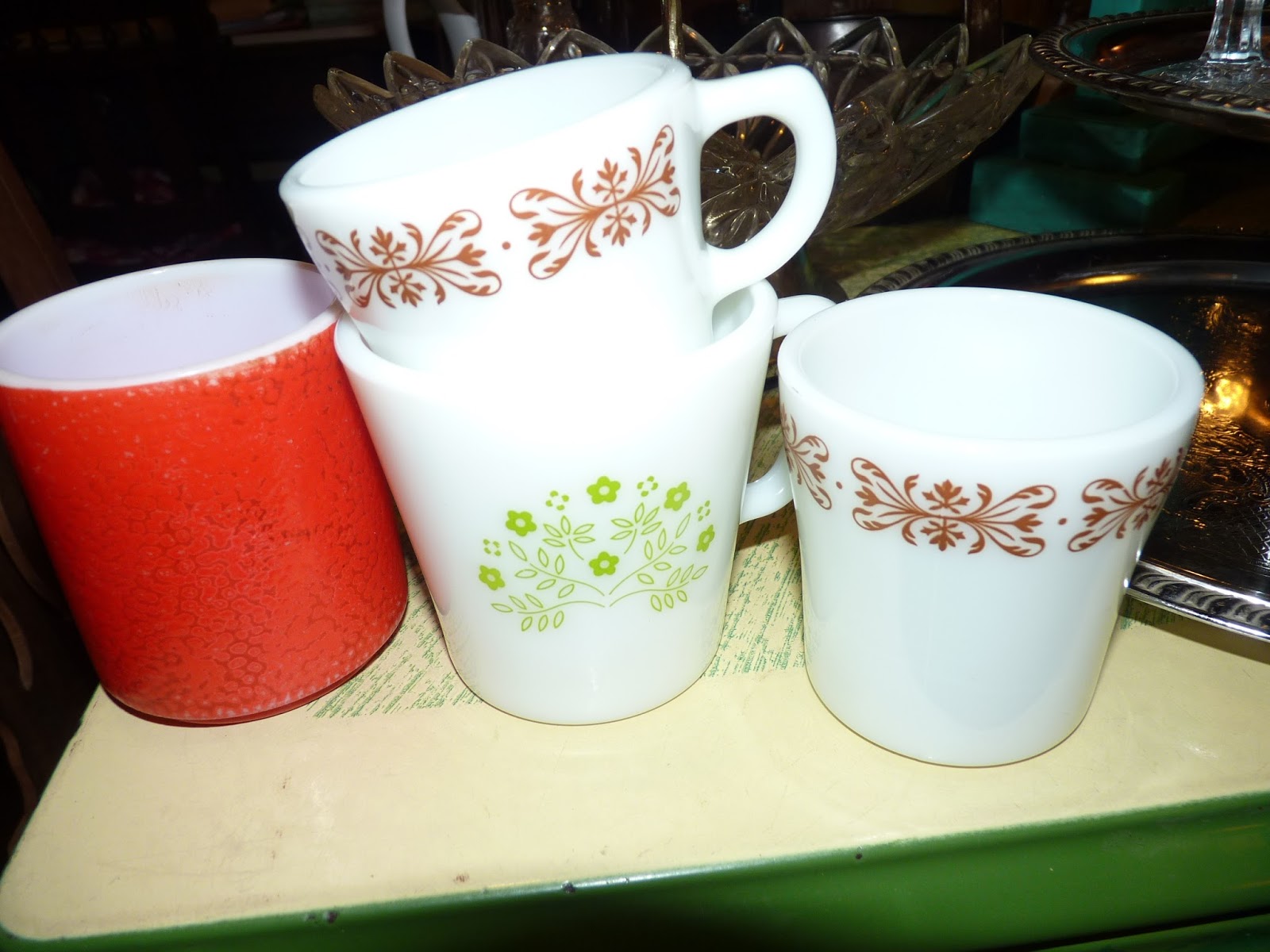
Mugs ad mugs...Pyrex and probably a red Hazel Atlas or maybe Federal.


Another old compote and two Prescut shakers.


I haven't identified the pattern of the compote yet, but my gut says this one could be as old as 1870's, judging by the glass.


This clock was actually a metallic color, but I painted it and added some antiquing glaze. I like it a lot better this way. It's heading to a booth.


I'm thinking of painting this two tier metal basket a persimmon color, and antiquing it. What do you think? It would certainly give it an autumn look.


This chrome tidbit tray and small wineglasses were all very dirty but cleaned up well. The glasses are quite old pattern glass, late 1800's, but I haven't had time to ID them yet.


I was on my way to my sister's house before we left for Ireland when I passed a yard sale that had this huge basket out by the road. It came home with me, but it will be headed to a booth soon.

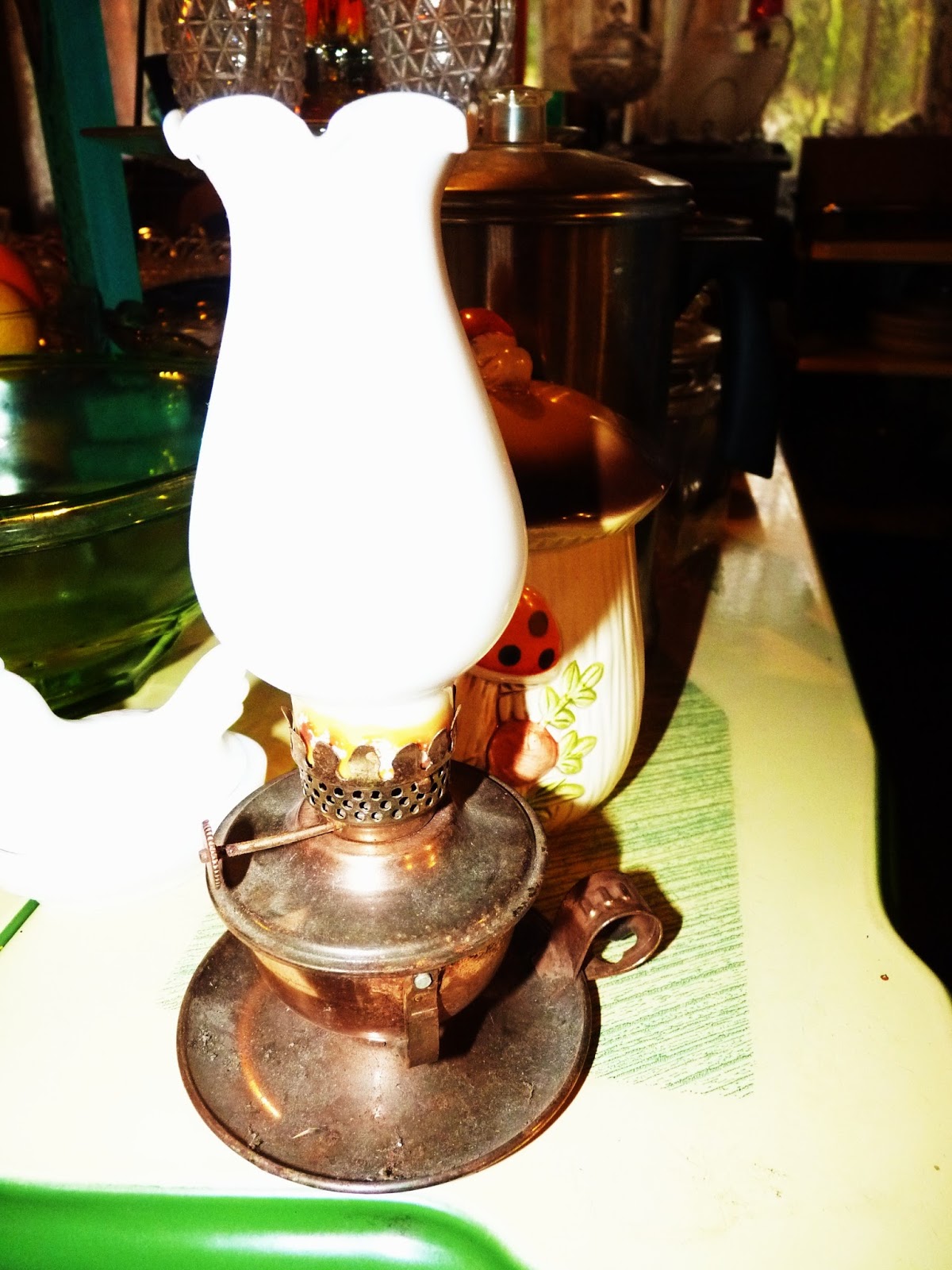
Little copper oil lamp needed a shade, and I just happened to have a milk glass one on hand.


Cute magazine rack was only $3 but it needs a bottom in it.


These were incredibly cheap finds at a charity shop.


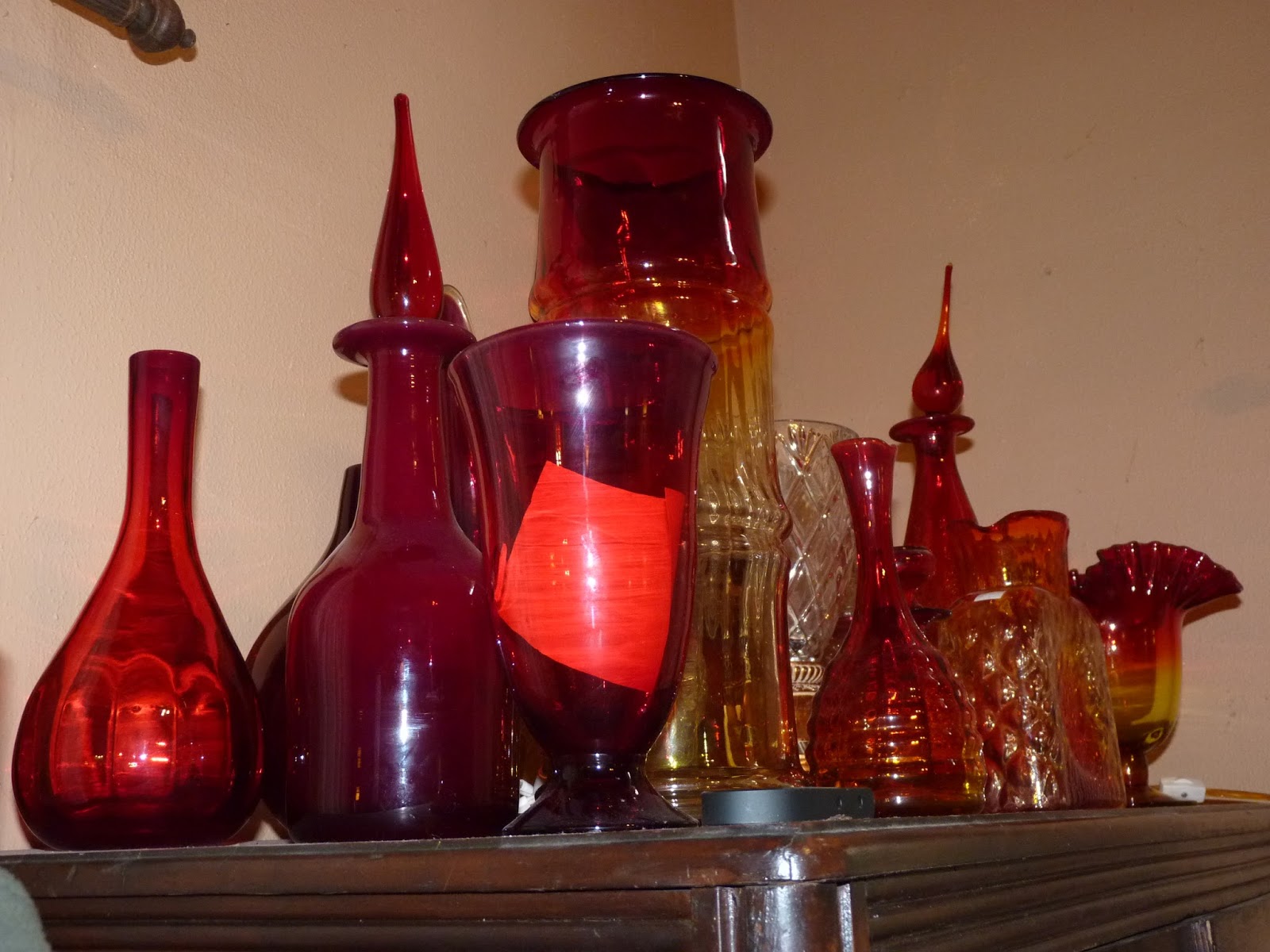
My Blenko collection continues to grow. I desperately need a place to display it. The odd-shaped one in the center was a real find, a rare piece from the early 60's. The tall green one on the right was one that I passed up originally but couldn't get it out of my mind so I called the mall to hold it for me. I am not 100% sure it is Blenko, but I'm fairly certain it is a piece from around 1980.


More Blenko and a few pieces by other makers. I would love to have a glass display case for these. Maybe one day. The tangerine (like the amberina of other glassmakers) is my favorite of the Blenko colors but I am finding myself drawn more and more to the greens and blues.


That's a bit of what we've found lately. Now to pack it all away and get the furniture fixed up to sell. The fun part is over--now the work begins!

Copyright Susanna Holstein. All rights reserved. No Republication or Redistribution Allowed without attribution to Susanna Holstein.
Related Posts Plugin for WordPress, Blogger...