Pages

Showing posts with label Grand Ronde. Show all posts

Sunday, July 26, 2015

In the Pacific Northwest: The Veterans Powwow

The day of the powwow arrived. The new powwow grounds with the arbor built of trees from the reservations' timberlands was ready. 
 All was quiet when we visited the day before the powwow, but vendors were already setting up and workers were busy getting everything set up. The center pole was stunning; the wires will support an awning that can be used when the weather is very hot, or if it is raining. It was not needed for this inaugural event in the new facility.


The entranceway, with Larry checking it out.

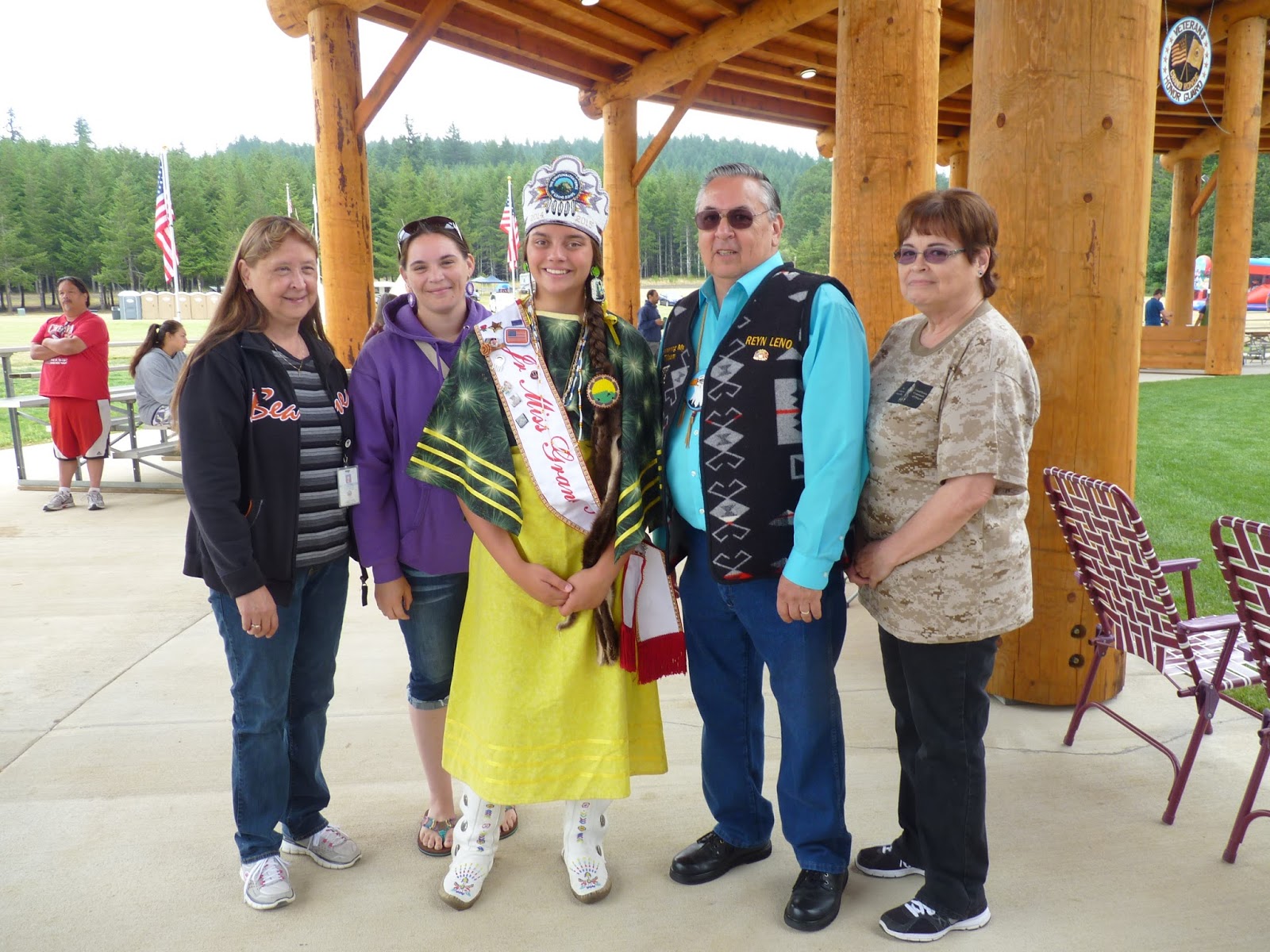
Junior Miss Grand Ronde Ayanna, Reyn's niece, with other family members.


Reyn making a welcoming speech.


Ready to begin! These photos are a composite of Friday night and Saturday events, followed by a video of Saturday's grand entrance.

The eagle staff was stunning.


Larry marching with the other veterans. I think those guys enjoyed this!


Dancers followed the veterans.


Larry and Reyn. Ayanna is dancing in the above photo.


Posing with royalty:

 Grass dancers enter the arena. These are dancers in the prairie tradition, as I understand it. Very colorful, with intricate moves.


And then the Grand Entrance! This video is 7 minutes long and really captures the excitement of the powwow.


Copyright Susanna Holstein. All rights reserved. No Republication or Redistribution Allowed without attribution to Susanna Holstein.

Thursday, July 23, 2015

In the Pacific Northwest, Day 3--Into the Forest

The Grand Ronde tribe owns about 10,000 acres now, and much of the land is in timber. Timbering was the main source of income for the tribe prior to the building of the casino and remains an important part of their economy. Reyn is a retired logger and his son Shonn formerly worked as a forester in the tribe's forests so we had two well-informed guides for our trip.

The green is as intense and lush as many parts of West Virginia, although the species of trees are quite different. I saw no oaks, hickory, or black walnut that are abundant on the easy coast. Here, the primary trees are evergreens, with a mixture of other trees I did not know. I did spot a few maples, but not much else that was familiar. Ferns covered the ground in many places, and blackberries were thick along the roadsides.


We passed by a campground and Shonn told us that when he worked in the forest they developed some walking trails as well. Land management practices in this forest include such things as stream clearing,

I was amazed at Old Tree, one of two very large fir trees on the reservation.


My camera was unequal to the task of capturing the size of this giant!


On a distant mountain a logging operation was in full swing.


We soon came upon a replanted area that had been previously timbered. Grand Ronde's timbering regulations require loggers to replant 4 trees for every tree that is cut. Trees are later thinned to remove any unhealthy specimens or those that are too close together. Loggers are also required to leave "snag trees" for the woodpeckers and to leave "bird trees" every so far apart to assure that birds can safely fly the distance from one tall tree to another.


A re-forested area, with some snag trees and bird trees standing.


We drove for miles on one-lane gravel roads through beautiful forests and occasional logged or replanted areas. As we were driving through one ares we saw something big coming.


It was an awfully skinny road to be meeting this thing!


But we passed by safely with his load high in the air. These logs are actually bigger than most of what is in demand for timber today. We saw one log truck carrying only 3 BIG logs and Shonn and Reyn noted that it was rare, and probably for some special order.


Later in the day Larry and I stopped at a little pull-off area along a pave road. I was intrigued by the deep green ravine and wanted a closer look.


I especially wanted to look at the moss on the trees, which we had seen earlier in the timberlands. Reyn told us that this moss is collected and used by florists. It hangs thick in the moister areas.


The sound of water on rocks caught my ear, and I went down a short path to find this little waterfall.


So pretty, so green, so inviting.


I learned a lot this day, and I came away with a healthy respect for the careful management of the land and the timber resources. This is a renewable resource, and will continue to provide jobs and revenue for Grand Ronde for a long, long time.

Copyright Susanna Holstein. All rights reserved. No Republication or Redistribution Allowed without attribution to Susanna Holstein.

Saturday, July 18, 2015

In the Pacific Northwest: On the Reservation:

But I will start with a photo that was from our flight to Oregon--a gorgeous view of Mount Hood as the plane was circling for a landing. I took this with my cell phone. What a sight! Can you imagine seeing this every day?


On our second day in Oregon, Reyn picked us up around noon and we headed out to tour the Grand Ronde Reservation.

First stop was the tribal cemetery. This was the land they were left when the tribal status was taken away.


Nearby is the memorial to veterans:


Money for the memorial was raised through fund-raising efforts like spaghetti dinners and so on. It took 6 years to raise the amount needed. Members of the tribe posed for the sculpture.


Each column in the memorial is dedicated to one branch of the military.

 It is moving to see such monuments, and particularly here, where those who served were once considered not citizens, then not Indians, and then finally Indians again.


Next stop was the Tribal Governance Center. Reyn's wife had driven their 1955 Chevy to work, and of course we stopped to check it out. Our grandson Jared, who recently moved to Portland, was with us for this day's tour, and that's him in the photo below.


Men and engines--what is it that makes the attraction so strong?


This car is as pretty under the hood as it it on the outside! The interior was immaculate too.


Inside the governance center's Tribal Council's chamber, Reyn showed us copies of the various treaties that were signed with the tribes that make up the Confederated Tribes of Grand Ronde.


Inside the Governance Center:


Three flags: The Grande Ronde flag, the Oregon flag, and the US flag, fly over the governance center.


Not far away is the Wellness Center,


which offers health and dental services as well as mental health services. A new building next to this one will combine human resources, training, and job services in one location. Also on the reservation is the housing office and the Education Center. At the time of our visit, children were attending summer programs that were offered for all children in grades pre-K through 12.

We also toured the housing available to tribal members. Options included low-income and senior housing as well as typical middle-class homes. Everywhere we noted how neat and well-maintained the homes, buildings and grounds were. I did not take any photos as these were private homes and I did not want to intrude on that privacy.

I was curious about the community gardens after someone mentioned them to me, so Reyn took us by.


These are new this year and include a greenhouse, chickens and raised bed vegetable plots.


Work is all-volunteer. New berry vines and bushes were in the ground, and the strawberries were already ripening. We ate several--incredibly sweet and full of flavor, but then Oregon is noted for its fine strawberries. I hope no one misses the ones we snacked on! Too delicious for words.


Later we visited the new powwow grounds and arbor:


More about that, and our trip through the tribe's timberlands, in my next post!


Copyright Susanna Holstein. All rights reserved. No Republication or Redistribution Allowed without attribution to Susanna Holstein.

Tuesday, July 14, 2015

In the Pacific Northwest: Day One

We looked forward to this trip for nine months. Finally the day came for our flight to Oregon!

This is part 2 of the story that began last year. A Facebook message saying "I think my Dad served with your husband in Vietnam" led to the reunion last fall of Larry with Reyn Leno, the friend who was his closest buddy in the Vietnam jungles. They got together for the first time in 44 years last November, and Reyn invited us to Oregon to meet his family and to attend his tribe's (the Confederated Tribes of Grand Ronde) annual Veterans Powwow.

We began planning almost immediately. Neither of us had ever been to Oregon; neither of us had ever been to a powwow or visited a reservation either. And we really wanted to meet the family of this man who was as close as a brother to my husband for almost a year when they were both 19.

The Grand Ronde tribe owns Spirit Mountain Casino and Lodge, and that is where we stayed during our visit. The Lodge was lovely and comfortable, built of natural materials and decorated with earthy colors so it fit well into its surroundings. It included a hallway museum that provided a good overview of the history of Grand Ronde with many pictures, videos and artwork.

Coyote, the gambler, greets visitors in the lodge's lobby:


One trickster to another!


Just a small part of the photo gallery:


Videos explain tribal culture,


and also tribal history. Larry's friend Reyn and Reyn's father were two of the speakers on the videos:


This tribe, we learned, was made up of many bands that were forced together onto the reservation at Grand Ronde in the 1850's through a series of treaties. Out of necessity they developed a common language, since they all had their own languages. The common language is Chinuk Wawa, also called Chinuk jargon, and is still taught in the tribal schools today.


Although life on the reservation was hard, a worse blow struck in 1954 when the US Government told the tribe they were no longer Indians. All 60,000 acres of their reservation, which was covered in virgin timber, was taken away except for their cemetery, and the people were left with no place to go. They stayed together in the area around the cemetery because they had nowhere else, and life was rough indeed. Most worked in the timber, or traveled to California in the summer to pick fruits and vegetables in the commercial fields there. This was the life Reyn knew growing up in the 50's and 60's prior to enlisting in the US Marines.

In 1973 a dedicated group of tribal members began to fight for the restoration of their status as Indians. A key point in their favor, and the pivotal part of their argument, was that by recognizing the tribal burial ground the government had recognized that this was a tribe. In 1983, after years of negotiations and struggle, tribal status was restored and 10,000 of the original 60,000-acre reservation was returned to the Grand Ronde people. I can only imagination the joyful celebration that must have followed that announcement!

Today the tribe is thriving. They provide free medical and dental care, mental health services, housing on the reservation, education programs and training opportunities, scholarships for continuing education, cultural programming and outreach and much more. Some, like Reyn, live off the reservation but are still covered by the services offered by their tribe. Reyn currently serves as Chairman of the Tribal Council, the Governing Body of the Tribe.

I will have many more photos and stories from our week in Oregon, so stay tuned! For more about the Grand Ronde's history and culture, check out this online audiovisual guide.

Copyright Susanna Holstein. All rights reserved. No Republication or Redistribution Allowed without attribution to Susanna Holstein.
Related Posts Plugin for WordPress, Blogger...