I have wanted to visit Newgrange ever since I listened to Frank Delaney's book, The Last Storyteller. It tells the history of Ireland through the voice of an old storyteller. Fascinating listening, particularly since it was read by the author.
So, Newgrange. Again, we were on that day tour with the guide who was a nice lady and certainly worked hard to keep us entertained, but for a place like this I wanted quiet and time to feel and listen. I managed to grab a few minutes and came away satisfied. If ever I get back to Newgrange I will go on my own, without a tour, and be there very early in the morning.
We
were met at the tomb by one of Newgrange's own tour guides, Philip. He was
knowledgeable and courteous, even when he explained that we could not take
photos inside the tomb. This was very disappointing to those of us who had
traveled a long way to see it and might never get back again. I question the
reasons for this, as surely photography would not damage those ancient stones.
I suppose it is income-related--they want to protect the copyright/ownership of
any photography of Newgrange as much as possible, and not allowing photos means
people have to come there to see it. Which leaves out a lot of people who may
never have the means to do so
The
entrance to Newgrange. It is a magical place. I was a disappointed, however, to learn that the exterior was actually a recreation of the site
based on the research of one particular scientist, archeologist Michael
O'Kelley. Many scientists have disputed his arrangement and design because the technology to erect such a structure was not available in 3200 BC when Newgrange was probably built. I have to agree. I think it looks entirely too neat and modern.
I believe, as the scientists who worked on the nearby Knowth mound do, that the stones were likely some sort of paving around the entrance. Knowth mound is not yet open to tourists on the inside, but work has been done on its exterior and the stones on that site are used as a sort of terrace around the mound.
The stones used at Newgrange were all original to the site, which is pretty amazing when one considers the sheer number of them. The mound was discovered in 1699 by a landowner who had noticed a large amount of stone in the
area and had ordered his workers to dig up the stone to be used for another
purpose. The workers, however, found the stone entryway and alerted the owner,
Mr. Campbell. Soon after a historian from Dublin visited the site. Found in the
tomb were things like beads, animal bones, pieces of glass and 2 human
skeletons.
Many of the stones have carvings in them that were done with stone implements.
This large stone is at the entrance.
Don't you wonder about those symbols, and what they meant? Were they simply art for art's sake, or were they a map of the area, or did they have some religious/spiritual/superstitious or ceremonial significance? Did it signify the placement of various tribes during winter solstice, and the "eternity" spirals a path to march or dance on that date?
It's another topic scholars disagree about, but I am content to think that the carvers were simply creating beauty--the image of a Stone Age man (or woman) sitting at this beautiful spot, stone tools in hand, and simply creating a design that pleased them makes me happy.
Then there are the large standing stones,
these concrete markers that note the site of some other structure,
more stones marking...what?...
...and in the distance, the smaller mound of Dowth. Certainly this Boyne River Valley was a place of importance to bygone cultures.
But the valley, its cattle and sheep, clouds and green,
and the peaceful River Boyne are keeping that secret to themselves.
Copyright Susanna Holstein. All rights reserved. No Republication or Redistribution Allowed without attribution to Susanna Holstein.
While I enjoyed the scenery and sights of Ireland during our travels, the people we met intrigued me even more. There was the lady at the Limerick train station, for example.
She was a homey body, probably 10 years younger than me, and she was waiting for the train with her daughter and granddaughter. A man walked up and sort of butted into line, but none of us minded, since the train wasn't going to leave any time soon.
The man also crowded into our conversation. I would have almost sworn he was trying to make time with the daughter or the mother, but neither gave him much room for it.
"My wife took up with a f-------- younger guy. Twenty-seven years we were married! I go home and the door's locked so I kicked it in and there he was. Well, Im moving to London and never coming back, that I can tell you." He puffed his cigar defiantly, but when none of us reacted he moved away. I was glad to see him go to tell the truth. He was more than a bit full of himself, and probably full of something else too.
The mother laughed and shrugged her shoulders. "He's a right one, isn't he? Doesn't know how to talk around young people or ladies either." She smiled. "I was married long enough to have eight children. Right after the last one was born my husband left and I said, 'Quick, shut the door and lock it!' I've done better without him, and that's the truth. We've done better without him and his drinking and all such, haven't we?" She laughed and her daughter smiled and nodded.
"It must have been hard, though," I said, "to get by."
"Oh well, we've always managed and had enough. The peace was worth it, and I've eight lovely children and now two grandchildren." She smiled, and I thought, yes, she looks content.
Then there was the boy on the ferry to Inisheer.
"I grew up in Michigan, but live in California now. I went to college there, and got a job so I stayed. It was a good job, but I was getting bored. So I quit the job to take a month off to travel in Europe. I'm staying in hostels and backpacking my way around. It's been amazing."
"But," I asked, "aren't you worried about finding another job?"
"I design apps for smartphones," he said, "and the demand is crazy. I don't have to look for a job; I just have to pick on. And I designed an app on my own that I'm getting patented. My girlfriend didn't mind me taking this trip, and my parents are happy because they never got to do this. It's like a dream I always had, and now I'm doing it!" And he leaned over the rail, the wind lifting his hair and the water shining in his eyes.
At the Cliffs of Moher a family laughed as a man struggled to push an elderly lady in a wheelchair up the steep "wheelchair-accessible" path. He backed off and took a run with her, to much laughter from the rest of his group. "For God's sake," one of the women shouted, "if you're going to go over the cliff with her at least throw us the van keys first!"
Our bus driver on that trip was talking about all the building that had happened during the time of the boom when Ireland was considered the Celtic Tiger of the stock markets. "And then," he explained, "the economy went all pear-shaped." Pretty descriptive way of saying it bottomed out, I thought.
On the public bus from Adare back to Limerick, I sat beside a young man who looked Middle Eastern but turned out to have been born in England. We got to talking and he said that he traveled once a month from Birmingham, England to Adare to see his girlfriend and his son. "It takes 12 hours by bus, but it's worth it to see my boy. I want to move here, or get her to move back to Birmingham but Adare is her home. Birmingham is my home, and my job's there. I miss my son, so I make this trip to see him. He's only three."
Then there was the lady who ran a small souvenir shop at Newgrange Farm where we had lunch on our last day in Ireland. "I have a daughter who lives in Charlottesville, Virginia," she told us. "I used to go visit her quite often, lovely place it is. But now I have the cancer, you see, so I can't travel like I used to what with the treatments and all. So I just work in this little shop. I was born in Canada, got married during the war to a lad from Dublin. We moved there after the war, and then here to Newgrange. I'll not go anywhere else. I love it here; they'll have to carry me out in a box."
As we sat in a shop drinking tea in the Amsterdam airport for the second leg of our flight, a woman sat down beside us. "I live in Caracao, just coming home to Scotland to visit family. I love it on the island but you know, have to come see Mum and Dad. My family is all in the same little village, so when I come home it's a constant round of tea and cakes. I learned to tell them I could only come to visit in the evenings, and that way I get wine and no cake!"
On the first leg of the trip home, from Dublin to Amsterdam, a well-dressed man shared the seat beside me. He was busy with some papers so we did not talk until just before the plane landed. As it turned out he was an architect, going to a meeting to plan the remodeling of a medical library to include something he called "book bots." This is, he explained, a book delivery system that basically uses robotics. Much less space is need for shelves because the books can be stored in a more compact area, leaving more space for students to study. He thought electronic books were making huge inroads in library collections, especially in specialized fields like medicine, because of the rapidly changing information of our times.
Then there was John Folan. We were on the bus, leaving Galway to go back to Dublin. Neither of us wanted to go; there was so much we did not see in county Galway. An elderly man sat on the seat by me and I said good morning to him. He returned the greeting and said, "I was just singing a bit there as I waited for the bus."
"You were? What were you singing?" I asked.
"My Cavan Girl. Would you like me to sing it for you?" Would I! So we rode through the early morning streets of Galway, listening to John singing a song of young love and determination. Absolutely beautiful.
"I'm 80 years old," he said. "I've no wife or children. I lost my wife, and she was expecting our child. I learned that prayer is the only healing for great loss.But I love to sing. There's too much doom and gloom in the world today. Singing keeps me young, you see." Then, on learning that I was from West Virginia, he sang Country Roads for me, and then another tune whose title I cannot recall. It was the most enjoyable bus ride I've ever taken. And I am sad that I did not get his contact information so I could stay in touch with this gentle man. You can hear John singing here on this youtube video:
Copyright Susanna Holstein. All rights reserved. No Republication or Redistribution Allowed without attribution to Susanna Holstein.
Our last full day in Ireland, and we had plans: a tour to the Hill of Tara and Newgrange.
We booked a tour through the tour company Mary Gibbons. We had had good luck up to this point with the two other tours we'd taken to Adare Castle and the Aran Islands, so we were really looking forward to this one. I have to say that of the three, this was my least favorite. We started out by driving out of Dublin while the guide gave us a long talk about Irish healthcare. While it might have interested some on the bus, I'd much rather have heard some history of the places we were passing.
We arrived at Tara, and the views were just stunning. As usual, I hung back, trying to take photos without tourists in them--which means I sometimes miss what the guide in saying. But in my book, it's better to experience the place by feeling and being than by being herded along.
No explanation was given of this monument, but its lonely simplicity drew me and my camera.
And then, there was the hill, just ahead of us, with its monolith monument.
I had to turn and just look around...here, the green of Ireland was well displayed.
On our way to the hill we passed a small passage mound. The guide hustled us by, but I hung back to look at it, and a man who was walking his dog on the hill stopped. "You know," he said, "there is a carving on that rock, similar to Newgrange. You can see it just there. Some believe it is a diagram of this place."
And yes, there is was. Enlarge this photo and you should be able to see it too. This spot held me for some time, thinking about its past, the people who built it and carved the stones.
I could not resist the view to the east. Incredibly green!
Finally we arrived at the stone on top of the hill. Legend has it that those descended from kingly lines will feel something when they touch this stone. Apparently I am peasant stock, for I felt nothing! I tried to get a sense of this place, of the crownings of kings that took place here, but could feel no connection. Odd, since all through our trip the places we went touched me very much. Here, nothing. Perhaps I was just tired and overloaded. Or maybe there's not a drop of royal blood in me.
A short distance from the hill is the Fairy Tree. Tie a bit of ribbon or cloth to the tree, and make a wish, so the legend goes. This is a hawthorn, actually. I had no ribbon, but did tie a bit of dried grass to the tree. Organic and biodegradable!
On the hill is a small church and cemetery. If our guide told us about it I don't recall, but we wandered over to see it.
We made it back to the bus, and then it was onward to Newgrange.
Copyright Susanna Holstein. All rights reserved. No Republication or Redistribution Allowed without attribution to Susanna Holstein.
I didn't have these in the right place to add them to yesterday's post, so they get a post all of their own.
Those who know me know that I am not a city person, but for a countrywoman like me, a visit to a large city is filled with fascinating things to see. I suppose if I lived in a city I would worry about crime, litter, homeless, traffic, and so on, but as a visitor these things do not capture my attention--I know they exist and are real problems, but there is so much beauty that enthralls me.
So, here are the last (I promise!) of my Dublin photos:
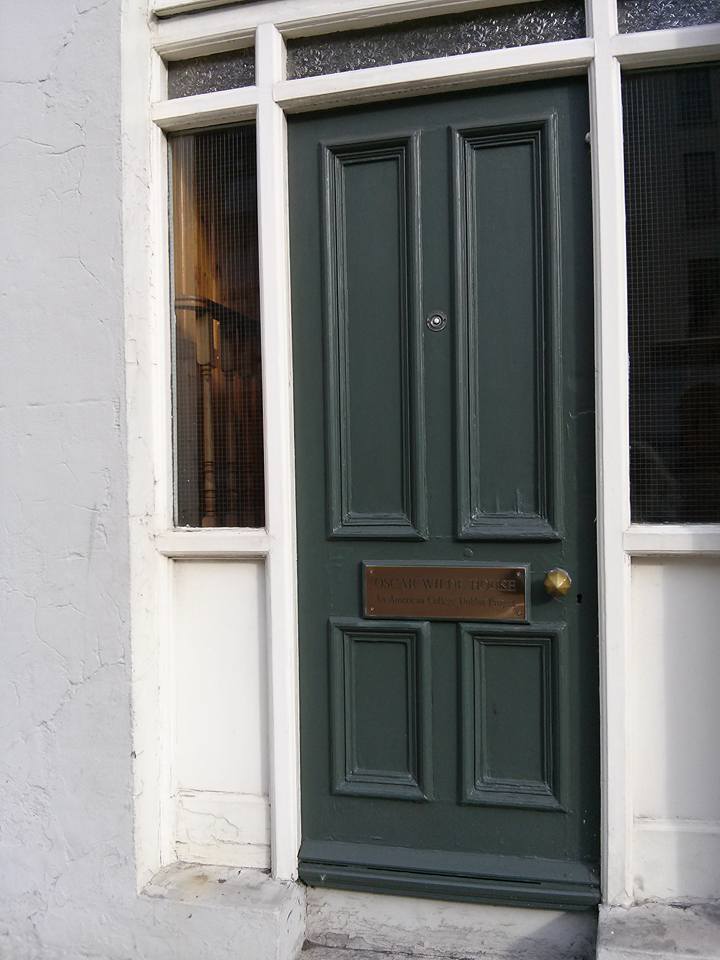
First is Number One Merrion Square, the childhood home of Oscar Wilde. I just read a brief bio of his mother, who used the pen name Speranza for her poetry, last night in the book Wild Irish Women, and it was clear where he got his abilities from. I didn't realize we were in his neighborhood until I saw the plate on the door--hard to read here.
Our hotel in Merrion Square, the O'Callaghan-Davenport Hotel. This was a fine place to stay--beautiful, with excellent, friendly staff and comfortable rooms. This was the place where they prepared a breakfast (for free, since it came with the room!) at 2:30 in the morning before we were to fly out. We came down to find hot tea and coffee, oatmeal, toast, yogurt, jams, fresh fruit and juice all waiting for us--and our taxi called for and at the door. That's service.
The interior was elegant, and my photos do not do it justice.
I took many of these photos during my walk with Leo--I believe I caught his head in this one! I was snapping fast with my phone so they won't be the best quality.
This is one of those sidewalk grates I referred to in my last post. This is glass and cast iron, and the glass looked like it was an inch thick. These light the underground storage areas of the buildings along the streets.
The annual sidewalk art show was in progress on this day. Paintings were lined along at least two of Dublin's public parks, this one at Merrion Square Park.
Busy, busy streets at an hour of the day. As you can see, it had recently showered but that doesn't slow down pedestrian traffic in Dublin.
One of the many beautiful buildings, former homes converted to shops and flats.
This storefront was awesome!
A former gentlemen's club was once housed in this building, and Leo pointed out the figures on the columns--this one is of a turtle, I believe, playing a fiddle, and there is a mouse up to something as well. Another was frogs playing cards. I would not have noticed these on my own.
A gelatto shop, with bright, fun lights.
Earlier Theresa and I window-shopped at this all-Ireland store. Crystal, oh my! Both of us love the sparkly things.
This place made us laugh--it really is a shop full of doorknobs and door knockers, though.
There are many ways to get around in Ireland. These tourists were on a foot-pedal bus. They were singing and laughing and made me want to jump on board with them.
Then there are the trains--fast, comfortable and an easy way to get almost anywhere in the country.
Of course, you can always go traditional and take a horse and carriage ride, or a double-decker bus,
or travel by bicycle,
Or take LUAS, the citywide tram system. That and bikes were about the only ways we did not try during our stay.
I'll finish with this quick video of a street band, playing on a Sunday night on the crowded O'Connell Street.
As I said, it's a busy, fascinating city. Tiring too, for a country mouse like me, but I would go again in a minute.
Copyright Susanna Holstein. All rights reserved. No Republication or Redistribution Allowed without attribution to Susanna Holstein.
After our time in Galway, we took the train back to Dublin. We really hated to leave, and I do hope to go back next year to see more of Galway, county Clare, and perhaps get to Dingle and Connemara, and the village of Roundstone where one of my all-time favorite movies, The Matchmaker was filmed.
Last trip to Ireland in 2013, Larry and I met Leo East, who stopped to help us as we were puzzling over a map. That chance meeting led to me being able to connect Leo with his old schoolmate Rob who now lives in The Netherlands. Life has some unexpected twists, doesn't it? On this trip, Rob encouraged me to call Leo, so I did.
Leo came to Dublin to meet up with me and took me for a fascinating three-hour walk around the city. He pointed out many sites of interest, told stories and was just altogether a delight to get to know better. I hope I see him again on my next trip. He is a walking encyclopedia of Irish history.
For example, the lovely houses in Merrion Square where our hotel was located: According to Leo, they were built for members of the Irish Parliament when it met in Dublin. A beautiful private park in Merrion Square was developed just for these members of the ruling class, a place for nannies to take children to walk and play. Then, when the Irish Parliament moved from Dublin Castle to London, most of the gentry vacated their Georgian homes and moved to London too,a transition that began around 1800. The empty houses were taken over by Irish who had been living in the poorest of circumstances because of the British Penal Laws enacted against Catholics. They moved their livestock into the back yards, and sometimes as many as 20 families lived in one house (these homes were three or four floors tall, so there was a good bit of room in them, but still it would have been pretty crowded). Conditions in Dublin became pretty squalid as the city's wealth and prosperity disappeared with the gentry. But over the years the homes have been restored for the most part, often housing businesses on the bottom floors and housing above.
And there were these heavy glass grates, almost like manhole covers, but rectangular instead of round, that I kept seeing in the sidewalks. I knew the glass was old because it was turning purple, a sign of glass made prior to 1914. Leo explained that these were skylights in underground storerooms that often ran out under the streets. The glass panels provided light in these places at a time when electricity was not available.
There was much more that he told me and I wish I'd had a recorder with me because I cannot remember it all. Next time, I'll at least have a notebook to jot it down!
It was such a pleasure to see Leo again. What a guy. We finally said good night, and Theresa and I headed off to bed to be ready for our trip the next day to the Hill of Tara and Newgrange.
Copyright Susanna Holstein. All rights reserved. No Republication or Redistribution Allowed without attribution to Susanna Holstein.
Not really cliffs in this first photo! We stopped for a late lunch at a pub in Doolin. The tables were made from the bases of treadle sewing machines! I had to get a quick picture of them. The food here was delicious, and so welcome after our trip on the ferry. Tea, sandwiches, soup, and a tot of Jameson's set me up just right.
Looking west,
towards the Aran Islands.
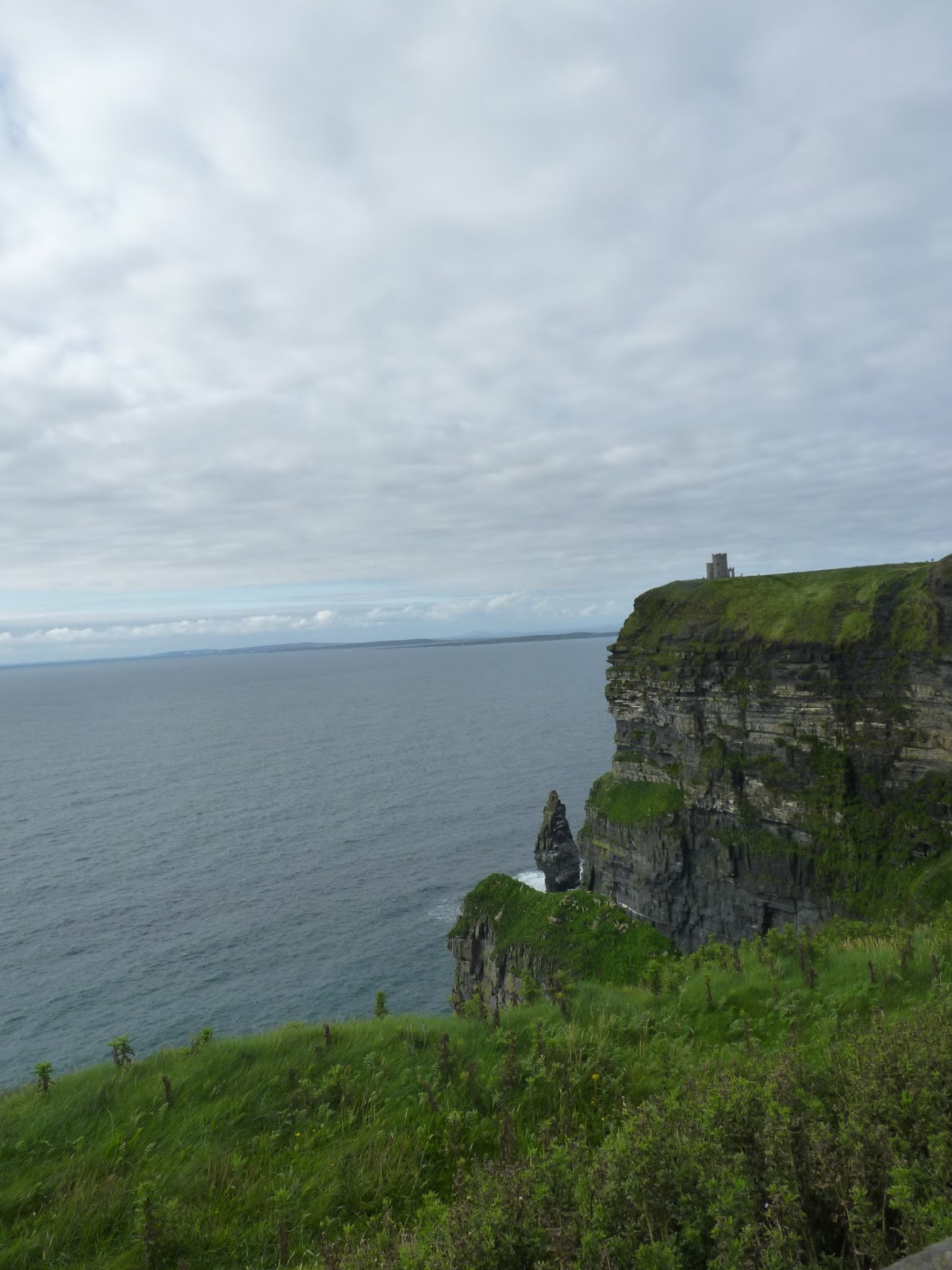
O'Brien's Tower. O'Brien seemed to be the name on a lot of places in this region, and I came home with a macabre story about the wife of one of them. More about her in a later post, I hope.
Looking north, I believe.
The light changed again, and the water looked more gray and stormy.
The sentinel rock I showed in my last post, far below O'Brien's Tower.
And then we were off again to take the Wild Atlantic Way back to Galway.
Copyright Susanna Holstein. All rights reserved. No Republication or Redistribution Allowed without attribution to Susanna Holstein.