Pages

Showing posts with label Limerick. Show all posts

Wednesday, September 16, 2015

Last of Limerick

Can you tell that I liked the time we spent in Limerick? Perhaps because this city did not seem quite as tourist-y as Dublin and Galway so we could see just life as usual as we rambled about.

But first a few leftovers I missed putting into the King John's Castle post:

Cannon fodder? That's me, outside of the castle, playing around with the huge cast iron cannons.


This one was inside the castle; the light coming in the window made such intriguing patterns.

And atop the tallest tower, with a rainbow over me. I like that--makes me feel like luck is coming my way.


Limerick is a cathedral city, St. Mary's. I have to admit to being a bit disappointed in this church, probably because we'd seen some pretty awesome ones before this--and then there was a musty, moldy smell that really upset my allergies. The churchyard was beautiful, though, with many old stones.


Founded in 1168, this is the oldest building in the city that is still used daily but the site itself was an ancient Viking meeting place in this part of Limerick known as King's Island. So the site has seen activity for a very long time.
This is not my photo, but from wikipedia. My photos of this church did not come out well.


The churchyard was looking a bit ragged on our visit. Restoration work on the cathedral is ongoing and was in evidence inside with some scaffolds set up, etc.


Inside:

The altar's top is carved from an ancient piece of limestone, 13 feet long. 


Carving inside on the church wall may be the epitaph of a person entombed behind the wall.


One of the tombs in the cathedral, of a young man of noble birth, whose name I have forgotten--and can't read on my photo, sadly.


A dedication plaque to a local woman who maintained the gardens around the cathedral for many years.


And finally, back out on the street. This is the outside wall of the rear of the cathedral.


A fountain, with a legend almost illegible now, that it was installed for the good of all.


A colorful mural on the side of a theater company's building.


A lady peruses goods in a junk shop window.


This is a cast iron covering in the sidewalk, presumably for water lines or something else beneath the streets. I liked that artistic pains were taken with the design of such a utilitarian object.


Down the street from the cathedral was this medieval wall which has been shored up in an attempt to save it. I wonder what the plans are for this wall, and if it was part of the wall around the city?


 More ancient stone walls, probably part of an old church? Set into a niche on this one,


a bright white statue that looked like it might be the Virgin Mary.


We peeked into someone's gate to see what kind of junk they had. Interesting stuff!


 The almost-full moon over our  hotel. Goodnight, and good-bye, Limerick!


Copyright Susanna Holstein. All rights reserved. No Republication or Redistribution Allowed without attribution to Susanna Holstein.

Monday, September 14, 2015

King John's Castle

After our day in Adare and exploring the castle there, we went adventuring in Limerick and found ourselves at the newly restored King John's Castle. Who was King John? He was the youngest son of King Henry II of England and Eleanor of Aquitaine. Born in 1166, he became the favorite of his father and was appointed Lord of Ireland. He later became King of England after the deaths of his four older brothers, ascending the throne after Richard I. He was the signer (and reason for) of the Magna Carta in 1215, just a year before his death, to settle the grievances barons under his rule. John was not, I believe, a popular king. John had this castle restored and added to during his rule, but he never slept here, according to legends that claim that when John came to visit, the current occupant, Walter deLacy, locked the castle and left town, leaving the disliked King to sleep in the fields nearby.


The town was originally called Trim and founded by St. Loman, a nephew of St. Patrick. The castle was known as Trim Castle, and existed even before that as a medieval settlement. Remains of the medieval walls still remain and can be seen beneath the present castle. Limerick was a walled city, and there are also remains of the walls that can be seen throughout the town today.


Heads on spikes? Yes, that was an actual (gulp) practice back in the day. Imagine coming into town with bad intentions and seeing your comrades' heads up on sticks around the entrance! I think I'd go the other way myself. This was the penalty for robbery, and the bodies of 10 headless men found during restoration work in 1971 attests that this practice was a reality. Yuck.


This is inside the actual castle walls. The first fortification was of wood and was burned down in three years; the stone building was then begun. The walls of this castle are 11 feet thick.


The sunken area is the "great hall", the gathering place in the castle. I was somewhat confused by this layout, and there was no guide available when we were there near closing time. It appears that the interior of the castle was filled in over the years or perhaps during restoration but I am not sure about that.


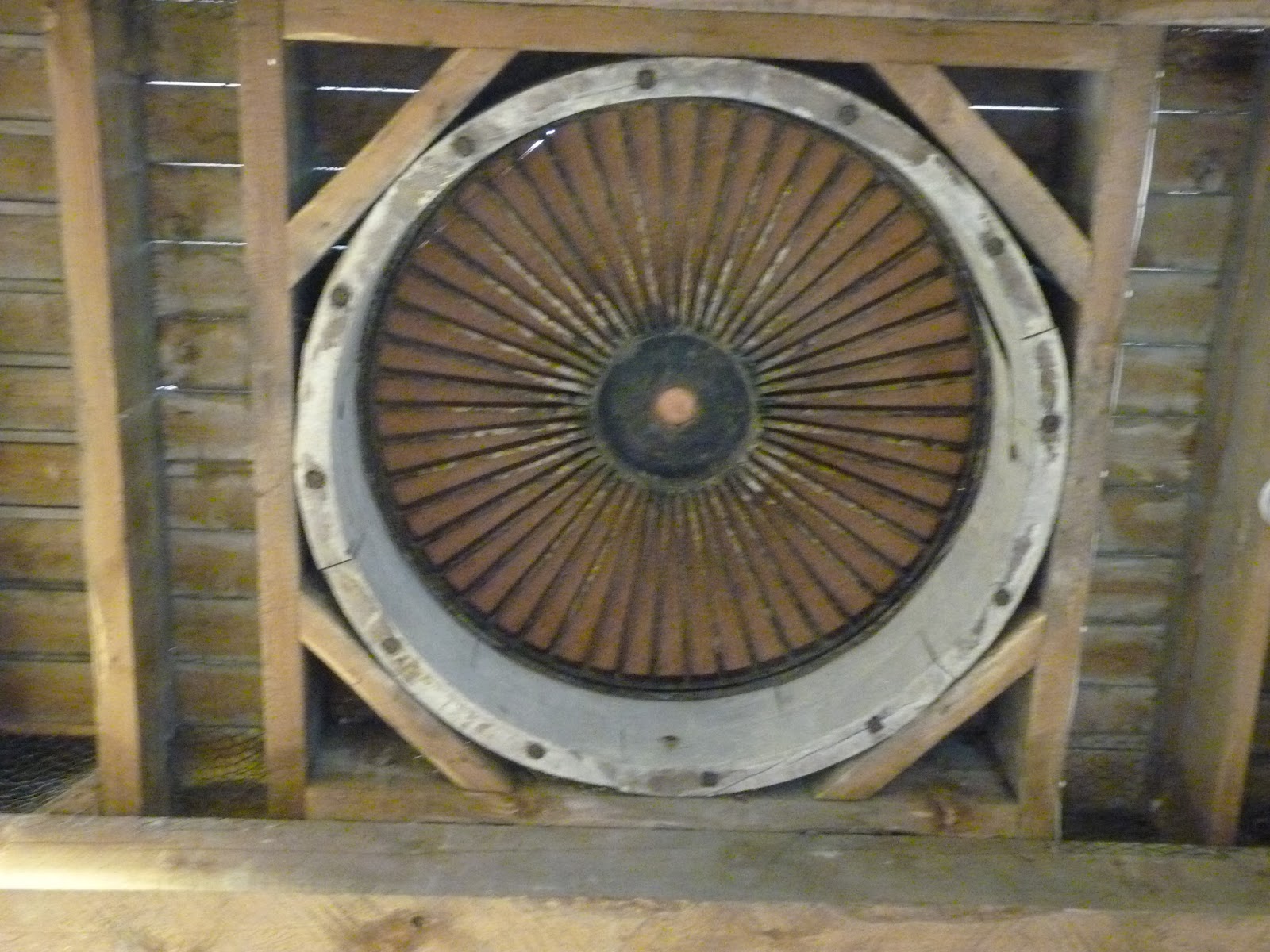
We went up to the top of one tower, which had a lovely view of the city. This photo is looking up into the underside of the roof; a flag is mounted in the center of this circular section.


 Looking at the city from the first tower we ascended.


But there was this other, taller tower. Could we go up there?


Why yes we could! But as you can see, rain was approaching (on the right). The rains came swiftly and left just as swiftly in Limerick--we would no sooner get our hoods and umbrellas up than the shower would be over, leaving behind...


gorgeous rainbows!


Here I am on the approach to the smaller tower.  I was thrilled to find that my vertigo was in abeyance during our trip, so I had no trouble clambering up or down the steps.


Looking down from the tall tower to the shorter one. This tower was ascended by going up some steep circular stairs that had room, just barely, for only one foot at a time.


Theresa on the tall tower. (Isn't my sister pretty?)


The view was stunning from the tower, a 360-degree panorama of the city below. And of rainbows!


Inside the mason's work area in the castle, there was an interactive video that explained his work,


A window that looked for all the world like Batman had burst through it,


and a model of how the castle looked when it was built.


I never did find out what all these chimney were--it looks like they were on a nearby church.


We left the castle as it began to get dark and crossed over the river Shannon. So very beautiful.


Our goal was the Treaty Rock. Although the treaty signed on this rock was intended to protect the rights of Catholics after the English came to rule, the conditions of the treaty were largely ignored, and the Penal Laws that followed caused great hardship for Catholics who were persecuted and forced to practice their religion in secret for 100 years.


It began to rain heavily at this point, but over the river the sun created more rainbows.


It was a long, wet walk back to our hotel, but the flowers along the way brightened our path. And at the hotel, we changed to dry clothes and headed down to the pub for Irish coffees by windows overlooking the river.


It was a long, fascinating day, full of history, stories and, well, rain. But hey, we were in Ireland!

Copyright Susanna Holstein. All rights reserved. No Republication or Redistribution Allowed without attribution to Susanna Holstein.
Related Posts Plugin for WordPress, Blogger...