 One of the first stories I told was a folktale called The Pedlar of Swaffham. I loved that story, and still do. I thought when I first learned it that it was a story about a fictitious town and a fictitious event. Later I learned that the town was real, but I still thought the story was just a folktale and nothing more.
 And then this trip to England came up and when I looked at a map I saw how close we would be to the town of Swaffham. Would my cousins take me there, on a sort of story pilgrimage? Indeed they would. Swaffham, they told me, was a place they used to stop at as children, traveling to the coast with their parents. So why not also go to the coast? I was thrilled; we had wanted to go to Dover to see the site made famous in World War II but that was too far away. Hunstanton, Les said, was where his family often went, and my mother also went there in her childhood. So we planned a day trip to see both places.

 We decided to have tea first, and stopped at a neat little tea shoppe in town, one Les remember stopping at many times with his father.
  I do like the tea shoppes; tea is easier on my stomach than coffee, and often you get a pot of tea instead of just a cup. Better and better.
I had a vague memory of having once seen online a sculpture of the Pedlar. Cousin John did not think there was such a thing, but he did know that in the church there were carvings of a pedlar and his dog. So once more, to the church we went. And what a church it was!


The church was full of people decorating, arranging flowers, cleaning, etc.
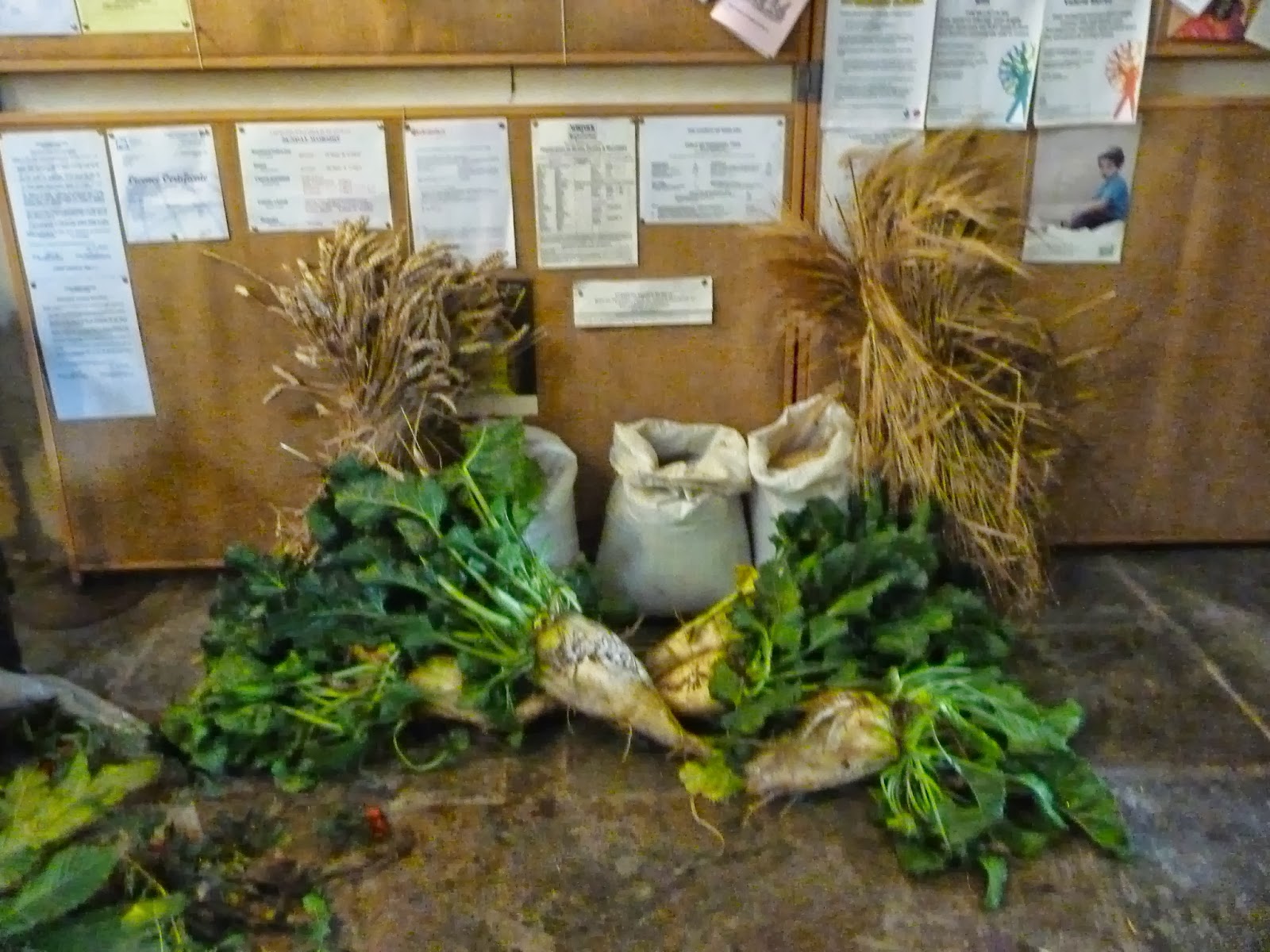 There was an arrangement of wheat, pumpkins and another vegetable that looked like an overgrown white beet. I asked Mrs. Clewes what it was and she told me it was a sugar beet; John said that these are one of the larger crops in the area.

But what about the pedlar? Was he real? We found the carvings; they were ornaments on the end of two pews, beautifully wrought in wood.

John Chapman

and his dog

and the aisle he paid to have restored.

As we were leaving we asked about any other sculptures of the pedlar. Well, said Mrs. Clewes, there was a sign with him on it. Perhaps that was what I was thinking of? We set off in search.
 We found it, and yes, it was what I had seen. I had thought it was a sculpture but when I saw the wood sign, I realized my memory wasfaulty. So, mission accomplished. I had seen Swaffham where the story took place, I now knew that the pedlar's name was John Chapman and that he had had a stall in the market and that this was more than just a tale, this was a legend with some basis in fact. When I came home, I went looking for more information about this fascinating story, and found that the tale is well-documented in many records. So, if you would like to read the story yourself, here is one very good version.
 The bottom line is that John Chapman was a very real person, he was a pedlar, and he did give a large amount of money toward restoration of the church. As to how he came by the money, that is less clear. Personally, I prefer to believe the popular version of the tale. How about you?
Copyright Susanna Holstein. All rights reserved. No Republication or Redistribution Allowed without attribution to Susanna Holstein.

