Pages

Showing posts with label animal folktales. Show all posts

Friday, February 15, 2019

Chick! Chick! Chick! Chicken Lore!


Who would think chickens would have so many superstitions and so much folklore attached to them? But then of course they would. Humans have been keeping chickens for centuries, valuing eggs, meat, feathers and the propensity of chickens to eat bugs and weed seeds.

Exactly how long has our relationship with the fair fowl existed? Wikipedia says that "Genetic studies have pointed to multiple maternal origins in South Asia, Southeast Asia, and East Asia,[4] but with the clade found in the Americas, Europe, the Middle East and Africa originating in the Indian subcontinent. From ancient India, the domesticated chicken spread to Lydia in western Asia Minor, and to Greece by the 5th century BC.[5] Fowl had been known in Egypt since the mid-15th century BC, with the "bird that gives birth every day" having come to Egypt from the land between Syria and Shinar, Babylonia, according to the annals of Thutmose III." (from wikipedia)

According to some research there are over 19 billion chickens in the world today, surely enough to take over the world if they had a mind. Fortunately, chickens have long been said to have a tiny mind--think Chicken Little--and perhaps that is just as well for the rest of us. (The story of Chicken Little was originally called Henny Penny, interestingly enough.)

1916 children's book illustration for Henny Penny. Artist unknown.

Chickens were once regarded as sacred animals, and to mistreat them could bring disaster, as this story notes:

"Cicero wrote about the sacred-chicken-related folly of Publius Claudius Pulcher in 249 B.C. Seeking approval to launch a surprise naval strike he consulted the sacred chickens aboard his ships. The chickens refused to eat, an ill omen for the upcoming battle. Frustrated, he announced, “If they will not eat, let them drink,” and had the birds thrown overboard. His fleet suffered near annihilation during the battle of Drepanium. After returning home from the humiliating defeat, Pulcher was subsequently convicted or exiled and died soon after. Several other ominous portents of the sacred chickens came true, including the Manicus’s defeat by the Numantines in 137 BC and the death of Tiberius Gracchus." From the blog Superstition Saturday.
.
Even today in Key West, chickens are a protected species and it is against the law to kill them, although not illegal to eat them, which seems an odd conundrum.

A rooster roams free near a restaurant where we were eating during a trip to Key West in 2016.

In West Virginia, chickens--roosters in particular--can be weather prognosticators. People say that if a rooster crows before midnight, his head will be wet by morning. If the rooster keeps crowing all day, there will be a hard rain within 12 hours.


Other Appalachian chicken sayings:

It's bad luck to set an even number of eggs.

Thunder will kill baby chicks that are just about to hatch.

To break a setting hen, tie a red ribbon around her neck, with a bow in front on her breast.

If hawks get in your chickens, place a flat rock in your fire grate. the hawks will leave.

If chickens pick their feathers after a rain, it will soon rain again.

A rooster crowing a daybreak will scare off evil spirits and ghosts.

It is unlucky to set a hen in August.

A hen that stands before you and flaps her wings is the sign that good news is on the way.

If you put iodine in the chicks drinking water they won't peck each other.

Thunder will cause a hen to stop laying.

Pennsylvania Dutch lore says that chickens squawking and fluttering about at night means that there will soon be a death in the famiyly. (I am most relieved to report that this is apparently not true of West Virginia chickens, as mine often carry on at night to the point that we go down to check on them, only to find them all looking at us like, "What?" No family deaths ensued after these ruckuses.)

An interesting belief from England says that if a hen lays an egg without a shell, she has been impregnated by the wind, and the egg is called a "wind egg." I have always heard that such eggs (they do happen sometimes, just the egg encased in a membrane with no shell) are laid by hens getting near the end of their laying years.


Some other chicken beliefs from around the world:


If you burn eggshells, the hens will not lay. Which is exactly opposite the practice of many West Virginians who bake the shells and feed them back to the chickens so that they will lay better and their shells will be hard.

In England, pieces of pancake are tossed to chickens and other poultry on Shrove Tuesday. If the rooster eats the pancakes without calling the hens, it's a sign of a poor harvest that year, but if he calls the hens, a good harvest can be expected.

In old Persia, people believed that setting a hen on a cloudy day will cause all her chicks to be black. But if you set her at dark, all the chicks will be pullets.

In France, a piece of iron is put into a setting hen's nest to protect her and her future chicks from lightning.

In Devonshire, England the following was a cure for snakebite: Kill a chicken and put the affected area immediately into the chicken's stomache cavity. Leave it there until the chicken's flash is cold. If the chicken's flesh turns dark, it was a sign that the flesh had absorbed the poison and the person would recover. If the chicken's flesh remained its natural color, it was bad luck for the victim, who probably would not survive the ordeal.

For more chicken history and lore, check out the following:

Smithsonian Magazine: How the Chicken Conquered the World.

Anomaly Info: Facts and Myths: Chickens.

The Cunning Wife: Magical Animls in European Folktales and Lore

Folklore Thursday: Origins of Breaking the Wishbone

Granny Sue's News and Reviews: The Golden Fruit

Granny Sue's News and Reviews: Chicken Riddles


And then there are chicken folktales! Here are ten from all over the world:

The Story of Chicken and Elephant:  from South Sudan

Chicken at the Well: from Africa

Half-Chicken: from Mexico

The Miraculous Hen: from Russia

Mrs. Chory's Chickens: from America

The Hawk and the Hen: from the Philippines

The Hen and Her Chicks: from India

Black Snake and the Eggs: from Africa

The Little Red Hen: from England

The Farmer and the Jackal: from India

Copyright Susanna Holstein. All rights reserved. No Republication or Redistribution Allowed without attribution to Susanna Holstein.

Tuesday, January 31, 2017

Good Old Aesop: The Man and the Snake

Aesop certainly knew how to tell a tale, and how to pinpoint human behavior. This tale, which has been told and re-told in many cultures (some probably even pre-dating Aesop--he got his tales from somewhere, after all!) was mentioned by a storytelling friend recently, and it seems apt for our times.

The Man and the Snake

 A man was out walking one cold winter day when he heard a rustling sound nearby. he investigated and found a snake, curled up near a rock. 

The snake looked up and spoke. "I am about to die. It is too cold for me. Please, put me under your coat and warm me."

"No," said the man. "I know you. If I pick you up, you will bite me, and your bite will kill me."


"No," said the snake. I promise I will not bite you if you will save my life."


Finally the man gave in. He picked up the snake and tucked it into his jacket, where the heat from his body would provide warmth. When he reached his home he walked over to the fireplace and unbuttoned his jacket. As he pulled the snake out the snake struck, sinking its fangs deep into the man's arm.

"What did you do?" the man cried. "Why did you bite me? I saved your life! I trusted you!"

"Ah," said the snake. as the man laid dying on the floor. "Yes, you saved me. But you knew I was a snake when you picked me up."

This story is often told by storytellers as a warning against drugs and other potential addictions and addictive behaviors.

There are many other versions of this story. Here are a half dozen of online sources:

Wikipedia offers a wide variety of versions of the story.

Fables of Aesop includes this story along with many more.

First People website has a Cherokee tale with the same theme.

Storyteller Mike Lockett offers his adaptation of the story on his site.

The venerable Snopes explores a few variants with different creatures in the starring roles. 

There's even a song by Johnny Rivers about this fable:


Copyright Susanna Holstein. All rights reserved. No Republication or Redistribution Allowed without attribution to Susanna Holstein.
Thursday, November 17, 2016

Pigs, Gods, Goddesses and Pig-Faced Women

I'm still talking hog today. After getting started on the topic yesterday I've found even more fascinating lore about the tasty four-legged porker.


For instance, that word porker. Some people believe it was said by sailors instead of pig, because to say "pig" at sea was very bad luck. People also believed that pigs, especially black pigs, were bad luck, and could even become possessed by evil spirits (remember The Amityville Horror?). An often-repeated theme in ghost stories is the sound of hogs grunting under a porch or building. I have heard this several times from people telling me about a haunted house in their area. 

Seeing a black hog was considered to be a sign of portending death. Pigs are often connected in superstitions to darkness, death and general bad luck. Some people believe this is because they have cloven hooves. Pigs are also said to be able to see the wind,although what good that is I don't know, and to be afraid of mirrors.   In the UK, "It is unlucky to have a pig cross your path - turn your back till it is gone - and if it begins to make a rather strange whining noise then there is to be a death in the family." From Whimsy.org

In eastern coastal Africa, people believed that carrying a pig bone in their pocket would ward off bad luck. Boar tusks are considered symbols of manliness and power in some cultures, and in New Guinea, the more pig's teeth a man has on a necklace the wealthy and important he is thought to be. Carrying a boar's tooth in your pocket was believed to prevent or cure toothache in the Ozarks, according to folklorist and collector Vance Randolph; one would carry it a pocket on whichever side the bad tooth was. 

The Irish legend of the Black Pig tells of a mythical black sow with poison skin that went, well, hog-wild. She began eating people and generally terrorizing the countryside. She is supposedly buried under a mound known as The Grave of the Black Pig. More Irish folklore connected to pigs can be found at this excellent blog.


The Welsh have their own tales of mythic boars. For example: "Celtic and Arthurian myth has many stories of boar hunts. In a Welsh tale from the Mabinogion, Culhwch seeks to win the hand of his beloved Olwen. He is clearly keen: Olwen's father, Ysbaddaden, is a forbidding giant who issues Culhwch with a lengthy list of ridiculously difficult tasks to fulfil before he can marry. The final tasks are to cut Ysbaddaden's hair and shave off his beard. The giant's beard was so tough that to soften it Culhwch had to obtain the blood of the Black Witch. And the only thing sharp enough to cut the beard was the tusk of Ysgithyrwn, the wildest boar in the land. After killing this boar, Culhwch (with help from his cousin Arthur), had to get the only scissors and comb up to the task of dealing with the giant's hair. These just happened to be between the ears of Twrch Trwth, an Irish king who had been transformed into an irate boar with poisonous bristles." From the Trees for Life website.
                                                                                                                                                   The Jack Tales of Appalachia include several tales where Jack comes to grips with contrary hogs, like Jack and the Varmints, where Jack must deal with a wild hog, a unicorn and a lion. There is also the tale of Jack and the Devil, when Jack tricks the Devil several times over, including a hog-raising venture they embarked on together. (This tale is similar to the folktale Tops and Bottoms.) 

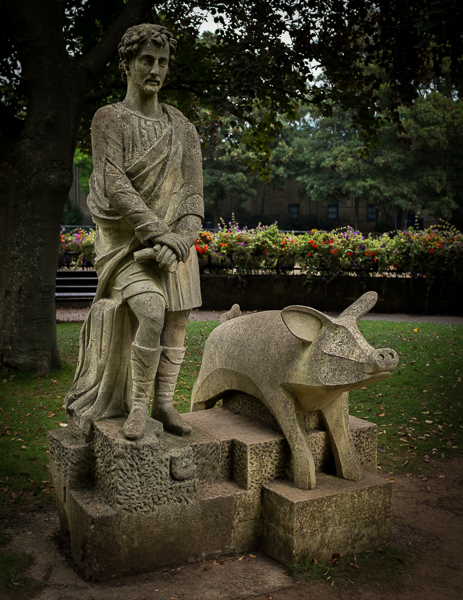
The ancient British city of Bath is tied by legend to a stange tale of pigs. A young prince named Bladud was sent to Greece to study and contracted leprosy there. Realizing that he could not hope to be King with such a disease, he went into the countryside and worked as a swineherd, looking after pigs. Unfortunately, his pigs caught the disease from him. The man had no luck it seems! Until one day his pigs crossed the river Avon and wallowed in the hot mud from a mineral spring. The pigs came out of their mudbath completely cured. This place is now called Swineford. 

The prince, on seeing this, also bathed in the mud and was cured. He established the baths at the place, and dedicated them to Sulis or Sul, the Celtic goddess of miracle cures. (Su, by the way is Old English for sow--and possibly where the hog call "suuu-eeee" comes from. So which came first, the goddess or the sow?) Read more at Under the Influence.

Our porcine friends even played a role (probably not a happy one for them) in ancient Norse Yule celebrations, as a hog would be slaughtered as sacrifice to the god Frey (god of farming and fertility); the meat would later be cooked, which is probably the source of the traditional Christmas ham. (Freya, the Norse goddess of love, wealth and war, is often portrayed riding on a boar),


Pigs, goddesses and gods? There are, as this article shows, more connections between them than I would ever have supposed.


Pig-faced women were an odd folk belief from the 19th century. According to the tales, there were women who looked like normal women, except for having the face of a pig. Rumors spread about wealthy women who were recluses because of this condition, and folk legends sprang up about women who called poor children "pigs" and whose faces were changed to that of a pig by a curse or evil spell placed on them for their meanness and miserliness.                                                                                 
                                                                                                                                                                                              
In New England this legend also exists but there it is the Pigman, and he is a creature to be feared. 

And lastly, there is this strange account of a wild pig found swimming in the ocean. A true tale, as it turns out, but certainly the stuff from which legends are made. And de-bunked--for in old days people believed that a pig could not swimm because it would cut it's own throat with its trotters.

All right, enough already about pigs! Anyone ready for some nice crispy bacon?


Copyright Susanna Holstein. All rights reserved. No Republication or Redistribution Allowed without attribution to Susanna Holstein.

Tuesday, November 15, 2016

High on the Hog? In a Pig's Ear

We had pork chops for dinner the other day, and Larry said, "We're eatin' high on the hog tonight!" Which got me to thinking about all the ways we refer to hogs or pigs to describe behavior, feelings, and other aspects of our life.


Eat like a pig: if you have ever watched a pig eat, you need no explanation! They are messy, selfish and outright belligerent at the feed trough, pushing each other out of the way, putting their feet in the trough and splashing their mash everywhere. 


The best meat on a hog is, in most opinions, the tenderloin. Which is high on the hog, running along both sides of the spine. Some people cut it into butterfly steaks, others cut it. along with the bone, into pork chops.  So if you're eating high on the hog, you're eating the very best.


Hog-tied: People sometimes tied all four feet of an animal's feet together to subdue the animal. It's unkind for sure. It rendered the animal helpless, and so now when we use the term, that's exactly what we mean. "I couldn't do a thing about it, he had me hogtied!" 


Sweating like a pig: this one is a bit puzzling, since pigs don't actually sweat. That's why they need wallows to keep cool.An alternative explanation for this term is that it refers to the iron-smelting process. Wikipedia can explain it better than I can:

"Pig iron is the intermediate product of smelting iron ore. It is the molten iron from the blast furnace, which is a large and cylinder-shaped furnace charged with iron ore, coke, and limestone. Charcoal and anthracite have also been used as fuel. Pig iron has a very high carbon content, typically 3.5–4.5%,[1] along with silica and other constituents of dross, which makes it very brittle and not useful directly as a material except for limited applications. The traditional shape of the molds used for pig iron ingots was a branching structure formed in sand, with many individual ingots at right angles[2] to a central channel or runner, resembling a litter of piglets being suckled by a sow. When the metal had cooled and hardened, the smaller ingots (the pigs) were simply broken from the runner (the sow), hence the name pig iron.[3] As pig iron is intended for remelting, the uneven size of the ingots and the inclusion of small amounts of sand caused only insignificant problems considering the ease of casting and handling them." Apparently these little "pigs" could lose moisture during processing.

Pig in a poke: A poke, as you probably know, is a bag or sack. So if you're buying a pig in a poke, you're buying something sight unseen--you're taking a chance on an unknown quantity. 

Throwing pearls to swine: Another self-explanatory term, I think! Pigs would eat those pearls, definitely, and not even blink. Except maybe Babe or Miss Piggie. They might actually appreciate the finer things in life. This one has biblical roots, from Matthew 7:6, Jesus's Sermon on the Mount: "Do not give what is holy to the dogs; nor cast your pearls before swine, lest they trample them under their feet, and turn and tear you in pieces."
In a pig's ear: this one is harder to track down. It means that the likelihood of something happening is pretty remote, as in "I'd vote for him in a pig's ear!" Locally, I have heard that asking for a pig's ear during Prohibition meant you wanted to buy a little whiskey. 

Making a silk purse from a sow's ear: This one is pretty old, dating back to a book written by the English clergyman Stephen Gosson, who published the story Ephemerides in 1579. In one passage he described people trying to do something impossible as "Seekinge too make a silke purse of a Sowes eare." I tend to use the phrase to describe trying to make something look better than it really is.

Road hog: We've all seen them--they take up more than they're share of the road, and don't really seem to care. And if you have seen a hog's behavior at a trough, you understand the resemblance.

Image result for vintage hog public domainHog-wild: When our pigs would get out of their pen, it was all we could do to try to herd them back in. It was almost impossible--they'd run around in all directions, grunting and squealing and literally kicking up their heels. The true wild hogs behave the same way, and are dangerous to boot, unpredictable and very, very fast. 

Hog heaven: a contented pig is a lovely thing. They almost smile as they nestle with their full bellies into their nice soft beds of hay after having a good wallow in the mud. They truly look like they're in hog heaven. So if you're in hog heaven, you're over the moon, on top of the mountain, over the rainbow, etc.

Going whole hog: all in! Like the sausage of the same name, pretty much putting everything you've got (except maybe your squeal?) into something. Like having all your eggs in one basket!

There are probably a lot more. Do you know of any I've missed here? I'd love to hear them!


Pigs can predict the weather too. "A January fog will freeze a hog" means fog in January will late frosts in Spring. If you should see pigs building their nests, or running around with straw or hay in their mouths, look for the weather to turn cold. Squealing pigs mean a change in weather is coming. Scratching their backs on a fence means rain is on the way, but if they're laying in the mud look for a dry spell.  Some people look to the hog's spleen at butchering time to predict the coming winter's weather. 

I'll end today's post with this favorite folktale from Joseph Jacobs:

The Old Woman and Her Pig


An old woman was sweeping her house, and she found a little crooked sixpence. “What,” said she, “shall I do with this little sixpence? I will go to market, and buy a little pig.”

As she was coming home, she came to a stile: but the piggy wouldn’t go over the stile.

She went a little further, and she met a dog. So she said to the dog: “Dog! bite pig; piggy won’t go over the stile; and I shan’t get home to-night.” But the dog wouldn’t.

She went a little further, and she met a stick. So she said: “Stick! stick! beat dog! dog won’t bite pig; piggy won’t get over the stile; and I shan’t get home to-night.” But the stick wouldn’t.

She went a little further, and she met a fire. So she said: “Fire! fire! burn stick; stick won’t beat dog; dog won’t bite pig; piggy won’t get over the stile; and I shan’t get home to-night.” But the fire wouldn’t.

She went a little further, and she met some water. So she said: “Water, water! quench fire; fire won’t burn stick; stick won’t beat dog; dog won’t bite pig; piggy won’t get over the stile; and I shan’t get home to-night.” But the water wouldn’t.

She went a little further, and she met an ox. So she said: “Ox! ox! drink water; water won’t quench fire; fire won’t burn stick; stick won’t beat dog; dog won’t bite pig; piggy won’t get over the stile; and I shan’t get home to-night.” But the ox wouldn’t.

She went a little further, and she met a butcher. So she said: “Butcher! butcher! kill ox; ox won’t drink water; water won’t quench fire; fire won’t burn stick; stick won’t beat dog; dog won’t bite pig; piggy won’t get over the stile; and I shan’t get home to-night.” But the butcher wouldn’t.

She went a little further, and she met a rope. So she said: “Rope! rope! hang butcher; butcher won’t kill ox; ox won’t drink water; water won’t quench fire; fire won’t burn stick; stick won’t beat dog; dog won’t bite pig; piggy won’t get over the stile; and I shan’t get home to-night.” But the rope wouldn’t.

She went a little further, and she met a rat. So she said: “Rat! rat! gnaw rope; rope won’t hang butcher; butcher won’t kill ox; ox won’t drink water; water won’t quench fire; fire won’t burn stick; stick won’t beat dog; dog won’t bite pig; piggy won’t get over the stile; and I shan’t get home to-night.” But the rat wouldn’t.

She went a little further, and she met a cat. So she said: “Cat! cat! kill rat; rat won’t gnaw rope; rope won’t hang butcher; butcher won’t kill ox; ox won’t drink water; water won’t quench fire; fire won’t burn stick; stick won’t beat dog; dog won’t bite pig; piggy won’t get over the stile; and I shan’t get home to-night.” But the cat said to her, “If you will go to yonder cow, and fetch me a saucer of milk, I will kill the rat.” So away went the old woman to the cow.

But the cow said to her: “If you will go to yonder hay-stack, and fetch me a handful of hay, I’ll give you the milk.” So away went the old woman to the haystack and she brought the hay to the cow.

As soon as the cow had eaten the hay, she gave the old woman the milk; and away she went with it in a saucer to the cat.

As soon as the cat had lapped up the milk, the cat began to kill the rat; the rat began to gnaw the rope; the rope began to hang the butcher; the butcher began to kill the ox; the ox began to drink the water; the water began to quench the fire; the fire began to burn the stick; the stick began to beat the dog; the dog began to bite the pig; the little pig in a fright jumped over the stile, and so the old woman got home that night.

Some days I feel like this little old woman--the faster I go, the behinder I get! Have a great day, all, and check your hogs for their weather predictions.

Copyright Susanna Holstein. All rights reserved. No Republication or Redistribution Allowed without attribution to Susanna Holstein.

Tuesday, January 12, 2016

The Lore of the Cat

Last week I wrote a post about the superstitions surrounding dogs. It was surprising to find out how feared our canine friends can be, especially if they're black. The color black, like being left-handed, seems to come in for a lot of wariness on the part of cultures all over the world. Hmmm...I think I need to do a post on left-handedness too. But not today. Today, the topic is of the feline world.

My husband says that my cats are my "familiars," from the old-time belief that witches and cats connived in magic and evil doings. Larry is joking of course, but it's a fact that the cats prefer me even though he is the one that feeds them. I might be the cats' favorite, but I don't have any magical powers, evil or otherwise!

Now we all know that black cats are bad news. Don't let one cross your path if you can help it, right? Well, not exactly. It all depends on where you live. In the British Isles and in Japan, a black cat is considered the bringer of good fortune in most regions. If you're a single lady, owning a black cat might bring you a plethora of suitors, for example. But in southern Virginia, some people would make an X on their forehead if a black cat crossed their path. It was important for the sign to be made three times before the cat had completed crossed the road.

In Western culture, the black cat is no friend to the superstitious. The Pilgrims associated black cats with witches and witchcraft and woe betide the person who owned one. On the early frontier, the blood from a black cat's ear or tail was thought to cure St. Anthony's Fire and the shingles, and according to John Caruso in The Appalachian Frontier: The Surge Westward, "a black cat with whole ears and tail was as rare as money."

But enough about black cats, except to say that if you are considering adopting a cat from the shelter, please take a black one. Apparently black dogs and cats have a hard time getting adopted, probably because of all the superstitions attached to them. What a shame. Because you know,  lot of people think a black cat brings wealth!

What else do people believe about cats? Apparently cats can predict the weather. If a cat is washing its ears frequently, it's a sign of rain, and wind is on the way if they're clawing at your curtains. And sleeping with all four paws tucked underneath? Rain is on the way. My cat Charlie can predict a thunderstorm for sure. You will find her under a cabinet or chair when a storm is brewing and she will not be budged from her safe spot. Sailors believed that cats could start storms from the magic they stored in their tails, and their shipboard cats (black ones were lucky!) were assured of being well-fed and care for.

In England in the Middle Ages, people believed that putting a cat inside the walls of a house under construction would ward off mice; some even put a cat and rat in the wall together. Pretty horrible, really--but there are examples of these poor creatures in a museum in England.

Cats are protected from harm by a lot of superstitions, however. The Irish believed that to harm a cat brought 17 years bad luck, and in the Appalachians hurting a cat meant you sold your soul to the Devil. Drowning a cat or kicking a cat would be a bad idea too. Drowning one meant you would die of drowning yourself, and kicking one would cause arthritis or other leg problems.

We have a strange creature here in the mountains called the "Wampus Cat." According to legend, this critter is half dog, half cat, and can run either erect or on all fours. It comes out just before dawn, and some believe it can steal children and pets. Dave Tabler has a good article about this creature on his Appalachian History blog.

There is also the Tailypo, a creepy folktale that is one of my favorites at Halloween. In this story, a man cuts the tail off a creature and cooks it and eats it, or tosses it to his dogs--versions vary. Later in the night the creature comes looking for its tail and the man sics his dogs on it. One by one, the dogs do not return as the creature comes back again and again, finally taking the old man too. But, they say, it did get back its taily-po.

This post could go on and on and on, because cats seem to be a favorite of the folklore-makers. So let's end today with this tale from England, which can also be found in American folktale versions, and then, go pet your cat!

The King of the Cats: A Folktale from Britain (from More English Fairy Tales, by Joseph Jacobs)

ONE winter's evening the sexton's wife was sitting by the fireside with her big black cat, Old Tom, on the other side, both half asleep and waiting for the master to come home. They waited and they waited, but still he didn't come, till at last he came rushing in, calling out, 'Who's Tommy Tildrum?' in such a wild way that both his wife and his cat stared at him to know what was the matter.

'Why, what's the matter?' said his wife, 'and why do you want to know who Tommy Tildrum is?'

'Oh, I've had such an adventure. I was digging away at old Mr Fordyce's grave when I suppose I must have dropped asleep, and only woke up by hearing a cat's Miaou.'

'Miaou!' said Old Tom in answer.

'Yes, just like that! So I looked over the edge of the grave, and what do you think I saw?'

'Now, how can I tell?' said the sexton's wife.

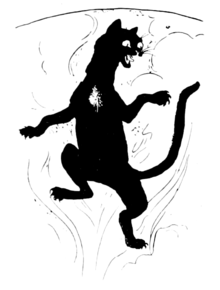
'Why, nine black cats all like our friend Tom here, all with a white spot on their chestesses. And what do you think they were carrying? Why, a small coffin covered with a black velvet pall, and on the pall was a small coronet all of gold, and at every third step they took they cried all together, Miaou -- '

'Miaou!' said Old Tom again.

'Yes, just like that!' said the sexton; 'and as they came nearer and nearer to me I could see them more distinctly; because their eyes shone out with a sort of green light. Well, they all came towards me, eight of them carrying the coffin, and the biggest cat of all walking in front for all the world like -- but look at our Tom, how he's looking at me. You'd think he knew all I was saying.'

'Go on, go on,' said his wife; 'never mind Old Tom.'

'Well, as I was a-saying, they came towards me slowly and solemnly, and at every third step crying all together, Miaou --'

'Miaou!' said Old Tom again.

'Yes, just like that, till they came and stood right opposite Mr Fordyce's grave, where I was, when they all stood still and looked straight at me. I did feel queer, that I did! But look at Old Tom; he's looking at me just like they did.'

'Go on, go on,' said his wife; 'never mind Old Tom.'

'Where was I? Oh, they stood still looking at me, when the one that wasn't carrying the coffin came forward and, staring straight at me, said to me -- yes, I tell 'ee, said to me, with a squeaky voice, "Tell Tom Tildrum that Tim Toldrum's dead," and that's why I asked you if you knew who Tom Tildrum was, for how can I tell Tom Tildrum Tim Toldrum's dead if I don't know who Tom Tildrum is?'

'Look at Old Tom, look at Old Tom!' screamed his wife.


And well he might look, for Tom was swelling and Tom was staring, and at last Tom shrieked out, 'What -- old Tim dead! then I'm the King o' the Cats!' and rushed up the chimney and was nevermore seen.


Copyright Susanna Holstein. All rights reserved. No Republication or Redistribution Allowed without attribution to Susanna Holstein.
Related Posts Plugin for WordPress, Blogger...