Pages

Showing posts with label cemetery. Show all posts

Thursday, January 17, 2019

Graveyard Plants

A friend recently posted on Facebook about periwinkle vine covering the ground in a cemetery. Around here people call periwinkle "graveyard vine." With good reason. The pretty, dark green vine is often found in cemeteries. In Spring it will bloom a violet-blue five-petaled flower--hence the name periwinkle for the color of its blossom.

Why was it planted in old graveyards? I asked a neighbor that question. She replied that it was because the plant was a good ground cover for graves, staying green all winter and growing low to the ground so it was not an impediment to walking or mowing. Makes sense to me.

Yucca in cemetery at Jackson's Mill, WV

Another plant often found in cemeteries is Yucca, also called Spanish Dagger. Seems an odd one for a graveyard, doesn't it? But yucca has another name: Eternity Plant. This spiky, arresting plant can live for hundreds of years.
Yucca protects a grave at a cemetery in Benwood, WV


Yucca is also referred to as Adam's Needle--I would love to know the origin of that name.

Evergreens in cemetery in Shepherdstown, WV

Cedars and evergreen trees are another favorite in graveyards--often we'll spot a cedar tree in a seemingly open field and sure enough there will be a cemetery beneath the tree. In England, pagans of old considered evergreens to be a sign of everlasting life, proof that life can continue even after winter's "death" of other plants.

Boxwoods overtake a grave in a cemetery in Sistersville, WV

Many still believe an evergreen in a cemetery--holly and yew are also graveyard favorites--symbolizes the eternal life we are promised by the Bible.
Blue spruce in the National Cemetery in Grafton, WV

You will find other perennial plants in burial places: iris, daylilies and peonies are commonly planted on graves. It is easy to see why these old perennials were favored. These plants returned every year, bloomed beautifully and in the case of iris and peonies, had heavenly scents. All of them spread, but not as rampantly as some other plants might.

Next time you visit an old cemetery, look around and see what plants are growing there. And think about the hands that so carefully dug the soil and planted these on the graves of their loved ones.

Copyright Susanna Holstein. All rights reserved. No Republication or Redistribution Allowed without attribution to Susanna Holstein.

Wednesday, September 19, 2018

Sad Angel: Adamsville Cemetery


I got so intrigued by the Sliding Hill ghost story that I asked my grandson Jared, who is visiting from Los Angeles, to go with me to explore the area. I can't say there is a lot to see--a country highway that borders the railroad tracks that hug the riverbank, small towns and rural homes and farms. But Jared is an adventurer and an explorer, and as intrigued by strange tales as I am.


We drove up Sliding Hill Creek Road, turning here and there, meandering for miles and just looking at the countryside. 

On Sliding Hill Creek Road
We ended up back on the highway, miles from our starting point, in a community called Clifden which  has its own strange story. According to the lady at the diner where we stopped for lunch, there is (or was) a house in the town where the walls just started crying one day. Literally. Water began seeping out of the walls for no reason anyone could discover. She said that the woman living in the house at the time wrote a book about it, but I have not yet found any information about the event or the book. A story for another day.

After leaving Clifden we turned back toward Sliding Hill, stopping on the way at a graveyard I've passed many times but never had time to visit. 

Check out the orb in this photo. I didn't notice it at the time, but now I'd like to go back and look at that gravestone the grave is centered over.

This is the Adamsville Cemetery, as I learned after a long search--it is not listed on Find-A-Grave, or if it is, it is under another name. The cemetery is not being maintained very well, as the grass and weeds were about a foot high, but we waded in anyway.

Yet another bright orb. Usually I can attribute these to dust, but today there was no dust at all;
the grass was still wet with dew.
I have wanted to stop at this cemetery because of this monument:


This angel has caught my eye so many times over the years, and this time I was determined to stop and take photos of her. And would you believe it, I forgot to get the name of the person buried in that plot. So I will have to stop again sometime. Which I will not mind doing. When a cemetery has become a forgotten place, it feels all the more important to stop and visit, a mark of respect for those beneath the soil.


In the center of this graveyard is a stonewalled enclosure made of large cut stones. I believe this might have been the original cemetery and that there was a church down below at one time. Few of the graves within the walls have markers but their presence was obvious when I walked across the area--the ground was sunken in regular intervals. 


Other sites apparently once had wrought iron fences around them; some of the fenceposts are still standing but the fences are missing.


One of the remaining fenced plots

One grave, far up the hill and against the treeline, particularly interested us. The parents' names, Charley and Emma Martin, were clear, as were their birthdates and that of their married daughter. 


There was also a son, Charley Jr, who was buried here. Oddly, there were no death dates for the parents or the daughter. I searched online in West Virginia death records for them and even googled the names but found nothing. Did the family move away after the young son died? How very lonely his grave if that is the case.

In searching for this cemetery's name online, I found another graveyard in the area that I will need to visit one day: the Welsh Cemetery. Suprisingly, Welsh immigrants ended up in Gallipolis, Ohio, and apparently several made their way across the river to West Virginia. We noticed at least one grave in the Adamsville Cemetery that listed place of birth as Wales. So far from their home.


Copyright Susanna Holstein. All rights reserved. No Republication or Redistribution Allowed without attribution to Susanna Holstein.

Thursday, June 1, 2017

Visiting Family

Memorial Day--the original date anyway--was yesterday, so we went visiting Larry's family in Graceland cemetery in Kanawha county, WV. Most of his closest relatives are buried there, although some are in cemeteries closer to Olcott, where they all lived.

Graceland is a large cemetery close to a major highway, but like most graveyards it is a quiet and peaceful place. I found such simple power in these two people, standing and reading from the Bible and paying no notice to anyone else.


We stopped first at the grave of his brother Maxey, who died at the young age of 49 of a heart attack. Max was an Army veteran, and Larry had brought some flags for the vets in the family.


Next we found the graves of his uncles Coy and Otto, both bachelors all their lives, and both veterans.


Then we moved on to his grandparents, who are buried in the old part of the cemetery. I love their names, Finley and Oma (pronounced Omie around here).


And finally, our last stop was at the mausoleum, where his parents were laid to rest. I never met Larry's uncles or his grandparents, all gone long before we got married, but thankfully I did know his brother and parents. Good people all.


We had a few extra flags with us, so we put them on the graves of some WWI vets, a belated thank you to them 100 years after the US entered that fray.

My family never had a tradition of visiting graves, for some reason. Perhaps it was because my mother's family were all in England, but my parents never or rarely visited my father's parents' graves in Arlington Cemetery. It is not an easy place to get to, I suppose, with all the Washington traffic, and maybe that was why. But there are quite a few family graves there, and I hope to go back again to find them.

As for my parents, they are buried in the National Cemetery in Culpeper, VA, about 7 1/2 hours from here, so I get there only rarely. My son's grave is also a good distance, six hours, and I can't get there often either. It grieves me but I take comfort in knowing he's near his wife and daughters' home. And I am sure he would have preferred to be there in the town he loved so well.


Copyright Susanna Holstein. All rights reserved. No Republication or Redistribution Allowed without attribution to Susanna Holstein.

Wednesday, December 10, 2014

Finding Family: Arlington National Cemetery


One goal of my trip east this past weekend was to visit Arlington National Cemetery and locate the graves of my grandfather William I. Connelly and great-great grandfather Dominick Connelly. About 45 years ago I remember finding my grandfather's grave but I did not realize that my great-great grandfather was also in Arlington. To tell the truth, it was only about 8 years ago that I learned any names of ancestors besides my grandparents, on my father's side. His family was not close; there must have been a rift of some sort between his mother and grandmother because even though my Dad's grandmother lived until the mid-1940's, Dad only remembered seeing her once--and his mother was extremely angry that he had done so.

We have never learned the cause of that separation. My great-grandfather, William Henry Connelly, died young and his widow (Hester Clementine Cathell Connelly) remarried to a man named Schmidt. Dad remembers that "Hettie" was referred to as "Nana Mitt" but he only saw her once, and that was at his uncle's house. Was the family angry that she remarried? Was it because Mr. Schmidt was German? That hardly seems likely since my grandmother Bertha Becker Connelly was the daughter of German immigrants. Was Mr. Schmidt a non-Catholic, and did Hettie fall away from the Church when she married him? This last seems most likely since my Dad's family were all staunch Cahtolics. Hettie had married a much younger man in her first union; was Mr. Schmidt much older, divorced, or somehow otherwise unsuitable? I suppose we'll never know. It is one of those family stories that died with those who knew about it, and I was not even aware there was a story until it was too late to find the truth.

But we had learned about Dominick in the old letters and photos my grandmother had saved for all those years. I remember many fascinating hours with my father as we searched through those pictures and he tried to remember who the people were. He had not known that all those boxes his mother had left behind held such treasures and he was thrilled to see, for perhaps the first time, pictures of his little brother Joe who tragically burned to death as a toddler. Dad said it was Joe's death that turned my grandmother's hair pure white.

Dominick, as it turned out, had served as a drummer in the Union Army in a company out of Baltimore. He died in 1907 at Colonial Beach, VA; he drowned during a family outing. He'd been a District of Columbia policeman at one time and seems to have been a colorful if perhaps rowdy kind of guy. Photos show a large man with dancing eyes, and I'm pretty sure I'd have liked him.


My sister Theresa and I were lucky to have my friend, storyteller Ellouise Schoettler, to be our guide at Arlington. Ellouise's husband Jim is also buried there, and she has done extensive research on the cemetery and has even developed a one-woman show based on this national treasure. Our first stop on Friday was, of course, Jim's grave. And what a surprise to find that resting beside him was a man who bore my maiden name! Harry Connelly is Jim's neighbor at Arlington, and quite possibly might be one of my relatives. Such a small world, isn't it?

Our sister Judy had provided us with the plot and grave numbers for our relatives. These are essential to finding anyone in that huge cemetery. The Visitors Center can look people up for you, but they could not find Dominick because both his first and last names were misspelled. But Judy's genealogical research had provided the correct information for us, thank goodness.

So, after all these years, Dominick had visitors last week. I wonder how long it's been since anyone has sought him out? Too long, I feel sure. But now we know where he is, and I hope we will be able to return, next time with a little stone or two to place on top of his stone, as is the tradition at Arlington to mark a visit.

We found Grandpa too, and Grandma of course, since they share the same plot. Now we know where they are it will be easy to find them again.

It is difficult to understand why it feels so important to locate these graves, particularly those of people we never knew. It seems like a circle closing, a completion of our family in some obscure way. I only know that it brought a sense of peace, a feeling that yes, this was something we needed to do. Our parents were not once for visiting family graves but to me it is an important part of acknowledging our past.

Our next quest will be to find the grave of great-grandfather William Henry Connelly, and perhaps also that of Hettie, that mysterious little lady who apparently caused a furor in her time. Wish us luck!

Copyright Susanna Holstein. All rights reserved. No Republication or Redistribution Allowed without attribution to Susanna Holstein.

Thursday, July 10, 2014

Traveling West Virginia: Benwood and McMechen

I have presented programs at the library here for several years, but usually didn't have time to look around. Located just outside of Wheeling, West Virginia, the homes in these adjoining towns were mostly homes for workingmen's families. Wheeling was an industrial hub, right on the Ohio River with busy railroads, and home of Mail Pouch Tobacco, Wheeling cigars, cut nails, steel-making, pottery-decorating and many other industries. Industries spread south and the towns of Benwood and McMechen thrived during those years of expansion. Like many other towns, the departure of the steel and other industries caused depopulation and an economic downturn in the region. Today there seems to be some growth as new industries are opening their doors in the area, most notably an area of large stores and shopping developing on the east side of Wheeling. The Marcellus shale drilling activity is also bringing many jobs and new business to the area.

We happened up one street and found the McMechen cemetery, located near where the original settler Captain William McMechen's cabin stood.


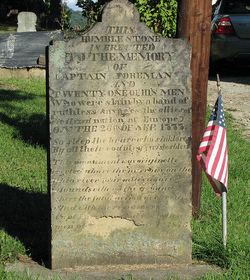
As I looked around, I could see why he would choose this spot: it was far enough away from the Ohio river to avoid flooding and provided an excellent view of the opening of the hollow so that anyone approaching could be seen immediately. In those early days (1771) threat of attack by the Native Americans in the area was very real and there are several accounts of massacres along the river, including one near here, known as the Foreman Massacre. (The men killed in that attack are buried at the Mount Rose cemetery in nearby Moundsville--another cemetery I need to visit).
photo from Find a Grave

I learned at the library that McMechen was named after Captain McMechen, and neighboring Benwood was named after his son Benjamin, and is an abbreviation of Ben's Wood, the property Benjamin owned.
This stone intrigued me. Who was Grandma Williams? She lived a long life certainly.

The plant I know as Spanish Dagger protects an old stone.


There were several graves here with a cast iron cover like this one. I do not believe I have seen any like this, although I have seen some cast iron gravestones before. I suppose the opening was for planting flowers?


There is a certain charm in little towns like this one. Close-built houses, narrow streets, and empty storefronts that offer an opportunity to speculate on what businesses once operated within.  Town was quiet the day we were there. It was hot and rain threatened.


In McMechen, the fire department houses a vintage firetruck and a memorial to a longtime fire chief.


Some memorials have an eternal flame; this one is continually running water, and what could be more fitting for a firefighter?


We found three buildings painted with the Mail Pouch logo:


Copyright Susanna Holstein. All rights reserved. No Republication or Redistribution Allowed without attribution to Susanna Holstein.

Monday, June 23, 2014

To My Grandfather


Your eyes are what I think about
and how even in the cracked gray photo
on my mother's dresser they twinkled
as if you were laughing at a joke that I cannot hear.
I was not even a glimmer in my father’s eyes 
when you were struck by a car 
as you stood quietly beside the old Roman road,
probably lighting your pipe.

I wonder what kind of father you were, and if you played
with your little children or if you were always working,
caring for the Highfields farm;
I think you must have been kind, 
for all your children had that way with them,
and Granny could not have loved a mean man.
Thin you were, a man of muscle and bone and twinkling eyes,
too early laid beneath a heart-shaped stone.
I stood by your grave and tried to conjure your image in my mind,

digging deep to find some part of you living on in me.


Copyright Susanna Holstein. All rights reserved. No Republication or Redistribution Allowed without attribution to Susanna Holstein.

Thursday, April 24, 2014

Otterbein Church in Evans, WV

I've passed this little church many times, always meaning to go back and look more closely. Saturday was finally the day we made time.

Built in 1896, the current church replaced the original structure. Graves in the cemetery date to 1864, and there are several Civil War soldiers buried here,
 such as this one, the grave of Jacob Shaver who was about 41 when the war broke out. The graves we saw were of men who served in the Union forces; this county was divided between the two sides during the war so I expected some Confederate graves here too, but we did not see any.


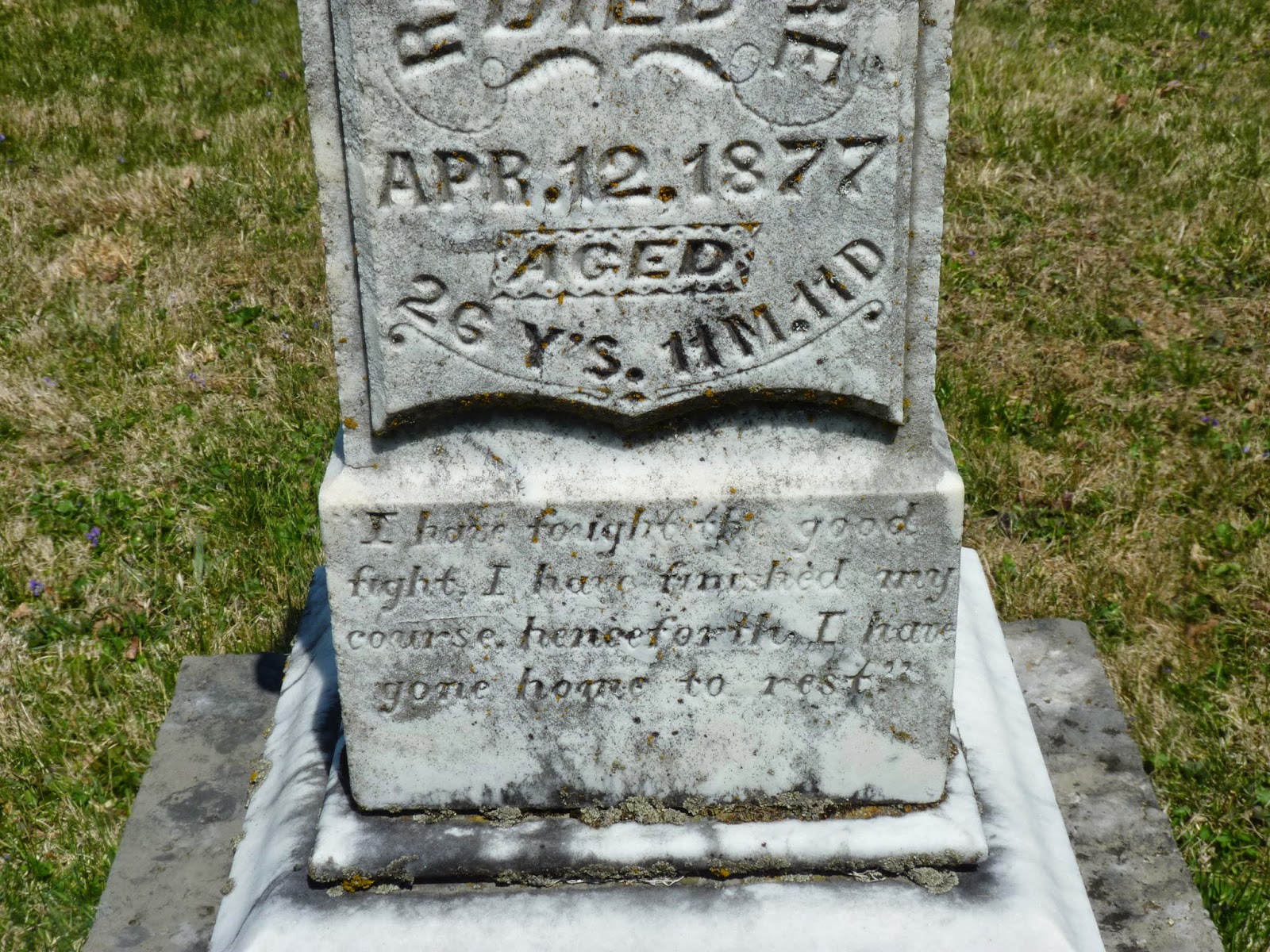
 There were two graves I noticed that were ministers. This man died far too young for the inscription:


This is the stone of another preacher and his "relict." That sent me scurrying for the dictionary! Apparently relict is another word for widow. Some say that it means a widow who did not remarry. Others say it can be used for either sex. Interesting.
 Across a quiet field, cattle grazed in front of a beautiful farmhouse.


Windows in windows, and many orbs floating about.


I would love to see what this handle looked like under the many layers of paint.


The bell still resides in the steeple, although I don't know if it rings any more, or if the church is still in use. It did not appear to be.


The front of the church sports an unusual bay window; the pulpit is located inside this window on the inside. Note the two doors: one was for men and one for women. I wonder which was which? My gut tells me the men entered on the right, women on the left but I might be wrong about that.


The doors were locked but I learned some time back that by placing the camera lens right against the glass I could get pretty good photos of interiors.


The view from the bay window, looking at the back of the pulpit.


The floor of the church has a slight upward slope; what a great idea. That would help those in the back pews be able to see more easily.


A plaque on the front of the church notes that the building is now on the National Historic Register. You can read more about the church and its history on the application for this status.


Old woodlands border the east side of the church.


 I was surprised to see another church very like this one in the distance. I will need to return to see that one.


Copyright Susanna Holstein. All rights reserved. No Republication or Redistribution Allowed without attribution to Susanna Holstein.

Related Posts Plugin for WordPress, Blogger...