Earth Day meant garden day for us. We spent the morning getting plants, and the afternoon getting them in the ground. It was such pleasure!
I started filling my containers with new dirt and flowers. The container collection seems to be growing, and you know, I'm okay with that. They're easier to care for weed-free, and require little or no bending! I put most of my annuals into pots and planters nowadays, and I don't even remember when that transition started.
Along the walk, I haven't done anything yet except enjoy the show by daffodils and tulips. The tulips are almost done now but are still adding a bit of color to what would otherwise be a green garden. I am hoping the tulips will come back next year. We don't have much luck with them usually, but I added lime, bone meal and blood meal to the soil this year so maybe that will help. They also got a good dose of wood ash.
A new, heavy concrete planter I found at a thrift store for $10. There are two of them, actually. I really like the concrete planters for they way they hold moisture, so important on our dry hill.
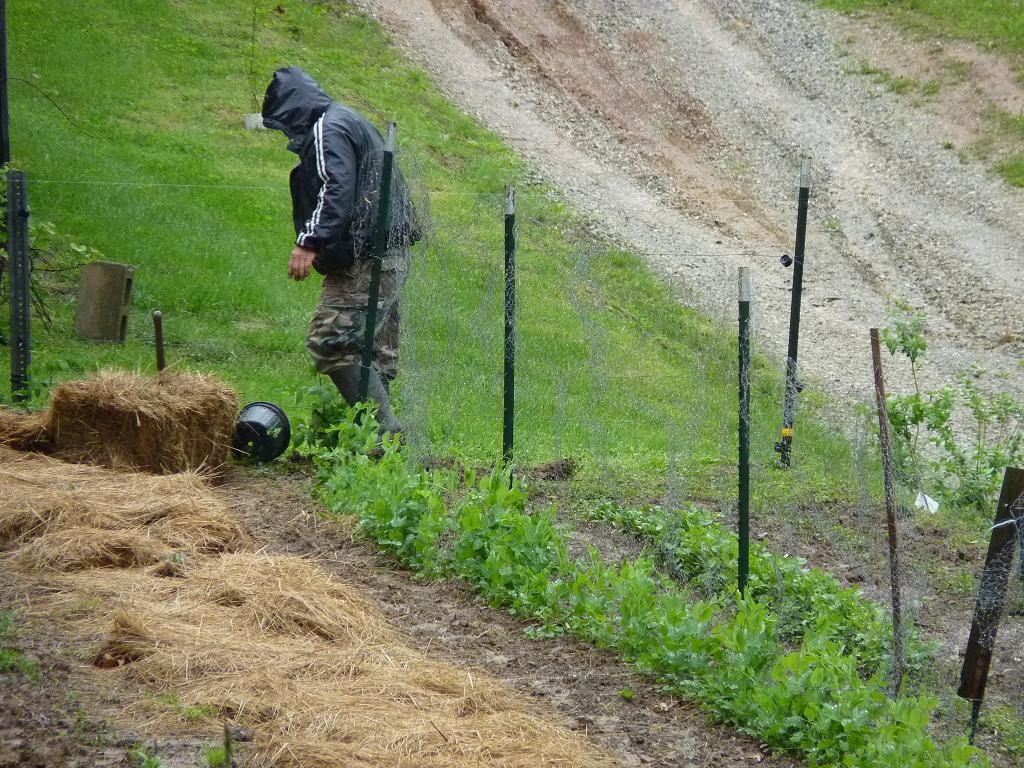
Peas, radishes, beets, and onions are coming along in the early garden.
And so are are cabbages, broccoli and lettuce in the upper garden. We put a row of green beans in last week but they're not up quite yet.
The poot clematis took a hit with that late freeze a couple weeks ago.
Still left to plant, but I rain out of potting soil so these will wait until I get back to town.
The real gardener around here, doing what he does best. He planted tomatoes yesterday. It's early, but we're taking the chance anyway.
Garden visitor: a towhee perched in the dogwood to watch me work,
and later brought his mate by to say hello. I think they may be nesting in our shrubs.
Larry wasn't too happy with me for punching holes in the bottom of these old coffee cans to use them as planters! He uses them all the time for watering plants and filling birdfeeders but I could just see them with geraniums...and now I don't have to pick them up from all over the yard :) The man is such a scatterer! Win-win for me. I gave him a scoop and a watering can, but I bet he finds more old cans to use instead!
Copyright Susanna Holstein. All rights reserved. No Republication or Redistribution Allowed without attribution to Susanna Holstein.
Showing posts with label planting. Show all posts
Saturday, April 23, 2016
Tuesday, February 28, 2012
That Time of Year
Yes, it's garden planting time! Larry and I put in peas, lettuce, radishes, carrots, onions and spinach yesterday, with help from Clyde who loves to get in the way and see what we're doing. Thanks to my sister Theresa, we had plenty of lettuce seed--after I complained in a post about the local seed stores not having any seeds available yet, she mailed me some. What a sweet sister. (Behind Larry are the remains of the old shed that was about to fall over. He's salvaging the wood for re-use on his little cabin project.
All of the things we planted are early-season crops so cold weather won't bother then. Cold, drenching rain isn't helpful though, which is what happened last year. I am hoping that this year the spring weather will be more cooperative.
Gardening is all about hope and optimism, isn't it? Each year we start with high expectations that this year everything will be right--the sun, rain and temperatures will be favorable and all crops will grow like the pictures in the seed catalogs. How often is that really the case? Rarely, at least in my gardens. But the well of optimism is deep indeed, and each year we and hundreds of other gardeners start all over again. Each year brings some disappointment, but there are always those faithful plants that surprise us with bounty and keep us returning to the garden every spring.
Have you been out to plant yet? Or is the season still too early in your area? We're early birds here, always wanting to get those spring vegetables in the ground, but in some places it's probably still too cold to consider even planting lettuce.
Here's to a glorious year for all our gardens!
Saturday, May 7, 2011
A Few Things Going On
Time for a little catch-up post on what's happening around our place these days. It's been a busy, busy time, as it usually is in the spring.
Baby chicks! I got them about 2 weeks ago. These are barred rock and Rhode Island Red pullets and a couple of unknowns that are straight run, meaning they could be pullets or roosters. Our hens are 2 years old and older so it is time to start looking at replacing some of them.
The potatoes are up and thriving on all the rain. This was taken about a week ago, and they are twice this size now. Larry planted them on March 21 in a lull between rainstorms. It's been tough getting things in the ground but we did manage to get all the spring veggies in.
We went ahead and planted new raspberry and blueberry bushes in the rain. We figured we had to water them anyway, why not? These are lovely big plants I bought at Green's Feed in Charleston with a gift certificate that was a retirement gift from people at work. They knew I liked to garden so this was a perfect gift. We got 4 blueberry bushes with berries already on them and 3 raspberry plants, plus some new herb plants. In this photo you can see the peas climbing up their trellis; they're about twice that height now and blooming.The hay mulch is around the cabbages and broccoli--those plants are struggling because of all the rain. It's been dry for like 24 hours now so maybe they can catch their breath a little.
The big snowball bush in the side yard is coming into its own. This bush is out of sight most of the time so I have to remember to look for it--unless I am hanging wash on the line. Which is what I need to do right now.
I found this lovely, big porch swing at ReStore, the Habitat for Humanity resale place. It's made of oak and is 6 feet long. We need to buy chains for it to hang it, and I think I'm going to put it on the front porch, where I used to have a swing. We took that swing down in favor of rockers but I've missed it. This is a better, bigger swing and I am in love. Can you just see it with pillows, me and a cat or two? That box of junk you can see to the left is another story:
Can you say auction? Can you say $2? The truck is still full and I will be sorting and listing on eBay for a good while from the haul we made. More on that later.
That's a quick catch-up on all the side projects going on in addition to the usual grass-mowing and so on that keeps up hopping in spring.
We also have a special event for this evening. More on that in tomorrow's post, I hope. In the meantime, Happy Mother's Day to all of you! I hope you have a restful and memorable day.
Baby chicks! I got them about 2 weeks ago. These are barred rock and Rhode Island Red pullets and a couple of unknowns that are straight run, meaning they could be pullets or roosters. Our hens are 2 years old and older so it is time to start looking at replacing some of them.
They are so cute when they're this size.
We went ahead and planted new raspberry and blueberry bushes in the rain. We figured we had to water them anyway, why not? These are lovely big plants I bought at Green's Feed in Charleston with a gift certificate that was a retirement gift from people at work. They knew I liked to garden so this was a perfect gift. We got 4 blueberry bushes with berries already on them and 3 raspberry plants, plus some new herb plants. In this photo you can see the peas climbing up their trellis; they're about twice that height now and blooming.The hay mulch is around the cabbages and broccoli--those plants are struggling because of all the rain. It's been dry for like 24 hours now so maybe they can catch their breath a little.
The big snowball bush in the side yard is coming into its own. This bush is out of sight most of the time so I have to remember to look for it--unless I am hanging wash on the line. Which is what I need to do right now.
I found this lovely, big porch swing at ReStore, the Habitat for Humanity resale place. It's made of oak and is 6 feet long. We need to buy chains for it to hang it, and I think I'm going to put it on the front porch, where I used to have a swing. We took that swing down in favor of rockers but I've missed it. This is a better, bigger swing and I am in love. Can you just see it with pillows, me and a cat or two? That box of junk you can see to the left is another story:
Can you say auction? Can you say $2? The truck is still full and I will be sorting and listing on eBay for a good while from the haul we made. More on that later.
That's a quick catch-up on all the side projects going on in addition to the usual grass-mowing and so on that keeps up hopping in spring.
We also have a special event for this evening. More on that in tomorrow's post, I hope. In the meantime, Happy Mother's Day to all of you! I hope you have a restful and memorable day.
Monday, August 10, 2009
What's Going on in the Garden
Usually by this time the garden is covered in weeds; we've given up the battle and settle for harvesting what we can for the rest of the summer from the understory of the weedy forest.
What's happening now: 
Swiss Chard: mammoth plants! Larry harvested it yesterday. We left it too long t00, one of the problems with me being gone so much on weekends. Still, I cleaned it up and we have 2 very big bags of frozen chard in the freezer. And the chickens and turkeys had good eating on the big red stalks of the rhubarb chard.


But this year Larry has been home, and it's a whole new story.
What's happening now:
Swiss Chard: mammoth plants! Larry harvested it yesterday. We left it too long t00, one of the problems with me being gone so much on weekends. Still, I cleaned it up and we have 2 very big bags of frozen chard in the freezer. And the chickens and turkeys had good eating on the big red stalks of the rhubarb chard.
We ate the last of the corn last night. We started the season with Early Sunglow, moved on to Seneca Chief and finished with Honey and Cream. Of the three, Seneca Chief is a clear favorite--great flavor, full, big ears and so easy to clean. A winner all around. The Early Sunglow was frozen in the husk for grilling. We ate some of it last night along with fresh corn and it was hard to tell the difference. We cut Seneca Chief and some of the Honey and Cream off the cob for freezing that way. And ate a LOT of corn this summer. Bliss.
Carrots: success! Finally, after years of trying, we grew decent carrots. Downside--who knew there was some worm that likes to get into the roots? Still, we have harvested about 10 pounds and that's less than half of the crop. I will slice these up, cutting out the worm damage, for the freezer.
Sweet potatoes: they were doing great but last week the deer got in and ate the tops. These are in the only garden without an electric fence. We'll fix that real soon.
Tomatoes: Sad. Blight has taken over. We're still getting a few, but the big boom is over and I only canned about 20 quarts, and about 25 pints of salsa. Oh well. It's enough. But my tomato sandwiches for lunch may be over. So sad. Deer are getting to the ones that are left since they're in the same garden with the sweet potatoes.
Squash: the first planting is still bearing like crazy and the second planting is full of blooms. We should have squash well in to fall. The butternuts are full of ripening fruit, too, and those will go in the cellar if they don't rot. A lot of rain in the forecast again, so we'll see. They're not ready to harvest yet.
Cucumbers: first planting still doing well and second planting is full of bloom. More dill pickles are in my future, and I am a happy woman.
Lettuce: fifth planting is ready to pick. So far we've had Green Ice, Ruby, Buttercrunch, Romaine, now the Black-seeded Simpson is coming on.
Potatoes: Larry has been digging them and drying them out to store in the cellar. He rinsed the potato bin with bleach water first. No sense encouraging disease and bacteria.
Indian corn: looking good so far. We'll see.
Celery: Big and beautiful. Time to harvest it this weekend.
Leeks: Ditto, although I'll leave them in the ground as long as I can. They are de-li-ci-ous! A milder, sweeter taste than onions, I think. I will try drying some, freezing some and just storing some in the cellar when frost is near.
Herbs: a bust. I've gotten a little bit of stuff dried, but the bulk of them were dug up by the dogs. Grrrr. Good thing I love my dogs. Next, year, new garden and a fence.
Blackberries: I don't really have any in my gardens, but Derek picked four gallons for us at his friend's house, so we have plenty in the freezer for blackberry cobblers like this one I made last night. Yum! You can find my recipe at this blog post from past year.
Grapes: some have black rot despite spraying to control it. Bah. but some have made it through so I should be making jelly pretty soon.
Cabbages and broccoli: mixed results here. We had some early cabbage, and I made 4 pints of sauerkraut and froze a few bags, but the late cabbage? Larry accidentally hoed out the little plants. Broccoli didn't do a thing, and the second planting suffered the same fate as the late cabbage. Just wasn't meant to happen this year, I guess.
Honey: ready to harvest, just need to find some time.
I've probably missed a few things, but that's the gist of it. A very good garden year, and we are grateful. We've learned a few things too, and have more to learn about carrots. But all in all, I am more than happy with this year's produce.
We're putting in cover crops of turnips, kale, spinach and rape now. I will be planting more lettuce and radishes close to the porch where the plants will be protected from harsh weather, hoping to keep fresh salads on the table far into winter. We'll see how that plan goes.
What's going on in your garden?
Wednesday, April 1, 2009
Spring Goodness=Lettuce and Flowers
On the last day of March, we enjoyed our first lettuce from the garden. The lettuce was planted at the beginning of February in a hot bed made by digging up a patch of dirt, burning a pile of brush on top of it, raking the soil even, scattering the seed and putting a cover of plastic over it to keep in the heat.
This photo of the lettuce bed was taken about 2 weeks ago. The lettuce has grown significantly since then with the warm days we've had scattered amidst the rain.
This picture shows the hand-dug garden patch. We have 4 other gardens this year; this is the smallest yet it often out-produces the others because we garden it intensively. There is no wasted space here, no long open rows for a rototiller. This garden is hand-dug (by Larry this year; last year I did it), planted closely, rotated often, hand-weeded and mulched. This year I am considering planting the upper garden to strawberries because we've had such problems with deer eating our plants.
In another garden, you can barely make out the peas and onions coming up. This was taken last week and they are much bigger now, and the peas have their climbing fence in place (chicken wire attached to poles). The beets are up too, despite Otis' best efforts to dig them up. An electric fence now surrounds this garden, and Otis stays a LONG way away!
A view of the abundant daffodils. My favorite flowers, I do believe. You notice the odd bloom on the pear tree? I think the top must have been nipped by frost, but the lower 3/4 of the tree is blooming nicely.
There is nothing quite like the first salad, the first green of the new season. We will have salad almost every night now for a while, but none of the succeeding bowls will come close to the first taste of Spring.
It will be quite a few weeks before we have anything else from the garden except onions, radishes and herbs. But we can wait. We have lettuce to remind us that the gardens will soon be bountiful once again.
Tuesday, January 1, 2008
Happy New Year! Planning Ahead
Happy New Year! January came in with wind and snow that started soon after midnight. Our bonfire crowd drew indoors soon after midnight and continued the stories and songs around the fireplace. I will post photos and more tomorrow after my computer recovers from too many downloads by grandchildren (who are accustomed to DSL and overwhelmed my satellite storage allowance—who knew there was such a thing?).
After the last of our visitors left today, we tidied up and enjoyed the snow falling so gently all afternoon. Not enough to amount to anything yet, but perhaps by morning it will make getting to work a challenge.
I used this quiet time to begin making lists of seeds to plant in the Spring. I’ve decided to have a little greenhouse once again after a five-year break, and it’s interesting to see what new varieties are being offered. I’ll share my lists when I’ve weeded them down—right now they’re wish lists that cover several pages of my notebook.
But the quiet and the catalogs inspired this poem:
Seed Catalogs
The first day of a new year.
In the vacuum left by departing visitors,
I huddle with quilts
in the warmth of a golden fire,
colorful catalogs on my lap.
Cocooned by snowfall
from the chatter
of everyday,
I plan
a summer of bounty and color.
A garden rich with green grows
amidst the swirling cold and white
of January.
After the last of our visitors left today, we tidied up and enjoyed the snow falling so gently all afternoon. Not enough to amount to anything yet, but perhaps by morning it will make getting to work a challenge.
I used this quiet time to begin making lists of seeds to plant in the Spring. I’ve decided to have a little greenhouse once again after a five-year break, and it’s interesting to see what new varieties are being offered. I’ll share my lists when I’ve weeded them down—right now they’re wish lists that cover several pages of my notebook.
But the quiet and the catalogs inspired this poem:
Seed Catalogs
The first day of a new year.
In the vacuum left by departing visitors,
I huddle with quilts
in the warmth of a golden fire,
colorful catalogs on my lap.
Cocooned by snowfall
from the chatter
of everyday,
I plan
a summer of bounty and color.
A garden rich with green grows
amidst the swirling cold and white
of January.
Tuesday, September 11, 2007
Memories of Gold

Imagine for a moment that you are on a West Virginia ridge on a perfect July morning. The sun has just risen, sending pink rays through morning mist. The ridge top basks in first warmth, while the hollows below are gray-dark and cool. Before you is a field of tall, lush plants, over six feet tall with leaves two feet long and almost a foot wide. The plants rustle in the soft morning breeze, and iridescent dewdrops glisten pinkly with reflected sunlight. Seashell-pink blossoms spike above the plants, a foam on the sea of undulating green. This is tobacco in its prime, proud and full of the promise of a good harvest.
Tobacco played an important role in the early development of our country. For the English settlers, it meant economic survival, providing a dependable cash crop. European demand assured a steady market, and the advent of slavery provided cheap labor for the handwork the plant required. Coming over the mountains from Virginia and Maryland, settlers found tobacco adapted easily to the rich virgin soil of cleared forestland and provided good cash income. Although some settlers in western Virginia owned slaves, the nature of the land suited small-farm enterprises, and most of those who farmed tobacco used family labor to grow and harvest their crops. When West Virginia became a state in its own right, tobacco farms were flourishing in many areas, providing a steady cash income to residents. As time passed and government subsidies supported the price of tobacco, growers found they could depend on a reasonable income for their efforts. Changing times forced many from their farms into other work, but tobacco was often continued as a good side income, and small plots continue to provide extra income to West Virginia’s rural growers today.
In 1981, my husband and I were considering a variety of cash crops that could be raised on our Jackson County farm. We sought the advice of our Ed Smolder, our county’s WVU Extension Agent, and his reply was quick: tobacco. Even though I was not initially in favor of the idea—tobacco smoke made me cough, reddened my eyes and gave me a sore throat—we eventually decided to give the crop a try. With the high return for a small plot of land and a local sales outlet at the tobacco market in Huntington, there was no argument that it was by far the best bet for a farm income. If we raised a reasonably good crop we could make enough money to pay our annual farm payment. For the next eight years we grew between one and three acres of burley tobacco, and I came to love those tall green plants and their heady aroma.
For the tobacco grower, the season starts early. One year’s crop has barely been sold at auction before the planning begins for the next crop. In February equipment and supplies are checked and the choice of variety to plant is made. There are many varieties from which to choose, differing in disease resistance, yield, drought resistance and growth characteristics. My favorite tobaccos were varieties called Number 17, a drought-resistant variety, and R7-11, a vigorous, high-yielding plant.
The real work for tobacco growers begins in March. While our neighbors were still huddled around their woodstoves, we were preparing our plant bed. One hundred feet long and twelve feet wide, the beds were plowed, piled four feet high with brush and scrap wood and burned off to kill the weeds and warm the soil. The burning could take all night; pots of coffee were brewed in the coals, hot dogs and marshmallows roasted, and one by one family members would drift off to bed, leaving a lone sentinel to watch the flames and contemplate life as the stars wheeled overhead.
Morning brought the sleepers back to the plant bed to rake out the ashes and till the soil to fine silt so that the tiny seeds could be scattered. A quarter of an ounce of seed could produce over 20, 000 plants. Fine as dust, they had to be spread evenly over the soil and firmed into the ground carefully for best results. Then the cover was pulled out of storage and spread over the bed, its edges weighted down with rocks to keep it from blowing away. The cover, as long and wide as the plant bed and made of woven fiberglass, protected the bed from frost and raised the soil temperature to encourage seed germination. After a good watering, the work crew finally headed off to bed for some well-earned rest, while the little seeds found their niches in the dark, warm soil.
In a few weeks, tiny pinpricks of green appeared and before long the bed was solidly green with impatient young plants pushing against the cover and each other for space and light. By May they were ready for the field, having attained a height of six to twelve inches. The cover was removed from the bed for a few days to let the plants “harden” as they became accustomed to direct sun and weather. The fields were already prepared—plowed, disked, fertilized, and cultivated to make the soil fine and receptive to the plants. On planting day, we were up at dawn, watering the plants heavily to make pulling them less traumatic on the roots; we squatted by the edge of the bed and pulled handfuls of plants to fill tubs for planting. The tubs were into the back of the truck with barrels of water, and truck, tractor, planter, and crew all headed to the field.
There was a sense of harmony and purpose at planting time. The work was steady and rhythmic, a union of man and machine, plant and soil. The click-swoosh of the planter as each plant was dropped, watered and covered, the rush of water into the tube as the machine pushed the plant into the ground, the slow pace of the tractor as it crawled along the long rows, the sun’s heat on necks and backs—until finally, the last click-swoosh signaled the drop of the final plant into the ground. The sunset and cooling air combined with the satisfaction of a good day’s work was enough, all that we needed from life at that moment. We would stand and look back over the field then head to the house as dusk settled around us. The comfort of walls, cushions, lamplight and soft chairs was luxury after the long day, and bedtime was early and appreciated. I felt a sense of continuity on planting days, a connection with generations of planters who had gone before me. I was where I needed to be, doing what I needed to do, and that was enough.
The growth of a tobacco plant is phenomenal. The six-to-twelve inch plants of May become imperial, six-foot giants by the end of July, with central stalks as big and sturdy as young tree trunks. As the blossoms open the field becomes a gardener’s fantasy, but the blooms are not allowed to remain for long. The flowers rob the plant of nutrients needed for the huge lower leaves, and it is these “lugs” that are the real crop the tobacco farmer is after. The plant must be “topped” by removing the upper flower stalk, and “suckered” to remove any growth in the leaf axils. Topping is done by hand, and the sticky tobacco juice creates black, tacky fingers in the heat of a July day. I did not like this part of tobacco growing, but I always saved a huge bouquet of the tobacco flowers. These would find their way into a vase on our dining table, a tribute to the green-and-pink glory of the field in full bloom.
Suckering had to be done throughout the month of August, as the plants ripened and the lower leaves continued to grow. By September, the cooling air and changing color of the leaves signaled the advent of harvest-time. The plants were no longer deep green—they were now golden yellow, a field of autumn sunshine. Full and heavy, they were ready for cutting and hanging in the drying barn to cure.
Harvest meant long days in the sun, bending to the rhythmic chop! of the machete or corn knife, and straightening to the swish! of falling plants. The plants were piled high on the wagon in golden mounds, then hauled to the barn and hung in tiers from sticks, one plant at a time. The process continued row after row, until the field was empty and the barn was full.
The sight of that full barn filled us with a sense of accomplishment. The barn seemed to glow with stored sunshine, and the strong tobacco aroma on damp mornings was a reminder of the hours of work that went into making the crop. As the fall days shortened and the woods began to burn with reds, oranges and yellows, the tobacco changed color too, from yellow to tan and finally to rich brown, the color of a fully cured leaf. By November the plants were ready for stripping and baling, the last step before the trip to the tobacco auction in Huntington.
Stripping is a weather-sensitive activity: the humidity must be just right to allow the dry leaves to be pulled from the stalks with minimal damage. Dark, cold, drizzly days when sane folks are stoking up the stove and finding a good book to read will find the tobacco grower in the barn, pulling and sorting the leaves according to color or “grade.” The leaves must be packed carefully, keeping them as intact as possible, all the while pressing them into compact bales weighing 90 to 130 pounds apiece. If the tobacco is stripped too wet, it will mold and lose much of its value. If baled too dry, it will shatter and potential earnings will turn to tobacco dust on the floor of the barn.
I loved stripping days. We’d take our camp stove to the barn and keep a pot of coffee boiling and a kettle of stew cooking as we worked. The odor of coffee and stew were overwhelmed by the strong tobacco smell. The coffee warmed our insides but not the outside as hours passed in the barn. Tier after tier emptied as we talked, sang, joked, and worked. Finally the last plant was taken down, the last leaf stripped, and the barn was empty again, the neat stacks of brown bales a fragrant memory of fire and rain, sweat and aching backs, morning dew and summer heat. Those bales were spring, summer and fall, packaged neatly and ready for sale.
The trip to the tobacco auction was always a cheerful one, for at the journey’s end was the reward for our year’s work. The auction house and tobacco warehouse in Huntington was a vast tobacco-filled cavern where growers, graders and buyers wander among the piles of brown bales, examining, comparing and evaluating. The tobacco was weighed in and ticketed with weight and our name, waiting for the graders to assign quality level.
The tobacco auction itself is a marvel of speed and efficiency. Two thousand pounds of tobacco sells in less than 20 seconds. The auctioneer’s rapid-fire delivery can be heard through the sound system in all corners. We watched carefully to see what tobacco similar in quality to our crop would bring. The price supports were guaranteed, but some years the price went above that minimum, so there was always the possibility of earning some unexpected money.
Even to practiced ears it was difficult to hear the final price per pound, and it was not until we looked at the tags on our bales that we would find out what we had earned that year. With calculators in hand, we would figure the total sale; the check itself seemed anticlimactic when we picked it up a few hours later. The trip home was leisurely as we reminisced over the past year and made plans for the next crop. We would usually find a quiet place for coffee and lunch, a small celebration of the completion of the year’s work.
The 1988 sale was different, however. Our conversation at lunch differed from those of past years. Instead of talking about what we would do in the coming year, we were questioning whether we would plant a crop at all. The increasing demands of my college classes, my husband’s job, and the decreasing availability of free labor as our sons grew up made tobacco growing an endeavor that strained our capabilities. Conscience pricked, too—should we continue to grow something proven to be so unhealthy? That autumn, I was unable to help with stripping because of breathing problems caused by the tobacco dust in the barn. My husband wanted to quit his smoking habit of twenty years; being around the plants and in the barn made quitting impossible for him. Reluctantly, we decided not to plant another crop.
So the 1988 crop was our last. The barn, although empty of tobacco for over twenty years, still smells of good burley when the weather is damp, and we go there sometimes just to be reminded of the good times and hard work of the past.
I miss growing tobacco. I miss it a lot. I miss burning the bed. I miss peeking under the bed cover for the first signs of green. I miss the planting and the fields of towering plants in their prime. I miss the satisfaction of the barn full of tobacco, and the excitement of the tobacco auction. It is a part of my life that is over, but the memories of those days will remain as golden in my mind as the harvest-ready plants, standing proud in the autumn sun.
Tobacco played an important role in the early development of our country. For the English settlers, it meant economic survival, providing a dependable cash crop. European demand assured a steady market, and the advent of slavery provided cheap labor for the handwork the plant required. Coming over the mountains from Virginia and Maryland, settlers found tobacco adapted easily to the rich virgin soil of cleared forestland and provided good cash income. Although some settlers in western Virginia owned slaves, the nature of the land suited small-farm enterprises, and most of those who farmed tobacco used family labor to grow and harvest their crops. When West Virginia became a state in its own right, tobacco farms were flourishing in many areas, providing a steady cash income to residents. As time passed and government subsidies supported the price of tobacco, growers found they could depend on a reasonable income for their efforts. Changing times forced many from their farms into other work, but tobacco was often continued as a good side income, and small plots continue to provide extra income to West Virginia’s rural growers today.
In 1981, my husband and I were considering a variety of cash crops that could be raised on our Jackson County farm. We sought the advice of our Ed Smolder, our county’s WVU Extension Agent, and his reply was quick: tobacco. Even though I was not initially in favor of the idea—tobacco smoke made me cough, reddened my eyes and gave me a sore throat—we eventually decided to give the crop a try. With the high return for a small plot of land and a local sales outlet at the tobacco market in Huntington, there was no argument that it was by far the best bet for a farm income. If we raised a reasonably good crop we could make enough money to pay our annual farm payment. For the next eight years we grew between one and three acres of burley tobacco, and I came to love those tall green plants and their heady aroma.
For the tobacco grower, the season starts early. One year’s crop has barely been sold at auction before the planning begins for the next crop. In February equipment and supplies are checked and the choice of variety to plant is made. There are many varieties from which to choose, differing in disease resistance, yield, drought resistance and growth characteristics. My favorite tobaccos were varieties called Number 17, a drought-resistant variety, and R7-11, a vigorous, high-yielding plant.
The real work for tobacco growers begins in March. While our neighbors were still huddled around their woodstoves, we were preparing our plant bed. One hundred feet long and twelve feet wide, the beds were plowed, piled four feet high with brush and scrap wood and burned off to kill the weeds and warm the soil. The burning could take all night; pots of coffee were brewed in the coals, hot dogs and marshmallows roasted, and one by one family members would drift off to bed, leaving a lone sentinel to watch the flames and contemplate life as the stars wheeled overhead.
Morning brought the sleepers back to the plant bed to rake out the ashes and till the soil to fine silt so that the tiny seeds could be scattered. A quarter of an ounce of seed could produce over 20, 000 plants. Fine as dust, they had to be spread evenly over the soil and firmed into the ground carefully for best results. Then the cover was pulled out of storage and spread over the bed, its edges weighted down with rocks to keep it from blowing away. The cover, as long and wide as the plant bed and made of woven fiberglass, protected the bed from frost and raised the soil temperature to encourage seed germination. After a good watering, the work crew finally headed off to bed for some well-earned rest, while the little seeds found their niches in the dark, warm soil.
In a few weeks, tiny pinpricks of green appeared and before long the bed was solidly green with impatient young plants pushing against the cover and each other for space and light. By May they were ready for the field, having attained a height of six to twelve inches. The cover was removed from the bed for a few days to let the plants “harden” as they became accustomed to direct sun and weather. The fields were already prepared—plowed, disked, fertilized, and cultivated to make the soil fine and receptive to the plants. On planting day, we were up at dawn, watering the plants heavily to make pulling them less traumatic on the roots; we squatted by the edge of the bed and pulled handfuls of plants to fill tubs for planting. The tubs were into the back of the truck with barrels of water, and truck, tractor, planter, and crew all headed to the field.
There was a sense of harmony and purpose at planting time. The work was steady and rhythmic, a union of man and machine, plant and soil. The click-swoosh of the planter as each plant was dropped, watered and covered, the rush of water into the tube as the machine pushed the plant into the ground, the slow pace of the tractor as it crawled along the long rows, the sun’s heat on necks and backs—until finally, the last click-swoosh signaled the drop of the final plant into the ground. The sunset and cooling air combined with the satisfaction of a good day’s work was enough, all that we needed from life at that moment. We would stand and look back over the field then head to the house as dusk settled around us. The comfort of walls, cushions, lamplight and soft chairs was luxury after the long day, and bedtime was early and appreciated. I felt a sense of continuity on planting days, a connection with generations of planters who had gone before me. I was where I needed to be, doing what I needed to do, and that was enough.
The growth of a tobacco plant is phenomenal. The six-to-twelve inch plants of May become imperial, six-foot giants by the end of July, with central stalks as big and sturdy as young tree trunks. As the blossoms open the field becomes a gardener’s fantasy, but the blooms are not allowed to remain for long. The flowers rob the plant of nutrients needed for the huge lower leaves, and it is these “lugs” that are the real crop the tobacco farmer is after. The plant must be “topped” by removing the upper flower stalk, and “suckered” to remove any growth in the leaf axils. Topping is done by hand, and the sticky tobacco juice creates black, tacky fingers in the heat of a July day. I did not like this part of tobacco growing, but I always saved a huge bouquet of the tobacco flowers. These would find their way into a vase on our dining table, a tribute to the green-and-pink glory of the field in full bloom.
Suckering had to be done throughout the month of August, as the plants ripened and the lower leaves continued to grow. By September, the cooling air and changing color of the leaves signaled the advent of harvest-time. The plants were no longer deep green—they were now golden yellow, a field of autumn sunshine. Full and heavy, they were ready for cutting and hanging in the drying barn to cure.
Harvest meant long days in the sun, bending to the rhythmic chop! of the machete or corn knife, and straightening to the swish! of falling plants. The plants were piled high on the wagon in golden mounds, then hauled to the barn and hung in tiers from sticks, one plant at a time. The process continued row after row, until the field was empty and the barn was full.
The sight of that full barn filled us with a sense of accomplishment. The barn seemed to glow with stored sunshine, and the strong tobacco aroma on damp mornings was a reminder of the hours of work that went into making the crop. As the fall days shortened and the woods began to burn with reds, oranges and yellows, the tobacco changed color too, from yellow to tan and finally to rich brown, the color of a fully cured leaf. By November the plants were ready for stripping and baling, the last step before the trip to the tobacco auction in Huntington.
Stripping is a weather-sensitive activity: the humidity must be just right to allow the dry leaves to be pulled from the stalks with minimal damage. Dark, cold, drizzly days when sane folks are stoking up the stove and finding a good book to read will find the tobacco grower in the barn, pulling and sorting the leaves according to color or “grade.” The leaves must be packed carefully, keeping them as intact as possible, all the while pressing them into compact bales weighing 90 to 130 pounds apiece. If the tobacco is stripped too wet, it will mold and lose much of its value. If baled too dry, it will shatter and potential earnings will turn to tobacco dust on the floor of the barn.
I loved stripping days. We’d take our camp stove to the barn and keep a pot of coffee boiling and a kettle of stew cooking as we worked. The odor of coffee and stew were overwhelmed by the strong tobacco smell. The coffee warmed our insides but not the outside as hours passed in the barn. Tier after tier emptied as we talked, sang, joked, and worked. Finally the last plant was taken down, the last leaf stripped, and the barn was empty again, the neat stacks of brown bales a fragrant memory of fire and rain, sweat and aching backs, morning dew and summer heat. Those bales were spring, summer and fall, packaged neatly and ready for sale.
The trip to the tobacco auction was always a cheerful one, for at the journey’s end was the reward for our year’s work. The auction house and tobacco warehouse in Huntington was a vast tobacco-filled cavern where growers, graders and buyers wander among the piles of brown bales, examining, comparing and evaluating. The tobacco was weighed in and ticketed with weight and our name, waiting for the graders to assign quality level.
The tobacco auction itself is a marvel of speed and efficiency. Two thousand pounds of tobacco sells in less than 20 seconds. The auctioneer’s rapid-fire delivery can be heard through the sound system in all corners. We watched carefully to see what tobacco similar in quality to our crop would bring. The price supports were guaranteed, but some years the price went above that minimum, so there was always the possibility of earning some unexpected money.
Even to practiced ears it was difficult to hear the final price per pound, and it was not until we looked at the tags on our bales that we would find out what we had earned that year. With calculators in hand, we would figure the total sale; the check itself seemed anticlimactic when we picked it up a few hours later. The trip home was leisurely as we reminisced over the past year and made plans for the next crop. We would usually find a quiet place for coffee and lunch, a small celebration of the completion of the year’s work.
The 1988 sale was different, however. Our conversation at lunch differed from those of past years. Instead of talking about what we would do in the coming year, we were questioning whether we would plant a crop at all. The increasing demands of my college classes, my husband’s job, and the decreasing availability of free labor as our sons grew up made tobacco growing an endeavor that strained our capabilities. Conscience pricked, too—should we continue to grow something proven to be so unhealthy? That autumn, I was unable to help with stripping because of breathing problems caused by the tobacco dust in the barn. My husband wanted to quit his smoking habit of twenty years; being around the plants and in the barn made quitting impossible for him. Reluctantly, we decided not to plant another crop.
So the 1988 crop was our last. The barn, although empty of tobacco for over twenty years, still smells of good burley when the weather is damp, and we go there sometimes just to be reminded of the good times and hard work of the past.
I miss growing tobacco. I miss it a lot. I miss burning the bed. I miss peeking under the bed cover for the first signs of green. I miss the planting and the fields of towering plants in their prime. I miss the satisfaction of the barn full of tobacco, and the excitement of the tobacco auction. It is a part of my life that is over, but the memories of those days will remain as golden in my mind as the harvest-ready plants, standing proud in the autumn sun.
Monday, May 21, 2007
This Year's Garden--A Work in Progress
It's been a rough year for gardening. Too cold, too wet, too hot, too dry--no happy medium of weather to please a gardener or the plants.
The sundial was a gift from my oldest son at least 10 years ago. Still keeping time, and no batteries needed.
Our "Lady of the Garden"--this small sculpture was bought at the libray's book sale about 8 years ago, I think. She gazes down at a small pool of water, when I remember to fill it. The miniature roses around her stone perch did not fare well this winter, and have not had a single bloom so far this year.
Tuesday, May 15, 2007
I Need a Day Off from My Day Off
Everyone needs a day off, right? Today I took one, and here's how it went:
8:00am: got out of bed; slept in for 2 extra hours! Make the bed, hang up clothes, grab a shower.
9:00am: on the porch drinking tea after starting the washer and dryer, sweeping floors and emptying the dishwasher. Time to read the poetry group's newsletter.
10:00am: sweeping the porch. The guys arrive to install our enclosed carport. I go off to plant potatoes and corn.
11:00am: watering the stuff we planted on Sunday. The carport is almost done.
12:00: still working in gardens; the carport is done and the workers are gone. Time to get in the shower--again, because I'm sweaty and dirty. Pick out storytelling clothes.
12:30: off for a storytelling gig at a local school. Load sound system etc.
1:00pm: arrive at the school, unload the car, get set up and figure out the lay of the land.
1:30: kids come and and I start telling stories. What a great time we had! This group was all ages, from preschool to 5th grade, plus teachers and bus drivers. What they all have in common--the need to listen, to remember, to imagine. That's why storytelling is so important. It reminds people of who they are and where they came from.
2:30: stories over, back to town to buy more plants, soil, groceries.
4:30: on the road home. Husband Larry is in front of me on Joe's Run. I wait while he talks to neighbors on our one-lane dirt road.
5:00: back at the house, change clothes, out in the garden to plant a new bed of evergreens where the old oak tree used to be before the ice storm of 2003.
6:00: still planting. Larry is laying the stone wall for a new flower bed by the porch.
7:00: finished planting, now watering. Larry is still laying stone.
8:00: still watering. Larry is cleaning up his tools. The wall is done (my Mother's Day present!)
8:30: on the porch with a glass of Chardonnay, talking to Larry and listening to whipporrwills. We have more of them than I can ever remember this year.
9;00: Larry is in bed, and I'm online, catching up on email and my blog.
8:00am: got out of bed; slept in for 2 extra hours! Make the bed, hang up clothes, grab a shower.
9:00am: on the porch drinking tea after starting the washer and dryer, sweeping floors and emptying the dishwasher. Time to read the poetry group's newsletter.
10:00am: sweeping the porch. The guys arrive to install our enclosed carport. I go off to plant potatoes and corn.
11:00am: watering the stuff we planted on Sunday. The carport is almost done.
12:00: still working in gardens; the carport is done and the workers are gone. Time to get in the shower--again, because I'm sweaty and dirty. Pick out storytelling clothes.
12:30: off for a storytelling gig at a local school. Load sound system etc.
1:00pm: arrive at the school, unload the car, get set up and figure out the lay of the land.
1:30: kids come and and I start telling stories. What a great time we had! This group was all ages, from preschool to 5th grade, plus teachers and bus drivers. What they all have in common--the need to listen, to remember, to imagine. That's why storytelling is so important. It reminds people of who they are and where they came from.
2:30: stories over, back to town to buy more plants, soil, groceries.
4:30: on the road home. Husband Larry is in front of me on Joe's Run. I wait while he talks to neighbors on our one-lane dirt road.
5:00: back at the house, change clothes, out in the garden to plant a new bed of evergreens where the old oak tree used to be before the ice storm of 2003.
6:00: still planting. Larry is laying the stone wall for a new flower bed by the porch.
7:00: finished planting, now watering. Larry is still laying stone.
8:00: still watering. Larry is cleaning up his tools. The wall is done (my Mother's Day present!)
8:30: on the porch with a glass of Chardonnay, talking to Larry and listening to whipporrwills. We have more of them than I can ever remember this year.
9;00: Larry is in bed, and I'm online, catching up on email and my blog.
Tuesday, February 20, 2007
Is It Time to Plant Yet?
It's suddenly feeling like Spring. After a very cold weekend with lots of snow and single-digit temperatures, the weather has taken a turn for the better. Today it's rainy and cloudy and my husband is supposed to burn off the lettuce bed. He digs up the soil, piles on brush and wood about four feet deep and lets it burn down to ash. After a day to cool down a bit, it's ready to plant.
We usually put in lettuce (Black-Seeded Simpson or Salad Bowl or Ruby Sails) and radishes (always Cherry Belles) and if we can find them this early, onion sets. Then he puts a frame around the bed and covers it with chicken wire and clear plastic sheeting--the chicken wire holds the plastic sheeting off the seedlings. In about a month, we might have a few radishes and the lettuce will be ready in 6-8 weeks.
I love this early planting. I feel like we've got a jump on the season, and we can mix the early wild greens in with the early salad. Even if it snows again, the little green seedlings are a sign that Spring is certainly on the way.
Lettuce pray
that Spring is on the way!
We usually put in lettuce (Black-Seeded Simpson or Salad Bowl or Ruby Sails) and radishes (always Cherry Belles) and if we can find them this early, onion sets. Then he puts a frame around the bed and covers it with chicken wire and clear plastic sheeting--the chicken wire holds the plastic sheeting off the seedlings. In about a month, we might have a few radishes and the lettuce will be ready in 6-8 weeks.
I love this early planting. I feel like we've got a jump on the season, and we can mix the early wild greens in with the early salad. Even if it snows again, the little green seedlings are a sign that Spring is certainly on the way.
Lettuce pray
that Spring is on the way!
Subscribe to:
Posts (Atom)