Pages

Showing posts sorted by relevance for query apples. Sort by date Show all posts

Monday, November 10, 2008

Making Apple Butter the Old-Time Way

Apple butter, start to finish:


Day One: this part took about 6 hours.


This weekend was the time to make apple butter. The weather was cool and crisp and the threat of rain held off for us. The apples get a bath before we start. Last time we cooked apple butter, it was 20 degrees and snowing, with a stiff cold wind. That was an experience! This was a much better weekend for it, even if a little chilly.
We all cut apples--and cut apples--and cut apples. No need to peel or core--the Squeezo does that. We had mostly red apples from Derek's tree, and some yellow ones from my favorite tree. Red apples are best because they provide the color I want in my apple butter. I don't know the variety of these apples--mine is a seedling tree that produces wonderful sweet apples, and Derek's tree has spicy, crisp red apples (I think they're a Winesap, but don't know for sure.)

The kettles start filling up, ready for cooking.


The ol' granny herself, in the Holstein apron a friend sent me. I do not collect Holstein stuff, but I like this apron because it provides pretty good coverage. We use the turkey fryer burner for cooking---it's sturdy and we can do the cooking outside and keep the mess out of the house. We've never used this thing to fry a turkey, but we sure use it for lots of other things!


The apples are cooked and ready for processing into sauce.


Tools of the trade: two Squeezos to separate the apple sauce from seeds, cores and skins, a five-gallon and a 10-gallon crock, ladles, plungers, bowls to catch the waste, a fire in the firepit to keep us warm--and coffee!


The other end of the Squeezo, and one crock is full.

Day Two: Again, another 6 hours of cooking, then a couple hours to jar up the finished product and clean everything up.

All of us took turns stirring during the day. Larry and Derek were the fire masters. The fire must be hot enough to keep the sauce bubbling, but not so hot it plops high in the air! When the wind picked up, we added two "blow Georges" to the sides--I'd never heard this term before, but Larry said that's what they called it when they used tin or something to shelter a fire from the wind. We used two small pieces of galvanized roofing tin and it did a good job.


Derek adds sugar. It takes a lot! My kettle holds 15 gallons, and to that amount of apple cause, we added between 25-30 pounds of sugar (or about a pound per 8 cups of sauce). If you compare that to making jam or jelly, it's pretty close to the same ratio.


Can you see the swirl of darker color following the paddle? The paddle, you'll notice, has holes in it to allow the sauce to flow through as it is stirred. One thing you don't see is pennies. There are about 5 pennies on the bottom of the kettle that move around as the sauce is stirred to keep it from sticking to the copper-and-brass kettle. The metal is very, very thin, so it's important to stir constantly and be sure the sauce doesn't stick--if it does, the whole kettle of sauce is ruined.


After the sugar is added, the apple butter really begins to darken. (See the blow Georges?)


Almost ready! The sauce cooked down about 4 more inches after this photo was taken. I test by the "slump" method, as Derek calls it. I dip out some sauce onto a place, and see if it piles up nicely. Then let it cool a bit and flip the plate. If the apple butter stays on the plate, it's done.


Cinnamon oil is powerful stuff! I used just three tiny bottles in the kettle to give it a good cinnamon-y flavor. Some people use red cinnamon candies, but I do not like that method. I prefer a more natural approach, and my apple butter has a deep color without adding anything to it for coloring. The right apples, the right amount of sugar, and long cooking produce the deep brownish-red color that says good apple butter to me.


Finished! How much did it make? I didn't count this year; usually we end up with 30 quarts, but because we started with such a full kettle of sauce, I think we had closer to 35 or 36 quarts. We put most of it into pint and half-pint jars but when I ran out of those we used quarts.

We also canned 22 quarts of applesauce while we were at it--and yes, you can see one jar that broke when I put it in the canner. Now that's a mess to clean up.


Ah! The finished, spicy brown, delicious product, best eaten on homemade biscuits as Jared is demonstrating. Worth every minute of work.

Wednesday, December 19, 2018

Apple Howling

Have you ever been apple howling?

Once upon a time it was a widely-held tradition, especially in the British Isles. It also happened here in the US.

What was apple howling, you might ask? It's certainly not self-explanatory. Apple howling usually took place on Twelfth Night, although in some places it also occurred on Christmas Eve, and in still others apple howling occurred on January 17th, Old Twelfth Night if Old Christmas (January 6th) was observed. It's rather like wassailing, except that instead of going to homes to sing for treats, the people went out to orchards and sang to the trees.

Here is a rough description of the apple-howling evening: a batch of warm mulled cider was prepared. After drinking a goodly amount, people would take the rest out to the orchard and pour it around the roots of the apple tree. The practice often included rhymes like:

Here's to you, good apple tree!
Long may you bear hats-full,
pockets-full,
bushel baskets-full!

or:

Stand fast root, bear well top.
Pray bring us a howling good crop!
Every twig, apples big!
Every bough, apples enow!

In some regions boys would go out with sticks or whips and whip the trees while also berating them with yells and insults.

In still other areas shotguns would be brought to the orchard and powder (no shot would be loaded) would be fired into the trees while people threatened and beseeched the trees to bear well in the coming year. Sometimes two cakes were baked with a dried pea in the batter of each. One cake was for men, the other for women, and whoever got the pea would be crowned the King or the Queen of the evening.

When we wassailed our trees in 2009--looking for the pea in the cake.


You can see an apple-howling in progress here:


and here is another. Both you will notice, include Morris dancers.


You might wonder why apples were so important that people went to all this trouble to encourage the trees to bear. But when you think about it, it's no mystery. Apples played a large role in early subsistence farmsteads. Apples could be eaten raw, fried, boiled, baked, made into sauce or apple butter. They could be dried for later use or used to make pies, cakes and other desserts. Cider was a staple drink in most homes, and could be kept for months if properly stored, or turned into vinegar, which was vital to the preservation of many foods. And of course, hard cider provided many a merry evening for those who imbibed!


This year, our apple blossoms were frosted, and we had no apples. Zilch. Not one. We rely on our apples almost as much as those early people did. We make applesauce, apple butter, and apple cider. We make pie filling to freeze and sometimes spiced apple preserves. The thought of a whole year without any of these foods was appalling. Usually we have at least some apples, but this year, we were empty-handed.

So we had to buy apples to make applesauce, and let me tell you, it is nowhere as good as the sauce from our own trees. We bought cider too, when the local store had it on sale for $1.50 a gallon. I processed it in quart jars so now we have about 20 quarts of cider to last us at least a little while. We made no apple butter, a sore disappointment because this is always a family event.

A few years back we tried wassailing our trees--and that year the trees all froze so we had no apples then either! Should we try it again this year? I think we will. Maybe we didn't say the rhymes correctly, or didn't pour on enough cider. Even if it doesn't work, it would be fun to do it again.

Our apple tree wassailing, 2009

Funny--James and Michaela are now in high school and driving! How time flies.
So, do you think you might give it a try? Let me know if you do!

Copyright Susanna Holstein. All rights reserved. No Republication or Redistribution Allowed without attribution to Susanna Holstein.

Thursday, August 28, 2014

Apple Thoughts

Of the many foods that we grow, apples have to be the most basic and most versatile of staples. How many other foods can you grow that can supply you with so many uses?

It begins with the blossoms, heavenly-scented and lovely  in the landscape or in flower arrangements. With the coming of summer the Lodi summer apples ripen and are ready to puree into tangy sauce. Apple cake, apple pie, apple cookies, apple bars, and apple candy are just a few of the sweet treats to be made with apples. They can be made into dumplings or added to pancakes. They can be jellied, jammed, candied, sauced, sliced, dried, fried, baked and broiled. Apples add flavor to stuffing, tartness to pork dishes, a sweet topping for chicken. I often make pickled crabapples, which are actually more candied than pickled, tasty and pretty as garnish on meats. Apples add crunch and flavor to salads and there is nothing quite as good as eating an apple straight from the tree.

Two of my favorite ways to use apples are old-time traditions—apple butter and apple cider. We get the cider press ready in September, gather jars and wash tubs and straining cloth and wait for a good day to get underway. Sometimes we put the cider in jugs and freeze it; if the freezer is full, I process the cider in jars and store it in the cellar. Both methods produce sweet, tangy juice that is as good with breakfast as orange juice, and a lot less expensive.

Apple butter requires a couple days’ work. My kettle is a 15-gallon one, so we only need about 3 or 4 bushels of apples to fill it. I cook the apples into sauce in the house first, as I was taught by my neighbor Belva. The next day we pour the sauce into the kettle and start the stirring down process, which usually takes about five hours. In the end we have thirty quarts of rich, spicy apple butter.

We all know an apple a day keeps the doctor away, but did you know that if you count the number of seeds in an apple you will know how many children you will have? Or that if you say the names of five or six people of the opposite sex as you twist an apple’s stem, the name you say as the stem breaks is the one you will marry? (None of these have been tested by me, so I can’t vouch for their accuracy!) You can also use the sprouts that you trim from the apple tree to make a pretty wreath. Hang it over your door for good luck.

If you have old apple trees on your property, consider this story before cutting them down:
There once was a farmer who had an apple tree in his field that had stopped bearing fruit. “Might as well cut it down,” the farmer said. “It’s only usefulness now is to heat our house this winter.”

“But it blooms so beautifully in the spring,” his wife protested. “And see how many birds nest in its branches? It makes a fine home for them. Just listen to their happy singing.”

“No, it only takes up space. I will cut it,” the farmer decided. He grabbed his axe and walked out to the tree. The birds continued to sing but the farmer paid no attention to them. He struck the tree with a mighty blow, then another. The axe bit into the center of the tree with the third swing, and out of the tree flowed golden honey, from a hive hidden in the tree’s hollow center.


“Why, this tree is full of bees and honey! I will not cut such a tree; it serves a worthy purpose.” From that day on, the farmer treated the old apple tree with respect, and took care of its health until the end of his days.

And then of course, there is the simplest use of apple trees of all--just climbing up them!


Copyright Susanna Holstein. All rights reserved. No Republication or Redistribution Allowed without attribution to Susanna Holstein.

Monday, September 16, 2013

Applesauce Cake, Apple Cake, Cider Punch and More

It's that time of year! Apples are everywhere, and we sure have our share of them. Our trees are loaded with huge apples. We spent yesterday making gallons of applesauce and cider--I canned a few quarts of the sauce but the rest is for making apple butter next weekend. We have several bushels in the cellar, and the trees are still loaded.

It's wonderful to have so many apples; some years the frost gets them and we're out of luck. Right now we're eating applesauce for breakfast, apples for snacks and drinking apple cider! Tomatoes were the star of our table for two months, but since they've died out the apples have replaced them as the most abundantly available food in our garden.

I've had a few requests for my applesauce cake recipe, and realized that I blogged it several years ago. So those of you who are interested, here's where the recipe is:

Applesauce Cake Recipe

My friend Jo Ann posted a fresh apple cake recipes that I have had for years. It's delicious! Here's a link to her blog post with the recipe.

Making cider is easy, if you own a cider press. We bought our used about 5 years ago and it's been one of the best investments we've ever made. We made about 40 gallons last year, and this year already have made about 15 gallons, and there are many, many apples still on the trees. You can see how we make cider here.

The Cider Punch I make is a recipe given to me by my friend Suzy McGinley. It's quick and easy and kids love it:

Combine cider, orange juice and ginger ale to your taste. Add apples and oranges sliced crosswise and cinnamon sticks to float in the punch bowl for garnish. It's as easy to make as it sounds,very pretty, and delicious. 

You can read more about cider on this post written a while back.

And if you want to see how we make apple butter, read stories about apples and a lot more, check out this link.

I hope some of you will post your favorite recipes on your blogs. (Jo Ann, see what you started? Thank you for the inspiration!)

Copyright Susanna Holstein. All rights reserved. No Republication or Redistribution Allowed without attribution to Susanna Holstein.

Thursday, November 18, 2021

Old-Time Apples: On the Rebound?

59 and showers this morning, but there was a glorious full moon last night when the clouds cleared for a bit.


Apples are near and dear to my heart. What other food can you eat for breakfast, lunch and dinner, as a snack, a vegetable side, in stuffing, cooked with pork, made into juice, cookies, cakes, muffins, pie, or dry, freeze or can to store, use for decoration and bird food, and even just eat raw?

So I was fascinated by two articles that came to my attention recently, about people preserving the old varieties and even hunting them down in abandoned orchards. 

My friend and longtime blog reader sent this link about the discovery of the Red Delicious apple in her hometown in Iowa. 

Another friend sent along this article about an apple detective and preservationist in North Carolina. He has saved so many varieties, it's just amazing. I wish I'd known about him or someone like him before some of the old apple trees on our place died out. One in particular we were told was called Maiden Blush, and it was such a pretty apple. He's growing one variety we have here, the Arkansas Black. Our tree never has many apples, and they're usually small. Often the deer get to them before we do. 

Another North Carolinian is also trying to preserve the old varieties.

And in case you've never heard, the Golden Delicious and the Grimes Golden apples were both discovered right here in West Virginia. I would love to know what my old yellow apple tree is, shown in the photo above. It came up from seed 45 years ago and still produces bushels of apples every year.

I don't want to pot the link to the article on the Grimes Golden as I get a message saying it's not a safe site, although it is the West Virginia Online Encyclopedia. But here is a copy of the article posted there:
 "The Grimes Golden is one of two apple varieties originating in West Virginia, both of which are yellow apples. The first Grimes Golden was found in the early 1800s growing on the farm of Thomas Grimes near Wellsburg in Brooke County. Local legend claims that the tree grew from a seed planted by John Chapman, otherwise known as Johnny Appleseed. Soon after the original tree was discovered, a large orchard was planted nearby using scions from the parent tree.

The Grimes Golden, popular for eating, cooking, and cider production for many years, made outstanding applesauce. The fruit was of medium size or larger, with tough yellow skin and firm, juicy flesh. Although the Grimes Golden is still around, it has largely been replaced in popularity by the Golden Delicious, the second apple variety to originate in West Virginia. The Grimes Golden is thought to be a parent of the Golden Delicious apple tree.

The original Grimes Golden tree bore fruit for more than 100 years and was carrying a crop of apples when it blew down in 1905. Wood from its trunk was used to make gavels for the West Virginia Agricultural Society, and part of the trunk was preserved at West Virginia University. A stone monument was erected at the site of the original Grimes Golden tree and is still standing today."

It gets harder and harder to find the older varieties in stores these days. I was thrilled to find some Yellow Delicious and Romes in a local store recently. The larger chain stores no longer carry them, sad to say. But the efforts of these orchardists is preserving them and I believe that the old-time apples will make a comeback, simply because of their depth of flavor and the many varieties available. Why settle for the newer varieties that usually vie for sweetness and shipping hardiness, when you can have a spicy, deeply flavored, crisp old-timer?

And now, I want an apple. A Yellow Delicious, I think. Thanks, Clay County, for giving us this treat of an apple.


Copyright Susanna Holstein. All rights reserved. No Republication or Redistribution Allowed without attribution to Susanna Holstein.

Tuesday, September 8, 2020

Covid Journal, Day 175: Cider Time!

Sunny and 67. We had beautiful weather all weekend, perfect really.

So perhaps this week I can get back to blogging. The last few weeks have been a whirlwind, surprising really as we continue to try to social distance and stay home. But we needed stock for our booths; we needed a new van; we needed seeds and chicken feed and gasoline and some other things, so we have had to go out more than we'd like. And with the virus on the rise in our little state, it's been kind of nerve-wracking. 

But the past two days were home time, working on canning the produce still coming in from the gardens. I put up pepper relish--a lot of work for 3 1/2 pints only to have one jar break in the canner. I also did some pickled peppers and am waiting to see how we like them. I froze the remainder of the 1/2 bushel Larry picked. Then there was a small batch of pasta sauce with the peck of tomatoes, and green beans snapped ready to cook. That was Sunday.

The next project, before we started.


Yesterday was cider time. Our young neighbors out the ridge had gotten several bushels of apples from a friend who'd cut the tree down because "it was messy." They wanted to make cider, so we set up our mill and the rest of the things needed, and they came over yesterday with their apples. After making their cider, we decided we might as well make ours--the mill was ready and all the supplies were on hand, and we had young help!

The little girl here is a great-niece of our friends, and was so funny. We completely enjoyed her, and their son as well who was a big help throughout the whole process. The little one had her hands into everything, doing her best to help, getting so muddy that she was soon down to her diaper, chattering and generally keeping us on our toes. I was amazed that she was barefoot and walking comforably on the gravel--she hates shoes so her feet must be like leather.

The tree in the first photo above was loaded with apples--I believe it's a Stayman Winesap variety. We also have a yellow apple tree that we grew from seed some 45 years ago, and it too was full of apples. So apples were shaken out of the trees, and more cider was made. We ended up with 14 gallons in all, which we split 50-50. We also have 4 1/2 bushels of apples in the cellar; 4 bushels for apple butter, and 1/2 bushel for pie apples and apple preserves. We have plenty of sauce already in the cellar. 


I hadn't expected this to turn into an all-day venture but since it did I scrambled to cook enough food for everyone. Fortunately I had made some chopped apple bread Sunday so everyone enjoyed that in the morning. Then I went inside around noon and put together a quick baked pita casserole, cooked the green beans prepared the day before, cut up watermelon, got out some bread, made sweet tea, and that was lunch. The cider crew finished up just as the food was ready. Perfect timing.

Then it was cleanup time, and processing the cider. Our friends took their home to do, and Larry and I had ours done pretty quickly. We ended up with 29 1/2 quarts. They are now all over the kitchen, awaiting cleanup, rings removed and the date written on the lids.


It was a good couple of days, but today I think I'll rest up a bit. Maybe do some apple pie filling for the freezer. And do a lot of porch-sitting.

Copyright Susanna Holstein. All rights reserved. No Republication or Redistribution Allowed without attribution to Susanna Holstein.

Wednesday, October 17, 2007

Fried Apples

I sent this in to the WV Department of Agriculture for their Cast Iron Cook Book, and it was included in that publication last year. It uses sorghum molasses; I described the process by which sorghum is made in my blog on September 30th.

Like most of my recipes, the measurements are "just about" right. Adjust to your taste.

These "fried" apples use no fat for cooking.

Cinnamon and Sorghum Fried Apples

4 cups tart, firm apples, cut into pieces or sliced, core removed.

¼ cup sorghum molasses

¼ tsp cinnamon

¼ cup water

Place apple pieces in cast iron saucepan.

Add water and sorghum and cook over medium high heat, stirring occasionally to keep from sticking.

When apples begin to soften, add cinnamon and reduce heat slightly. Stir as needed to keep from sticking; too much stirring will break apart the apple pieces.

Add more molasses to your taste.

Cook until all water is gone and apples begin to caramelize in the molasses. Remove from heat.

Caution: apples are very hot, so allow to cool a little before serving.

Monday, October 7, 2013

Apple Time

Apples are everywhere this year, and they're big, juicy and ready to be put up right now. We've stowed 5 bushels in the cellar, made apple butter and applesauce and cider, so today we decided to put up some pie filling.

There are a couple ways to make your own pie filling; some people make it so that it can be canned and is very similar to the canned filling you can buy at the store.I prefer freezing it because at this time of year I'm tired of canning and usually out of jars and space in the cellar. If you want to try the canned version, here's one recipe that sounds good to me and doesn't require buying something called Clear Jel.

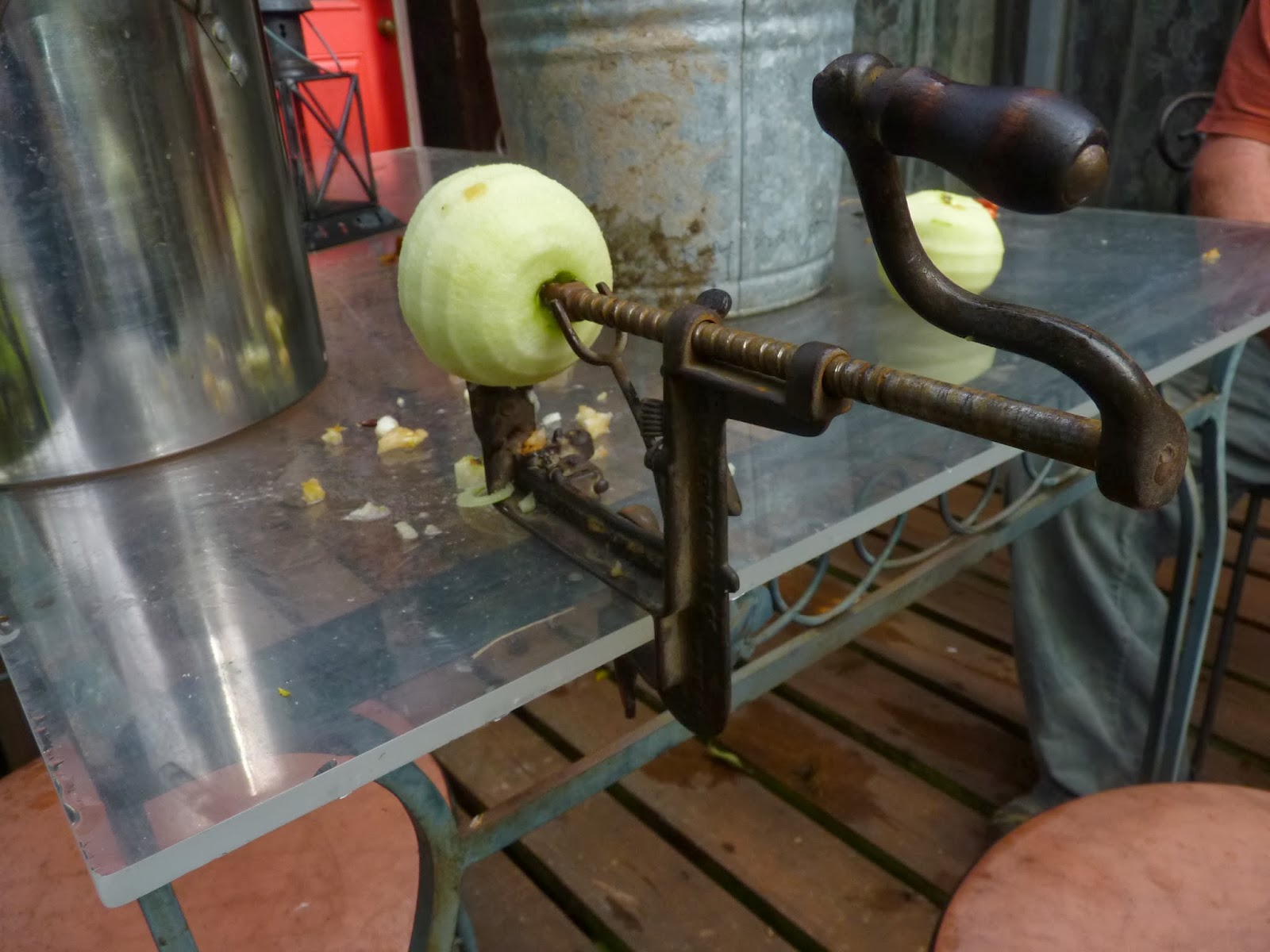
We brought out two tools I haven't used in quite a while: the apple peeler and the corer-slicer. I've had both of these since I was 22, and used them almost every year but then I bought a Squeezo to make my applesauce and my boys grew up and I was canning less. But with so many apples this year, I thought it was time to get the old tools out. And now that Larry has used them and fell in love with their simple mechanics, I would bet we'll be using them a lot more often.

Here's Larry peeling the apples


and here's he is coring and slicing


This tool did have another arm on it that was supposed to do the peeling but I much prefer the big peeler so I removed the peeling arm some time ago. I wonder where it is now? Hmmm...

We ended up doing about a bushel of apples in 2 hours, making 23 quarts of pie filling. The chickens were quite happy to get the peels; in past years I would boil them to get juice to make jelly, but we have no need of more jelly this year. The peels and cores could also be covered with water and left to make vinegar, something I've also done before.

To make the filling: I put the apples into lemon juice and water as I sliced them to keep the slices from turning brown. Then I drained them, added sugar, cinnamon and nutmeg (I measure nothing so I can't give amounts--I make sure the apples are coated with sugar; I judge the spices by the way the mixture looks). Then I bag up the mixture in quart bags and freeze. No cooking required! I've used this method several times in the past with good results, and it is very like the method recommended on the HGTV website.

Now, what to do with the rest of the apples? I think I might try drying some next week, and probably make some more pie filling because next year the crop might not be so abundant.

Copyright Susanna Holstein. All rights reserved. No Republication or Redistribution Allowed without attribution to Susanna Holstein.

Thursday, December 20, 2007

Winter Story: The Twelve Months


Unfortunately a spammer's comments caused me to take this story down from my blog. I'm reposting in the hope that the spammer will not return.

This is a good story for the winter months. This is an adaptation by France Jenkins Olcott in her book Good Stories for Great Holidays. It's in the public domain now and available as an e-text from the Electronic Text Center at the University of Virginia Library. At the end of the story, I'll include links to other online information.

The Twelve Months


There was once a widow who had two daughters, Helen, her own child by her dead husband, and Marouckla, his daughter by his first wife. She loved Helen, but hated the poor orphan because she was far prettier than her own daughter.


Marouckla did not think about her good looks, and could not understand why her stepmother should be angry at the sight of her. The hardest work fell to her share. She cleaned out the rooms, cooked, washed, sewed, spun, wove, brought in the hay, milked the cow, and all this without any help.
Helen, meanwhile, did nothing but dress herself in her best clothes and go to one amusement after another.


But Marouckla never complained. She bore the scoldings and bad temper of mother and sister with a smile on her lips, and the patience of a lamb. But this angelic behavior did not soften them. They became even more tyrannical and grumpy, for Marouckla grew daily more beautiful, while Helen's ugliness increased. So the stepmother determined to get rid of Marouckla, for she knew that while she remained, her own daughter would have no suitors. Hunger, every kind of privation, abuse, every means was used to make the girl's life miserable. But in spite of it all Marouckla grew ever sweeter and more charming.


One day in the middle of winter Helen wanted some wood-violets.


"Listen," cried she to Marouckla, "you must go up the mountain and find me violets. I want some to put in my gown. They must be fresh and sweet-scented-do you hear?"


"But, my dear sister, whoever heard of violets blooming in the snow?" said the poor orphan.


"You wretched creature! Do you dare to disobey me?" said Helen. "Not another word. Off with you! If you do not bring me some violets from the mountain forest I will kill you."


The stepmother also added her threats to those of Helen, and with vigorous blows they pushed Marouckla outside and shut the door upon her. The weeping girl made her way to the mountain. The snow lay deep, and there was no trace of any human being. Long she wandered hither and thither, and lost herself in the wood. She was hungry, and shivered with cold, and prayed to die.


Suddenly she saw a light in the distance, and climbed toward it till she reached the top of the mountain. Upon the highest peak burned a large fire, surrounded by twelve blocks of stone on which sat twelve strange beings. Of these the first three had white hair, three were not quite so old, three were young and handsome, and the rest still younger.


There they all sat silently looking at the fire. They were the Twelve Months of the Year. The great January was placed higher than the others. His hair and mustache were white as snow, and in his hand he held a wand. At first Marouckla was afraid, but after a while her courage returned, and drawing near, she said:


"Men of God, may I warm myself at your fire? I am chilled by the winter cold."


The great January raised his head and answered:
"What brings thee here, my daughter? What dost thou seek?"


"I am looking for violets," replied the maiden.


"This is not the season for violets. Dost thou not see the snow everywhere?" said January.


"I know well, but my sister Helen and my stepmother have ordered me to bring them violets from your mountain. If I return without them they will kill me. I pray you, good shepherds, tell me where they may be found."
Here the great January arose and went over to the youngest of the Months, and, placing his wand in his hand, said:


"Brother March, do thou take the highest place."


March obeyed, at the same time waving his wand over the fire.


Immediately the flames rose toward the sky, the snow began to melt and the trees and shrubs to bud. The grass became green, and from between its blades peeped the pale primrose. It was spring, and the meadows were blue with violets.


"Gather them quickly, Marouckla," said March.


Joyfully she hastened to pick the flowers, and having soon a large bunch she thanked them and ran home. Helen and the stepmother were amazed at the sight of the flowers, the scent of which filled the house.


"Where did you find them?" asked Helen.


"Under the trees on the mountain-side," said Marouckla. Helen kept the flowers for herself and her mother. She did not even thank her stepsister for the trouble she had taken. The next day she desired Marouckla to fetch her strawberries.


"Run," said she, "and fetch me strawberries from the mountain. They must be very sweet and ripe."


"But whoever heard of strawberries ripening in the snow?" exclaimed Marouckla.


"Hold your tongue, worm; don't answer me. If I don't have my strawberries I will kill you," said Helen.


Then the stepmother pushed Marouckla into the yard and bolted the door. The unhappy girl made her way toward the mountain and to the large fire round which sat the Twelve Months. The great January occupied the highest place.


"Men of God, may I warm myself at your fire? The winter cold chills me," said she, drawing near. The great January raised his head and asked: "Why comest thou here? What dost thou seek?"


"I am looking for strawberries," said she.


"We are in the midst of winter," replied January, "strawberries do not grow in the snow."


"I know," said the girl sadly, "but my sister and stepmother have ordered me to bring them strawberries. If I do not they will kill me. Pray, good shepherds, tell me where to find them."


The great January arose, crossed over to the Month opposite him, and putting the wand in his hand, said: "Brother June, do thou take the highest place."


June obeyed, and as he waved his wand over the fire the flames leaped toward the sky. Instantly the snow melted, the earth was covered with verdure, trees were clothed with leaves, birds began to sing, and various flowers blossomed in the forest. It was summer. Under the bushes masses of star-shaped flowers changed into ripening strawberries, and instantly they covered the glade, making it look like a sea of blood.


"Gather them quickly, Marouckla," said June.


Joyfully she thanked the Months, and having filled her apron ran happily home. Helen and her mother wondered at seeing the strawberries, which filled the house with their delicious fragrance.


"Wherever did you find them?" asked Helen crossly.


"Right up among the mountains. Those from under the beech trees are not bad," answered Marouckla.


Helen gave a few to her mother and ate the rest herself. Not one did she offer to her stepsister. Being tired of strawberries, on the third day she took a fancy for some fresh, red apples.


"Run, Marouckla," said she, "and fetch me fresh, red apples from the mountain." "Apples in winter, sister? Why, the trees have neither leaves nor fruit!"


"Idle thing, go this minute," said Helen; "unless you bring back apples we will kill you."


As before, the stepmother seized her roughly and turned her out of the house. The poor girl went weeping up the mountain, across the deep snow, and on toward the fire round which were the Twelve Months. Motionless they sat there, and on the highest stone was the great January.


"Men of God, may I warm myself at your fire? The winter cold chills me," said she, drawing near.


The great January raised his head. "Why comest thou here? What does thou seek?" asked he.


"I am come to look for red apples," replied Marouckla.


"But this is winter, and not the season for red apples," observed the great January.


"I know," answered the girl, "but my sister and stepmother sent me to fetch red apples from the mountain. If I return without them they will kill me."
Thereupon the great January arose and went over to one of the elderly Months, to whom he handed the wand saying:


"Brother September, do thou take the highest place." September moved to the highest stone, and waved his wand over the fire. There was a flare of red flames, the snow disappeared, but the fading leaves which trembled on the trees were sent by a cold northeast wind in yellow masses to the glade. Only a few flowers of autumn were visible. At first Marouckla looked in vain for red apples. Then she espied a tree which grew at a great height, and from the branches of this hung the bright, red fruit. September ordered her to gather some quickly. The girl was delighted and shook the tree. First one apple fell, then another.


"That is enough," said September, "hurry home."


Thanking the Months she returned joyfully. Helen and the stepmother wondered at seeing the fruit.


"Where did you gather them?" asked the stepsister.


"There are more on the mountain-top," answered Marouckla.


"Then, why did you not bring more?" said Helen angrily. "You must have eaten them on your way back, you wicked girl."


"No, dear sister, I have not even tasted them," said Marouckla. "I shook the tree twice. One apple fell each time. Some shepherds would not allow me to shake it again, but told me to return home."


"Listen, mother," said Helen. "Give me my cloak. I will fetch some more apples myself. I shall be able to find the mountain and the tree. The shepherds may cry `Stop!' but I will not leave go till I have shaken down all the apples."


In spite of her mother's advice she wrapped herself in her pelisse, put on a warm hood, and took the road to the mountain. Snow covered everything. Helen lost herself and wandered hither and thither. After a while she saw a light above her, and, following in its direction, reached the mountain-top.
There was the flaming fire, the twelve blocks of stone, and the Twelve Months. At first she was frightened and hesitated; then she came nearer and warmed her hands. She did not ask permission, nor did she speak one polite word.


"What hath brought thee here? What dost thou seek?" said the great January severely.


"I am not obliged to tell you, old graybeard. What business is it of yours?" she replied disdainfully, turning her back on the fire and going toward the forest.


The great January frowned, and waved his wand over his head. Instantly the sky became covered with clouds, the fire went down, snow fell in large flakes, an icy wind howled round the mountain. Amid the fury of the storm Helen stumbled about. The pelisse failed to warm her benumbed limbs. The mother kept on waiting for her. She looked from the window, she watched from the doorstep, but her daughter came not. The hours passed slowly, but Helen did not return.


"Can it be that the apples have charmed her from her home?" thought the mother. Then she clad herself in hood and pelisse, and went in search of her daughter. Snow fell in huge masses. It covered all things. For long she wandered hither and thither, the icy northeast wind whistled in the mountain, but no voice answered her cries.


Day after day Marouckla worked, and prayed, and waited, but neither stepmother nor sister returned. They had been frozen to death on the mountain.


The inheritance of a small house, a field, and a cow fell to Marouckla. In course of time an honest farmer came to share them with her, and their lives were happy and peaceful.


What a great tale! And on the Children's Literature Web Guide, the Cinderella page lists many ideas for classroom use and actiivities to do with this story. Another, slightly different version of the story is on the Sacred Texts website, and on this one. And there is an article in Wikipedia about a Soviet film version of the story, made in 1956.


A Greek version of the story, told by my friend and storyteller Cathy Mosley, is available on H-Net. And then there is this Czech version, which is more like the Olcott story above.


The Baldwin Project offers many classic children's stories, and there is a version of the Twelve Months from the book Fairy Stories Every Child Should Know by Kate Douglas Wiggin & Nora Archibald Smith .


For more information than you'll ever need about calendars, Bill Hollon's site is the place to go with a good bibliography, a FAQ and well-organized information.

Thursday, January 7, 2010

Here Comes the Snowstorn


We're ready. After a slippery, long trip home today, we're snug as bugs and ready for the predicted snow. It is supposed to be between 3 and 12 inches--quite a range. We have two inches of new snow already so I'd say we're likely to have about 6 inches anyway judging by the way it's coming down. All week we have been getting an inch here, two inches there, half inch here so there's a good bit on the ground to start with.

We used our checklist and are all set if the electricity goes off or if we can't get out for a few days. I have books from the library and Larry has some movies, and I have tons of projects to work on if I get to be stuck at home. He graded off the driveway so it will be easier to clear this new snowfall, and got about 15 gallons of water ready; with a well no power means no water.

A snowy day is a good time for storytelling, don't you think? Here is one of my favorites from Russia, the story of the Twelve Months. This is from the book Good Stories for Great Holidays, by Frances Olcott Jenkins and is in the public domain. I've posted it before, but good stories always bear repeating, don't they? You can find other snow stories on my blog by clicking here.

THE TWELVE MONTHS: A SLAV LEGEND
BY ALEXANDER CHODZKO (adapted)


THERE was once a widow who had two daughters, Helen, her own child by her dead husband, and Marouckla, his daughter by his first wife. She loved Helen, but hated the poor orphan because she was far prettier than her own daughter.

Marouckla did not think about her good looks, and could not understand why her stepmother should be angry at the sight of her. The hardest work fell to her share. She cleaned out the rooms, cooked, washed, sewed, spun, wove, brought in the hay, milked the cow, and all this without any help. Helen, meanwhile, did nothing but dress herself in her best clothes and go to one amusement after another.

But Marouckla never complained. She bore the scoldings and bad temper of mother and sister with a smile on her lips, and the patience of a lamb. But this angelic behavior did not soften them. They became even more tyrannical and grumpy, for Marouckla grew daily more beautiful, while Helen's ugliness increased. So the stepmother determined to get rid of Marouckla, for she knew that while she remained, her own daughter would have no suitors. Hunger, every kind of privation, abuse, every means was used to make the girl's life miserable. But in spite of it all Marouckla grew ever sweeter and more charming.

One day in the middle of winter Helen wanted some wood-violets.

"Listen," cried she to Marouckla, "you must go up the mountain and find me violets. I want some to put in my gown. They must be fresh and sweet-scented-do you hear?"

"But, my dear sister, whoever heard of violets blooming in the snow?" said the poor orphan.

"You wretched creature! Do you dare to disobey me?" said Helen. "Not another word. Off with you! If you do not bring me some violets from the mountain forest I will kill you."

The stepmother also added her threats to those of Helen, and with vigorous blows they pushed Marouckla outside and shut the door upon her. The weeping girl made her way to the mountain. The snow lay deep, and there was no trace of any human being. Long she wandered hither and thither, and lost herself in the wood. She was hungry, and shivered with cold, and prayed to die.

Suddenly she saw a light in the distance, and climbed toward it till she reached the top of the mountain. Upon the highest peak burned a large fire, surrounded by twelve blocks of stone on which sat twelve strange beings. Of these the first three had white hair, three were not quite so old, three were young and handsome, and the rest still younger.

There they all sat silently looking at the fire. They were the Twelve Months of the Year. The great January was placed higher than the others. His hair and mustache were white as snow, and in his hand he held a wand. At first Marouckla was afraid, but after a while her courage returned, and drawing near, she said: --

"Men of God, may I warm myself at your fire? I am chilled by the winter cold."

The great January raised his head and answered:

"What brings thee here, my daughter? What dost thou seek?"

"I am looking for violets," replied the maiden.

"This is not the season for violets. Dost thou not see the snow everywhere?" said January.

"I know well, but my sister Helen and my stepmother have ordered me to bring them violets from your mountain. If I return without them they will kill me. I pray you, good shepherds, tell me where they may be found."

Here the great January arose and went over to the youngest of the Months, and, placing his wand in his hand, said, "Brother March, do thou take the highest place."

March obeyed, at the same time waving his wand over the fire. Immediately the flames rose toward the sky, the snow began to melt and the trees and shrubs to bud. The grass became green, and from between its blades peeped the pale primrose. It was spring, and the meadows were blue with violets.

"Gather them quickly, Marouckla," said March.

Joyfully she hastened to pick the flowers, and having soon a large bunch she thanked them and ran home. Helen and the stepmother were amazed at the sight of the flowers, the scent of which filled the house.

"Where did you find them?" asked Helen.

"Under the trees on the mountain-side," said Marouckla.

Helen kept the flowers for herself and her mother. She did not even thank her stepsister for the trouble she had taken. The next day she desired Marouckla to fetch her strawberries.

"Run," said she, "and fetch me strawberries from the mountain. They must be very sweet and ripe."

"But whoever heard of strawberries ripening in the snow?" exclaimed Marouckla.

"Hold your tongue, worm; don't answer me. If I don't have my strawberries I will kill you," said Helen.

Then the stepmother pushed Marouckla into the yard and bolted the door. The unhappy girl made her way toward the mountain and to the large fire round which sat the Twelve Months. The great January occupied the highest place.

"Men of God, may I warm myself at your fire? The winter cold chills me," said she, drawing near.

The great January raised his head and asked: "Why comest thou here? What dost thou seek?"

"I am looking for strawberries," said she.

"We are in the midst of winter," replied January, "strawberries do not grow in the snow."

"I know," said the girl sadly, "but my sister and stepmother have ordered me to bring them strawberries. If I do not they will kill me. Pray, good shepherds, tell me where to find them."

The great January arose, crossed over to the Month opposite him, and putting the wand in his hand, said: "Brother June, do thou take the highest place."

June obeyed, and as he waved his wand over the fire the flames leaped toward the sky. Instantly the snow melted, the earth was covered with verdure, trees were clothed with leaves, birds began to sing, and various flowers blossomed in the forest. It was summer. Under the bushes masses of star-shaped flowers changed into ripening strawberries, and instantly they covered the glade, making it look like a sea of blood.

"Gather them quickly, Marouckla," said June.

Joyfully she thanked the Months, and having filled her apron ran happily home.

Helen and her mother wondered at seeing the strawberries, which filled the house with their delicious fragrance.

"Wherever did you find them?" asked Helen crossly.

"Right up among the mountains. Those from under the beech trees are not bad," answered Marouckla.

Helen gave a few to her mother and ate the rest herself. Not one did she offer to her stepsister. Being tired of strawberries, on the third day she took a fancy for some fresh, red apples.

"Run, Marouckla," said she, "and fetch me fresh, red apples from the mountain."

"Apples in winter, sister? Why, the trees have neither leaves nor fruit!"

"Idle thing, go this minute," said Helen; "unless you bring back apples we will kill you."

As before, the stepmother seized her roughly and turned her out of the house. The poor girl went weeping up the mountain, across the deep snow, and on toward the fire round which were the Twelve Months. Motionless they sat there, and on the highest stone was the great January.

"Men of God, may I warm myself at your fire? The winter cold chills me," said she, drawing near.

The great January raised his head. "Why comest thou here? What does thou seek?" asked he.

"I am come to look for red apples," replied Marouckla.

"But this is winter, and not the season for red apples," observed the great January.

"I know," answered the girl, "but my sister and stepmother sent me to fetch red apples from the mountain. If I return without them they will kill me."

Thereupon the great January arose and went over to one of the elderly Months, to whom he handed the wand saying: --

"Brother September, do thou take the highest place."

September moved to the highest stone, and waved his wand over the fire. There was a flare of red flames, the snow disappeared, but the fading leaves which trembled on the trees were sent by a cold northeast wind in yellow masses to the glade. Only a few flowers of autumn were visible. At first Marouckla looked in vain for red apples. Then she espied a tree which grew at a great height, and from the branches of this hung the bright, red fruit. September ordered her to gather some quickly. The girl was delighted and shook the tree. First one apple fell, then another.

"That is enough," said September; "hurry home."

Thanking the Months she returned joyfully. Helen and the stepmother wondered at seeing the fruit.

"Where did you gather them?" asked the stepsister.

"There are more on the mountain-top," answered Marouckla.

"Then, why did you not bring more?" said Helen angrily. "You must have eaten them on your way back, you wicked girl."

"No, dear sister, I have not even tasted them," said Marouckla. "I shook the tree twice. One apple fell each time. Some shepherds would not allow me to shake it again, but told me to return home."

"Listen, mother," said Helen. "Give me my cloak. I will fetch some more apples myself. I shall be able to find the mountain and the tree. The shepherds may cry `Stop!' but I will not leave go till I have shaken down all the apples."

In spite of her mother's advice she wrapped herself in her pelisse, put on a warm hood, and took the road to the mountain. Snow covered everything. Helen lost herself and wandered hither and thither. After a while she saw a light above her, and, following in its direction, reached the mountain-top.

There was the flaming fire, the twelve blocks of stone, and the Twelve Months. At first she was frightened and hesitated; then she came nearer and warmed her hands. She did not ask permission, nor did she speak one polite word.

"What hath brought thee here? What dost thou seek?" said the great January severely.

"I am not obliged to tell you, old graybeard. What business is it of yours?" she replied disdainfully, turning her back on the fire and going toward the forest.

The great January frowned, and waved his wand over his head. Instantly the sky became covered with clouds, the fire went down, snow fell in large flakes, an icy wind howled round the mountain. Amid the fury of the storm Helen stumbled about. The pelisse failed to warm her benumbed limbs.

The mother kept on waiting for her. She looked from the window, she watched from the doorstep, but her daughter came not. The hours passed slowly, but Helen did not return.

"Can it be that the apples have charmed her from her home?" thought the mother. Then she clad herself in hood and pelisse, and went in search of her daughter. Snow fell in huge masses. It covered all things. For long she wandered hither and thither, the icy northeast wind whistled in the mountain, but no voice answered her cries.

Day after day Marouckla worked, and prayed, and waited, but neither stepmother nor sister returned. They had been frozen to death on the mountain.

The inheritance of a small house, a field, and a cow fell to Marouckla. In course of time an honest farmer came to share them with her, and their lives were happy and peaceful.


Monday, September 27, 2010

Sunday: Apples and Pears

After no rain at all for so long the soft rain on Sunday felt like a blessing on our skin. I can only imagine how the plants and the soil felt.

We had a lot on the to-do list this weekend and surprisingly we got it all done. First was additional cleanup at the cabin which we did on Saturday.

Then it was on to putting up food. While the gardens are pretty much done with the exception of the peppers, the apple tree and pear tree are loaded. So far we've made about 30 gallons of cider and there are still plenty of apples and pears.

So Sunday was designated as Apples and Pears day. While Larry worked outside on cider (and stacking logs, an ongoing project to organize the logs from the cabin), I worked inside on mincemeat, pear conserve and applesauce.

I made green tomato mincemeat, my favorite kind. Instead of suet, I used venison in the mixture, just as I did the last time I made it. The result is tasty and spicy. You can find the recipe I use on this blog post.

The tomatoes were from the farmer's market because mine are long gone. I made one and a half times the recipe, ending up with 15 and a half pints. I loved the bright green of these tomatoes, and they were good and firm, too. 

 This year I added a couple lemons to the mix as well. The color as I chopped was a visual treat; just wish the apples had been red. But in the end, it doesn't make much difference, because once ready for cooking, the mixture looks like this:


But once it's cooked? Ah, rich, spicy brown.


Next was pear conserve. This is a recipe I concocted a couple years ago and it was so good that we hoarded jars of it to use on special occasions. The combination of pears, orange peel and juice, red cherries and spices is a taste treat, especially on a warm biscuit. It's so pretty in the jars, too.

No photos of the cooking process this time, but you can see my recipe with photos by clicking here.

I'm still working on making applesauce for apple butter cooking sometime soon, and I think I've very near my goal of 60 quarts. I cooked another half of a bushel yesterday, and hope to do one more bushel by the end of the week. My only concern is that these are all yellow apples, and I am not sure my apple butter will cook up to the rich brown color it usually does since there are no red skins lending color to the process. I guess we'll find out come cooking time.


After the day's work, it was good to relax with homemade corn bread and vegetable soup in front of our first fire in the fireplace since last April. There is no place in our home as cozy as the log room. I'm wondering if the new room will be as welcoming and if it is, how we will choose between the two in the evenings.
Related Posts Plugin for WordPress, Blogger...