Pages

Showing posts with label winter folktales. Show all posts

Tuesday, January 29, 2019

Stories and Folklore on Ice

With cold weather breathing down our necks again, I got to thinking about ice.

I've dealt with a lot of ice in the last few weeks. Larry is usually the go-to man for such things but with his new knee still healing up, I've been out and about a lot more than usual as I take care of outside chores. I don't mind, and I am sure to put those Yak Trax  ice cleats on my boots, but I have to say, I will be glad to have my man back on the job.

Our driveway was basically a skating rink at the end near the house. Lots of rain followed by freezing temperatures made sure the water was ice in no time at all. Lots of ice. Ice many inches thick in places. Then there was the usual ice on walks, on puddles, and well, pretty much everywhere. I broke up what I could with a mattock, spread sand and wood ash on walks and the worst places on the driveway. And then waited for the thaw, which came late last week.

And now, looks like more ice is on the way and this next weather wave will start with wind and rain before turnng abruptly to snow and below zero temps. Ah me.

But with all that said, I must admit ice holds a fascinating beauty. Like these photos, for example:

This first one was taken by my storytelling friend Gwyn Calvetti, who lives in Minnesota where sub-zero weather is a common winter occurrence. This is a soap bubble, blown in these cold temperatures--it freezes almost immediately and just look at the beauty created!


My sister Juianne Estes often hikes in Shenandoah National Park, and this past weekend took photos of the beautiful ice formations she saw during her hike, like these:


I remember when Jack Frost visited our windows in my childhood home. We don't see that phenonemon these days, but every now and again we might see something pretty on the car windows:


Then there are icicles, admittedly potentially dangerous, but still full of beauty:


Earlier this winter we got to see ice flowers for the first time, and now that I know why they form, I know when and where to look for them in the future.


Of course, ice can bring destruction too, as happened here in the 2003 ice storm--an event I will never forget and hope to never experience again. But never say never, right?


And then there are icy superstitions and weather lore:

Corona: “If a circle forms ‘round the moon,‘Twill rain soon.” The circle that forms around the sun or moon is called a halo. Halos are formed by the light from the sun or moon refracting (bending) as they pass through the ice crystals that form high-level cirrus and cirrostratus clouds. These clouds do not produce rain or snow, but they often precede an advancing low pressure system which may bring bad weather. (from National Park Service's education page.)

Ice in November to walk a duck, the winter will be all rain and muck.

If at Christmas, ice hangs on the willow, then clover may be cut at Easter.

If ice will bear a man at Christmas, it will not bear a mouse afterward.

As long as icicles hang from the roof in winter, so long will flax hang from the distaff.

To be caught in a hailstom is a sign your friends are growing cold

Take a meat chopper outside and cut the ground to frighten off a hailstorm.

This tale comes from Australia:

"An aboriginal myth says that frost comes from the seven stars of the Pleiades, also called the Seven Sisters. The sisters once lived on Earth but were so cold they sparkled with icicles. They flew up into the sky and once each year they pull off their icicles and hurl them down to Earth."

Icy riddles too:

I have no taste,
I have no smell,
You can see right through me,
and can not tell

Lives in winter
dies in summer
grows with its roots upward.

An Anglo-Saxon riddle from the book of Exeter Riddles, circa 960-980 AD). This is riddle #6.

A thing came marvelously     moving over the waves,
comely from the keel up.     It called out to the land,
loudly resounding.     Its laughter was horrible,
awful in its place.     Its edges were sharp;
hateful it was,     and sluggish to battle,
bitter in its hostile deeds.     It dug into shield-walls,
hard, ravaging.     It spread mischievous spells.
It spoke with cunning craft     about its creation:
“Dearest of women     is indeed my mother;
she is my daughter     grown big and strong.
It is known to men of old,     among all people,
that she shall stand up beautifully     everywhere in the world.”


A famous riddle tells the story of a person (sometimes male, in other versions female) who is found murdered in their bed with many stab wounds. The victim and the bed are soaking wet, and on the nightstand is a glass of bloody water. What was the murder weapon?

Why are there sometimes ripples on icicles? Inside Science has the answer!

There is a lot more science about icicles on this sites:

How do icicles form? an article from LiveScience.

Icicle shapes discussed at Inside Science.


With its transformative powers, it is small wonder that ice sometimes appears in folktales and legends. The Snow Queen is probably one of the best known, and was the basis for Disney's Frozen.

Icicle Woman is a haunting (and kinda bloody) ghost story from Japan.

A funny Cajun tale about a unique way to retrieve an axe!

How Davy Crockett saved us from The Frozen Dawn.

Enough about ice! Now I need something warm to drink! Coffee, anyone? But not iced, at least this time.


Copyright Susanna Holstein. All rights reserved. No Republication or Redistribution Allowed without attribution to Susanna Holstein.

Thursday, January 24, 2013

Jack Frost, Father Frost, Frosty Tales


The weather this week is so cold that I do believe we may find that Jack Frost has  painted on some of our older windows in the morning, like the window in this image I found on Wikipedia

As a child, I was fascinated by the icy ferns, vines and prisms etched onto the single-pane windows of Victorian foursquare home. Sometimes the ice would get so thick as the condensation melted and ran to the bottom of the pane that three-dimensional shapes resembling the trunks of miniature trees would form. These "trees" branched out into the fern forests that often stretched out to completely cover the window. 

We would gaze in rapture for a while, tilting our heads so that we could see the early morning sun bounce off the icy glass and create rainbow prisms. But then, oh then, we would have to touch the window. We had to, it was a compelling force inside us that made us touch the glass with our warm fingertips and melt little round circles in the ice. Sometimes we etched our names in the frost, or drew pictures. And sometimes, we might pick away at the mini-trunks until one came loose. Then we'd pry it off and eat that freezing cold and probably very dirty ice. By the time we were finished, the icy forest was decimated but we didn't worry because we knew that in a few hours time it would be back.

Today's children don't experience the wonder of Jack Frost's artwork because our newer, insulated, double and triple paned windows do an effective job of keeping this wintry visitor outside. It's better for the envronment of course because less energy is lost and so less resources consumed as we try to keep warm. But it is a shame that children miss out on the magical experience of waking to find the windows transformed into a fairy world of ice. 

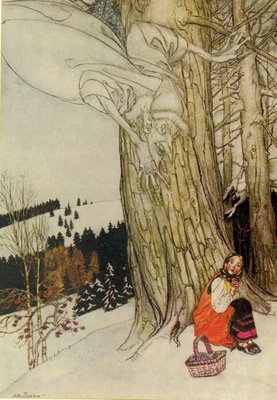
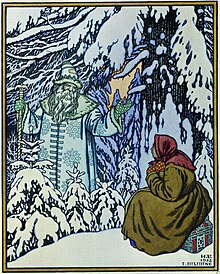
Surprisingly, I found little folklore about Jack Frost, and even fewer stories. There are several images of him, most of a faintly threatening and frightening type like this one by Arthur Rackham, which I think is strange because as a child I saw Jack Frost as a friendly little creature with an artistic flair. I did find this story from Russia, not about Jack Frost but about King Frost, which I suppose makes sense given the Russian weather--Frost is certainly King for a good part of the year. It is a chilly, and chilling, tale:

THE STORY OF KING FROST

From the Yellow Fairy Book by Andrew Lang

There was once upon a time a peasant-woman who had a daughter and a step-daughter. The daughter had her own way in everything, and whatever she did was right in her mother's eyes; but the poor step-daughter had a hard time. Let her do what she would, she was always blamed, and got small thanks for all the trouble she took; nothing was right, everything wrong; and yet, if the truth were known, the girl was worth her weight in gold--she was so unselfish and good-hearted. But her step-mother did not like her, and the poor girl's days were spent in weeping; for it was impossible to live peacefully with the woman. 

The wicked shrew was determined to get rid of the girl by fair means or foul, and kept saying to her father: 'Send her away, old man; send her away--anywhere so that my eyes sha'n't be plagued any longer by the sight of her, or my ears tormented by the sound of her voice. Send her out into the fields, and let the cutting frost do for her.'

In vain did the poor old father weep and implore her pity; she was firm, and he dared not gainsay her. So he placed his daughter in a sledge, not even daring to give her a horse-cloth to keep herself warm with, and drove her out on to the bare, open fields, where he kissed her and left her, driving home as fast as he could, that he might not witness her miserable death.

Deserted by her father, the poor girl sat down under a fir-tree at the edge of the forest and began to weep silently. Suddenly she heard a faint sound: it was King Frost springing from tree to tree, and cracking his fingers as he went. At length he reached the fir-tree beneath which she was sitting, and with a crisp crackling sound he alighted beside her, and looked at her lovely face.

'Well, maiden,' he snapped out, 'do you know who I am? I am King Frost, king of the red-noses.'

'All hail to you, great King!' answered the girl, in a gentle, trembling voice. 'Have you come to take me?'

'Are you warm, maiden?' he replied.

'Quite warm, King Frost,' she answered, though she shivered as she spoke.

Then King Frost stooped down, and bent over the girl, and the crackling sound grew louder, and the air seemed to be full of knives and darts; and again he asked: 'Maiden, are you warm? Are you warm, you beautiful girl?'

And though her breath was almost frozen on her lips, she whispered gently, 'Quite warm, King Frost.'

Then King Frost gnashed his teeth, and cracked his fingers, and his eyes sparkled, and the crackling, crisp sound was louder than ever, and for the last time he asked her: 'Maiden, are you still warm? Are you still warm, little love?'

And the poor girl was so stiff and numb that she could just gasp, 'Still warm, O King!'

Now her gentle, courteous words and her uncomplaining ways touched King Frost, and he had pity on her, and he wrapped her up in furs, and covered her with blankets, and he fetched a great box, in which were beautiful jewels and a rich robe embroidered in gold and silver. And she put it on, and looked more lovely than ever, and King Frost stepped with her into his sledge, with six white horses.

In the meantime the wicked step-mother was waiting at home for news of the girl's death, and preparing pancakes for the funeral feast. And she said to her husband: 'Old man, you had better go out into the fields and find your daughter's body and bury her.' Just as the old man was leaving the house the little dog under the table began to bark, saying: 'YOUR daughter shall live to be your delight; HER daughter shall die this very night.'

'Hold your tongue, you foolish beast!' scolded the woman. 'There's a pancake for you, but you must say:
"HER daughter shall have much silver and gold; HIS daughter is frozen quite stiff and cold." '

But the doggie ate up the pancake and barked, saying: 'His daughter shall wear a crown on her head; Her daughter shall die unwooed, unwed.'

Then the old woman tried to coax the doggie with more pancakes and to terrify it with blows, but he barked on, always repeating the same words. And suddenly the door creaked and flew open, and a great heavy chest was pushed in, and behind it came the step-daughter, radiant and beautiful, in a dress all glittering with silver and gold. For a moment the step-mother's eyes were dazzled. 

Then she called to her husband: 'Old man, yoke the horses at once into the sledge, and take my daughter to the same field and leave her on the same spot exactly; 'and so the old man took the girl and left her beneath the same tree where he had parted from his daughter.

 In a few minutes King Frost came past, and, looking at the girl, he said: 'Are you warm, maiden?'

'What a blind old fool you must be to ask such a question!' she answered angrily. 'Can't you see that my hands and feet are nearly frozen?'

Then King Frost sprang to and fro in front of her, questioning her, and getting only rude, rough words in reply, till at last he got very angry, and cracked his fingers, and gnashed his teeth, and froze her to death.

But in the hut her mother was waiting for her return, and as she grew impatient she said to her husband: 'Get out the horses, old man, to go and fetch her home; but see that you are careful not to upset the sledge and lose the chest.'

But the doggie beneath the table began to bark, saying: 'Your daughter is frozen quite stiff and cold, And shall never have a chest full of gold.'

'Don't tell such wicked lies!' scolded the woman. 'There's a cake for you; now say: "HER daughter shall marry a mighty King."

At that moment the door flew open, and she rushed out to meet her daughter, and as she took her frozen body in her arms she too was chilled to death.

Now, go sit by the fire, sip tea, and be glad that you are a kind and loving person and not like the wicked old woman in the story.


I found this book cover image of a book published in England in 1887on Wikipedia while browsing around. You can read the story by clicking here.


Copyright 2012 Susanna Holstein. All rights reserved. No Republication or Redistribution Allowed without attribution to Susanna Holstein.

Sunday, January 8, 2012

Moon Through Blue Bottles


Cold moon, blue through the bottles dangling in the ash tree as the Wolf Moon--or Moon After Yule or Old Moon, same moon different names--beams white through bare branches.

Here on earth the fire burns white-hot

 and smoke and embers reach for the faraway stars.


Here's a story for you, about the wolf and the moon:


HOW THE WOLF LOST HIS TAIL

Own day the wolf and the fox were out together, and they stole a dish of a creamy cheese called crowdie. The wolf was the bigger of the two beasts, and in those days he had a long, long tail, a beautiful tail to be sure, and his teeth were long and and sharp.


The fox was more than a little afraid of the wolf, so he said nothing when the wolf ate almost all of the crowdie, leaving just a dab for the fox to lick out of the bottom of the bowl. The fox was angry and he decided to get back at the wolf on the very next night they went out together.

There was a full moon the next time the wolf and fox prowled together. "I smell a very nice cheese," said the fox. There it is. Do you see it?" And he pointed to the moonlight shining on the ice.

"How can we get it?" asked the wolf, licking his lips.

"Here is my plan. You stay here. I will see if the farmer is asleep. Keep your tail on top of the cheese so no one else can see it. Can you do that? I might be gone for a long while."

"Don't be silly! Of course I can do it!" snarled the wolf. And he put his tail on top of the moon's reflection in the ice and held it there for an hour or more. You know what happened, don't you? His tail froze to the ice!

The fox waited until he was sure the wolf's tail was stuck fast to the ice. Then he hurried to the farmer's house and cried, "Look up there! There is the wolf! He is coming to eat you and your children!"

The farmer and his wife ran out of the house with large sticks to kill the wolf, but the wolf saw them coming. He tried to get up but found his tai lwas stuck tight to the ice. He gave a great jerk and ran off, leaving his beautiful tail behind.

That is why to this day the fox has a full bushy tail, but the wolf? Well, now you know why his tail looks as it does.

Based on the story from Scottish Fairy and Folk Tales, by George Douglas,c 1901, and reprinted at www.sacred-texts.com

About wolves in Scotland: today there are no wolves in Scotland, and there have not been for centuries. Tales of wolves are noted in writings such as the story above, and there is currently some discussion about reintroducing them in the highlands.For more about the history of wolves in Scotland, check out these links:

For an academic look at the wolf in Scottish legend and lore, "A Noxious Pack" is a  fine read.

Wolf's Tale  from the website Wolves and Humans gives great background information, clips of writings about wolves and a photo found in Scotland of a rock carving of a wolf.

To learn about re-introducing wolves to Scotland, read another page from Wolves and Humans and this article by the BBC.


Thursday, January 7, 2010

Here Comes the Snowstorn


We're ready. After a slippery, long trip home today, we're snug as bugs and ready for the predicted snow. It is supposed to be between 3 and 12 inches--quite a range. We have two inches of new snow already so I'd say we're likely to have about 6 inches anyway judging by the way it's coming down. All week we have been getting an inch here, two inches there, half inch here so there's a good bit on the ground to start with.

We used our checklist and are all set if the electricity goes off or if we can't get out for a few days. I have books from the library and Larry has some movies, and I have tons of projects to work on if I get to be stuck at home. He graded off the driveway so it will be easier to clear this new snowfall, and got about 15 gallons of water ready; with a well no power means no water.

A snowy day is a good time for storytelling, don't you think? Here is one of my favorites from Russia, the story of the Twelve Months. This is from the book Good Stories for Great Holidays, by Frances Olcott Jenkins and is in the public domain. I've posted it before, but good stories always bear repeating, don't they? You can find other snow stories on my blog by clicking here.

THE TWELVE MONTHS: A SLAV LEGEND
BY ALEXANDER CHODZKO (adapted)


THERE was once a widow who had two daughters, Helen, her own child by her dead husband, and Marouckla, his daughter by his first wife. She loved Helen, but hated the poor orphan because she was far prettier than her own daughter.

Marouckla did not think about her good looks, and could not understand why her stepmother should be angry at the sight of her. The hardest work fell to her share. She cleaned out the rooms, cooked, washed, sewed, spun, wove, brought in the hay, milked the cow, and all this without any help. Helen, meanwhile, did nothing but dress herself in her best clothes and go to one amusement after another.

But Marouckla never complained. She bore the scoldings and bad temper of mother and sister with a smile on her lips, and the patience of a lamb. But this angelic behavior did not soften them. They became even more tyrannical and grumpy, for Marouckla grew daily more beautiful, while Helen's ugliness increased. So the stepmother determined to get rid of Marouckla, for she knew that while she remained, her own daughter would have no suitors. Hunger, every kind of privation, abuse, every means was used to make the girl's life miserable. But in spite of it all Marouckla grew ever sweeter and more charming.

One day in the middle of winter Helen wanted some wood-violets.

"Listen," cried she to Marouckla, "you must go up the mountain and find me violets. I want some to put in my gown. They must be fresh and sweet-scented-do you hear?"

"But, my dear sister, whoever heard of violets blooming in the snow?" said the poor orphan.

"You wretched creature! Do you dare to disobey me?" said Helen. "Not another word. Off with you! If you do not bring me some violets from the mountain forest I will kill you."

The stepmother also added her threats to those of Helen, and with vigorous blows they pushed Marouckla outside and shut the door upon her. The weeping girl made her way to the mountain. The snow lay deep, and there was no trace of any human being. Long she wandered hither and thither, and lost herself in the wood. She was hungry, and shivered with cold, and prayed to die.

Suddenly she saw a light in the distance, and climbed toward it till she reached the top of the mountain. Upon the highest peak burned a large fire, surrounded by twelve blocks of stone on which sat twelve strange beings. Of these the first three had white hair, three were not quite so old, three were young and handsome, and the rest still younger.

There they all sat silently looking at the fire. They were the Twelve Months of the Year. The great January was placed higher than the others. His hair and mustache were white as snow, and in his hand he held a wand. At first Marouckla was afraid, but after a while her courage returned, and drawing near, she said: --

"Men of God, may I warm myself at your fire? I am chilled by the winter cold."

The great January raised his head and answered:

"What brings thee here, my daughter? What dost thou seek?"

"I am looking for violets," replied the maiden.

"This is not the season for violets. Dost thou not see the snow everywhere?" said January.

"I know well, but my sister Helen and my stepmother have ordered me to bring them violets from your mountain. If I return without them they will kill me. I pray you, good shepherds, tell me where they may be found."

Here the great January arose and went over to the youngest of the Months, and, placing his wand in his hand, said, "Brother March, do thou take the highest place."

March obeyed, at the same time waving his wand over the fire. Immediately the flames rose toward the sky, the snow began to melt and the trees and shrubs to bud. The grass became green, and from between its blades peeped the pale primrose. It was spring, and the meadows were blue with violets.

"Gather them quickly, Marouckla," said March.

Joyfully she hastened to pick the flowers, and having soon a large bunch she thanked them and ran home. Helen and the stepmother were amazed at the sight of the flowers, the scent of which filled the house.

"Where did you find them?" asked Helen.

"Under the trees on the mountain-side," said Marouckla.

Helen kept the flowers for herself and her mother. She did not even thank her stepsister for the trouble she had taken. The next day she desired Marouckla to fetch her strawberries.

"Run," said she, "and fetch me strawberries from the mountain. They must be very sweet and ripe."

"But whoever heard of strawberries ripening in the snow?" exclaimed Marouckla.

"Hold your tongue, worm; don't answer me. If I don't have my strawberries I will kill you," said Helen.

Then the stepmother pushed Marouckla into the yard and bolted the door. The unhappy girl made her way toward the mountain and to the large fire round which sat the Twelve Months. The great January occupied the highest place.

"Men of God, may I warm myself at your fire? The winter cold chills me," said she, drawing near.

The great January raised his head and asked: "Why comest thou here? What dost thou seek?"

"I am looking for strawberries," said she.

"We are in the midst of winter," replied January, "strawberries do not grow in the snow."

"I know," said the girl sadly, "but my sister and stepmother have ordered me to bring them strawberries. If I do not they will kill me. Pray, good shepherds, tell me where to find them."

The great January arose, crossed over to the Month opposite him, and putting the wand in his hand, said: "Brother June, do thou take the highest place."

June obeyed, and as he waved his wand over the fire the flames leaped toward the sky. Instantly the snow melted, the earth was covered with verdure, trees were clothed with leaves, birds began to sing, and various flowers blossomed in the forest. It was summer. Under the bushes masses of star-shaped flowers changed into ripening strawberries, and instantly they covered the glade, making it look like a sea of blood.

"Gather them quickly, Marouckla," said June.

Joyfully she thanked the Months, and having filled her apron ran happily home.

Helen and her mother wondered at seeing the strawberries, which filled the house with their delicious fragrance.

"Wherever did you find them?" asked Helen crossly.

"Right up among the mountains. Those from under the beech trees are not bad," answered Marouckla.

Helen gave a few to her mother and ate the rest herself. Not one did she offer to her stepsister. Being tired of strawberries, on the third day she took a fancy for some fresh, red apples.

"Run, Marouckla," said she, "and fetch me fresh, red apples from the mountain."

"Apples in winter, sister? Why, the trees have neither leaves nor fruit!"

"Idle thing, go this minute," said Helen; "unless you bring back apples we will kill you."

As before, the stepmother seized her roughly and turned her out of the house. The poor girl went weeping up the mountain, across the deep snow, and on toward the fire round which were the Twelve Months. Motionless they sat there, and on the highest stone was the great January.

"Men of God, may I warm myself at your fire? The winter cold chills me," said she, drawing near.

The great January raised his head. "Why comest thou here? What does thou seek?" asked he.

"I am come to look for red apples," replied Marouckla.

"But this is winter, and not the season for red apples," observed the great January.

"I know," answered the girl, "but my sister and stepmother sent me to fetch red apples from the mountain. If I return without them they will kill me."

Thereupon the great January arose and went over to one of the elderly Months, to whom he handed the wand saying: --

"Brother September, do thou take the highest place."

September moved to the highest stone, and waved his wand over the fire. There was a flare of red flames, the snow disappeared, but the fading leaves which trembled on the trees were sent by a cold northeast wind in yellow masses to the glade. Only a few flowers of autumn were visible. At first Marouckla looked in vain for red apples. Then she espied a tree which grew at a great height, and from the branches of this hung the bright, red fruit. September ordered her to gather some quickly. The girl was delighted and shook the tree. First one apple fell, then another.

"That is enough," said September; "hurry home."

Thanking the Months she returned joyfully. Helen and the stepmother wondered at seeing the fruit.

"Where did you gather them?" asked the stepsister.

"There are more on the mountain-top," answered Marouckla.

"Then, why did you not bring more?" said Helen angrily. "You must have eaten them on your way back, you wicked girl."

"No, dear sister, I have not even tasted them," said Marouckla. "I shook the tree twice. One apple fell each time. Some shepherds would not allow me to shake it again, but told me to return home."

"Listen, mother," said Helen. "Give me my cloak. I will fetch some more apples myself. I shall be able to find the mountain and the tree. The shepherds may cry `Stop!' but I will not leave go till I have shaken down all the apples."

In spite of her mother's advice she wrapped herself in her pelisse, put on a warm hood, and took the road to the mountain. Snow covered everything. Helen lost herself and wandered hither and thither. After a while she saw a light above her, and, following in its direction, reached the mountain-top.

There was the flaming fire, the twelve blocks of stone, and the Twelve Months. At first she was frightened and hesitated; then she came nearer and warmed her hands. She did not ask permission, nor did she speak one polite word.

"What hath brought thee here? What dost thou seek?" said the great January severely.

"I am not obliged to tell you, old graybeard. What business is it of yours?" she replied disdainfully, turning her back on the fire and going toward the forest.

The great January frowned, and waved his wand over his head. Instantly the sky became covered with clouds, the fire went down, snow fell in large flakes, an icy wind howled round the mountain. Amid the fury of the storm Helen stumbled about. The pelisse failed to warm her benumbed limbs.

The mother kept on waiting for her. She looked from the window, she watched from the doorstep, but her daughter came not. The hours passed slowly, but Helen did not return.

"Can it be that the apples have charmed her from her home?" thought the mother. Then she clad herself in hood and pelisse, and went in search of her daughter. Snow fell in huge masses. It covered all things. For long she wandered hither and thither, the icy northeast wind whistled in the mountain, but no voice answered her cries.

Day after day Marouckla worked, and prayed, and waited, but neither stepmother nor sister returned. They had been frozen to death on the mountain.

The inheritance of a small house, a field, and a cow fell to Marouckla. In course of time an honest farmer came to share them with her, and their lives were happy and peaceful.


Monday, December 8, 2008

A Story for the Season: Silver Pine Cones

Here is an interesting story to tell during the holiday season, and an idea for a simple craft and gift--a pine cone painted silver. The story is said to be from the Hartz Mountains of Germany, according to this website. You can find many other versions of the tale online, although I found no print source of the story listed. If you know one, please share!)


Legend of the Silver Pine Cones

There once lived a poor family without enough food to eat or wood for their fire. The mother decided to go into the forest to search for pine cones; these would burn brightly, if only for a short time, and provide some warmth for her cold house and family. Perhaps, she thought, I might be able to sell a few of the pine cones and make a little money to buy food too.

In the forest, the woman kicked away the snow and began picking up the fallen cones. Her fingers were soon numb with cold, but she persisted in her task.


“Why are you stealing my pine cones?” She looked around and saw a tiny elf on a log beside her.


"My family is cold and hungry," the woman explained. "The pine cones will warm us in the fire, and I might be able to sell a few and then buy a bit of bread for my little children."


"Well," the elf said, “Go into the next forest. The pine cones there are much better.” the elf disappeared as quickly as it had come.


The woman was tired, but the elf had spoken so assuredly that she decided to see if the elf was right. She made her way to the next forest, which was quite a long walk. But the elf had not lied--there were pine cones all over the ground and the woman quickly filled her basket. How happy everyone will be at home tonight, she thought. The sun was setting as she made her way home.


As she opened the door, she glanced down at her basket. The pine cones had all turned to silver!


The woman was able to buy all the food her family needed for the winter, and even then she had many silver pine cones left for the coming years. And because of her saving, careful ways, her family was never hungry or poor again.


Some people still believe that a silver pine cone brings luck. Hang one on your tree, or paint some pine cones silver this holiday season and give them to friends and family, along with a copy of this story. It is a simple gift, but one that is sure to be cherished.

Friday, December 5, 2008

Silver Hoof and Other Winter Stories

Storytellers, parents and teachers are always looking for new stories to share with their listeners. Here is one of my favorites from The Malachite Casket: Tales from the Urals by Pavel Bazhov (1879-1950).

Silver Hoof
There was an old man who used to live in our village called Kokovanya. He'd none of his own family left, so he thought he'd take some orphan into his hut to be a child to him.

He asked the neighbors if they know of anyone, and they told him: "Grigory Potapov's children were left orphans on Glinka not long ago. The bailiff sent the older girls to the manor sewing-room, but there's a little girl of six nobody wanted. That would be the child for you."

But Kokovanya said: "I'd be unhandy-like with a lass. A lad would be better. I'd teach him my trade and he'd help me, too, when he got bigger. But what can I do with a lass? What can I teach her?"

But then he thought about it all again. "I knew Grigory and his good wife too," he said. "They were lusty workers and right merry folk. If the lass takes after them, it won't be dull in the hut. I'll have her. But maybe she won't come?"

"Eh, her life's none so sweet," the neighbors told him. "The bailiff gave Grigory's cottage to some poor devil, and told him to look after the orphan till she grows up. But he's got a dozen of his own. They haven't enough for their own mouths. And the wife nags at the orphan child and grudges her every crust. She's little, but she's big enough to understand. She feels it. Wouldn't you say she'd want to get away from it all? And then you'll talk to her a bit, and she'll take to you."

"Aye, that's true," said Kokovanya. "I'll talk to her kindly-like."

When the next holiday came round he went to the place where the orphan lived. He found the hut crowded with folks, young and old. A little girl sat by the stove nursing a brown cat. The child was small and the cat was small too, so thin and bedraggled it was a wonder anyone would let it in. The child was stroking the cat and it purred so you could hear it all over the hut.

Kokovanya looked at the girl and asked: "Is that Grigory's giftie?"

"The same," said the goodwife. "And as if it's not enough feeding her, she's got to drag in that mangy beast too. We can't get rid of it. And it scratches the children. And then on top of it all, I've got to feed it!"

"They must tease it, your children," said Kokovanya gravely. "When she has it, it purrs." Then he turned to the child. "Well, Podaryonka [a little gift], how'd you like to come and live with me?"

The child stared. "How did you know I'm called Daryonka?"

"It just came," he said. "I didn't think, I didn't know, I just happened on it."

"But who are you?" the child asked.

I'm a sort of hunter," said Kokovanya. "Summertime I wash sand and look for gold, and winters I go to the woods and look for the goat, but I never get a sight of it."

"Will you shoot it if you do?"

"Nay," said Kokovanya, "I shoot ordinary goats, but that one I won't. I want to see where he stamps his right forefoot."

"What for?"

"Come and live with me, and I'll tell you all about it," said Kokovanya.

The little girl wanted very much to hear about the goat, and she could see he was a merry, kind old man. So she said: "I'll come. But take my Kitty too. Look how good she is."

"That's as sure as I stand here," said Kokovanya. "Only a fool would leave a cat that sings like that. She'll be as good as a balalaika in the hut."

The goodwife heard their talk, and she was as glad as could be to get the orphan off her hands. She started putting Daryonka's things together all in a hurry. She was afeard Kokovanya might think better of it.

The cat seemed to understand all about it too. She kept rubbing up against their legs and purring: "R-r-right! You'r-r-re r-r-ight!"

So Kokovanya took the orphan home. He was tall and bearded, and she was a bit of a thing with a button nose. Down the street they went with the draggled cat trotting along behind.

That was how they came to live together--Grandad Kokovanya, the orphan Daryonka and Kitty. The days passed, they didn't get rich but they had enough and there was plenty for everyone to do.

In the morning Kokovanya went to work, Daryonka tidied the hut and made soup and porridge, while Kitty hunted mice. In the evening they were all at home, very comfortable and merry.

The old man was a wonderful teller of tales. Daryonka loved to listen, and Kitty would lie purring: "R-r-right! You'r-r-re r-r-ight!"

But after every story Daryonka would remind the old man: "Now, tell me about the goat, Grandad. What is he like?"

At first Kokovanya tried to put her off, but then he told her.

"That's a very special goat. On his right forefoot he's got a silver hoof. And when he stamps with that silver hoof he leaves a gem there. If he stamps once there's one gem, if he stamps twice there are two, and if he begins to paw the ground there'll be a whole pile."

He told her, and then he was sorry, because after that Daryonka could talk of nothing but the goat.

"Grandad, is he a big goat?"

Kokovanya told her he was no taller than the table, with thin legs and a pretty head. But Daryonka kept on: "And has he got horns, Grandad?"

"Aye, that he has, and fine ones too. Ordinary goats have two horns, but this one's got antlers, with five tines."

"And does he eat people, Grandad?"

"No, he doesn't eat people, he eats grass and leaves. Well, and he may nibble a bit of hay from the stacks in winter."

"And what color is he?"

"In summer he's brown like Kitty here, and in winter he's silver-gray."

Autumn came and Kokovanya got ready to go to the woods. He wanted to see where the goats were feeding. But then Daryonka started begging and pleading.

"Take me with you, Grandad! I might get a look at the goat, even if he's a long way off!"

"A long way off you wouldn't know him," said Kokovanya. "All goats have horns in autumn. And you wouldn't see how many tines there are. In the winter, now--that's different. Ordinary goats haven't got horns then, but Silver Hoof has them all the time. So then you can know him even when he's far away."

With that talk he managed to quiet her. Daryonka stopped at home, while Kokovanya went to the woods. On the fifth day he came back.

"A lot of goats are feeding Poldnevsk way this year," he said. "That's where I'll go when winter comes."

"But how'll you sleep in the woods in winter?" asked Daryonka.

"I've got a bit of a hut there, by the glade where we go mowing," he said. "It's a stout one with a window and a stove. I'm all right there."

Then Daryonka started off again: "Will Silver Hoof feed there too?"

"Who knows? He may."

Then the child started off with her begging and pleading: "Take me with you, Grandad! I'll stop in the hut. Maybe Silver Hoof'll come up close and then I'll see him."

At first the old man wouldn't hear of it. "What! Take a little girl into the woods in winter! You'd have to go on skis and you don't know how. You'd sink in the snow. What would I do then? You'd freeze too!"

But Daryonka wouldn't let him alone. She kept begging: "Take me, take me, Grandad! I can ski a little bit!"

Kokovanya talked this way and that, but at last he thought to himself: "What if I do take her after all? If she tries it once she won't ask again."

"All right," he said, "I'll take you. Only see you don't start crying when we get to the woods or asking to go home."

When winter was really come, Kokovanya loaded a hand sled with two sacks of rusks, some hunting supplies and other odd things he'd need of. Daryonka made herself a little bundle too. She took some scraps of cloth to make a frock for her doll, a hank of thread and a needle, and then she put in a rope too.

I may be able to catch Silver Hoof with it, she thought.

She was sorry to leave the cat, but there was naught else to be done with it. She stroked it and talked to it, and explained all about everything.

"Grandad and I are going to the woods, Kitty, and you must stop here and catch all the mice. When we see Silver Hoof we'll come back home again and I'll tell you all about it."

Kitty looked up with cunning eyes and purred: "R-r-right! You'r-r-re
r-r-ight!"

So Kokovanya and Daryonka set off. And all the neighbors stared in amaze. "The old man must be doting! Taking a little girl like that to the woods in winter!"

Just as Kokovanya and Daryonka were leaving the last houses behind, they heard all the dogs making a big fuss and commotion, barking and howling as though some wild beast had got in. They looked round, and there was Kitty running down the middle of the street, spitting and swearing at the dogs. Kitty was a fine big cat now, and able to look after herself. There wasn't a dog anywhere that would try a fight with her.

Daryonka wanted to catch her and take her back home, but just try to catch Kitty! She ran into the woods and up a tree in a flash. Get her out of there if you can! Daryonka called and called, but Kitty wasn't to be lured down. So what could they do? They had to go on. And when they looked around, there was Kitty running along near them, off to one side. That was how they came at last to the hut.

So all three of them lived there. And Daryonka liked it. "It's nice here," she said. Kokovanya agreed, "Aye, it's more cheerful-like." And Kitty curled up in a ball by the stove and purred loudly: "R-r-right! You'r-r-re r-r-ight!"

There were a lot of goats that winter. Ordinary goats. Kokovanya brought one or two home every day. The hides piled up and the meat was salted--far too much to be taken back on the hand sled. Kokovanya saw he would have to go home for a horse, but how could he leave Daryonka alone in the woods with only the cat? But Daryonka had got used to the woods and she spoke of it herself.

"Grandad, why don't you go to the village for a horse? We ought to take the salt meat home."

Kokovanya was astonished.

"What a wise head on little shoulders! As sensible as a woman grown. Thought of it all by yourself. But won't you be frightened, all alone?"

"Why'd I be frightened?" she answered. "You say yourself the hut's a good strong one, the wolves can't get in, and besides they don't come here. And I've got Kitty with me. I won't be frightened. But come back quickly all the same!"

Kokovanya left. And Daryonka stopped behind alone with Kitty. She was quite used to being along in the daytime when Kokovanya was tracking goats. But when it began to get dark she felt a bit queer-like. So she looked at Kitty and saw she was lying comfortable and contented. That made Daryonka feel better. She sat down by the window and looked out towards the glade and--there!--something like a little ball bounced out of the woods. It came closer and she saw it was a goat. He had thin legs and a slender head, and five tines on his horns. Daryonka ran out at once, but she found nothing there. She waited and waited, and at last went back to the hut. "I
must have dreamed it," she said, "it was just my fancy."

Kitty purred: "R-r-right! You'r-r-re r-r-ight!"

Daryonka went to bed taking the cat with her, and slept soundly till morning. Another day passed. No Kokovanya. Daryonka felt dull and
lonely but she did not cry. Instead she pet the cat.

"Don't fret, Kitty," she said. "Grandad'll come tomorrow, you'll see."

Kitty only sang her usual song: "R-r-right! You'r-r-re r-r-ight!"

Again Daryonka sat by the window looking at the stars. She was thinking of going to bed when she suddenly heard a pitter-pitter-pat behind the wall of the hut. She jumped up, frightened, and then heard the pitter-pitter-pat by the other wall, then back by the first one again, then by the door, and at last up on the roof. It was not loud, it sounded like very quick, light footsteps.

Suddenly Daryonka thought to herself: What if that's the goat that came yesterday? She wanted so badly to see it that even fright couldn't hold her back. She opened the door and peeped out, and there was the goat, quite close, standing as quiet as could be. It raised its front foot to stamp and a silver hoof gleamed on it, and the horns had five tines. Daryonka did not know what to do, so she called it as she would an ordinary nannie or billie.

How that goat laughed! Then he turned and ran across the glade. Daryonka went back into the hut and told Kitty all about it.

"I've seen Silver Hoof. I saw his horns and I saw his hoof. Only I didn't see him stamp and leave precious stones. He'll show me that next time."

Kitty sang her usual song: "R-r-right! You'r-r-re r-r-ight!"

The third day passed and still no Kokovanya. Daryonka's face was quite clouded. She even cried a bit. She wanted to talk to Kitty, but Kitty was gone. Then Daryonka got really frightened and ran out to look for the cat.

It was a light night with a full moon. Daryonka looked round and there was the cat, quite close, sitting in the glade with the goat in front of her. Kitty was nodding her head and so was the goat, as if they were having a talk. Then they began running about on the snow.

The goat ran here and ran there, then he stopped and stamped.

They ran about the glade for a long time, and disappeared in the distance. Then they came right up to the hut again. The goat jumped up on the roof and began stamping with his silver hoof. And precious stones flashed out like sparks--red, green, light blue, dark blue--every kind and color.

It was then that Kokovanya returned. But he did not know his hut. It
was covered with precious stones, sparkling and winking in all colors. And there stood the goat on top, stamping and stamping with his silver hoof, and the stones kept rolling and rolling down.

Suddenly Kitty jumped up there too and stood beside the goat purring loudly--and then there was nothing, no Kitty and no Silver Hoof.

Kokovanya scooped up half a hatful of stones, but Daryonka begged him: "Don't touch them, Grandad! I want to look at it just as it is in
the morning."

Kokovanya did as she asked. But before morning heavy snow fell and
covered everything up.

They cleared the snow away afterwards, but they couldn't find anything. Well, they didn't do so badly after all, with what Kokovanya had collected in his hat.

So it all ended well, though it was a shame about Kitty. She was never seen again, and Silver Hood didn't come back either. He'd come once, that was enough.

But after that people often found stones in the glade where the goat had run about. Most of them were green ones, chrysolites, folks call them. Have you ever seen them?


There is something magical about the story of Silver Hoof. I think if I told it I would leave out the cat's lines, and probably some other things would change in the telling, but the bones of the story are lovely--an old man who befriends an orphan and a mysterious creature with mystic abilities. What's not to love?

Here are some links to other winter tales for telling that I posted on my blog last winter:

Grandfather Frost

The Twelve Months

The Snow Man by Hans Christian Andersen


Winter Wiggle Breaks for preschool fun activities

Links to stories about Grandmother Winter, the Snow Woman and more

Enjoy!

Thursday, December 20, 2007

Winter Story: The Twelve Months


Unfortunately a spammer's comments caused me to take this story down from my blog. I'm reposting in the hope that the spammer will not return.

This is a good story for the winter months. This is an adaptation by France Jenkins Olcott in her book Good Stories for Great Holidays. It's in the public domain now and available as an e-text from the Electronic Text Center at the University of Virginia Library. At the end of the story, I'll include links to other online information.

The Twelve Months


There was once a widow who had two daughters, Helen, her own child by her dead husband, and Marouckla, his daughter by his first wife. She loved Helen, but hated the poor orphan because she was far prettier than her own daughter.


Marouckla did not think about her good looks, and could not understand why her stepmother should be angry at the sight of her. The hardest work fell to her share. She cleaned out the rooms, cooked, washed, sewed, spun, wove, brought in the hay, milked the cow, and all this without any help.
Helen, meanwhile, did nothing but dress herself in her best clothes and go to one amusement after another.


But Marouckla never complained. She bore the scoldings and bad temper of mother and sister with a smile on her lips, and the patience of a lamb. But this angelic behavior did not soften them. They became even more tyrannical and grumpy, for Marouckla grew daily more beautiful, while Helen's ugliness increased. So the stepmother determined to get rid of Marouckla, for she knew that while she remained, her own daughter would have no suitors. Hunger, every kind of privation, abuse, every means was used to make the girl's life miserable. But in spite of it all Marouckla grew ever sweeter and more charming.


One day in the middle of winter Helen wanted some wood-violets.


"Listen," cried she to Marouckla, "you must go up the mountain and find me violets. I want some to put in my gown. They must be fresh and sweet-scented-do you hear?"


"But, my dear sister, whoever heard of violets blooming in the snow?" said the poor orphan.


"You wretched creature! Do you dare to disobey me?" said Helen. "Not another word. Off with you! If you do not bring me some violets from the mountain forest I will kill you."


The stepmother also added her threats to those of Helen, and with vigorous blows they pushed Marouckla outside and shut the door upon her. The weeping girl made her way to the mountain. The snow lay deep, and there was no trace of any human being. Long she wandered hither and thither, and lost herself in the wood. She was hungry, and shivered with cold, and prayed to die.


Suddenly she saw a light in the distance, and climbed toward it till she reached the top of the mountain. Upon the highest peak burned a large fire, surrounded by twelve blocks of stone on which sat twelve strange beings. Of these the first three had white hair, three were not quite so old, three were young and handsome, and the rest still younger.


There they all sat silently looking at the fire. They were the Twelve Months of the Year. The great January was placed higher than the others. His hair and mustache were white as snow, and in his hand he held a wand. At first Marouckla was afraid, but after a while her courage returned, and drawing near, she said:


"Men of God, may I warm myself at your fire? I am chilled by the winter cold."


The great January raised his head and answered:
"What brings thee here, my daughter? What dost thou seek?"


"I am looking for violets," replied the maiden.


"This is not the season for violets. Dost thou not see the snow everywhere?" said January.


"I know well, but my sister Helen and my stepmother have ordered me to bring them violets from your mountain. If I return without them they will kill me. I pray you, good shepherds, tell me where they may be found."
Here the great January arose and went over to the youngest of the Months, and, placing his wand in his hand, said:


"Brother March, do thou take the highest place."


March obeyed, at the same time waving his wand over the fire.


Immediately the flames rose toward the sky, the snow began to melt and the trees and shrubs to bud. The grass became green, and from between its blades peeped the pale primrose. It was spring, and the meadows were blue with violets.


"Gather them quickly, Marouckla," said March.


Joyfully she hastened to pick the flowers, and having soon a large bunch she thanked them and ran home. Helen and the stepmother were amazed at the sight of the flowers, the scent of which filled the house.


"Where did you find them?" asked Helen.


"Under the trees on the mountain-side," said Marouckla. Helen kept the flowers for herself and her mother. She did not even thank her stepsister for the trouble she had taken. The next day she desired Marouckla to fetch her strawberries.


"Run," said she, "and fetch me strawberries from the mountain. They must be very sweet and ripe."


"But whoever heard of strawberries ripening in the snow?" exclaimed Marouckla.


"Hold your tongue, worm; don't answer me. If I don't have my strawberries I will kill you," said Helen.


Then the stepmother pushed Marouckla into the yard and bolted the door. The unhappy girl made her way toward the mountain and to the large fire round which sat the Twelve Months. The great January occupied the highest place.


"Men of God, may I warm myself at your fire? The winter cold chills me," said she, drawing near. The great January raised his head and asked: "Why comest thou here? What dost thou seek?"


"I am looking for strawberries," said she.


"We are in the midst of winter," replied January, "strawberries do not grow in the snow."


"I know," said the girl sadly, "but my sister and stepmother have ordered me to bring them strawberries. If I do not they will kill me. Pray, good shepherds, tell me where to find them."


The great January arose, crossed over to the Month opposite him, and putting the wand in his hand, said: "Brother June, do thou take the highest place."


June obeyed, and as he waved his wand over the fire the flames leaped toward the sky. Instantly the snow melted, the earth was covered with verdure, trees were clothed with leaves, birds began to sing, and various flowers blossomed in the forest. It was summer. Under the bushes masses of star-shaped flowers changed into ripening strawberries, and instantly they covered the glade, making it look like a sea of blood.


"Gather them quickly, Marouckla," said June.


Joyfully she thanked the Months, and having filled her apron ran happily home. Helen and her mother wondered at seeing the strawberries, which filled the house with their delicious fragrance.


"Wherever did you find them?" asked Helen crossly.


"Right up among the mountains. Those from under the beech trees are not bad," answered Marouckla.


Helen gave a few to her mother and ate the rest herself. Not one did she offer to her stepsister. Being tired of strawberries, on the third day she took a fancy for some fresh, red apples.


"Run, Marouckla," said she, "and fetch me fresh, red apples from the mountain." "Apples in winter, sister? Why, the trees have neither leaves nor fruit!"


"Idle thing, go this minute," said Helen; "unless you bring back apples we will kill you."


As before, the stepmother seized her roughly and turned her out of the house. The poor girl went weeping up the mountain, across the deep snow, and on toward the fire round which were the Twelve Months. Motionless they sat there, and on the highest stone was the great January.


"Men of God, may I warm myself at your fire? The winter cold chills me," said she, drawing near.


The great January raised his head. "Why comest thou here? What does thou seek?" asked he.


"I am come to look for red apples," replied Marouckla.


"But this is winter, and not the season for red apples," observed the great January.


"I know," answered the girl, "but my sister and stepmother sent me to fetch red apples from the mountain. If I return without them they will kill me."
Thereupon the great January arose and went over to one of the elderly Months, to whom he handed the wand saying:


"Brother September, do thou take the highest place." September moved to the highest stone, and waved his wand over the fire. There was a flare of red flames, the snow disappeared, but the fading leaves which trembled on the trees were sent by a cold northeast wind in yellow masses to the glade. Only a few flowers of autumn were visible. At first Marouckla looked in vain for red apples. Then she espied a tree which grew at a great height, and from the branches of this hung the bright, red fruit. September ordered her to gather some quickly. The girl was delighted and shook the tree. First one apple fell, then another.


"That is enough," said September, "hurry home."


Thanking the Months she returned joyfully. Helen and the stepmother wondered at seeing the fruit.


"Where did you gather them?" asked the stepsister.


"There are more on the mountain-top," answered Marouckla.


"Then, why did you not bring more?" said Helen angrily. "You must have eaten them on your way back, you wicked girl."


"No, dear sister, I have not even tasted them," said Marouckla. "I shook the tree twice. One apple fell each time. Some shepherds would not allow me to shake it again, but told me to return home."


"Listen, mother," said Helen. "Give me my cloak. I will fetch some more apples myself. I shall be able to find the mountain and the tree. The shepherds may cry `Stop!' but I will not leave go till I have shaken down all the apples."


In spite of her mother's advice she wrapped herself in her pelisse, put on a warm hood, and took the road to the mountain. Snow covered everything. Helen lost herself and wandered hither and thither. After a while she saw a light above her, and, following in its direction, reached the mountain-top.
There was the flaming fire, the twelve blocks of stone, and the Twelve Months. At first she was frightened and hesitated; then she came nearer and warmed her hands. She did not ask permission, nor did she speak one polite word.


"What hath brought thee here? What dost thou seek?" said the great January severely.


"I am not obliged to tell you, old graybeard. What business is it of yours?" she replied disdainfully, turning her back on the fire and going toward the forest.


The great January frowned, and waved his wand over his head. Instantly the sky became covered with clouds, the fire went down, snow fell in large flakes, an icy wind howled round the mountain. Amid the fury of the storm Helen stumbled about. The pelisse failed to warm her benumbed limbs. The mother kept on waiting for her. She looked from the window, she watched from the doorstep, but her daughter came not. The hours passed slowly, but Helen did not return.


"Can it be that the apples have charmed her from her home?" thought the mother. Then she clad herself in hood and pelisse, and went in search of her daughter. Snow fell in huge masses. It covered all things. For long she wandered hither and thither, the icy northeast wind whistled in the mountain, but no voice answered her cries.


Day after day Marouckla worked, and prayed, and waited, but neither stepmother nor sister returned. They had been frozen to death on the mountain.


The inheritance of a small house, a field, and a cow fell to Marouckla. In course of time an honest farmer came to share them with her, and their lives were happy and peaceful.


What a great tale! And on the Children's Literature Web Guide, the Cinderella page lists many ideas for classroom use and actiivities to do with this story. Another, slightly different version of the story is on the Sacred Texts website, and on this one. And there is an article in Wikipedia about a Soviet film version of the story, made in 1956.


A Greek version of the story, told by my friend and storyteller Cathy Mosley, is available on H-Net. And then there is this Czech version, which is more like the Olcott story above.


The Baldwin Project offers many classic children's stories, and there is a version of the Twelve Months from the book Fairy Stories Every Child Should Know by Kate Douglas Wiggin & Nora Archibald Smith .


For more information than you'll ever need about calendars, Bill Hollon's site is the place to go with a good bibliography, a FAQ and well-organized information.

Wednesday, December 12, 2007

Christmas Story: Why the Evergreen Trees Never Lose Their Leaves


This lovely story, written by Florence Holbrook, 1860-1932 (thank you for the correction, Ginger!), has passed into public domain so is free of copyright restrictions. It's a good story to tell at this time of year, and could be used to show children the differences in the kinds of trees the story mentions. The book, Good Stories for Great Holidays, contains 120 stories for 17 holidays, and the tales are "arranged for story-telling" according to Ms. Olcott. Copies of various editions of the book are available at several online booksellers, and it is also available for download from Amazon.com and from the e-book site at the University of Virginia as well as other e-text sites.


WINTER was coming, and the birds had flown far to the south, where the air was warm and they could find berries to eat. One little bird had broken its wing and could not fly with the others. It was alone in the cold world of frost and snow. The forest looked warm, and it made its way to the trees as well as it could, to ask for help.

First it came to a birch tree. "Beautiful birch tree," it said, "my wing is broken, and my friends have flown away. May I live among your branches till they come back to me?"

"No, indeed," answered the birch tree, drawing her fair green leaves away. "We of the great forest have our own birds to help. I can do nothing for you."

"The birch is not very strong," said the little bird to itself, "and it might be that she could not hold me easily. I will ask the oak." So the bird said:
"Great oak tree, you are so strong, will you not let me live on your boughs till my friends come back in the springtime?"

"In the springtime!" cried the oak. "That is a long way off. How do I know what you might do in all that time? Birds are always looking for something to eat, and you might even eat up some of my acorns."

"It may be that the willow will be kind to me," thought the bird, and it said: "Gentle willow, my wing is broken, and I could not fly to the south with the other birds. May I live on your branches till the springtime?"

The willow did not look gentle then, for she drew herself up proudly and said: "Indeed, I do not know you, and we willows never talk to people whom we do not know. Very likely there are trees somewhere that will take in strange birds. Leave me at once."

The poor little bird did not know what to do. Its wing was not yet strong, but it began to fly away as well as it could. Before it had gone far a voice was heard. "Little bird," it said, "where are you going?"

"Indeed, I do not know," answered the bird sadly. "I am very cold."
"Come right here, then," said the friendly spruce tree, for it was her voice that had called.

"You shall live on my warmest branch all winter if you choose."

"Will you really let me?" asked the little bird eagerly.

"Indeed, I will," answered the kind-hearted spruce tree. "If your friends have flown away, it is time for the trees to help you. Here is the branch where my leaves are thickest and softest."

"My branches are not very thick," said the friendly pine tree, "but I am big and strong, and I can keep the North Wind from you and the spruce."

"I can help, too," said a little juniper tree. "I can give you berries all winter long, and every bird knows that juniper berries are good."

So the spruce gave the lonely little bird a home; the pine kept the cold North Wind away from it; and the juniper gave it berries to eat. The other trees looked on and talked together wisely.

"I would not have strange birds on my boughs," said the birch.

"I shall not give my acorns away for any one," said the oak.

"I never have anything to do with strangers," said the willow, and the three trees drew their leaves closely about them.

In the morning all those shining, green leaves lay on the ground, for a cold North Wind had come in the night, and every leaf that it touched fell from the tree.

"May I touch every leaf in the forest?" asked the wind in its frolic.

"No," said the Frost King. "The trees that have been kind to the little bird with the broken wing may keep their leaves."

This is why the leaves of the spruce, the pine, and the juniper are always green.

Monday, November 26, 2007

Christmas Story: Baboushka

There are so many good Christmas legends! Here is one, a story from Russia. I love this story because of the simplicity of its message. For more about Russian Christmas traditions, go here.

An old woman sat is her cottage, thinking about the work she needed to do Her floors were never clean, no matter how much she swept.

Outside she heard voices, and then came a knock on her door. When she opened it, there stood three men, dressed in rich clothing. They looked as if they had been traveling a long distance.

"We have come a long way," one of the men said “We are seeking the Child who is to be the King of us all. Do you know where we can find him? We are bringing him gifts of great worth.”

“I do not know of this child,” Baboushka told them. “Come in and drink some tea. You look very cold. It is a terrible night to be out.”

“We must go on. Come with us, Baboushka! Come with us!”

“Indeed I cannot! The snow and wind would carry me away. And besides, I have so much work to do!” The three men left. Baboushka watched them leave, and as she sat down she wondered about what they had said.

A Child King? What was this they spoke of? But she thought, my little house always needs to be cleaned. I do not have time to make a journey!
Baboushka sat and rocked and thought about the three men and their gifts, and she began to wish she had gone with them. Housework could have waited. She should have gone with them to honor the Child.

At last she decided that she would leave first thing in the morning, and perhaps she would find the men who had stopped at her cottage and travel with them. She hurriedly looked around her cottage and found a few things she might give the Child as a gift.


She bundled up well in the morning, wrapping herself in scarves and shawls and a heavy coat. The snow blew around her but she traveled on. Everywhere she went she asked, “Have you seen three rich men traveling by here? Do you know where the Child is that they seek?” But no one could help her.


So she traveled on and on, but she never found the child. Some people say she is still traveling. She finds little children sleeping and looks to see if it might be the One she is seeking. But she is never sure, so she leaves the child a gift just in case.

On Christmas morning, children know that Baboushka has been to see them while they slept, and that she is still searching for the Child and the three men. They know that is Baboushka who has left the gift for them, just in case they might be the One she is seeking.
Related Posts Plugin for WordPress, Blogger...