Pages

Showing posts with label Holstein family. Show all posts

Friday, June 12, 2020

Covid Journal, Day 89: A Birthday Remembrance

59 this morning, so crisp and cool! Just what spring is supposed to be.


Today was Larry's mother's birthday. Dollie Mae Walls Holstein, born in a coal camp and died in a coal camp. She was a lifelong smoker, a woman born to hard work and a hard life.

I never really got to know her. Larry's parents didn't understand why he left his first wife, and so were not overly receptive of me when I showed up. I redeemed myself a little when I presented them with a grandson, but his mother died when our baby was only two, too soon to get to know him.

I met Dollie three times before she passed away unexpectedly in her sleep. At our last meeting I felt her warm to me, and that made me happy. Her health was poor; she had heart issues and Parkinson's, and her shaking was really bad. I remember her holding our baby briefly and how the love shone from her eyes--the way it did whenever she looked at Larry, her youngest son.Would that all mothers could shine such adoring eyes on their children!

We visited Larry's parents once at their mobile home. We'd been to a special event at my college, a reception for President's List students at the President's home, quite posh. We were all dressed up for the occasion, and I think Larry wanted to show his parents how his life had changed for the better.

Their trailer was small, one of those early mobile homes from the 1950's. Inside it was dingy with smoke and coal dust. It was obvious that his mother was unable to do any cleaning, as there were piled dishes, open cans of beans and Vienna sausages, piles of mail everywhere. I fretted about it after we left--shouldn't we do something to help? But Larry said no, he had tried before and they refused to let him do anything. His ex-wife still lived next door, which made him uncomfortable too. His parents still had a large picture of her on their wall.

We never saw his mother alive again. She passed away just weeks after our visit. She was only 66 1/2 years old, younger than we are now.

In her coffin, she looked beautiful and serene. Her hair was carefully styled, she was wearing makeup, and was dressed in a soft lavender dress with a pearl necklace. She looked....elegant. I saw a woman I'd never really met, a glimpse of how she once was, or how she might have been had life dealt her a better hand. For me the sadness of that was worse that the sadness of her death.

I think about her often these days. Larry tells me stories about how she was. About how she worked in a munitions factory during World War II, how she was pregnant before she was married, how she loved her roses and would shake the coal dust off the blossoms every time a coal truck passed, how she once threw a butcher knife at his Dad when he came in drunk, narrowly missing him, the knife stuck in the door frame. He tells me about how she had to carry water and coal into the Jenny Lind house, knocking ice off the buckets on cold mornings, how she cooked on a coal stove, how she loved her little twins, Larry and Mary.

I try to see her not as she was when I knew her, but how she was when she was young and strong, unafraid of standing up to a drunk husband or the truant officer (she had to go to court once--Larry's oldest sister was missing school because she had no shoes. In court the truant officer made a comment about Dollie being a bad parent, which apparently didn't sit well. Dollie lunged at the woman,breaking her arm as her brother yelled, "Break the other one, Dollie, I'll go your bail!"). I try to see her holding her babies, cleaning the trailer when it was new and bright and she was so proud of it (even had a toilet and running water!). In my mind I see her in front of her home, shaking the coal dust from her roses, watering them carefully with water hauled from the creek, or frying potatoes on her coal stove and packing her coal-mining husband's lunch bucket.

Today she'd have been 98. Happy birthday, Dollie. I hope you are resting in peace in a place where there are many roses, and no coal dust.


Copyright Susanna Holstein. All rights reserved. No Republication or Redistribution Allowed without attribution to Susanna Holstein.

Thursday, August 30, 2018

Idy Mae's Full Moon: A Little Taste of One Story


I thought you might enjoy a small listen to a clip from one story on my new CD, Idy Mae's Full Moon.

My husband Larry leads into this story; the music is by West Virginia old-time musician Dr. David O'Dell on banjo and Lester McCumbers on fiddle.

The story tells one tale from Larry's adventures with his pet crow. Someday I will need to record his story about his pet groundhog Sally.

The cover photo for this clip is Larry and his twin sister Mary with their mother, Dollie Walls Holstein.

Enjoy!

(PS--you can order the CD by clicking the BUY NOW button on the right side of my blog. $15 and free shipping 😊)


Copyright Susanna Holstein. All rights reserved. No Republication or Redistribution Allowed without attribution to Susanna Holstein.

Sunday, August 19, 2018

Indian Creek: Searching for the Past

We were on our way to Charleston after I attended a writing workshop this past Saturday. Our goal was to be at the bookstore to hear some live music, have a glass of wine or beer and perhaps see some friends at the store. But a sudden idea struck me.

"How far is it to where your mother grew up?", I asked my husband.

"Well, if we turn here, it's not too far. We can still get to Charleston in plenty of time, I think." He turned quickly onto WV Route 3. "She grew up in Indian Creek. I haven't been there in years."

Indian Creek, according to his granny Virgie, was so named because Indian women would do their wash there in the creek. Virgie loved to tell ghost stories ("haint tales" she called them), and this was one of her favorites.

"Them Indian wimmen would knee there by the creek and you can still see the places where they'd kneel and the rocks where they'd scrub the clothes. There was another rock, kindly scooped out, and that's where they'd lay their little babies. If you go there at night, you can hear them Indian wimmen singing, hear their little babies cryin'. I ain't never heard it myself, but it's what people say."

As we drove along Route 3 a little park caught our eyes. Drawdy Falls, the sign read. Larry did not remember it being there when last he drove the road, at least 40 years ago. The park is maintained by local residents, and when we were there it was clean as a pin, a testament to their work and attention.

Drawdy Falls are known for the way the falls wrap around the park. I could not get photos of the best part of the falls because the water was very high from recent storms and to get that photo, I would have to walk out into the creek.

But it was beautiful to see, and the grounds were so pretty, shaded over by tall trees and overhung by high rock cliffs.

Someone had put up a lean-to shelter, apparently having spent a night or two there.

Was this the place Granny Virgie referred to in her story? It surely could have been. The falls and the rapids below would be good places to wash clothes and there is probably always a deep water hole in the creek in that area. A sign noted that remains of ancien Indian camps have been found here, with several artifacts recovered. Given its ideal location--sheltered and protected by the cliffs but with good flat areas for camping and plenty of water and fuel for fires (wood and coal both abundant)--it seems very likely. We heard nothing of course, but it was daytime.

We drove a little further and came to a bridge across the Big Coal River. This bridge accessed the community of Indian Creek, a small settlement on the banks of the river and the creek. As far as Larry could remember, there had never been a bridge there, and certainly there was not one when his mother (Dollie May Walls) lived there. Probably there was a ford in the river and perhaps even a stout swinging walking bridge, as there are several of those still in use in the area.

Larry did not know where in the little community his mother might have lived, or how long her family was there. Coal miners followed work--if word came of a new mine opening or better working and living conditions in another coal camp, families often just pulled up stakes and moved. Few actually owned their homes anyway; most of the land was owned by coal and timber companies who rented homes and lots to the miners and their families.

He also does not know how his mother met his father. His father was raised in Cabin Creek, WV, a large coal-mining area. After marrying, his parents settled down briefly in Witcher Creek, WV (so named, the stories go, for witches who once lived there, a story for another post). This was some distance across steep mountains from Indian Creek, so we surmise that his mother's family moved somewhere near Cabin Creek for work, and she met his father there. His oldest brother and sister, I believe, were born on Witcher.

When we left Indian Creek we continued along Route 3 through Bloomingrose (I love that name) and a few other former coal camps, Larry pointing out some places he remembered and the mine where he almost went to work. Thank goodness he did not, or I might never have met him, and his life would have certainly been far different.

As we were turning to go north on WV Route 94, another sign caught my eye--UBB Memorial, it said, the arrow pointing to the road we were already on. "We need to go there," I said.

"We won't get to Charleston in time then," Larry replied. "But I'm game if you are." So instead of turning north, we continued south.

I'll have more about our trip in tomorrow's post. There is a lot more to tell.

Copyright Susanna Holstein. All rights reserved. No Republication or Redistribution Allowed without attribution to Susanna Holstein.

Thursday, June 1, 2017

Visiting Family

Memorial Day--the original date anyway--was yesterday, so we went visiting Larry's family in Graceland cemetery in Kanawha county, WV. Most of his closest relatives are buried there, although some are in cemeteries closer to Olcott, where they all lived.

Graceland is a large cemetery close to a major highway, but like most graveyards it is a quiet and peaceful place. I found such simple power in these two people, standing and reading from the Bible and paying no notice to anyone else.


We stopped first at the grave of his brother Maxey, who died at the young age of 49 of a heart attack. Max was an Army veteran, and Larry had brought some flags for the vets in the family.


Next we found the graves of his uncles Coy and Otto, both bachelors all their lives, and both veterans.


Then we moved on to his grandparents, who are buried in the old part of the cemetery. I love their names, Finley and Oma (pronounced Omie around here).


And finally, our last stop was at the mausoleum, where his parents were laid to rest. I never met Larry's uncles or his grandparents, all gone long before we got married, but thankfully I did know his brother and parents. Good people all.


We had a few extra flags with us, so we put them on the graves of some WWI vets, a belated thank you to them 100 years after the US entered that fray.

My family never had a tradition of visiting graves, for some reason. Perhaps it was because my mother's family were all in England, but my parents never or rarely visited my father's parents' graves in Arlington Cemetery. It is not an easy place to get to, I suppose, with all the Washington traffic, and maybe that was why. But there are quite a few family graves there, and I hope to go back again to find them.

As for my parents, they are buried in the National Cemetery in Culpeper, VA, about 7 1/2 hours from here, so I get there only rarely. My son's grave is also a good distance, six hours, and I can't get there often either. It grieves me but I take comfort in knowing he's near his wife and daughters' home. And I am sure he would have preferred to be there in the town he loved so well.


Copyright Susanna Holstein. All rights reserved. No Republication or Redistribution Allowed without attribution to Susanna Holstein.

Monday, March 13, 2017

Idy Mae’s Full Moon

(Re-publishing a story I originally posted in 2007. It's still one of my favorites.)

“Ready or not, here I come!”


Larry and Mary around 1953-54,
 a few years before this story took place
It was summer in the coal camps, and that meant lots of kids outside playing. The long summer evenings were especially good for playing hide-and-seek, and there weren’t many games Larry liked better. The woods, buildings and creeks around Olcott in southern Kanawha County were full of good places to hide—caves, abandoned mines, hollow trees, rock piles, under the company houses, in neighbor’s barns—and Larry knew them all.


The problem was, so did the other kids. Finding a new and clever place to hide was a real test of a kid’s ingenuity. Today we might think that some of these hiding places were extremely dangerous, and wonder at the parents who let their children play in such places, completely unsupervised. But this was a different time, a different way of life, and different people.


Danger was not an obstacle to these kids. They lived with that every time their dads went down the mines. Uncertainty and suspense were not new either. That was part of life, when mines closed, miners went out on strike, there was an accident in the mine, any of the other familiar calamities of a miner’s family life. Playing games like hide-and-seek in abandoned mines and old buildings was exciting and fun, and by the standards of those days, completely harmless.


But Larry was running out of new hiding places. And tonight he was tired. The company had replaced their old outhouse that day, and he and his brother and his father had dug the hole for the new building. It was hard work—the soil in that area was shallow and shaly, hard digging. But there was nothing for it, the old outhouse hole was almost full and the company men were coming with the new building. So they got to work.


The digging didn’t take too long, because his uncles stopped by to help. Getting a new outhouse was a community event—neighbors stopped by to check on progress, drink coffee and offer advice. The visiting slowed the progress but made the job more enjoyable, especially when Uncle Ot stopped by. Uncle Ot was always full of stories and jokes, and the occasion called forth some of his spicier material.


The hole was finally finished just before the company men arrived on the truck with the new outhouse. It wasn’t an entirely new building, actually—they carefully removed the outer walls of the outhouse and the roof, prying them loose from the venerable and well-used “box,” which was where the seat and the opening into the dirt hole was located. The walls and roof were attached to a new box, and the whole thing put in place over the newly dug hole with great seriousness and gravity. Uncle Ot christened the completed job with his beer bottle, and everyone went inside for supper, even the company men.


Not long after, Booge came looking for kids to play hide-and-seek. Larry and his twin sister Mary were always ready to play, as were the Clendenin kids next door. It didn’t take long for kids to gather from all around the neighborhood, and the game began. Larry took Mary’s hand and they set off to look for a good hiding place while Shirley counted to 100.


“Let’s hide in the washroom,” Mary whispered.


“In there?” Larry was scornful. “That’s a baby place to hide. They’ll look in there first thing. I got a better idea.”


“So what’s your big idea?” Mary asked. Larry always treated her ideas like she was dumb, and it made her mad.


“Shut up and come with me.” Larry moved quickly through the soft twilight air.


“Where are we going?” Mary didn’t like being told to shut up, and she was going to prove she didn’t have to listen to him. They were twins and she had just as much right to talk as he did.


“SHHHH!” Larry was making straight for the new outhouse, and it dawned on Mary that this might be his “better idea.”


“In there?” She almost said it out loud she was so surprised.


“SHHHH!” Larry warned again. “Listen, who will ever think of looking for us in here? We can get down under the box, on the edge of the hole.”


“Ewww!” Mary crinkled up her nose. “In the outhouse hole? I’m not going in there!”


“Aw, no one’s even used it yet. It’s clean as a whistle. And do you think Shirley will look there? Course she won’t, she’s a girl.”


Mary studied on this for a minute. It was a good idea, and Larry was right, although she wasn’t going to tell him so. Shirley would never look down there.


“Okay,” she agreed, still a little reluctant. “Help me get in there, Larry.”


Larry put one foot down inside the box and felt around with it for the edge of the hole. “Okay, I’m going in,” he said. He braced himself by placing one hand on each side of the “seat” hole and put his other foot down into the hole. Getting his foot on firm ground, he lowered himself carefully into the seat and got comfortable. Mary followed his example, and perched on the other side of the hole under the seat.


They waited. They heard Shirley counting “97-98-99-100! Here I come, ready or not.” They didn’t move a muscle, even though it was hard not to giggle when they heard Shirley passing right outside the door of the outhouse. They heard her finding other kids one after another. “One, two, three on you, I found you,” she’d sing out, and they heard the found kid groan and come out of hiding.


Shirley came back to the outhouse and stood outside it for a moment. Larry and Mary held their breath. Shirley opened the door, put one foot inside. Then they heard the door close and Shirley moved on to look elsewhere.


Things were going very well. Shirley found everyone except Larry and Mary, and now the other kids were helping her hunt. It was perfect.

They didn’t figure on Idy Mae. She’d come over to visit their mother, and stayed to drink coffee on the porch. One cup led to another and another, and soon Idy Mae said she thought she might go “inspect” the new outhouse. She lumbered off the porch toward the new building, oblivious of the massive manhunt being conducted by the children out in the yard.


Larry and Mary were still as mice when the cat is near in their perfect hiding place. They listened to the kids calling their names and grinned at each other. This was better than the best game of hiding seek they could remember, and they were without a doubt the winners in this game.


The door creaked open and heavy footsteps sounded over their heads. Had they been found? Had Shirley figured out where they were? How could she know where they were? The footsteps stopped and they heard heavy breathing and the sound of clothing rustling.


And that was when Mary realized what was happening just over their heads. The two kids looked up as Idy Mae was settling down. Larry saw more of Idy Mae than he had ever seen in his life, a full moon that was descending with remarkable speed.


“Idy Mae! Idy Mae! Don’t!” Mary screamed.


Idy Mae Estep moved faster than she had in the past 50 years. Her big face filled the opening in the box as the two children tried to scramble out from under.


“What in tarnation are you two young ‘uns doing down there?” she thundered.


It took a while to explain, and while they were trying Shirley appeared in the door.


“One, two, three on you, you’re it!” she cried.


Larry and Mary a couple years ago--I think she's trying to throttle him, and perhaps with good reason!

Tuesday, September 9, 2014

Weekend Trip to Philadelphia: The Swedish Log Cabin

The only time I was in Philadelphia before this weekend was, being picked up  at the airport by my friend, storyteller Megan Hicks, and whisked to or from her home. This time we decided to drive so we could see a bit of Pennsylvania and perhaps even downtown Philly.

The reason for the trip was a house concert at Megan's house, performing with New York author Tommy Pryor whose new book, I Hate the Dallas Cowboys, is due for release in October. Tommy is a native New Yorker and has lived in the city his entire life. Juxtapose him with me, a granny from the West Virginia mountains, and you can see what an interesting evening it was. We had a great time with an attentive, appreciative audience in Jack and Megan's unique home that is filled with art both of their making and from others. Truly an experience just to visit!

But we had some time to sightsee while we were there, and we took advantage of it to visit one site in particular, a small log cabin on the banks of Darby Creek. You know West Virginia is full of log cabins, and we've even moved three for various projects at our own home, so why was this one little place such a draw?


It is because of family genealogy. As we researched Larry's family we were surprised to learn that his heritage was not German as we had thought, but Swedish. And when his ancestors came to America around 1642, they settled just south of Philadelphia. So they probably built little cabins like the one still standing on Ridley Creek when they arrived, and took that building skill with them.


The next generations ventured south to North Carolina and southwest Virginia before finally ending up on Bull Creek in southern Kanawha/Boone counties in the part of Virginia that became West Virginia. We were startled to learn that his family had lived in three countries, two states and two counties without ever leaving Bull Creek--when they arrived there the US still belonged to England, became the US, then the Confederate States of America. During the Civil War West Virginia split off from Virginia, and some years later further political divisions of the state led to the creation of new counties, and Bull Creek moved from Kanawha to Boone county.

So here we were, with the opportunity to see what kind of cabin Larry's ancestors might have lived in. It was charming with its stone corner fireplaces and chimneys, stone in the chinking and the bubbling creek close by.

We puzzled about the location; there certainly wasn't a lot of arable land around the cabin, no big fields to till. But on thinking it over, we realized that probably these people came from places where they did not farm as much as fished and maybe hunted for their food, and the creek may have supplied a good part of their diet.

I think this might have been a springhouse, given it's location so close to the hillside. Or maybe a smokehouse? A sign pointing to the stone wall remains called that structure the "Rock House" but I wondered if it might have been a barn. Odd that the log cabin survived while the rock house did not.


There were steep cliffs around the place, good protection against attack by the probably unfriendly natives. There was plentiful wood for heat and building, and water for household use. Those cliffs were good blockers of winter winds too.


It was a quiet, restful little place, an oddity in the bustle of a county of one million inhabitants; it felt like we were back in the mountains and only the roar of nearby traffic interfered with that vision.


Next time we were in the Philadelphia area we hope to visit New Sweden, the place many Swedish settlers lived when they came to this country around 1636 and after. Genealogy travel has become popular in America, and it's easy to see why because there is just something satisfying about seeing and standing in the places our ancestors once lived.


Copyright Susanna Holstein. All rights reserved. No Republication or Redistribution Allowed without attribution to Susanna Holstein.

Thursday, September 5, 2013

Music in the Graveyard: The Holstein Family Cemetery

 Larry never knew exactly where his family's graveyard was. His parents and brother elected not to be buried there, and instead were interred in a commercial cemetery closer to the main highway. But Larry knew there was a cemetery called the Holstein Cemetery, and he also knew that many relatives were buried there.

When we visited his homeplace last weekend, we hunted up his distant cousin, Junior Holstein. Junior is an old-time musician; we have met up with him from time to time over the years, most recently when he was the Master Fiddler Player at Augusta Heritage last August. He was also honored to be onstage at the Vandalia Festival last year. Finding Junior is a quest: he has a homeplace but he is often out and about. He doesn't drive but has many friends and relatives, and he will go about anywhere to play music.

We found Junior with a group of his friends under a spreading shade tree in the little community of Ashford, WV. He was happy to see us, remembering me from last year, and wanted us to go with him to his home where he could play music and maybe we could sing. On the way there, he mentioned the Holstein cemetery. Would he take us there, we asked? Sure, he said. He'd like to go himself.

The cemetery is located on a little knoll about Bull Creek, where Larry's early ancestors settled when this was still part of Virginia. According to what we could find in family history, they came there around 1770. They lost their homes when the mineral rights were naively sold years ago and strip-mines took their farms. Today Bull Creek is off limits; only mine traffic is allowed. How sad is that?

But the cemetery is still accessible. As we entered, Junior said, "My mother and father are buried here. I want to sing something for them." He pulled out his guitar and began to sing That Home Above, a gospel song (you can here Bill Monroe singing it here). Junior's singing, in his aged, quavering yet true voice, was perfect for the time and place.

Junior's singing, in his aged, quavering yet true voice, was perfect for the time and place.
 What struck me in this place was that although all buried here were related, they spelled their last name at least four different ways! There was Holstein, Holsteen, Holstine, and Holstien. Which is correct? All of them, as well as Holsten, Holston, Holestine, and several other variations.


Many graves were marked only with rough stones, with no names discernable.


This old tree with its gaping opening caught my eye and reminded me of Larry's stories of his father going after bee trees and bringing home "bee gums." He'd cut out the section where the bees were, put a board on top and bottom and bring his bees home.

Larry was touched to see the grave of Dempsey Holstine, who loved to play music. Someone had placed a wreath shaped like a guitar on his grave. How fitting and respectful.


We didn't spend a lot of time here; Junior wanted to get home so we could sing. But we will return, and soon. There is so much history here of hard-working people, many of them coal miners and their families, and here is where his roots first grew.

Copyright Susanna Holstein. All rights reserved. No Republication or Redistribution Allowed without attribution to Susanna Holstein.

Wednesday, May 30, 2012

A Wild Week

 Last week was certainly one for the books. Lots of travel, lots of changes in plans, and lots of interesting things to see and do. Here's a quick look at the week:

Monday: Unpacked from the family reunion, caught up a little on laundry and housework and gardens and packed again for a trip to Texas with my youngest son. Went to my booth to do a little tidy-up and collect my mid-month check. It was a good one :) The lumber arrived for the subfloor of the new cabin room. I picked cherries and Larry harvested the first broccoli.

Tuesday: on the road early, driving across Ohio, Kentucky, Tennessee and on to Little Rock, Arkansas. At Little Rock, my son had a sudden change in plans that meant he would not be going on to Texas. So rather than driving on to Dallas the next day, we came right back home. It was a long trip, but the sight of the sun setting in Arkansas was almost worth the drive. Never have I seen such a huge, beautiful sun and sunset. To top it off, a stunt plane began flying loops as the red sun was setting and mist rose from the huge, flat fields. Incredible. And incredibly, no pics because I was driving and my camera was in the back seat.

We stayed at a really nice hotel, thanks to Derek who used some of his frequent flyer points to book us a room. The view from our room was beautiful. We were on the 13th floor--I thought hotels didn't have them?


This odd photo was one I took from our window. I have no idea what happened when I snapped it, but I kinda like it. I would have liked to explore Little Rock--it seemed to be a vibrant, busy place with lots to see.

Wednesday: we made the return trek through Memphis, Nashville, Louisville, Cincinnati and on to home. The Mississippi River at Memphis was gorgeous and I really wanted to stop a while and look around but we had no time for that. We did stop at a Waffle House where our waitress' name was Porsche. Grits, eggs, bacon for me and grilled chicken and eggs for Tommy was a bright spot in the morning--especially served with such Southern humor and down-home friendliness. I loved the black lady who came in with a basket of handcrafted flowers, singing and smiling. We were home before midnight and believe me, I slept like a baby.

Thursday: home to regroup. Tommy got a call for a job interview in Dallas! So guess what? No, we didn't drive back down. He booked a flight out of Columbus, Ohio for Friday. I caught up on email, did laundry, cleaned up the porch and deck, painted the porch rockers and cabinet and worked in my flower gardens while Larry mowed grass. Then we all went to bed early for a 4:00 am wake-up.

Friday: we were up and out by 4:30 am, headed to Columbus on Larry's birthday. We got there at 7:30am, dropped Tommy at the airport, then found a Waffle House for breakfast. This one was not the southern-comfort place of Arkansas, but still cheerful and friendly. I have to say, though, someone needs to teach them to make grits. We left in search of a thrift store I'd visited last December that ranked in my mind as one of the best ever. Run by Volunteers of America, their prices are good and the range of items for sale is stunning. We had a little trouble finding it, but a stop at a yard sale (and some good finds there!) got us directions.

We shopped a bit, then headed out of town--in the wrong direction. A look at the map showed another route we could take, though, a "back way" through small towns and farm country. We decided to give it a try. It was a beautiful trip, past fields of corn, old farmhouses, tiny towns and villages, through the woodsy paradise of Hocking Hills and into the college town of Athens, Ohio where we finally found the usual route again.

We arrived in Ripley at last (the town closest to where I live) and were just in time to scout the "Ripley On Sale" event at the courthouse. We scored there too, lots of bargains. It was beastly hot, so we didn't stay long. And who should we see there but our little great-granddaughter and her mommy! We talked a bit then headed to a Mexican restaurant for Larry's birthday dinner, then home to feed the animals. That should have been the end of the day, but it didn't stop there.

We got back in the car and headed to Charleston because, folks, it was Vandalia weekend! Vandalia is the annual gathering of state musicians and artists on the lawns of the state Capitol. There are contests for fiddlers, banjos, etc, a liar's contest, cake walk, music jams everywhere, dancing of all kinds, our friends Ron and Wendy there with their birds---this is the showcase of our state's culture. Friday night was the concert and awarding of the Vandalia Award and we knew our friends Mike and Tim Bing and their brother Dave were this year's recipients. We didn't want to miss that! We walked into the theater just as the Bings were given the award--what timing. Then we enjoyed an hour of some of the best music and poetry as the staff and students of Allegheny Echoes took the stage. Following them the Augusta Heritage Center presented their staff and students to highlight the 5 weeks of classes offered every summer at Davis & Elkins College in Elkins, WV.

The surprise of the night for us was when Larry's cousin, Junior Holstein, was brought onstage to play fiddle. Junior is one of the last of his generation of fiddlers and knows many old-time tunes that are not known to younger musicians.


He played two tunes; my favorite was "Mockingbird" in which he played birdcalls as part of the melody of the tune. We got a chance to talk to Junior a bit after the show. What a night. Bed was welcome when we finally got home around midnight.

Saturday: Up early to go to town to finish looking at the big sale at the courthouse and buy some plants from the Master Gardeners there, breakfast at the Downtowner, a visit with great-granddaughter again, grocery store, home to unload, then back to Vandalia. We enjoyed the music and dancing for a bit and I took the two children of some friends for a tour of the state Capitol building, including a look at the "bloodstain" and the tale of how it supposedly got there. It surely looks like a torso, doesn't it?


I used to be a security guard at the Capitol so I knew many ins and outs of the building and I do believe we explored them all! We rejoined Larry and the children's parents, then headed out to our house for a hotdog roast over the firepit, salads, melon, good conversation, on the deck and stories and songs on the porch. It was the perfect end to the day.


Sunday: We went nowhere! Laundry, dishes, garden work, lawn mowing, and general catching up was the order of the day. Derek and his girls came over for a cookout in the evening. We enjoyed fresh peas, lettuce and broccoli from our garden with the grilled chicken and vegetables provided by Derek who is a master on the grill.

Monday: All day at home again, this time working hard in my flowerbeds again and cleaning house. I also did some storytelling work. Larry started work on the sub-floor for the new room.

So, that was our week. There were little time for blogging for sure. I hope to make up for that by blogging daily again for a while and I want to catch up with all of you to see what you've been up to as well. This week will be much slower, with focus on the building project, developing stories and gathering produce from the gardens. It's time to pull the peas and plant cucumbers already. More about the garden in another post.

Copyright 2012 Susanna Holstein. All rights reserved. No Republication or Redistribution Allowed without attribution to Susanna Holstein.

Friday, January 16, 2009

One Reason Why Finding Family Records is So Difficult


This is a copy of my husband's grandfather's death certificate. We found it online at the West Virginia History and Culture site; older records are slowly becoming available online, a huge help to those of us who can't go to the sources ourselves.

If it had not been for this one piece of digital paper, we would probably be no wiser than we were 2 years ago when we started looking for Larry's family records. This paper, while filled with inaccuracies, was the key to unlocking the rest of the story.

If you can read the document, you'll see that John Holstein (my husband's grandfather) died on April 1, 1940. The person filling out the certificate spelled the last name wrong at first but corrected it. However, John Holstein's father's name is given as Kelby or maybe Kelley Holstein, and his mother as Louis Pain. Louis, for a woman?

After many more hours of searching, we discovered that a lady we did not know, but apparently a distant relation, had been searching for Larry's ancestors too, several years earlier. She had posted some of her work online at Rootsweb. And there we discovered that Kelby was a bad mispelling of Caleb! This lady had it as Calbe and had not been able to find the information she wanted either. However, as we began to search for Calbe Holstein and Louis Pain (using as many variant spellings as I could think of!), I found at last the right names: Caleb and Louise Paine Holstein.

From there I was able to find Census records, and through the online genealogy site, to link the family back to the earliest Holsteins who settled in Kanawha County on Bull Creek. And that family links back to the Holston River Valley, and from there to Philadelphia and further back to Sweden.

But oh, the problems caused by bad spelling. I pity the person who might be looking for Larry's Uncle Ot. If you look at that death certificate, you'll see he's listed as "Auto"!

Have you run into similar problems searching for your family tree? I am glad we got this much done and it certainly changed Larry's ideas about who his people were--he assumed they were part of the wave of immigrants brought in to mine coal in the mid to late 1800's. He also thought they were German, and Confederates during the Civil War.

It was quite a shock to learn they were very early settlers (and possibly among the first settlers in Kanawha County) in West Virginia, had owned land and been farmers, that they were of Swiss and not German descent, and that many of them fought on the Union side of the war. I don't think he's fully reconciled to that yet!

Sunday, January 4, 2009

Weekend Report: Possible Cousins, Elizabeth, Sanoma Rd, Friends and Family


An antique tractor rests beside the road outside Elizabeth, WV.

Saturday was an interesting day. Last week I received an email from a blog reader who wondered if she might be related to my husband. Her mother was a Holstein from Boone County, so it was possible. Larry's people, we learned last year, lived in two counties in two different states and two different countries--and they never moved off the same land. How could this be possible?


The Holsteins came to what is now West Virginia in the mid-1700's, when this state was still part of Virginia, and still belonged to the British Empire. Stephen Holstein fought in the Battle of Point Pleasant along with Daniel Boone, according to some accounts. Kanawha County was formed from Greenbrier and Montgomery counties (in 1788), and later part of the county, along with pieces of Logan and Cabell counties, was used to form Boone County. So there you are: two countries, two states, and two counties, and the same piece of land.


I was so intrigued by the email and subsequent telephone conversation with Connie Gaston that I offered to meet her to discuss things further. She was happy to do so, so we arranged to meet in Elizabeth, Wirt County, which was not too far for either of us to travel (Connie is living in Ritchie County now).


We started the day with our usual Saturday breakfast meeting with friends at the Downtowner. What a good way to start a weekend! I'm afraid we sort of take over the restaurant but it's a small place. And great food. Then we meandered off to Elizabeth. We decided to take a back route through Windy Ridge, a happy choice because the day was beautiful and the views were stunning. We arrived early in Elizabeth, so naturally I scouted for a junk shop. And found a great one! We came away with a box of oddments including a metronome, Fire King dishes, a chafing dish, and a book or two among other things for a grand total of $4.75. What a deal.


We met with Connie and her cousin Debbie (also of Holstein lineage) at Mom's Place, a little homey restaurant in downtown Elizabeth. I knew Connie was a Holstein right away--the curly blond hair and blue eyes along with a certain jawline were clear evidence. My husband also saw some familiar traits in Debbie.


So, are they related to Larry? It's difficult to tell. Both were raised out-of-state and their family members spoke little about the past or ancestors. Connie had made a trip to West Virginia when she was very young and remembers little about it. They had a few photos of their family's homeplace and a few of family members. Some names seemed to be familiar to all three of them, but there is no way to be sure there is any common ancestor without doing some research.

One thing is certain--those families all lived within a small geographical area, and I know of no place on earth with more Holsteins except for Wisconsin (and those are four-footed). Obviously, there must have been common ancestors for all these people who bear the same surname, however differently they spell it (Holstein, Holstien, Holsten, Holstine, Holstin, Holston, Holestine, Holestin, just to list a few of the variants we found in our research).


I wrote down the names Debbie and Connie recalled, and when time allows I'll be looking to see if perchance we've found some distant cousins, courtesy of this blog.


We decided to take the long way home. There is much beautiful country in Wirt County, a very rural place with rugged ridges and wide river valleys. After checking the map, we headed out Rte 5 so we could stop at Burning Springs, the site of one of the longest producing oil wells in West Virginia. The small museum has a bounty of antique equipment and information. No attendant was on hand although the door was open, but with no light or heat we didn't stay long.


Sanoma Road was a lovely surprise. Ridge views, an old cemetery, river bottoms and well-kept farms lined the road. We ended up in Spencer and browsed two of our favorite places there, a consignment store and an antiques mall, before driving home on Rte 33.


Washtubs outside an abandoned house on Sanoma Road have served their purpose and rust quietly into the earth. I wonder who used them, and what for--laundry? bathtime? or maybe in the garden, or during butchering. The location of the house was at the top of the ridge, where two roads intersected. A great place, and it seems odd that the place was left to rot away.

As we were eating a simple supper of raw veggies, leftover ham and rolls, and potato salad, the telephone rang. Friends were having a bonfire--did we want to come over? I never miss a bonfire as anyone who's read this blog for a while knows. We decided to make a quick trip to granddaughter Jordan's to drop off her Christmas gifts on the way to the fire.


We had a nice visit--what did I give Jordan? A cookbook, of course! And an old-time pastry blender because you just can't make good biscuits without one. And for the baby expected in May, a book and CD of nursery rhymes.


We made it to the bonfire around 8:30, and it was a good end to a fine day. The fire was warm, the conversation laid back and relaxed. Our son Derek and his girls came too. We talked and laughed until nearly midnight, when the beginnings of a rain shower told us it was time to head home.


A long, interesting, and varied day, just the kind I like!

Saturday, December 1, 2007

The Coal Corner

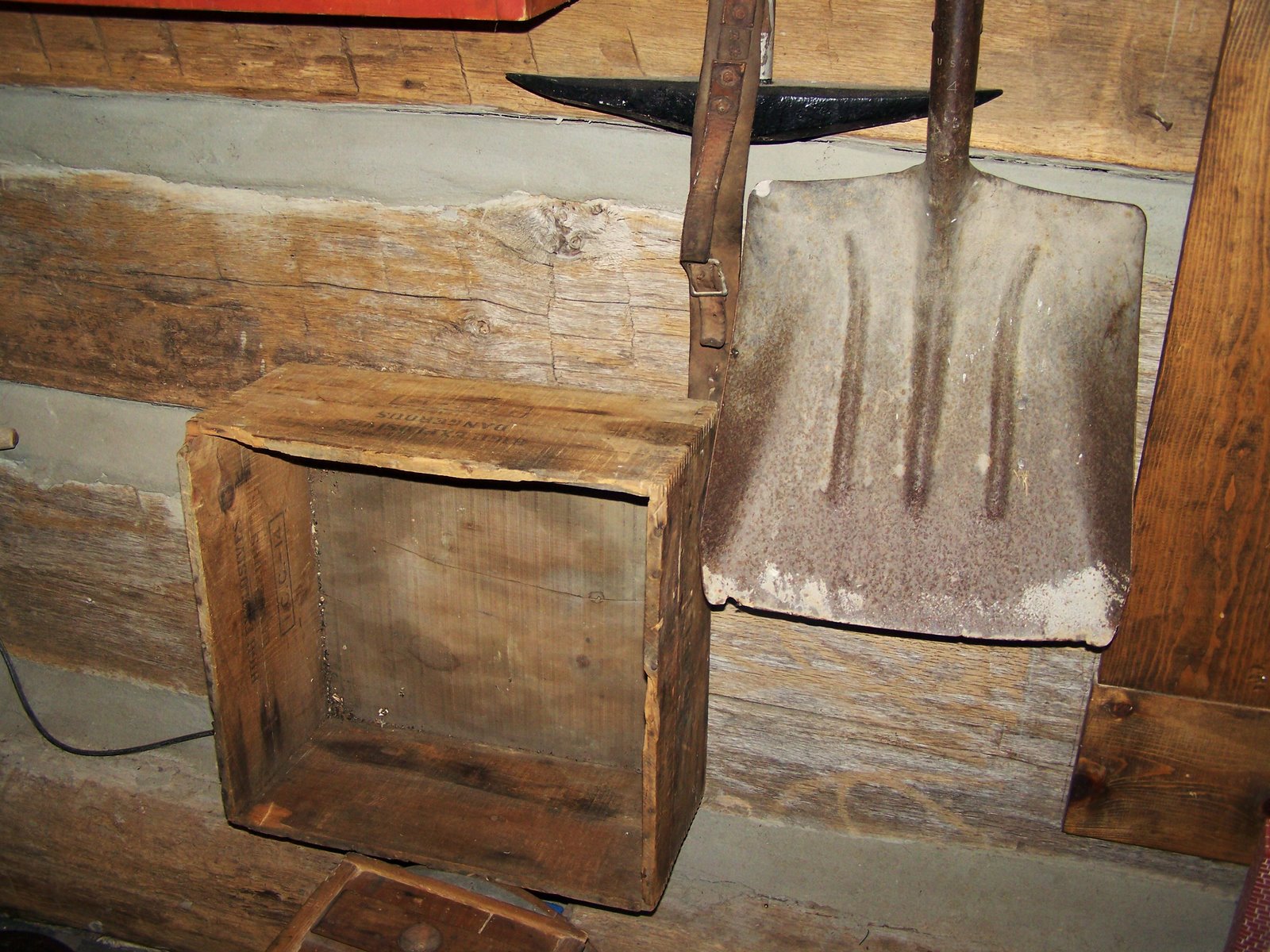
Larry's coal collection. On the wall beside the shelf is a miner's belt (name on it is S.E.Bragg), a miner's pick and a coal shovel.

My husband has been quietly collecting coal-mining items for the past two years, and has quite a nice collection now. His stuff frequently goes a-storytelling with me. We had to make a place for his collection, and it finally settled in the log room.
Larry remembers many of these tools from his childhood, but like all of his father's mining things, no one thought of saving them--they were to be used and discarded when their use was over.

This picture shows many of his items:


left to right: on the wall, his Dad's mining certificate (dated 3-19-42, when he was 26 and had just joined the union). Below the certificate is a collection of Larry's family photos-grandparents, his parents and his Aunt Cora (pronounced Cory); on top of the shelf a miner's lunch pail (it has three parts--the lid, then a section that holds the lunch that nests into the lower section that holds water). The miner's cup is hanging onto the pail by a piece of
cap wire, or wire used to detonate blasting caps. Next to the lunch bucket is a miner's safety lamp, with a protective screen that keeps the flame contained. The picture of a miner is not a family picture, but one I found in a junk shop and was so struck by I had to bring it home. That man looks proud of his work.


On the next shelf is a miner's hardhat, this one for working in low coal (usually described as 30"-50" high seam); my bottle of turpentine (often used as medicine in my husband's childhood), and an old miner's lamp. Behind the lamp is a frame that holds scrip, the coins paid out to miners as loans by the coal companies, and to be redeemed only in the companies' stores.


Next shelf holds an assortment of carbide lamps (these hang on the front of the miner's hardhat) a box that held a carbide lamp originally, a miner's self-rescuer kit, and my collection of Prince Albert tobacco cans. Since the can features prominently in a story about Larry that I tell, I try to keep a stock of them in case I misplace one (as has happened on two occasions).


The bottom shelf holds an old cloth miner's hat that predates the hardhat by 40 years or so, a battery powered miners light, a crow call (to go with a story about Larry's pet crow he had as a boy), a carbide can, an old patent medicine bottle and a couple of books about mining. Under the cloth cap is a container of carbide. We have occasionally lit the carbide lamps, but not often because of the smell. It's astounding to think that with the danger of methane open flames were used for years in the mines.


The most recent item added is the dynamite box, found at a flea market. Larry remembers many such boxes from his childhood, but like all his father's mining tools, no one thought of saving such things--they were to be used and discarded when their use was over.


And last, but definitely not least, this eight-foot breast auger. These tools were used by miners to drill back into the coal face. Dynamite charges were then rammed into the hole and set off using the cap wire (more involved process than that, but that's the basic idea). Larry used one of these when he was a boy to drill in the columns left by the strip miners. They'd drill the columns and blast them to get "house coal," or coal to be used in the home for cooking and heating. What they did was illegal and very dangerous (think "retreat mining" as the miners who were recently trapped in Utah were doing). But it provided coal for their home, and in the times when his Dad was injured, laid off or working non-union it helped keep them warm and fed.

We found this breast auger in two parts--first the auger, then the breast plate--at Chester Bills' shop in St. Mary's over a period of a few months. Usually selling for over $100 these days, we were able to get ours for $15 per piece. Larry painted it, and found sturdy brackets to hang this heavy piece of metal in the log room.

That's the collection so far. The more I learn about mining the more it fascinates me. It's the people, really, that draw me. What manner of man will go below ground got 8 hours or more a day, crawl through tunnels that might be 5 or more miles long, and know that at any time the top could cave in on him, or that he might get into a pocket of deadly gas, or the wall might break through and water come rushing in? Who could face that every day?

Much as I try to fathom it, I cannot get my mind around it. Today there are still men doing this job, and although safety has improved, the danger is ever-present. I think of them, and pray for them, every time I turn on a light switch.

Monday, September 24, 2007

Weekend: Archives and Holstein Family History

(It was an interesting Saturday. I'll tell about it in three posts. This is the first.)

I had another clear weekend, no storytelling on the schedule, and we were looking for fun. We have a long list of things we want to do and places we want to go, but first we looked to see if there were any festivals in West Virginia within a 3-hour drive. Only one--Sutton's Fall Festival.

We considered a trip to Parkersburg to visit Trans-Allegheny Books. It's supposed to be a great used book store, housed in an old Carnegie library building. I have yet to make a visit. We could go there and then travel up to St. Mary's to Chester Bill's antique/junk emporium. That place can suck you in for hours.

Or, we could go to Charleston to the state archives and start researching Larry's family, then mosey up to Sutton to the festival. That was the trip we decided to take--both of us are curious as to when his family arrived in America and how they got to West Virginia's coal mines. I've learned a lot about my family, but Larry knew little about his.

So, after breakfast at our favorite Saturday morning place, the Downtowner in Ripley, we headed south. I was struck by the statue of the miner near the entrance to the state's cultural center.

The lady at the archives was helpful. We knew his grandfather's name (John Amos Holstein) and his grandmother (Virgie Lawrence Holstein) so we figured we had it made.

Wrong. There was no listing anywhere for either of them. Well, then, we tried his father. How many men with the name "Ray Holstein" can there be, who were born on Kayford Mountain around 1919-1922? Turns out, none--at least, none that were listed in the state archive records we searched.

How can this be? we asked our guide. The answer is stunning and simple. They weren't born in hospitals, didn't own property. Kayford Mountain straddles three counties, so his father could have been born in any one of them. People didn't bother to register things at the courthouse when it was a long and difficult journey, might increase taxes or government snooping, and they might have to miss work in the bargain.

"Let's prove you exist," the lady said. Good idea. At this point Larry wasn't sure! We found his birth record easily enough because he was born in a hospital. His father's and mother's information was full of errors, including misspelled name, wrong age and wrong place of birth. Great. That sure will help our search in the future.

We left, discouraged, but realizing two things: we needed to get to the graveyards, write down dates of deaths and births, then go to the state vital statistics department to get records of at least these events. We also knew that we needed to record, right now, as much as Larry can recall about his grandparents, their siblings and children because there is apparently no record yet in existence that links this family together. Unless there is some erstwhile genealogist out there who has already done this, and the chances of that are slim.

Larry had some records, and we spent a lot of time Sunday trying to find them with no luck. They're put up, and you know what that means! All we have now are a few photos and his father's coal-mining certificate. When we find the rest--his parents' marriage license, an affidavit of his father's birth (needed to qualify for Social Security), and a few other things--we might have more pieces of the puzzle.

Yesterday we got on the computer and listed everyone he could remember, and tentative dates of birth and death. It's a start. I think the journey is going to be a long one.

Tuesday, July 10, 2007

Swinging Bridge over the Coal River

On our return trip from storytelling at Twin Falls State Park in southern West Virginia, we decided to take the long way home and visit the area where my husband grew up.
He was so happy to see that the long swinging footbridge over the Coal River near Emmons was still in place and in excellent repair.


Larry remembers walking across the bridge many times to play baseball, go visiting, or to go swimming in the cool shade along the river. The bridge is very well constructed, with steel cables holding it together. I liked the way this big steel o-ring looked.

And after walking across, looking down into the shady river below, it was time to head on up the road. I think the old bridge will be in place long after we're gone, barring a bad flood or some other accident.
Related Posts Plugin for WordPress, Blogger...