Pages

Showing posts with label West Virginia storyteller. Show all posts

Tuesday, October 26, 2021

Ghost Stories

Ghost stories abound at this time of year. Fall is a time of death, really, as trees shed their leaves and frost kills what is left in the gardens. Night comes early and the chill, damp air lifts fog from the valleys to cover the land with an ethereal glow. It's a time for drawing in, hunkering down, shuttering the windows, stoking the fire and contemplating the end of life we all face at some time. Why are there so many ghost stories? What gives this particular type of tale its longevity and popularity? The answers are as varied as the tales themselves. In West Virginia, we have many such tales, from vanishing hitchhikers to malevolent peddlers to crying ghost babies. The degree of "hauntedness" varies. Some are fragments, really, a mere whisper of a tale or piece of memory passed down as a "they say" story. Others are well-known, documented in books and occasionally on film or in photos. My interest in ghost stories started as a child when my parents told us the story of the haunted house in Royston, England, where they had an apartment as newlyweds. Add to that the big old house in Manassas where we lived when I was a child, with its chipping plaster walls, spooky basement and Civil War relics in the yard, and my fertile imagination was well supplied. When I moved to West Virginia, however, I found that I had moved to the mother lode of ghost stories. It seemed like every place in the state had a story connected with it. In my own county, I heard almost a dozen stories of haunted places or events. As I learned more about my new home, I found books by Ruth Ann Musick, collections of ghost stories from around the state. Many were vague, others were more developed with names and specific locations. The stories grabbed me because they were told by ordinary people living their ordinary lives--except there were these weird things that had happened that they knew about and were willing to share. I wondered why we had so many ghosts in this state. Was it because of the valley fogs that can look pretty spooky in the evening light? Was it that people who live here just have more active imaginations than people in other places? Did it have to do with the ancestry and cultural background of West Virginians? Did religion play a role? I've come to the conclusion that it is all of the above. We are a state of storytellers, as you would know if you stood in line at any grocery store. We talk to strangers and we talk in stories. West Virginians tend to be a religious people too, and ghost stories often carry lessons of forgiveness, retribution, unrest because of a grave sin, or warnings to listen to elders. We're imaginative--some of my posts recently demonstrate the imaginative and creative minds of our residents: the plane van and the big eye, for example! Our heritage here is Scottish, English, Irish and German predominantly, but with a good helping of Italian and a seasoning of Polish, Russian, African-American, and many other nationalities. British folklore, particularly that of Ireland, includes revenants of all kinds, along with both little people and giants. Some of those tales were simply transplanted and adapted to a new environment. The German tales also moved to the mountains, with their often darker themes. Then there is our environment: towering dark mountains, deep shadowy hollows, evening and early morning fogs, the intense quiet broken only the falling leaves, an owl's call, the cry of some unnamed night creature. All lend themselves to a sense of the supernatural, of someone or something watching, lurking, in the dark and hidden places along our roads. On this Halloween, take some time to travel into the countryside. Find a quiet place, stop your car, get out and listen. You too may find, even if you are not in West Virginia, that there is something in the air that sends a shiver down your spine, and has you looking over your shoulder. You may go home with your own tale to tell.
I've posted many ghost stories here in the past 3 years. Here are a few you may want to go back and read:
My most recent ghost story was written from a prompt in a newspaper article.
The story my parents told about their haunted house in England.
A couple of ghostly poems; and here is another. And a classic from Thomas Hardy.
Ghost story and comedy, all in one! The Gatehouse Ghost story is a true story that happened to me.
Links to other ghostly information.
Strange photos we took at the old Moundsville State Penitentiary, which now does ghost tours.
Raw Head, Bloody Bones was a look into the background of this chilling tale used to scare little children.
A recipe for Bony Fingers? Why not?
Jump Tales for Halloween--just the bare bones, but easy to develop for telling.
West Virginia's most famous ghost story, The Greenbrier Ghost. This is on my new CD Beyond the Grave both as a ballad and a story. (Yes, I finally found a melody for it)
A ghostly tale from Rowlesburg, West Virginia.
The Wizard Clipp, another famous story in our state. Another one that's on my new CD.
Short tale, easy to tell.
I've written about the "why" of ghost stories before; this older post contains a good booklist.
A true story of something that happened to me. It still gives me shivers to remember it.
One of the stories from Jackson County, Sidna is a tale I often tell. It's on the CD!
A story told to me by a young girl, this story is on my new CD too.
Want a copy of my new CD, Beyond the Grave; Ghost Stories and Ballads from the Mountains?
Email me at susannaholstein@yahoo.com and I can tell you purchase details.

Friday, June 16, 2017

Telling Tales in Craigsville

And my goodness it was fun!

Every year I plan a new program that reflects the national library summer reading theme. This year's theme is Build a Better World. I took a little different approach, at the request of one library; rather than addressing bricks-and-mortar building, I planned a program that focused on building community and working together to make this world a better place. 

And stories teach this so well, not in a beat-you-over-the head way, but with humor and excitement and thoughtfulness. Research proves that we learn best through stories, after all, and the best part of that is that we enjoy the learning. 
  
To illustrate my theme, I used cardboard blocks (ordered some sturdy ones meant for children's play) on which I attached a world map cut into pieces. I told stories from all around the world: from Ghana and Burma and China, the US and Thailand, India and France. 


I used puppets, chants, drums, mbira (thumb piano), a flannelboard story and songs to keep the audience engaged since there is usually all ages present, and we all learn differently. 

Telling Margaret Read MacDonald's story Grandfather Bear is Hungry, using puppets and audience participation

Handing out feathers for the story How Vulture Got His Bald Head. We also used little plush birds that "sing" the bird's call, adding a little more learning to the story.

This time I also used a crankie story, something most children have not seen.

 
Not the best photo as this was between frames. The pictures scroll as I tell the story and turn the crank.
At the end of the program, we used the blocks to put the world back together again, building a world that I hope might be a tiny bit better because of the stories we shared.

We had a blast at the Craigsville library, and I am looking forward to presenting this program at more libraries around West Virginia. Truly, the world will be a better place if we will listen to each other's stories.


Copyright Susanna Holstein. All rights reserved. No Republication or Redistribution Allowed without attribution to Susanna Holstein.

Saturday, November 26, 2016

Oh the Holly Has a Berry...


Re-posting a post from 2009. I'd forgotten I wrote this one. Enjoy!

Like many people, I like using holly as one of the greens to be used as decoration during the holidays. And like me, I wondered about the folklore and superstitions connected with this prickly plant. And as with many of our Christmas customs, the traditions have roots in ancient cultures, and were incorporated later into Christian and modern celebrations.


My mother always waited until Christmas Eve to bring in the greens, or to "bring in Christmas," as some people say. I thought this was because she didn't want the greens to dry out, and that was probably at least part of the reason. If you have ever tried to use hemlock branches as decoration, for example, you learned the error of your ways quickly, I bet. The needles drop almost as fast as the branches enter the house.


But holly retains its green color and red berries quite well. And the pine boughs we carried in lasted until after Old Christmas too. Today while researching holly, I found perhaps another reason Mom delayed bringing the evergreens into the house: having holly in the house before Christmas Eve or after Twelfth Night could cause quarrels in the family, and a misfortune for every leaf and branch! Goodness, I'd want to avoid that too--although I can see why quarrels might ensue--the dried-out leaves are so prickly that the one who had to remove them was probably not in a good mood for the rest of the day.


In pagan times, there was a ritual of a battle between the Holly King and the Oak King at winter and summer solstice; at winter solstice the Oak King was victorious and at summer solstice the Holly King would be triumphant.


The holly had its place in the Christian tradition too. It was and still is believed by some that the cross was made of hollywood and that the crown of thorns was made with holly. According to this legend, the holly's white berries were turned red by Jesus' blood. The Christianized version of "The Holly and the Ivy" refers to this story:


4. The holly bears a prickle
As sharp as any thorn;
And Mary bore sweet Jesus Christ
On Christmas day in the morn. Chorus

5. The holly bears a bark
As bitter as any gall;
And Mary bore sweet Jesus Christ
For to redeem us all. Chorus

6. The holly and the ivy,
When they are both full grown,
Of all the trees that are in the wood,
The holly bears the crown. Chorus

[7. The rising of the sun
And the running of the deer,
The playing of the merry organ,
Sweet singing in the choir. Chorus]

One version collected by ballad scholar Cecil Sharp, however, is probably closer to the original song:

Holly hath berries red as any rose,
The forester, the hunter, keep them from the does.
Nay, ivy, nay, it shall not be I wis;
Let holly have the mastery, as the manner is.
Ivy hath berries black as any sloe;
There come the owl and eat him as she go.
Nay, ivy, nay, it shall not be I wis;
Let holly have the mastery, as the manner is.
Holly hath birds a fair full flock,
The nightingale, the popinjay, the gentle laverock.
Nay, ivy, nay, it shall not be I wis;
Let holly have the mastery, as the manner is.

In ancient times, holly was considered "male" and ivy "female." Probably this is because of the winding, supple nature of ivy and the strong, sturdy shape and sharp prickles of the holly.


It's not really surprising that plants that manage to remain green in the winter months would be thought to have special powers. In Wales, it is considered unlucky to pick holly when it has berries, and bringing it into a friend's home could cause death to an inhabitant. Some people collect the berries after the holidays and keep them as good luck charms.


Other superstitions about holly:
  • Carry a piece of holly in your pocket and you will never be struck by lightning
  • Holly flowers were thought to be able to freeze water.
  • Holly wood was believed to control animals, so many whip handles were made from holly
  • If you bring a branch with holly berries into the house, it will bring good luck, but for every berry that falls before New Year's a little of the luck will leave.
  • The Zoroastrians believed the the sun never cast the holly's shadow
  • new babies were sprinkled with water in which holly was soaked to ward off evil spirits (which makes me wonder--holly water=holy water?)
  • The Irish believed that decorating with mistletoe and holly in winter kept the fairies happy and won their favor
  • Smooth holly brought in for the holidays means the wife will rule the house in the coming year; rough holly means the man will be dominant. (Keep the peace--bring both inside!)
  • To cure a child of illness, pass the child through a cleft holly tree
Now, go gather ye holly while ye may (or was that rosebuds?). Just be sure to take it out again before Twelfth Night, don't lose any berries, and don't carry it into your neighbors house and all shouls be well...I think.
Sources:
Trees for Life website
Encyclopedia of Superstition, Folklore and the Occult Sciences of the World by Cora Linn Daniels and C. M. Stevans
The Book of Christmas Folklore by Tristram Potter Coffin
The Winter Solstice: The Sacred Traditions of Christmas by John Matthews
A Book of Christmas by William Sansom
Caer Feddwyd website
Encyclopedia of Superstitions 1949 by Mona A. Radford
The Cottage Smallholder blog
Irish Superstitions for the Christmas Season

Tuesday, November 25, 2014

Tellabrations! Two and Three

I have been Tellabration-crazy this year. Tellabration began as a day set aside for the celebration of storytelling, to be held the Saturday before the US holiday of Thanksgiving. it was intended as a day for storytellers to give back to their communities; most events are free but any money collected was to go back to a storytelling guild or other means to support storytelling.

Then the idea caught on, and events spread from the US to worldwide, and the dates spread too. Tellabration now covers most of a month with events all over the globe, and in my area there were three within driving distance. I've not been able to participate much in recent years so this year I decided to take part in as many of the scheduled events as possible. The first was held in October as part of WVU's Mountaineer; the second was this past Thursday evening in Athens, Ohio, and the third was Saturday, on the original Tellabration day, in Beckley, WV. The Beckley event is the longest-running of the three, having been in existence since at least 1997 when I participated for the very first time (and was terrified!).

I wrote about the WVU Tellabration earlier, so I'll catch up now with the other two. The Athens event was held at the Athens County library, in an inviting, open setting that allowed patrons to listen as they checked out books and did other work in the library. Three women and three men told tales and sang songs. I was the only out-of-stater, but I am really just over the river from Ohio so I feel part of the storytelling scene there. It was a good night with good stories and a relaxed atmosphere.

Then Saturday I drove down to Beckley, about 2 1/2 hours south of home. Larry had intended to go with me originally as we were invited to stay at the home of storytelling friend Danny McMillion, but he was nursing a cold, and my oldest son and grandson were arriving for hunting season, so Larry opted to stay home by the fire and play host to our visitors until I returned.

The event was held at Tamarack, West Virginia's premier arts and crafts showcase. I was mesmerized by the displays of gorgeous artisan glass.

The staff at Tamarack were putting up trees and other decorations and the place was looking beautiful.

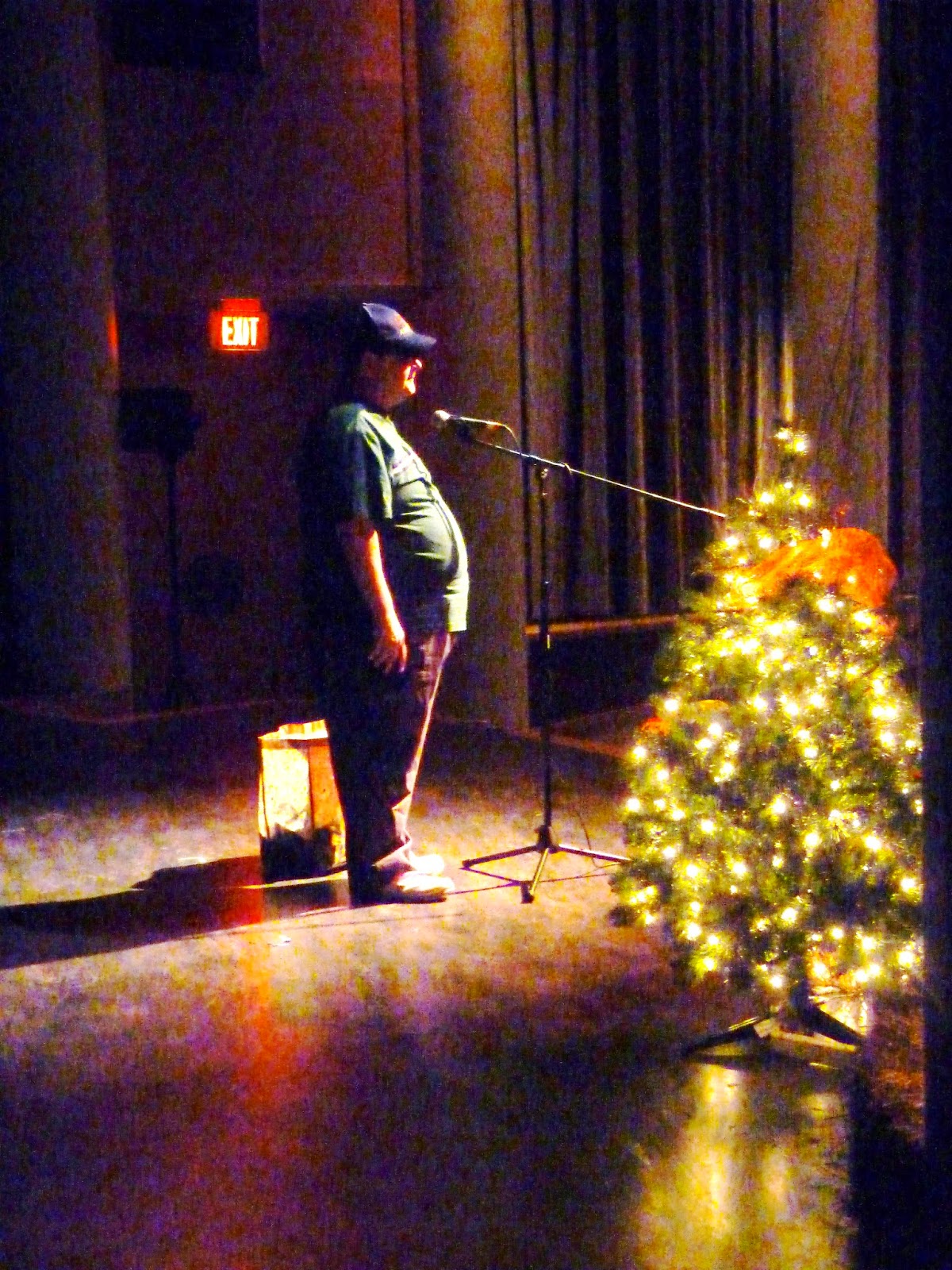
The telling was Spectacular! Sue Atkinson, a transplanted southerner with a soft Georgia accent, was out MC.


Terry Farley
Terry Farley led us off with his hilarious comedy, songs and jokes. What a funny man he is! Then Scott Hill told us about his son's quest to be a professional team mascot, I told a story from my husband's childhood in a coal camp and sang a ballad or two,

Fred Powers followed me with stories from his 20-year experience as a coal miner,
and John Wyatt wrapped up the show with songs and stories from his days working for a West Virginia Railroad. It was just perfect, and the audience showed their delight by staying afterward to talk with us and thank us for the stories. 

The Greenbrier cafe's tree
We stayed to eat dinner in the cafe run by the Greenbrier resort, delicious food and good conversation making a good end to the day. Then I followed my friend Danny to her lovely vintage home and more good conversation followed. She made me an awesome breakfast the next morning and I was soon homeward bound.

Stories, stories. They wrap our world, explain our world, make us laugh and cry, and teach us compassion and joy. Where would we be without them?

Copyright Susanna Holstein. All rights reserved. No Republication or Redistribution Allowed without attribution to Susanna Holstein.

Wednesday, July 16, 2014

Come Tell Stories with Me August 3-8 at Augusta!

Once upon a time in the mountains, a family gathered by the fire and shared stories carried from one generation to another, perhaps even tales that crossed the ocean with their ancestors. Be part of the tradition of “passing it down” this week as we explore the Appalachian folklore, superstitions, and culture that weave together to create stories and a storytelling tradition that continues to be a lively part of life in the mountains we call home.

The class will be highly interactive with storytelling and lecture interspersed with class discussion. 

The Icehouse,  a unique pub on campus and site of much music.
We will view videos and listen to recordings of a variety of Appalachian region storytellers, take a nature walk to see native plants and learn about their uses and lore, 
Messages written by Civil War soldiers on the walls of the former
hospital are scattered throughout the building

take a field trip to historic Beverly to visit the house that was once used as a Civil War hospital and tour the Beverly museum. Students will be expected to work on one story per day for performance in class; this is not expected to be polished work but rather a beginning to putting flesh on a story’s bones. Class members will be expected to offer coaching and feedback as requested to help each other to a better understanding of their stories and to improve performance.

Cloggers competing during Old-Time Week.
The Appalachian region is a fascinating place. Expect to have fun, laugh much, talk much and listen, listen, listen as we immerse ourselves in the legends and lore of the mountains!

Hallihurst, one of two mansions on the Davis & Elkins College campus.
For more information about this week-long class and registration forms, visit the Augusta Heritage Old-Time Week page.

See you there!

Copyright Susanna Holstein. All rights reserved. No Republication or Redistribution Allowed without attribution to Susanna Holstein.

Friday, July 11, 2014

Traveling West Virginia: Middle Island Nature Preserve

Middle Island Creek is the longest creek in West Virginia, and Middle Island itself is located where the creek empties into the Ohio River. The state of West Virginia maintains the Ohio River islands as natural environments. Formerly, Middle island was farmland. A few years back I had the privilege to meet Walter Carpenter whose family once owned twelve islands, I believe he said, in the Ohio River. This was one of those islands. Walter remembered farming on the islands as a young man.

Today Middle Island is mostly young forest and undergrowth, serene and quiet except for the occasional call of birds, the hum of a passing tug on the river, and the murmur of traffic in the small town of St. Mary's, WV. You can drive right on to the island via an old steel bridge, that has the unusual feature of a 90-degree turn at one end. Pretty surprising!


The road is flat, straight, and invitingly green.


Plaques along the road tell the islands story and describe the flora and fauna of the region.


A monument on the island memorializes the La Rue family who were the first European settlers in the area. Jacob and Isaac LaRue are buried on Middle Island.


I got out of the car to wander a little ways along a path that passes through an impossibly green tunnel of trees.


Sweet gum leaves hang low, blocking the sun along the path.


A robin finds a high perch to sing his song.


You can drive a good ways along the island; in place the trees open to afford a view of the beautiful Ohio.
We passed walkers, joggers and bikers along the road.


Downriver, a barge makes its way under the St. Mary's bridge.
  
 And another is following not far behind. I don't know why but it makes me happy when I see barges on the river.

That 90-degree turn I mentioned, pictured as we were leaving the island.


To get to Middle Island, take I-77 to the Emerson Avenue exit (between Parkersburg, WV and Marietta, OH). Go North on State Route 2 to St. Mary's. Turn left on George Street. the bridge to the island is about 4 blocks straight ahead on George Street.

Copyright Susanna Holstein. All rights reserved. No Republication or Redistribution Allowed without attribution to Susanna Holstein.

Saturday, June 21, 2014

From Morning to Evening, What a Fine Birthday

Today started early--I was on the porch at dawn, hoping to see that moment when, as my friend Dianne Hackworth reminded me, the sun stands still. But fog and clouds hid old Sol from my view--and that was all right because the rain last night was most welcome.

We left at 8am to go back to the West Virginia Folk Festival for a second day in the Oral Traditions Tent. We were there yesterday for my performance time in the tent. It was hot, hot, hot, but the audience was pretty cool and into the stories, poems and ballads I shared.

For the past few years, the festival has occurred on my birthday weekend so I am usually there and not having cake and ice cream at home. It's well worth it to hear such good stories and poems and to see people I may not see again for months, and to be surrounded by music and crafts in a small community nestled in the West Virginia hills (and home to the state song by that name).

 Two friends collaborated to surprise me this year with not just a cake, but a cake topped with a fizzing sparkler! What fun that was! I am still smiling from the surprise and laughter of that moment.

The cake was mighty good too. We shared pieces with everyone in the tent, a sweet treat on the first day of summer.


A highlight this year was Kirk Judd's presentation of poems in his new book, My People Was Music. Kirk doesn't read his poetry, he performs it, and his poems tell stories--stories of mountain hikes, of heritage and music, of friends and family and life in these hills. Not all easy words, but all worth hearing. The tent was full to capacity and beyond for his performance. Afterwards we visited with a fiddle player from Cincinnati who told me a few ghost stories. He was curious about the story behind the name of the small community of Burnt House, so I told him the story of the murders and the supposed appearance of the girl who burned to death in a fire there (a story you can find on my CD, Beyond the Grave).

I visited the historic Holt House to see a fellow Two Lane Livin' writer, Karen Pennebaker. While there I toured the house--built in 1901, the same time period as the house I grew up in, it had much of the same woodwork and trim. I especially loved the kitchen, though, with its "border" of aprons. What a fun way to display them.

I had another reason for my visit to Holt House--lemon ammonia cookies! They are delicious, and I look for them every year. This is NOT household ammonia, this is baking ammonia, and old time ingredient used to make the cookies rise. This link will take you to a recipe that looks and sounds much like the cookies I bought today.

The rain held off almost all day, but late in the afternoon the skies opened and dumped torrents of rain. Susan Sheppard of Parkersburg forged ahead with her reading, even though water was pooling at her feet.

Judi Tarowsky followed, and her husband of 44 years provided shelter for his wife. That's love, friends. (And believe me, both of them were a lot happier about it than the photo appears--what happens when I grab a quick snap with my phone sometimes.) I have to give props to Judi and Susan--real troupers, both of them, and great storytellers.

Now I am home and packing again for a week away at the fantastic Allegheny Echoes Music and Creative Writing Workshops (with a little break to do a program for the library in Lost Creek, WV). I have done some of my best writing at Echoes, and am looking forward to a week of evenings in a cabin on the banks of the Greenbrier River and days working with other writers to craft new work.

Copyright Susanna Holstein. All rights reserved. No Republication or Redistribution Allowed without attribution to Susanna Holstein.

Thursday, June 19, 2014

In Honor of Mothers

This was written for the May issue of the new local newspaper, The Jackson View. June seems an appropriate time to post it here; my mother's birthday was June 13 and Larry's mother's was June 12.

I watched her navigate the aisles of the grocery store, steering her cart with one child in the seat, another clinging to the side, and she herself pregnant with a third. She corrected her children, consulted her shopping list, compared prices and kept moving rapidly and efficiently through the store and finally to the checkout where she unloaded the cart, denied her children’s cries for candy, exchanged comments with the cashier, fished out her card to pay, and then steered the loaded buggy and her children out into the parking lot. Behold the young mother: the original multitasking machine.

Mom and Dad (June and Bill Connelly, Manassas, VA in 1959. That was
Grandma and Grandpa's car, and they probably took this photo since they
were into photography and had a color camera. The car later became ours.
 As I drove away my thoughts turned to my own mother. Married at seventeen to a dashing American from New Orleans who was stationed near her home as part of the Army Air Force, she left her life and family in rural England to come to a country where she knew just one person: her husband. Together they built a tiny house with few of the amenities we take for granted today, and started a family that grew to 13 children. In the 1970’s she went out to work for the first time since her days as a land girl during World War II. She sold Avon and Amway, babysat for neighbors’ children, and took a job as a nurse’s aide in the wing of the hospital she loved best, the maternity ward. She continued working for 20 years in a variety of jobs. Mom was always learning something new, interested in meeting people, and she would cross a street to see a baby in a stroller. Her love of life knew no bounds; everything fascinated her. She loved her new country but never gave up her British citizenship.

Dollie Holstein with Larry and his twin sister Mary, probably about 1954. Yes,
that's a big bruise on Mary's head, probably caused by that little guy on the left.
Those memories led me to my husband’s mother, who grew up in a coal camp in Boone County, WV and went on to marry a coal miner and live in Cabin Creek. She saw first-hand the struggle for the miners’ union and knew the hardships of coal camp living: the poorly built company houses, the company store and the dangers of using scrip for credit, the constant dust and dirt raised by passing trucks and coal trains. Yet she, like my mother, was determined to make the best of what life had brought her. She cared for her husband when he was injured in the mines and raised her four children to be able to take care of themselves, to work for what they got and to never lose sight of their heritage. She loved dishes with pretty flowers on them, and grew roses every year, carrying out her dishwater to wash the coal dust off their petals.

Mothers. They teach us grace and dignity, they show us by their example how to live lives of beauty and commitment. As our world gets increasingly complex and confusing, it is the mothers who provide the light that can guide their children to ethical, empathetic, and responsible living. Today we hear much about dysfunctional families, absentee parents, and troubled children. Yet the other story—the story of the quiet, steady mothers who work and care for their families and homes—that story is seldom told. It is not a headline grabber or tabloid material.


So here’s to the mothers who stand behind their families, guiding them like that young mother with her grocery cart, making wise decisions and teaching her children right from wrong. Happy Mother’s Day to her, and to mothers everywhere.

Copyright Susanna Holstein. All rights reserved. No Republication or Redistribution Allowed without attribution to Susanna Holstein.

Tuesday, June 17, 2014

Michaela's Banana Cake

 I posted grandson James' cherry cobbler recipe last week, so here is the recipe for the cake Michaela made. I asked her if she wanted to make a cake from a mix, or from scratch, and she answered immediately, "From scratch!"

Last year we made Wacky Cake because she was intrigued when Hannah told her about it. This year we did another fairly simple cake, banana cake. It's another good way to use up those over-ripe bananas in your fruit bowl.

Banana Cake 

Mix in a large bowl:
2 1/2 cups of flour (regular, not self-rising. If you use self-rising, use a little more flour and skip the next 3 ingredients)
1 1/4 teaspoon baking powder
1 1/2 teaspoon baking soda
1 teaspoon salt
1 2/3 cups white sugar

Add:
1/3 cup vegetable oil (I use light olive oil)
1/3 cup buttermilk (I make buttermilk substitute by adding a teaspoon of vinegar to 2% milk)
1 1/4 cups mashed bananas

Blend ingredients well. Then add:
1/3 cup buttermilk
2 eggs

Beat vigorously until well blended. Pour into a greased 10x14 pan and bake in a preheated 350-degree oven for 35-45 minutes.

For frosting, you can make the standard buttercream frosting, or cheat like we did and use packaged cream cheese frosting. To either, add about 1/2 cup of mashed bananas.

Michaela's "fancy" glass with sweet tea. The Sangria bottle works nicely for making tea!

Yum!

Copyright Susanna Holstein. All rights reserved. No Republication or Redistribution Allowed without attribution to Susanna Holstein.

Wednesday, June 4, 2014

Greenland Gap

Last week we drove across state to attend our grandson's graduation. As always, the drive was gorgeous; I can never decide in which season the mountains are at their most beautiful. On this trip, I wanted to be sure we took the time to drive through Greenland Gap, a 250-acre parcel of incredible landscape that is protected by the Nature Conservancy. It's not easy to find, really, since there are few signs leading you to the Gap, but I had a vague memory of how to get there, so we decided to visit the area on our way home.

We got an early start and turned confidently up the road leading, I thought, to the place but after driving a bit decided it was not the right way. After a few more false starts we asked directions from a state roads worker--who would know better, right?--and soon we were there.

What is Greenland Gap? It's exactly what it says, a gap cut through the mountains by Patterson Creek. During the Civil War it was the site of a battle between Union and Confederate troops; the small 87-man Union unit held off 1500 Confederates for four hours before surrendering. It is easy to see how they could have done so because the opening between the rocky cliffs is so narrow it would have been pretty easy to defend. (The defenders, who were holed up in a church and a cabin, were eventually burned out and that ended the conflict.)

Being there early in the day was a special delight. The air was almost chilly, sharp and bright, and the sunlight was just beginning to filter through the trees.

Patterson Creek was running high due to recent rains, and the waterfall was perfect. I honestly could have stayed all day just listening. Is there anything as restful as the sound of water running over rocks?

There are two hiking trails in the gap but we were not equipped, and probably not in the physical shape, required to tackle them. The trails lead to the top of the towering cliffs on either side; jumbled rockfalls litter the sides of the cliffs and the going is pretty tricky, so I hear. There are some Canadian plants growing in the area, and I have heard reports of eagle sightings although I do not know if those are verified or if vultures who hang out here were mistaken for the more stately bird.

I was focused more on the creek, I'm afraid--no photos of those majestic cliffs. With the green leaves so thick, I don't know that I could have taken one from where we were, anyway.

I hated to leave but we had miles to go before reaching home. We'll be back, though--it will be part of our visits to our son's house, we decided. Some places are just worth seeing again and again. Greenland Gap is one of those places.


You can see a video made by WCHS-TV about Greenland Gap, and hear the waterfall for yourself by clicking here.

Copyright Susanna Holstein. All rights reserved. No Republication or Redistribution Allowed without attribution to Susanna Holstein.

Sunday, May 25, 2014

Memorial Day Flowers

These are not what you might be thinking from my post title; these are pictures from around my flowerbeds at home. The past week we really got focused on getting the place cleaned up in time for Memorial Day, and we almost finished. A half-truck of mulch still to spread, a few more weeds to cut, and a little more cleaning up and we'll be done.

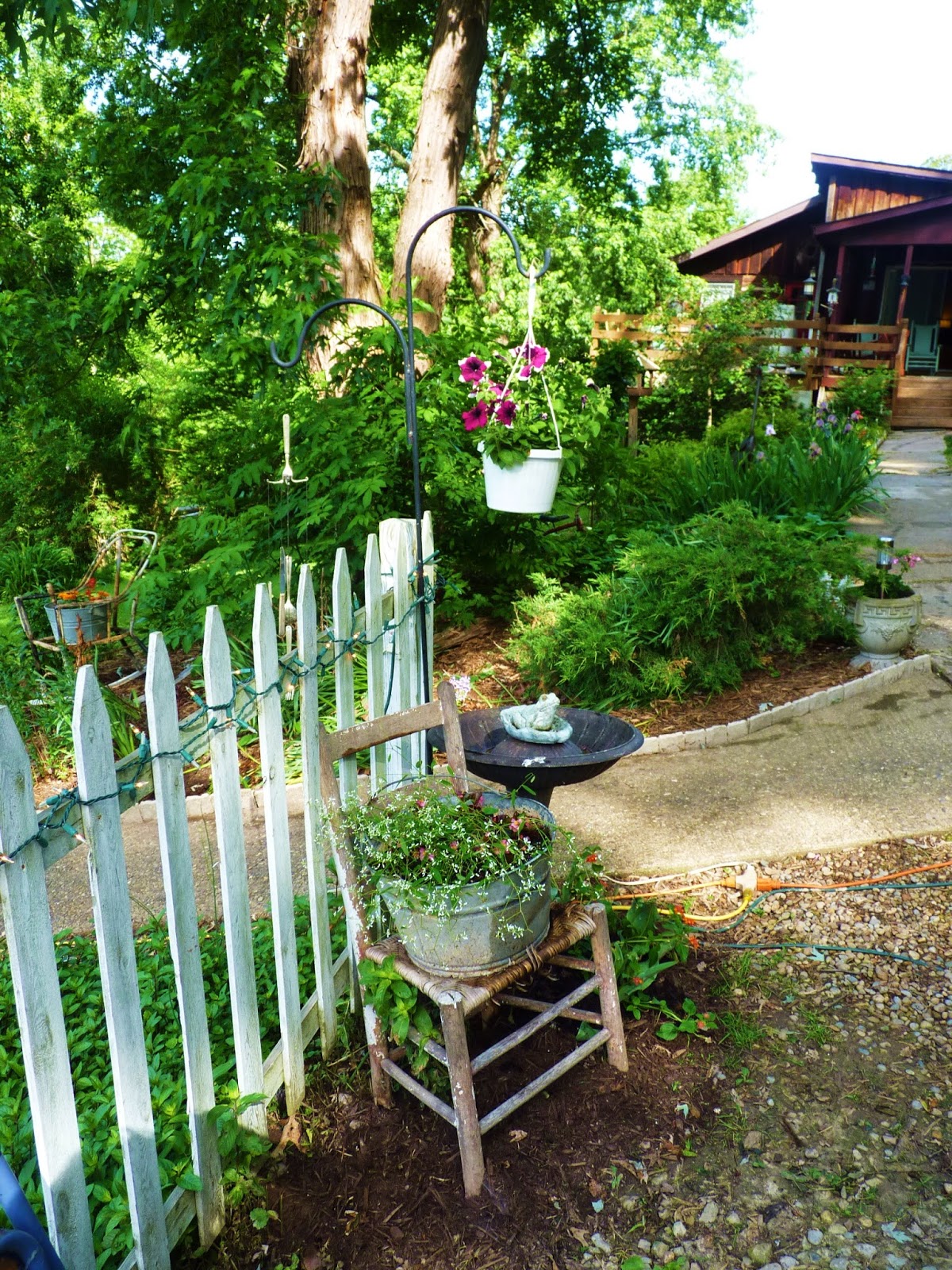
 This metal rocker frame was one of those plastic "wicker" rockers someone tossed in the trash. We removed the plastic, and ended up with a nice frame for the garden. I've planted morning glories around it. We'll see how they do.

My gardens are always a mishmash of whatever comes up. Here the vervain is crowded by the oregano that planted itself and an ever-spreading grape hyacinth that came from who knows where. Behind them, the dead stalk is actually a small cherry tree that Larry accidentally broke off--it had come up from seed, and is now sprouting new growth. I am curious to see what kind of cherry it is, a wildling or a seedling from my sour cherry.

Young apple trees survived the winter in fine shape, but a black cherry sadly did not.


The newest of the flowerbeds is now at least 10 years old, I'd guess. It's doing very well after all the dirt, manure and mulch we've added over the years.

One spot in the "new" bed: when I find something that does well here, I plant more of it. Our spring weather is great, but summer can be tricky because our sandy clay loam soil can dry out quickly and we get a lot of sun. So if a plant can thrive in those conditions, those are the ones for me. Coreopsis, daylilies, stevia, coneflower, vervain, and some hostas seem very happy here.


The far end of the new bed has been taken over by pink poppies, and I don't mind one bit. Wild yarrow has also made itself at home here, and coneflower has seeded in all of my beds.


Another view of the rocker frame, and you can also see the windchime made by my nephew Josh Mathias, who has started an etsy shop of his creations. I'll be writing a post about Josh's work soon.


The peonies are finally recovering from being moved a few years back. I planted a red one two years ago but no blooms yet, mainly because my old dog Jeb (who passed away a month ago; we sure miss him) was always digging it up.

I am doing a lot more container flowers this year because of the dogs. The new ones are learning not to lie in my beds, but if the flowers are in pots they're safer, and by placing the pots strategically in the flowerbeds I can protect some areas from being mashed by dogs. It's a trade-off: I know my flowerbeds are attractive places for them because the mulch is cool, and I know some plants will be damaged by the dogs whatever I do. In exchange, the dogs keep groundhogs, possums, most of the deer and other varmints away. I cannot imagine trying to have gardens here without dogs to help protect them.


The herb garden was a jungle. I made the mistake of allowing a goldenrod plant to stay in the garden and bloom last year. I was rewarded with goldenrod coming up everywhere and strong roots that were a bear to remove. That little succulent groundcover I call sedum was also taking over, along with my arch enemy gill-over-the-ground. I filled two big wheelbarrows cleaning up this little patch, but it's looking good now. I'll need to be vigilant with the hoe this summer


That's a tour of most of the gardens in the yard. They will probably not look as good for long, as summer will descend on us, weeds will try to take over again and I get too busy with storytelling. But for this one moment, I am enjoying the peacefulness and beauty around me. I hope your gardens are doing well, and that you will have time this weekend to enjoy the fruits of your labors too.

As for me, this day will be spent on the porch, reading, listening to the birds and petting the dogs.

Copyright Susanna Holstein. All rights reserved. No Republication or Redistribution Allowed without attribution to Susanna Holstein.
Related Posts Plugin for WordPress, Blogger...