Pages

Showing posts with label Kanawha county. Show all posts

Monday, May 19, 2025

Weekend Fun: Salt Fest

55°f/14°C, clear and sunny again. Corn is up!

Since Saturday dawned clear, crisp, and no humidity, we decided on a road trip to Eastern Kanawha County, which is a very large county just south of us, and home to our state Capitol. There is a unique small industry there---J.Q. Dickinson Salt Works. They were having their annual salt festival, with music, crafts, all the usual festival stuff, but we're also offering tours of the salt works and museum. A quick call to my friend Suzy and she was happy to join us for the day. Since the loss of her brother John, she has been having a hard time, so we thought an outing would do her good.

This festival, in its fifth year, is quite small, which is just perfect for me as I do not enjoy huge events, just find them exhausting and repetitive. There was a small stage and I was delighted to see my friends Kim Johnson and Bobby Taylor onstage, playing their excellent old-time music. Both are among the top musicians in our state.

There was a really nice dining hall, where the salt works hosts farm-to-table dinners. Food choices seemed limited, however, to polish sausages, pepperoni rolls and the like, although I did find a Saigon cinnamon roll that was very good, a bit more spicy than the norm, and thankfully no icing. Drinks were offered too, everything from lemonade to sodas to beer, wine, and cocktails. Suzy and I tried a lavender-blueberry lemonade made with vodka that was surprisingly delicious.


As for the tours, those seemed a bit unorganized. The main store clerk told us that we would have to walk "back there" with a vague wave of the hand, and to look for signs for the tour and the times. We set off, and managed to find "back there", which wasn't very far. A shuttle took us to the museum and surrounding grounds, which were just lovely.


We were delighted to find a formal garden being restored.


I had no idea what this flower was, but it turned out to be a very unusual type of peony. Stunning!


Wild geraniums seemed quite at home.


Some of the roses looked a bit rough, perhaps having been let go and now being coaxed back to health. The salt works and grounds were unused for years, only restored about 10 years ago, I think.


I could have spent more time in that pretty garden, but the museum beckoned.


Picture of the original salt works, on the banks of the Kanawha River.

 
The Dickinson family didn't throw out much! There is much memorabilia,  and totescfull of old documents still to be sorted and catalogued. These shelves hold small wood replicas of the historic village of Malden, where the salt works is located.


This building was the central office for the works, and still has the original furniture and flooring. The floor is laid at a diagonal, and is wuite beautiful. 


A by-product of salt making was pharmaceuticals,  such as brombromide.

One of the barns on the property. 


And another barn, this one housing a few head of cattle.

Same barn, different angle.


We chose to skip the tour of the saltmaking process because the tour was so crowded we couldn't hear the guide. Larry and I toured it before,  so you can read about it here.  I wrote a pretty extensive post then, with many photos. It really is fascinating. Suzy was getting tired by this point, and the heat when we went inside the first greenhouse-like building really bothered all of us. 

I missed out on buying some salt, as the store was quite crowded, but we will go back another day. The salt is surprisingly delicious, with a very distinct taste.

We left the festival in early afternoon to continue on to the next part of our road trip: waterfalls. More about that in my next post. I will leave you today with a tiny clip of Kim and Bobby's music. It's not quite their usual fast paced style, but nice anyway. I can't recall the name of the young man singing.


Copyright Susanna Holstein. All rights reserved. No Republication or Redistribution Allowed without attribution to Susanna Holstein.

Thursday, May 15, 2025

Memory Lane

62°f/16.7°C, clear and humid. High of 82°f today.


View of the Elk River, as we crossed the bridge into the old part of town.

We took a drive yesterday to Clendenin, a small town in Kanawha County, WV, about an hour and a half from our home. The library in Clendenin was the first branch I managed, and I left a piece of my heart in that little town. 


Main street. There are basically only 2 streets with shops and the post office on this side of the river,  and one on the other side. Small town indeed.

Clendenin has had its share of fame, and tragedy. It was the place where the Union Carbide Corporation got its start: the Elk River, oil and gas wells and the proximity of coal mines combined to make it an ideal location in its day for the beginnings of West Virginia's chemical industry. The town boomed; there was a three-floor department store, banks, and fine homes. Saturdays saw the town jammed with shoppers.

A new pavilion graces the riverbank, a sign of hope for the community.

The Elk River was and is both a blessing and a curse to Clendenin.  The river has no system of locks and dams, so flows unimpressed by either for its entire length, which means that heavy rains can cause significant flooding. I don't know how often Clendenin has flooded, but I helped clean up the library after one flood in 1997, which came 4 feet up the library walls. Then in 2016 a flood of historic proportions hit the town. Many buildings were swept away, and the library was destroyed.


In the window of the pharmacy. Not sure why!

Somehow the town is making a comeback despite the devastation. The site of the library is now a playground. 


The bank closed but a small brewery opened in that building. Bond's Pharmacy, a fixture in the town for almost 100 years I think, is still open. A bakery has opened, and the abandoned railroad track bed has become a bike trail.

The exterior of the bank/brewery,


and inside, some unique decor.


the huge vault is still in.place, but can't be opened because after the last flood the door rusted shut. Don't you wonder what might be inside?


Things are not the same after the flood, of course. The grocery store closed; the Dairy Queen was swept away and the town no longer has a police force but depends on the county deputies for law enforcement. The library was not rebuilt, but has moved into a renovated school building that also houses office and other agencies now. 

 I was surprised at how many memories came swarming back as we drove around the area. I was librarian there in 1992-93, and then oversaw that branch for another 10 years, along with the others in the system, until I moved up to facilities manager. So over 30 years ago, and yet as we chatted with people in the brewery, they mentioned names that brought faces vividly back to mind. Such good people, who worked hard with me to not only save that library from closing, but raised enough money to build an addition.

We enjoyed our visit. Larry has memories of the area too, as he worked for several years as a Mason in the county school system's maintenance department. We drove the long way home, passing another library I managed, this one for 7 years. 


The library was moved to a new location because we could not renovate the building to made American with Disabilities Act requirements. Now a business is in the building, but the exterior is exactly the same as when I worked there.

We will have to go back to see how the Clendenin is progressing, take a walk on the trail and to check out the bakery and brewery again. 

Now, if only the Elk will stay in its banks!

Copyright Susanna Holstein. All rights reserved. No Republication or Redistribution Allowed without attribution to Susanna Holstein.

Sunday, May 11, 2025

A Night Out, and Veggie Garden

55°f/13°C clear. High of 84°f/29°C expected. 81° as I write this at 3pm. 


After working in gardens and yard all day, we decided to have a night out. We ate dinner before we decided this, but there was live music
 at Taylor's Bookstore in Charleston, and a new Irish pub I have wanted to check out, so we  cleaned up and headed out.

The pub, called Hagy's, was a little disappointing, to be honest. I was hoping for a warm space with lots of wood, but this pub was more modern, with walls a nice shade of green, some contemporary-looking metal art on the walls that I suppose were Celtic symbols, and hard surfaces. The bar was beautiful, though,  a nice thick, rich wood. Service was okay, not particularly warm and welcoming but polite enough. I ordered an Irish coffee, which was very good, and Larry was thrilled that they had Guinness on tap. We checked out the menu, and noted many traditional dishes, like Champ and pasties of all kinds. So we will go back to try those out and hope for a better experience now that we know what to expect. At least they were playing good Irish music. That was nice.

We then went on to Taylor Books, which never disappoints. The vibe there is what I hoped for at the pub: eclectic furnishings, wood floor, deep red trim on the walls, a nice crowd of people of all ages and kinds. Wine and beer are $5 a glass, and free live music. And books, lots and lots of books both new and used, and art everywhere. They even have an underground theater where Indie movies are shown.


We chose a half-round booth which could actually seat 5, but it was soft and we were tired and decided age gave us a little privilege. Over the course of the evening various young people sat with us, and we had some very enjoyable conversations. The music was great, kind of swing with bluegrass overtones. 


We stayed until after 10 before beginning the hour-long drive home.

Today I've talked with my sons and had a long visit with Derek, who came for breakfast and stayed to chat on the porch. Perfect. Then I was back in the garden. I tilled it yesterday, 2 1/2 hours of jouncing along behind the tiller, and today I went back over it again. This evening, I hope, we can get some corn and beans planted. Rain is forecast tomorrow,  so if we can get some things in the ground that would be nice. At least I am now easy in my mind about the garden because once the ground is ready, planting is a simple matter.

It's hard to get a photo of the whole of this long, narrow garden. Here you can see the pale green lettuce to the center right, but can't see the kale and small patches of spinach, radishes, and chard. There is a row of onions in there too. Tomato plants are in the straw-covered area.


My trusty steed. Behind it to the left, peas are slowly growing on the trellis, there are onions in front of that and rhubarb under it. At the top are the leeks I planted last fall, ready to use now. Just behind the tiller I will plant summer squash and zucchini.


On this upper end I'd cabbage and broccoli, with the row of purple asparagus just visible behind them. We will plant cucumbers on this trellis; right now that's weeds you see at the base of the trellis. Pmanning on onions behind the asparagus,  garlic in front of it. Then corn in front of the cabbages, flowers behind them.
In the center front will be peppers and maybe squash. Celery will go in under the trellis.


Wishing all of you who wear the badge Mother a happy, beautiful day! 

Copyright Susanna Holstein. All rights reserved. No Republication or Redistribution Allowed without attribution to Susanna Holstein.

Tuesday, July 17, 2018

A Bit Like the Pied Piper, and Family History

A bit like him because today I was storytelling in Hamlin, WV whereas the Pied Piper was in Hamelin, Germany. I was also in the tiny, busy library in Alum Creek, WV, and that's where the family history part of this post comes in.

I am almost finished with my summer library programs, and it has been great fun traveling to different parts of the state to tell tales, sing songs and engage children and adults alike in the delightful world of stories. A favorite this summer has been the indomitable Molly Whuppie, who in my telling is transported from Scotland to our mountains, and is one clever mountain girl. There's a bit from the story "The Well at the End of the World" mixed into my version too--all is fair in love, war and the telling of tales.

Another favorite this summer is the story of Jack and the Giant, known throughout the world of folktales as Tops and Bottoms. Again, this is an old European tale transplanted to the Appalachian mountains, and a fine story it is too.

While en route to Hamlin, my husband was engrossed in what he was seeing--places he had not seen in years, when he sometimes traveled this road. For a while, he said, he was seeing a girl who lived out there near Sumerco (pronounced Some AIR Co). She told him about a nearby church where snake-handling was part of the worship service. He wanted to see that, so one evening he and the girl walked down to the church. They went just inside the door, afraid to go any further. Sure enough, there were people dancing and holding up bibles with snakes on them. He was looking for the door as soon as he saw that, and left pretty quickly.

On our way home I suggested we drive through Kanawha State Forest. This was the former site of a CCC Camp, and I was interested in seeing it.


Oddly, though we live only 50-60 miles from this forest, I'd never been there. The road into the forest is long, narrow and winding, and lined with homes for almost the entire route. Once in the forest though---well, it's a magical, green place, and on this weekday almost deserted.


This land was once the property of the Black Band Coal Company for which Larry's father once worked (we still own some scrip from that company, and I just bought the pieces pictured below). The 10,000 acres was deeded to the state of West Virginia in the 1930's. The coal company got its name from the kind of coal mined from these hills, of a quality so high it won first place in the 1889 World's Fair.


Larry remembered many happy times in this forest. He said he would ride his bike about 10 miles over the mountains to come to the park by the back way, so he could go swimming in the pool there. He's do all kinds of work--helping people in the gardens, carrying water, bringing coal, etc--to get the money to get in. He'd leave early in the mornng and stay all day. For a boy from the coal camps, that must have been a real treat. I admit to being a bit jealous because even though I was raised in town, I do not recall even one time going to a public pool.  He also recalled once coming to the park for a picnic with his brother, sisters and mother. His father, he said, would never go on an outing like that, although his Dad would find ways to get into the forest to gather ginseng. This wasn't allowed, of course, but for those who knew where to find it, 'sang was a good source of money and when times were hard a man did what he had to do.

A small enclosure caught our attention, and we were both surprised to find ti contained an old family graveyard, for the Shrewsbury family who were early settlers in the area, owning over 4000 acres here. The area is still called Shrewsbury Hollow.


Although there is no readable stone to mark his grave, Find-a-Grave gives the following information about John C. Shrewsbury:

"John C. Shrewsbury was born in Bedford County, Virginia, and at the age of nineteen came alone to Kanawha, settling about ten miles from Charleston. Three of his uncles, named Joel, Samuel, and John, preceded him and engaged in the manufacture of salt above Charleston. He engaged with them as wood-chopper for the furnaces, and later he learned to manufacture barrels which were used by the firm. Afterward, he manufactured salt on his own capital in the same neighborhood. About 1837 he went to Missouri, but returned in 1840. and resumed salt making, which he kept up until 1846. In that year, he settled on a 4,000 acre tract of land about six miles west of Charleston on Davis Creek, where he resided until his death in 1878. He was married in Kanawha County about 1828, to Elizabeth Farley of Virginia. Her ancestors were Virginians who settled in Kentucky in an early day. The marriage of this couple resulted in the birth of the following children: Dabney, Columbus, John, George, Hutson, Samuel, and Elizabeth."
From "History of the Great Kanawha Valley With Family History and Biographical Sketches”, Published 1891 Brant, Fuller & Co.Madison Wisconsin.

Their son Columbus eventually settled just north of my county, in Pleasants county, WV and was an oil and gas driller.

The Civilian Conservation Corps memorial:


We left the park by the back way, over a very steep mountain on a gravel road. The beauty and the sheerness of the mountains were both breath-taking, a reminder that such beauty and wildness could exist just a few miles away from the city of Charleston.


The view was marred in some places by a giant mountaintop removal coal mine, a sad sight to see.
In the distance you can see the destroyed mountain, which will be much more visible in winter. The road below in the photo is the same one we were on, just further down. It snaked back and forth across the face of these steep hills for many miles.

We emerged in the small community of Hernshaw, and as we drove through Larry pointed to a garage and said, "That's where we used to buy dynamite." I don't know about you, but dynamite played no role in my childhood memories. But for Larry, it was all part of living in the coalfields.

It was truly the long way home, but I am glad we took the time. I'd like to go back in the fall; the colors will be glorious, and perhaps a bit more of the views will open up as the leaves fall.

We'll be back over some of the same route tomorrow, and I am hoping to get more photos to share. Til then!


Copyright Susanna Holstein. All rights reserved. No Republication or Redistribution Allowed without attribution to Susanna Holstein.

Sunday, June 4, 2017

Salt Works: What's Old is New Again

One of the earliest industries in West Virginia was nearly forgotten about until recently, when the J. Q. Dickinson Salt Works revived the salt-making business that had been in their family since the very early 1800's. I've read several accounts of West Virginia salt history, and there are some conflicting facts and dates, so if you see a glaring error in this post, please comment below. 

Salt was a precious commodity in pioneer times, as it was needed to preserve meat. Most settlers found a salt lick (a spring where the water is salty) and boiled down their own supply, a process that could take days of labor and hundreds of gallons of water. Finding a lick was easy--simply follow the wildlife. Even today many roads in West Virginia and probably other Appalachian states are named things like Buffalo Lick, Stone Lick, Big Lick, etc.

I had heard about the re-opening of the Kanawha Valley salt works a few years ago, and we finally had an opportunity to visit. I had always heard this referred to as "salt mines" but in reality the salty water is brought to the surface with brine wells. Tobias Ruffner and his brother David drilled the first deep brine well in 1808 and found an underground reservoir (the ancient Iapetus Ocean) that produced more brine that anyone would have thought possible. Tobias was a true gadgeteer and homespun engineer, building most of his own tools as the need arose; he was the butt of many jokes until his determination paid off. His well is believed to be the first deep bored well in the United States. The Ruffners also were the first to use coal to fire their evaporators, instead of the traditional wood. Most of the forests in the area had been cut to feed the hungry salt industry, so coal was a good alternative and was abundant in the region. 

Thousands of people worked at the salt works and wells were drilled up and down the valley as more people got into the salt business. One of those was the Dickinson family, who operated wells first with rented equipment in the area of present-day Belle, but in 1814 moved to Malden to the area called the Kanawha Salines and drilled their first brine well in that area in 1817. There they became part of the trust known as the Kanawha Salt Company, which was a group of four salt producers who sought to regulate the quality and the price for salt, as prices began to plummet with so many wells in production. The legendary former slave Booker T. Washington worked in the salt works as a young child after slavery was abolished, and described the work as grueling and his life in early Malden as hard and primitive, scrabbling for survival. I am sure his experience was echoed by many of the people who worked in the industry. 

The saltworks continued in operation until the mid-70's, although the salt produced was not, I think, for home use. Rather it was in demand in the growing chemical industry in the Kanawha Valley. My husband remembers visiting a friend who had served in Vietnam with him who worked at the Malden works and lived in one of the cabins reserved for workers on the property. These cabins still stand, I understand, but they and some other sites of the original workings are now private property and off limits to visitors. The works eventually shut down until the descendants of the original Dickinson family decided to revive the business and create gourmet table and cooking salts. Now there are tours of the new works, a gift shop and monthly farm-to-table dinners, along with other activities offered to celebrate the revival of an old tradition.


I was fascinated by the whole process, and the history behind it. The early way of extracting brine was a dangerous, tricky enterprise. Large hollow trees were lowered into holes dug into the muddy licks, and men were lowered into these to send up buckets of the brine, according to our tour guide.
Men could only stay down in the wells a certain length of time before they had to be brought back to the surface; derricks similar to those of oil wells were used for these wells as well as the later ones.


This is one of the early well sites, I think the guide said. The large stone to the right was on top of the large gray stone structure. The one of the right is one solid piece. The company is not sure how exactly this well operated. I was just stunned at the size of that stone slab!


Today the brine is pumped from the wells with modern electric pumps, and stored in large tanks for a day or two to allow some of the sediment to settle. Then it is sent to the salt houses and the process begins. Solar power is used for evaporation instead of wood or coal, so it's a far more ecologically friendly process.

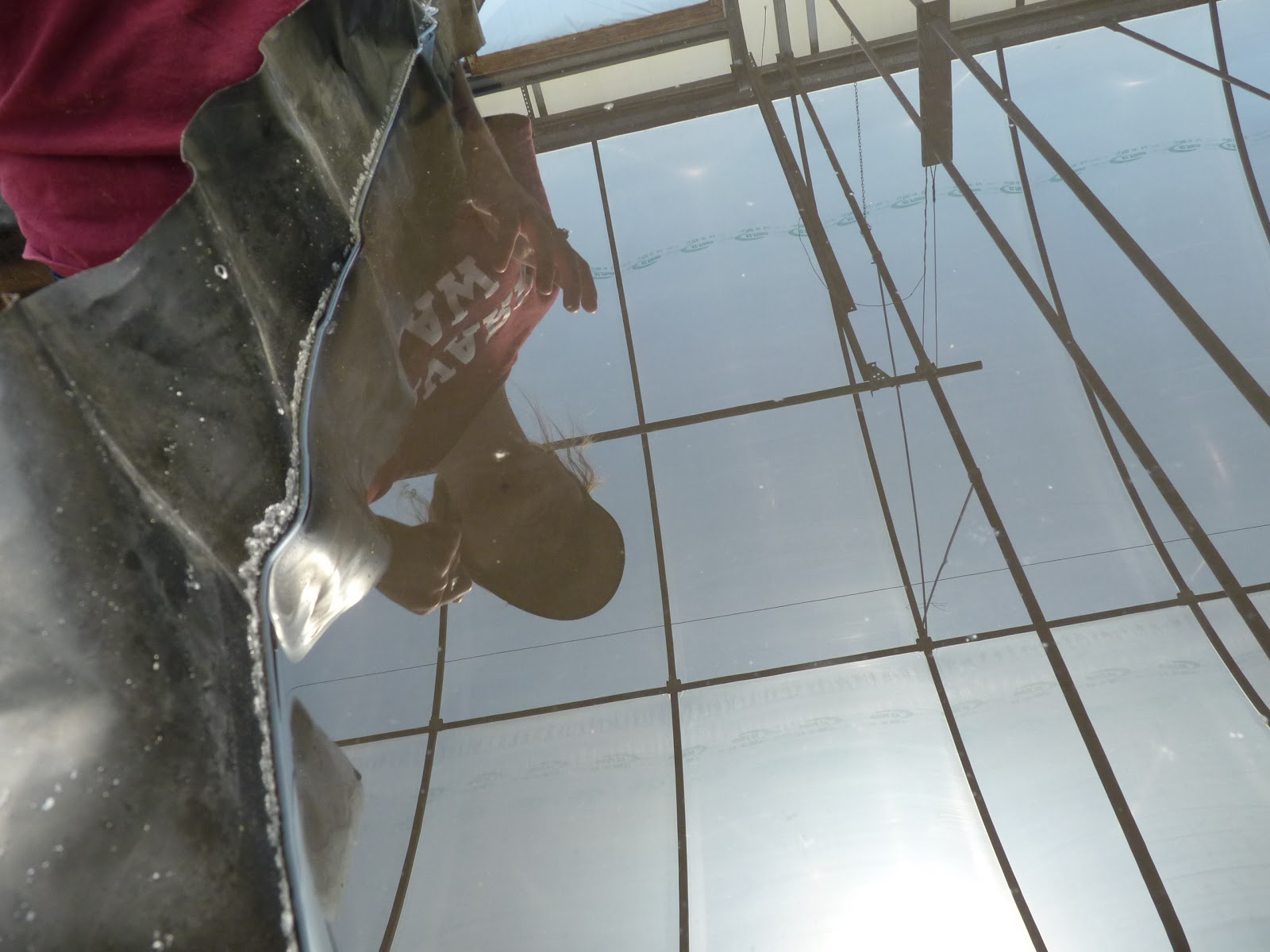
Here is the brine in one of the sunhouses, which resemble large greenhouses. In these houses the brine is allowed to evaporate and the calcium separates and sinks to the bottom of the trays.


It was pretty warm and steamy in here--my camera lens fogged immediately and I had to clean it often to take photos.


From the sunhouses the brine is transferred to another large tank, and finally to the last step of the process.
 Here, you can see the salt crystals forming. They are remarkably beautiful, very white and square! I thought they had settled to the bottom, but actually the crystals are floating on top. When they have been in these trays a day or so (I can't remember exactly what our guide said), they are raked up with the skimmer (the long-handled tool in the below photo), and then scooped up into buckets with the wood scoop.


The process is repeated 2 or 3 times for each tray, and the crystals get smaller each time.


You can see salt gathering bere on the sides of this new tray which had just been filled that morning.


The final step: The salt is sifted, cleaned by minute inspection, and put into flour-sack fabric bags.


Cleaning is done literally with a pair of tweezers! Each batch is carefully inspected and any minute fleck of dark matter is removed.


Finished, graded and ready to package.


In the gift shop, a model of the original works is displayed. This was made by a prison inmate who was taking a class that required a project based on history. He chose the salt works and did an excellent job.


Several different products are offered for sale in the gift shop. There is the table salt, available in grinders or bags, pioneer salt which is reddish-brown and is like the salt the early settler made. It is often purchased by historical groups and re-enactors, and has a strong iron flavor. There are also flavored salts offered in gift packs, and an incredible burnt caramel sauce that tastes better than any I have ever tasted.

We came home with a grinder and some caramel sauce. I wondered if there would really be a difference in the taste of the salt. I mean, salt is salt, right? I was startled by the clarity of the flavor--I can best describe it as clear and bright. We don't seem to use as much of it either. The grinder is refillable and refill salt can be ordered online.


We tasted the caramel sauce at the gift shop and I can't wait to get some good vanilla ice cream to go with it. Delicious!

If you'd like to visit the saltworks, tours are offered daily except for Sundays, when they are closed. Check out their website for more information or to order salt and other items.

And if you're interested in more history about salt-making in West Virginia, these are the resources I consulted for this post:

Dickinson Family. West Virginia Encyclopedia Online.

Fallows, James. Artisanal Salt from an Ancient Sea. Atlantic magazine, Dec 5, 2014.

History of the Great Kanawha Valley [West Virginia], Volume 1. Brant, Fuller & Co., pp 166. (Online at Amazon.com)

History of West Virginia Mineral Industries--Salt. WV Geological and Economic Survey.

Ruffner Family. West Virginia Encyclopedia Online and West Virginia Heritage Encyclopedia,
Volume 19, published by Jim Comstock, Richwood, WV 1976, pp 4175-4176.

Tobias Ruffner.West Virginia Heritage Encyclopedia, vol 19, pp 4176-4179.

Salt industry history. West Virginia Heritage Encyclopedia,vol 19,  pp 4210-4211.

Booker T. Washington and saltmaking. West Virginia Heritage Encyclopedia, vol. 19, pp 4181-4182.

Settle, Mary Lee. Addie: A Memoir. University of South Carolina Press, 1998.


Copyright Susanna Holstein. All rights reserved. No Republication or Redistribution Allowed without attribution to Susanna Holstein.
Related Posts Plugin for WordPress, Blogger...