Pages

Showing posts with label Marion County. Show all posts

Saturday, April 24, 2021

At Valley Falls

50 this morning, warming to 59 with steady rain showers and heavier rain in the afternoon. Cooling off now to the upper 40's. 

We had a road trip today, to pick up some things I won in an online auction. I am a real convert to the online format for auctions. I can look at the items and bid from my home, then go pick them up at the designated time. No long days in auction houses--especially during these COVID times when I would not go into one for any amount of cool things.

After pickup, I suggested to Larry that we drive a little further to a West Virginia state park I haven't seen in years: Valley Falls. It's in the center of our state, in Marion county, and like most parks a bit out of the way, along a curvy secondary road. The park boasts a series of beautiful low waterfalls on the Tygart River, and the area has a rich history dating from the early settlement by European pioneers in this region. The falls have had a variety of names: Evil Spirit Falls by the Native Americans, Hard Around Falls and Big Muddy Falls by later settlers, until it finally became known by its current name, Great Falls of the Tygart--Tygart being the surname of an early settler.


The first white man thought to have seen the falls is believed to have a Jonathan Nixon, in the late 1700's. In 1827, W.W. Fetterman came to the area and in 1837 built a "whip" or "whipsaw" mill to produce lumber used in most of the building in the area. What is a whip mill? Wikipedia had the best explanation I could find: "Prior to the invention of the sawmill, boards were rived (split) and planed, or more often sawn by two men with a whipsaw, using saddleblocks to hold the log, and a saw pit for the pitman who worked below. Sawing was slow, and required strong and hearty men. The topsawer had to be the stronger of the two because the saw was pulled in turn by each man, and the lower had the advantage of gravity. The topsawyer also had to guide the saw so that the board was of even thickness. This was often done by following a chalkline.

Early sawmills simply adapted the whipsaw to mechanical power, generally driven by a water wheel to speed up the process. The circular motion of the wheel was changed to back-and-forth motion of the saw blade by a connecting rod known as a pitman arm (thus introducing a term used in many mechanical applications)."

Mr. Fetterman hired an Englishman to cut and built the millrace, which must have been a prodigious task. The race is still in place, and is large and deep. 

This stack of stone is the only remaining piece of the original mill.


Here you can see part of the millrace. What a job that must have been, especially in those days of hand labor and limited tools.

In the 1852 the Baltimore and Ohio Railroad came through, and there was a need for a hotel for overnight accommodations for travelers on their way to Wheeling and points West. 


Today, CSX trains still run through the park. We were lucky enough to be there to see it, although I'd have loved to have been up on the bridge when the train passed under. Next time.

Valley Falls boomed. There were over 100 homes built, and a variety of businesses sprang up: planing mills, feed and flour mills, a coffin factory, shoemaker, axe handle factory and many more. Soon there was a blacksmith, a Wells Fargo office. a post office and a ferry, as the town grew up on both sides of the river. The Fetterman family was involved in many of these endeavors, and apparently was quite successful.

The Civil War brought additional industry and activity to the area. A gunstock plant was built, and ice was cut from the river and stored in the easily available sawdust for summer use. But when the Fettermans heard that the Confederate army had taken Fairmont, they left, and never returned to Valley Falls. There is, however, a small community near Grafton, WV that bears the Fetterman name.

The location of the town, and its heavy involvement with the timber industry, let to its demise. Fire swept through the town in 1886. leveling many of the buildings. Two years later a devastating flood swept away much of the town yet again. Although the mill was repaired and continued in operation until 1905, the fate of the town was sealed, and it eventually dwindled away. The area was acquired by the West Virginia state park system beginning in 1964, and more land was added over the years until the park became its current 1000+ acres. It is a day use park now, with no overnight camping or facilities.

We ventured out on the rocks around the falls; the walking is easy if you're careful. The color of the water is such a gorgeous green.


My first visit to Valley Falls was an accidental one, back in 1973 or 74. My first husband, me and our little boys were on a road trip, exploring West Virginia, where we wanted very much to move. We needed a place to camp for the night, and turned up a road called Camp Towles. Thinking it was a campground, we drove back the narrow road until eventually we were on a very narrow gravel track alongside a river. As I learned later, we were just across the Tygart River from Valley Falls State Park. At the time, it was nearly dark, the place was lonely and deserted, so we just got out the sleeping bags and made camp right there, falling asleep to the sound of the falls. 

In the morning I was up early. The mist from the river gave an ethereal beauty to the place, and I wandered along the little road, picking a few raspberries to add to our breakfast and just enjoying the solitude. I looked down, and there in the gravel I found a beautiful, turned brass piece. I dug it out of the mud and polished it up. On the way home we stopped at Valley Falls State Park and learned the history of the place; I thought my brass piece must be a cabinet handle or something like that, from one of the long-ago homes og Valley Falls. I took it home and put it on our bookshelf, where it shone brightly and made me remember the place I'd found it whenever I looked at it.

A few weeks later, my brother Tom came to visit. He spotted my prized brass piece and said, "Sue, what in the world are you doing with a hash pipe??" Yes, I was that naive, I had no idea what the thing was. My brother took it home with him, and now I wonder exactly what he might have done with it. Or maybe it's better I don't know.

I look at Valley Falls today and try to imagine how it must have been back in those days, bustling with men and horses, trains and noise. It's quiet today, only the sound of the falls and the voices and laughter of visitors. I think, really, it's better this way. I leave you tonight with the music of the falls. 


Copyright Susanna Holstein. All rights reserved. No Republication or Redistribution Allowed without attribution to Susanna Holstein.

Tuesday, October 23, 2018

Travevling West Virginia: Through the Hills to Mannington

I have this thing: I like to take different ways to get to places that have a "usual" route. Usually the different way takes longer. Sometimes a lot longer. But often the time is worth it.

So yesterday we took the long way to Mannington, which is in the north-central part of West Virginia, not far from Morgantown and Fairmont. Not far mile-wise, but quite a distance in many other ways. Normally we'd take Route 50 east across to Route 19 and then head north. But while I've traveled almost the entire length of Route 20, there's one stretch we've never driven. So that's the way I wanted to go. To get there meant driving north on Route 2 along the Ohio River for a ways--one of my favorite drives anyway. There were a lot of barges on the river but this time I didn't try for photos. I wanted to get on to the "new" road.

As it turned out there is still some of Route 20 we've missed! The route we took had a little shortcut at the beginning, and then turned off of 20 for yet another shorter route towards the end. One day I'll catch those two pieces.


We were surprised to see another Joe's Run! That's the name of our road. I like the old schoolhouse beyond it too--it's in the midst of renovations, looks like.

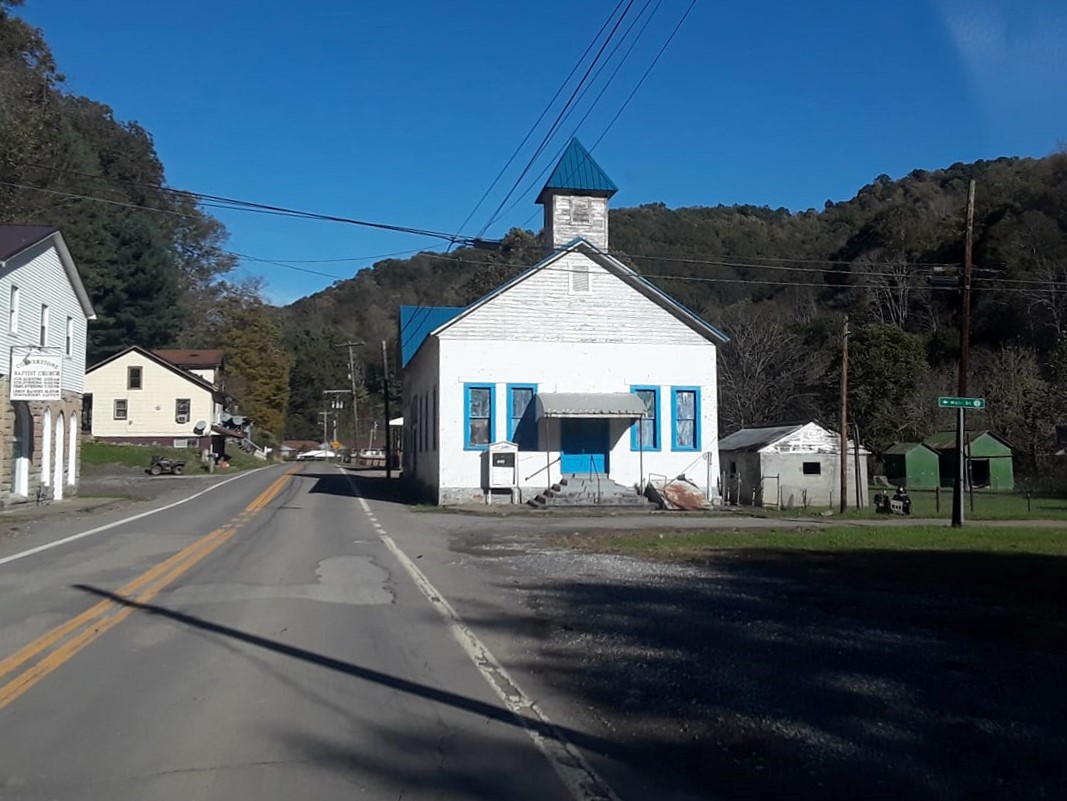
 This church is prepared for evil! Blue paint on windows and doors, even the roof!

Colorful homes along the way.


Loved the name of this road.


It was a beautiful day for a drive, hardly a cloud in the sky. The road was, well, rough. And busy. We were in the heart of gasline country, and there were signs of the activity everywhere. I should have taken some photos--it really is disturbing how much the landscape is being altered, and not for the better. Large clear swaths travel up and down the hills, pipes and mud and trucks are everywhere, and there are big stations, for lack of a better word, with all kinds of pipes and machinery. Electric lines and big towers crisscross and well, it just ain't pretty. There are pipelines being built across my county too, and I am concerned that this area too will soon be scarred by this booming industry.

There were still pockets of rural beauty, and we thought about how far people in this back country have to travel for groceries, health care and other necessities. Even though the road was two-lane, it took us two hours to drive from the river to Mannington and there were no towns in between. There were some small communities, a few Dollar Generals, gas stations, drug stores, and convenience stores but no grocery of any size that we saw.

This was once coal mining country and there were still some homes that looked like they'd once been coal camp houses but as far as I could tell there were no mines operating. The gaslines seemed to be the major source of work. But there was much to see, much that harkened back to simpler days.

Mannington itself has seen its share of ups and downs. The Depression really hurt this town, and it has been years recovering. A major fire in the downtown area in 2010 or 11 destroyed some historic buildings. I have been to Mannington before and this trip I noticed that the town has grown and improved a lot since my last visit. We stopped to eat in this restaurant/bakery that was in an old bank building. The food was superb, the service the same.

I think they must have some very small employees.


The town is full of historic homes. We didn't have time to take photos of them and need to make another trip soon. This one intrigued me though.


More buildings in the town, and just out of town. The old railroad depot, and the amazing round barn. They give tours of the barn but unfortunately they were closed when we got there.


I've spent hours researching a few stories about this town and a few of its past citizens--some honorable like the Looman family's ghost, some notorious like the evil Ernie Yost, some mysterious like Serilda Jane Whetzel who is believed to have been a witch. I had enough of each of those stories to be able to tell a short story about some of them and continued my research today because I am fascinated and don't want to let go of them yet.

The storytelling was fun--we were outside and it was windy and a bit chilly and the chimes in the schoolhouse were v-e-r-y long. I was glad of my long warm coat! Children came in costume, parents came bundled up, everyone enjoyed hot chocolate and popcorn. Every event has its challenges, but we all had a good time and I was glad to be there to share stories and just be there with these good people. And of course, I met people who told me even more stories.


Today I'm back into research. Larry's a good man--he does the basic cleaning when I'm in this busy season, and does some of the cooking too. I keep up the laundry, pay the bills, and do some cooking when I pull my head out of books and computer. Tomorrow I'll be on the road again to Petersburg, WV and more stories at the library there. So back into studying I go!

Copyright Susanna Holstein. All rights reserved. No Republication or Redistribution Allowed without attribution to Susanna Holstein.

Sunday, August 22, 2010

Tomato Tasting

Jaime felt well enough today to go to a little festival in Fairmont today. A tomato-tasting festival.

You heard right. Tomato tasting. And it was a taste treat.

I saw a little blurb in the local paper, so Jaime looked up the directions. The festival was to be held at High Gate, the former home of a coal baron in Fairmont that echoed the timbered look of old English architecture. The festival was held on the grounds of the carriage house of the original estate, and the tasting itself was inside the carriage house.


The grounds are beautiful. Fairmont has a strong Italian heritage and stellar stonework is evident throughout the city. At High Gate, stone walls, arches, steps and walls abounded. James and Michaela had a great time climbing up and over the walls as we explored the various vendors.


We found a soap maker who had lovely rose petal soap and Shea butter hand lotion as well as handmade birdhouses.


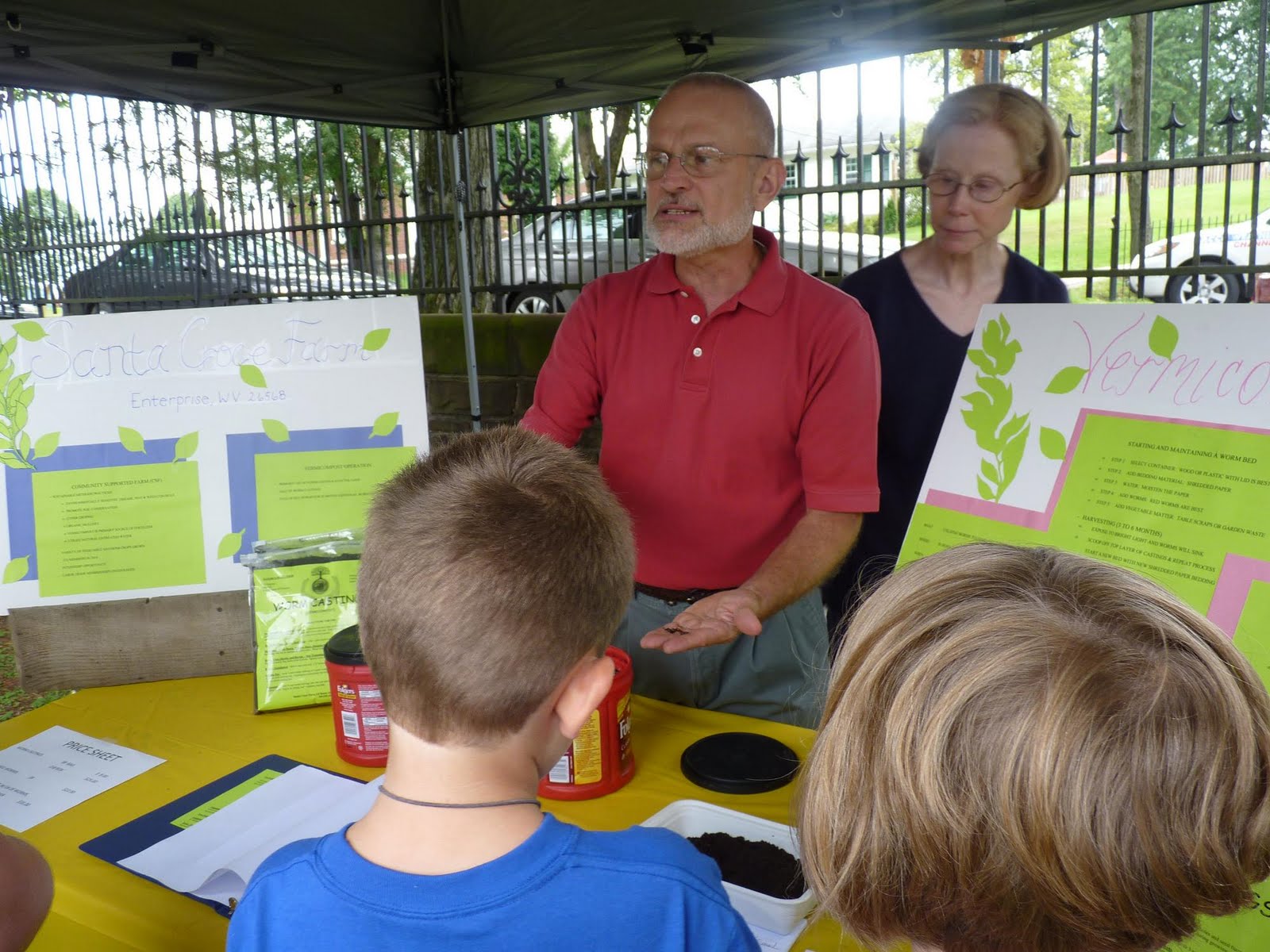
Worms!

We talked to people promoting worm farms, looked at the screen house full of Monarch butterflies, bought lemon thyme plants.


Then we found the tasting. Oh. My. There were tomatoes of all sizes and varieties. Most were the heirloom varieties. I saw many of the kinds I grew this year--Cherokee Beefsteak, Strawberry Beefsteak, German Pink, Amish Paste, Roma, Yellow Pear, Brandywine, Mortgage Lifter, Hillbilly. Our favorite was one grown by my friend and Master Gardener June Riffle called Zebra, I think. It was a yellow and green-striped tomato and was tangy and full of flavor. On the list for next year's greenhouse.

June's Zebra Tomato won third place! We think it should have been first.

Seeing June and her daughters was a surprise pleasure. They were selling breads and jams and other items. June is a storyteller, part of the duo called Mountain Echoes. She's also a great gardener and beekeeper.


Lasagna class was getting to start, but we had to leave.

We didn't stay for the many workshops and lectures scheduled for the day.

I left thinking that many other small towns could offer a similar festival. It was laid-back, interesting and unusual, and made me want to try a few new varieties next year. The classes were interesting too--we wanted to stay for the one on tomato diseases and treatments, but it was time to go home to make Aaron's dinner. Which was Eggplant Parmesan, good homemade bread from the festival and a salad featuring Jaime's Strawberry Beefsteak and German Pink tomatoes.

Thursday, October 8, 2009

The road to Fairview....
Route 218

passes interesting buildings...
The middle school--how cool is that! going to school in a castle.
and cool old trucks...

and takes me to a place where the people love stories (especially ghost stories)...
Inside the city hall building with the elementary school students

and where I love the people. Wide smiles, hugs, homecooked lunch, good coffee, flying conversations...what's not to like?

Fairview Library children's librarians Jo and Julie--dynamite librarians who know what it takes to meet the needs of their community.

Thanks for having me to tell stories again!

Wednesday, October 7, 2009

Ghost Rider?


Okay, creative people! What would your caption for this photo be? We had to turn around and go back to take a picture. Don't you love people's strange minds?
We saw this in front of a convenience store in Enterprise, WV. Enterprising person there, certainly!

Tuesday, October 6, 2009

On the Road Again

I'm off to Fairview, West Virginia today, a small town near the WV-Pennsylvania line, to tell stories at the library and the elementary school. It's always a pleasure to visit this town, and to soak up the atmosphere of history in a mining community that has known much history, some good and some tragic.

Last Friday when we returned home (and boy do I have photos and stories to tell you about that trip!) a thunderstorm blew in and just as quickly left. The sun peeped through the raindrops so I knew there would be a rainbow. I hurried up to the top of the ridge and took photos. Here is one; I'll share more when I return this evening.


See you tonight!

Wednesday, April 8, 2009

Along Mill Falls Road

(Quick post tonight because I am right tired!)

Last weekend we stayed with my son and daughter-in-law near Fairmont while I was the Mountain State Storytelling Institute. Here are a few photos taken along their road.

Daffodils dot the site of an old homestead. This place inspired a rough draft for a poem that I'm working on.


Up on the ridge the green is not so evident as it is along the creek below.


Forsythia lights the way along Mill Falls Creek.

This sycamore tree seems suspended in mid-air; the soil under its roots is washed away but the tree remains upright.

Thursday, October 9, 2008

Grant Town and Ida May

This is just one of the many pretty roads Aaron and I traveled on Wednesday in northern Marion County. You would not guess to look at this land that there are many deep mines under the surface--some active, some long since idle, and a couple with deadly histories.


One of the things I find fascinating about this area is the Italian heritage. Many families are descended from Italian immigrants who came to work in the mines, and the bakeries and restaurants attest to this background. Pepperoni rolls were actually invented in this part of West Virginia, although there still seems to be a little disagreement about exactly who made them first.


We passed this place on the way to Grant Town. I won't say what Aaron called it, but I liked the way it sat at the edge of the road on the little rise. I wonder if it had been a boarding house, a store, a hotel? Hard to say. It may have just been always a residence.


Coal still drives a large part of the economy in this part of West Virginia, although nothing like its heyday. The roads are narrow and twisting, and as you can see in this photo there's no extra room for the big coal trucks to maneuver.


Aaron said that truckers will call ahead in certain areas because tow of them cannot pass each other in those places--like one he called "the dip and squeeze." If you saw the narrow little bridge and sharp curve with no space for shoulders, you'd understand the name. Trucks approaching on either side will call ahead to warn any truck coming in the other direction to wait. Of course, if you're traveling without a radio, you're on your own.


This is the Grant Town power plant where Aaron works. As I understand it, this plant is a recycling plant--they use coal waste from other power plants to generate more energy.


And this is a former strip mine site. Would that all strip mines were reclaimed as well as this one.


On another part of the reclaimed mine, a small forested knoll rose above the landscape. The reason it wasn't tampered with? There is an old graveyard hidden beneath the trees. We didn't investigate as we weren't dressed for hiking, but one day I'd like to go back there.


The post office at Ida May (pronounced, I'm sure, Idy May) is located beside what used to be the mining company's company store. Ida May once was a thriving mine community. It is the tunnels from the old mine that run under the ridge where Aaron's house is located.


There is so much to see in Marion County--the abandoned railroad trestles, the rail trail, The Farmington monument and Monongah. Not all of its history is pretty, but it is filled with stories of people making a living in a dangerous industry, of immigrants making a home in a new place, of ghost stories and small towns and small farms. Sometimes getting off the beaten track, away from the usual tourist destinations, brings the biggest rewards and understanding of people and their place.


Related Posts Plugin for WordPress, Blogger...