Pages

Showing posts with label Summers County. Show all posts

Wednesday, June 22, 2016

From Ghosts to Controversy: Saint Colman

As I was browsing through stories of Summers county, WV, I came upon Saint Colman's Catholic Church and yet another unusual story.

This tiny church in a remote corner of Raleigh county near the Summers county line was established as the place of worship for a small Irish immigrant community of farmers. The place they settled, about 1855, became known (and is still known) as Irish Mountain. The church is reportedly log, covered over with white clapboards.

According to the local oral tradition, there is one corner of the church cemetery known as the Graveyard of the Lost Souls, where newborn babies and others unbaptized before death were buried--they were not allowed to be buried in consecrated ground. Today this seems un-Christian and even cold-hearted but it was the custom for many years in the Catholic church. I won't go into details about the controversy, not to mention heartbreak, caused by this policy, but this website and video give a touching insight into one man's efforts to discover the grave of an aunt who died at birth. Such things that are done in the name of religion!
Today the community on Irish Mountain is gone, and their farms lost in the forests covering the land. The name of this church, though, caught my attention. Who was Saint Colman? I'd certainly never heard of him.

The answer to that question was a surprise. Good grief, there are over 300 Irish saints called Saint Colman! So which one was the patron saint of this lonely church? Was it Saint Colman of Kilmacduagh, or Saint Colman of Lindisfarne, or Saint Colman of Mayo, or Saint Colman of Stockerau (my preference, since he is the patron saint of hanged men, horned cattle, and horses and is invoked against plague and for husbands by marriageable girls; and against hanging and gout!)? Or one of the hundreds of others?

According to the West Virginia Encyclopedia, this particular church was named after Saint Colman of Kilmacduagh, the abbey he founded in County Galway, Ireland. Below is a photo of the remains of the abbey, from Wikipedia.

By Jerzy Strzelecki - Own work, CC BY-SA 3.0, 
https://commons.wikimedia.org/w/index.php?curid=15875239

Colman Mac Duagh was educated on Inishmoor in the Aron islands, and then, seeking more solitude, moved to the Burren in County Clare.There are many legends that have been passed down about him; Wikipedia has several interesting ones about his friendships with a rooster, a mouse, and a fly!
The Burren
So it is fitting after all for this remote little Catholic church to be named after a saint who sought solitude, isn't it? As for the sad graveyard, there are stories of it being haunted and somehow that isn't surprising. I believe it is haunted by the sorrow of those poor mothers and fathers who were not allowed to bury their little ones in the family plot, with a stone to mark their name.

I will have to add this to my list of places to visit next time we're in the south of the state. And I think I'll bring some flowers for those poor lost souls.

Copyright Susanna Holstein. All rights reserved. No Republication or Redistribution Allowed without attribution to Susanna Holstein.

Monday, June 20, 2016

The Ratliffe Mystery

Murdered peddler stories are rampant in West Virginia folklore. I used to wonder about that but after doing some research I think I have discovered why so many poor peddlers met their Maker in the Mountain State.

I've identified 5 factors:

1. Peddlers often came to America from middle/Eastern Europe. They spoke little English and what they had was probably limited and broken. The came and worked, saved enough money to buy a big leather sack and some cheap goods to sell along their travels.
2. They had little or no family here to come looking if something happened to them.
3. They had long unpronounceable names that were often shortened to a nickname, or given more Anglo names.
4. They traveled in lonely places, out on the frontier and through sparsely settled countryside. They usually traveled alone.
5. As they traveled, the peddlers sold their ware from their big packs. As the supplies in the pack dwindled and the bag flattened, their flat pockets began to bulge with cash.

So: foreigners with strange names or nicknames, traveling alone in lonely country, and at times carrying a lot of cash. They were sitting ducks.

The murder tales often include the fact that the corpse was headless. Because removing the head was a simple way to hide a body's identity in the days before forensics and fingerprints. In this particular story from Summers County, WV (probably Virginia at the time), there is a slightly different twist.

From The History of Summers County West Virginia (©1908), by James H. Miller:

Photo from my blog post about the tunnel, linked above.
"During the building of the Big Bend Tunnel in 1872 a peddler by the name of Ratliffe disappeared and was never heard of after. He had on his person $375.00 and left the tunnel accompanied by Harry Gill, who lived in the mountains back of Bradshaw's Run in Forest Hill District.

Mr. Henry Milburn saw the peddler and Gill cross the Greenbrier River near his place and they went on the the direction of Gill's. That night a Mr. Lowe who lived in the neighborhood heard the cries of distress of someone appealing for help. At first he thought the cries came from his father's and he ran in that direction on Bradshaw's Run, but discovered that the trouble was in the mountains.


The cries ceased and later in the night a great fire, was seen in the direction of Gill's. The next day it was learned that Gill's stable had burned during the night, claimed to be accidental. The peddler was never seen or heard of afterwards, and no evidence could be found of him except a piece of his trousers was found in a hollow hickory tree in the neighborhood of where the stable was burned, with a hole near the waistband, indicating and appearing to have been made by a bullet.

No arrests were made, as no evidence could be found for certain that Ratliffe was dead. A few years ago this same Harry Gill died and during his last illness the neighbors came in to attend him and administer to his wants, and during this last illness he seemed to be in great despair, although perfectly sane in mind, and he would cry out, "There is Ratliffe! Take him away!"

Finally he secured a pair of scissors and demanded to know if Ratliffe was gone. He kept hold of this weapon until his death. People were present at his death who were not in the state at the time of the disappearance of the peddler, and had never heard of him or of the circumstances. Gill lived to be an old man, and was in later years elected constable. Whether Ratliffe was killed was never known."

A strange tale, following on the heels of my last post and the story of the Civil War soldier's terrible wound and amazing recovery!

Southern West Virginia--a place of beauty, mystery, and history.

Copyright Susanna Holstein. All rights reserved. No Republication or Redistribution Allowed without attribution to Susanna Holstein.

Saturday, June 18, 2016

Jumping Branch: A Little History, A Strange True Tale

I was so intrigued by the community of Jumping Branch when we passed through there this week that we returned after my storytelling performance to learn a little bit about the community.

First, how did it get its name? I am always interested in place names, especially those that are a little odd. According to The History of Summers County West Virginia by James H. Miller, "Jumping Branch is a stream running by Jumping Branch Post Office and village on its way to Bluestone. In the days of the early settlement there was no bridge across it, and the traveler made his crossing by jumping his horse from one bank to another." Another reference in Miller's book noted that men would also jump their teams of horses over the stream. I'd like to have seen that.

 At the library I asked a staff member about the place. "Well, I live there but I don't know the history because I'm not from there, you see. We moved there a few years ago." Some of us are just born curious, I guess, while others accept things as they are.

The old buildings seemed to have stories to tell, but how to find them? On our way through the first time I saw an elderly lady getting her mail and decided that I would try knocking on her door when we returned, to see if she could tell us anything about the place.

It turned out that she was a good choice. Not only did she know about Jumping Branch, she'd lived there all her life. She went back inside her pretty home and returned with a scrapbook of old photos.

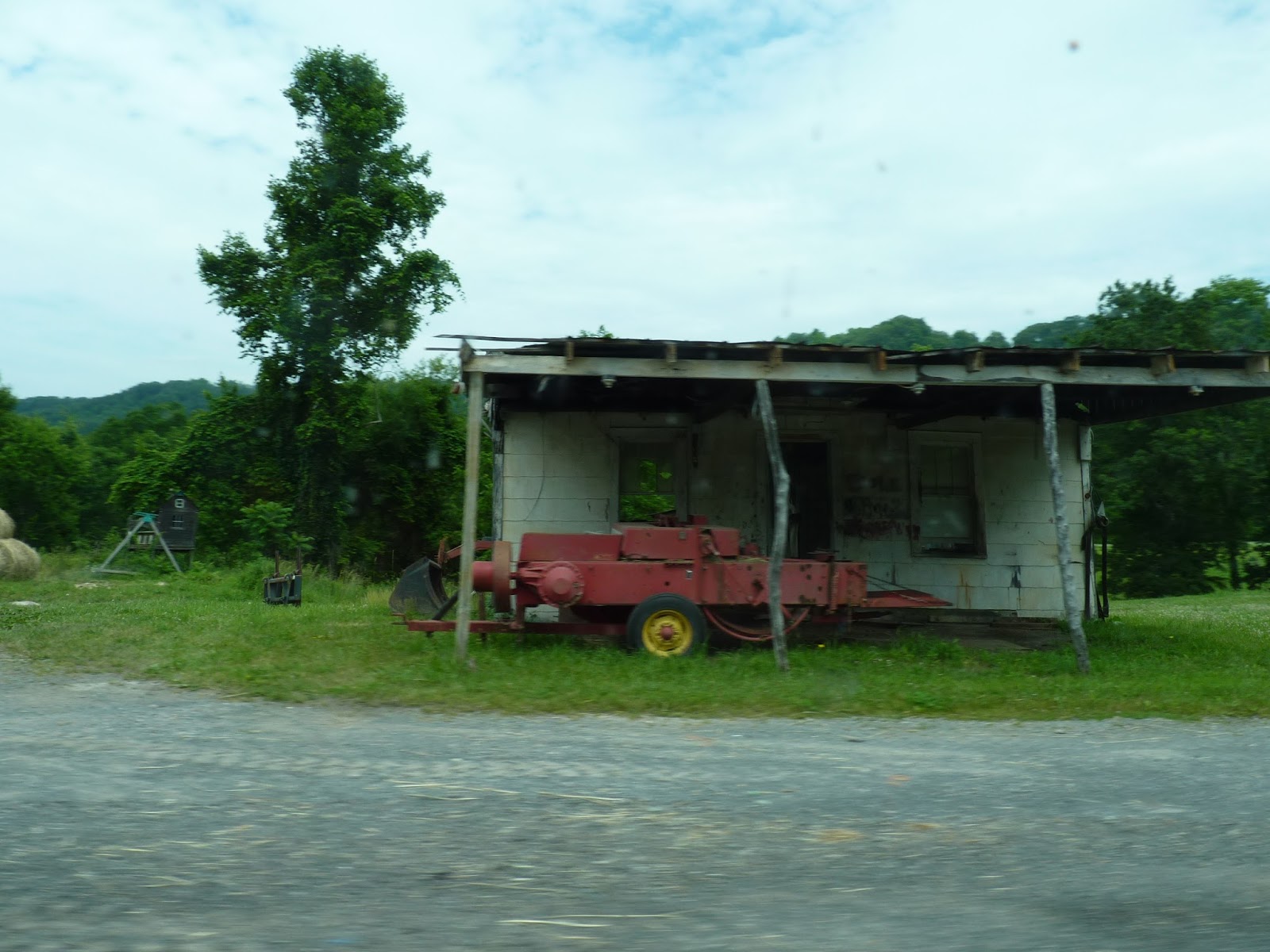
Her father, she said, operated a store in the green block building for years. He was a butcher but also sold a variety of other things, including kerosene, I noticed, judging by the old tank beside the block building. The large building across the way was once the Odie Meador Lumber Company store. I later learned that the owner of the lumber company, Mr. Meador, was elected sheriff of the county in the 1970's but died in office. The front part of this building is believed to be log.

Odie Meador Lumber Company. It was a thriving business in its day.

Was this once a coal mining community, I asked? The cluster of buildings reminded me of coal camps I'd seen in other places in our state, but she said no, this was a farming community and the stores here supplied the surrounding farms. It was easy to see this; the land lays beautifully with rolling meadows and pastures well watered by streams.


We did not get the story on this building, although it looks like a store.

There was an auto repair garage here too, the concrete base of the pumps still barely visible under encroaching grass.

I believe she told us that this was once the post office.


This house, she said, was once used as a local hospital. I did not think to ask what time period that might have been.


Not far from where we were talking to our new friend was the Bluestone Baptist Church. According to our informant, the church was established about 1782. I searched in Mr. Miller's history book and found that the church has had an interesting history. He gives its establishment as 1798, still very early days in the US. The meetings were originally held in the log house of a Mr. Meador, and people came from miles around, from as far away as Giles County, VA. Eventually they built a log church, which burned so they built another which was burned by Federal troops in the Civil War. The church managed to weather all storms and continues to serve the area to this day.

Once Jumping Branch had two grain mills, our informant told us, and people would come from everywhere to get their meal ground. Now the mills are gone, but I thought I could see the site of one of them under a tangle of growth along a stream.


Before we left, our friend told us the story of her great-grandfather, Joseph Floyd Young, who served in the Civil War as a Confederate soldier with 151st Militia, and later the 17th Virginia Cavalry.

Floyd Young CWP 3
photo from Ancestry.com shows a young Young, apparently prior to his injury.
According to the family story, Young was shot through the temple--clear through. The wound was cleaned by pulling a silk handkerchief back and forth through it. Can you imagine the pain? Mr. Young survived the wound although he was blind, she said, and felt his way around the house. He would feel for the stove by stretching out his hands to feel the warmth.

The story amazed me. How could anyone survive such a wound? I found a bit more about it in Civil War Tales, Volume 1, by Gary C. Walker. In this account, "Joseph Floyd Young of the 17th Virginia Cavalry was wounded through the eye as a bullet or shell fragment passed out through the temple. The wound was treated by pulling a silk rag through the wound channel, back and forth repeatedly to cleanse the wound in what was left of his eye socket."

Yowch. Apparently Young was unmarried at the time, marrying in 1867. Later images of him do not seem to show much damage to his eye, which seems to have healed incredibly well.

JF & Sarah Young
A later image of Mr. Young, with his wife Sarah. From Ancestry.com

We drove slowly back to Hinton, to find, at last, a late late breakfast. As we drove we passed these roses, growing rampant and wild alongside the road. Such beauty, such stories, such memories.


Copyright Susanna Holstein. All rights reserved. No Republication or Redistribution Allowed without attribution to Susanna Holstein.

Friday, June 17, 2016

Such Beauty: Day 2, Sandstone to Jumping Branch

A quick post this morning as I have to leave very soon for the WV State Folk Festival in Glenville, WV. I'd hoped to write this post last night but our power was off for quite a while. I am not complaining, because it rained at last! After the past few weeks of dry weather, we are in sore need of rain.

Sandstone Falls overlook:


Along the way:


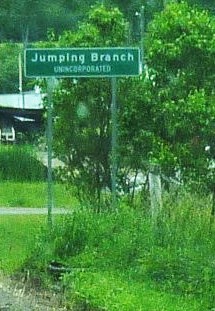
In the little community of Jumping Branch:


I'll have more about Jumping Branch in a later post. We heard some good stories here.

Later, friends! Off to tell some tales!

Copyright Susanna Holstein. All rights reserved. No Republication or Redistribution Allowed without attribution to Susanna Holstein.

Tuesday, November 2, 2010

Weekend: Downstate

Wendy Perrone told me about a new coffeehouse near their Three Rivers Avian Center, and then she said, "They have open mic Saturday night and I'm going to tell the story of the Greenbrier Ghost." Now! We had plans, you know--we were going to start on the turkeys, then sit around the house and hope for a trick-or-treater or two. Sometimes we actually do get a few, although never very many. (I know I mentioned our Saturday night adventure in a previous post, but wanted to say more about it, so here it is!)

The coffeehouse and open mic idea teased us. And we were already tired from being in town all morning. Neither of us wanted to do turkeys, that's the truth. So we convinced each other that we could do all 13 of them on Sunday (yeah, right, after a long drive and getting in after midnight?) and off we went to Hinton. We could justify the trip, actually, because we needed to drive to Charleston to get a gas heater anyway--Hinton was only another hour and a half south of Charleston.

So, off we went. After a stop at Lowe's to drop $500 or so in less time than it takes to type it, we grabbed a bite to eat and headed down the road. It was a perfect day for a drive, cool and crisp and some color still in the trees. We topped over Sandstone Mountain and luckily Larry did not turn into the truck escape ramp as I told him to (shoot, I thought it was our exit!) and exited on Rte 20 toward Hinton.

We passed through Ramp, WV and had to stop to take a photo of this sign:

It's only funny or understandable if you're from West Virginia and know what ramps are. The Sandstone River below was so pretty:

There is something about railroad tracks along a river...the sense of travel, loneliness, moving on to other places, perhaps?

We got to Hinton just as the sun was setting:


and made a few circles through town before finding the coffeehouse.


But once there, oh. my. goodness. What a fun place!


People in costume, pumpkin carving contest, music,


storytelling (Wendy telling her tale),


and Raymond, a poet I'd only met online previously and had no idea would be there, read a creepy story and poem:


...and many more talented people sharing their work with a fairly large and constantly shifting audience. Trick-or-treaters came and went, the coffee flowed, and the wonderful aroma of baking filled the rooms. The coffeehouse is so homey inside with books, sofas, comfy chairs, and soft light all creating an inviting atmosphere. Walk out the door and the river is just down the street. There's even a big front porch and a conference room.

We left reluctantly at 9:45, and were home just after midnight, drving the speed limit the whole way and stopping for gas, etc. I always thought of Hinton as being a logn way away, but actually it's only 2 and a half hours, not so bad at all. And well worth the drive for the scenery and good company to be found at its end.


Related Posts Plugin for WordPress, Blogger...