Pages

Showing posts with label mistletoe. Show all posts

Tuesday, December 21, 2021

Solstice Fire

Tonight we lit a fire in the firepit and sat outside, drinking hot chocolate and watching a glorious sunset. What a way to end the year, with a fiery display both above and below.


This is the night to burn your mistletoe saved from last year's celebrations, so we took ours out to the fire and let it burn. I still have a few leaves in the house, as the old folklore says it provides protection from a great many bad things. I need to get a twig of holly too, also a strong protector, so the old ones said. 


We watched the fire in front of us, and the spectacular show above.


I loved seeing the progression of color intensify until it spread almost horizon to horizon.


Until at last, there was this great show, then all ebbed to gray. 


It was time to come inside, to yet another fireside, where we will spend the rest of this beautiful evening. A perfect way to welcome winter. 

Copyright Susanna Holstein. All rights reserved. No Republication or Redistribution Allowed without attribution to Susanna Holstein.

Tuesday, December 20, 2016

And Finally, Mistletoe!

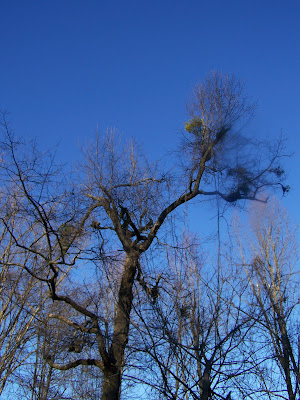
Mt husband had an appointment for routine tests today at the VA in Huntington, which is about  2-hour drive down the Ohio River. I went with him because he was getting his eyes dilated. We both remembered that we'd seen mistletoe--lots of it--in trees along this route, so today we drove with our eyes searching the treetops.

Because it just isn't Christmas without the kissing ball being hung with mistletoe, right? My mother made one every year, and it is part of my many fond memories of Christmas. Some years back I made one for our home, and at first it held just plastic mistletoe. Then we discovered some close to home. But over the years the patch has dwindled and I've been searching for another source. Route 2 along the river is like the motherlode of mistletoe, but getting it is not so easy.

We noted locations as we drove today: that tree too close to the railroad tracks, those trees too far over a steep bank, those too close to houses and probably on private property. But we spotted one that looked possible. It was off the road a bit but still on the right0of-way, no houses nearby, and on level ground. Larry had brought along his shotgun but we didn't want to use it because it's very noisy and might upset people. So we figured we'd chuck rocks up into the tree and maybe knowck down a few bits--just enough for my kissing ball.

 We stopped on our way back, and lo and behold, there was plenty, right on the ground! Other tire tracks suggested someone else had been there, so maybe they dropped some.
Or maybe the extreme temperature changes over the weekend, along with some brisk wind, broke it loose. Some even had berries.

So once again my kissing ball is full of mistletoe, and hung in a doorway to catch the unsuspecting. It's these little things that make the season for me--the memories, and the traditions we keep alive.

Stop by, and maybe you'll get lucky and get a kiss!


Copyright Susanna Holstein. All rights reserved. No Republication or Redistribution Allowed without attribution to Susanna Holstein.

Thursday, December 8, 2016

More About Mistletoe

A few years ago I posted a little bit about mistletoe, but there is much more about this small parastic plant that plays a large role in our holiday festivities.

For example, did you know that if you kiss someone under the mistletoe, you are supposed to remove one berry from the bunch? That might be difficult if your bunch is plastic, as much mistletoe is these days. And what if your twig has no berries at all? Does that mean no kisses? And if a single woman should not be kissed under the bough during the winter holiday, she would likely remain single the rest of the year.

Why the kissing tradition? According to this site, mistletoe once offended the gods, who therefore comdemned it to have to look on while pretty girls were being kissed." Poor mistletoe!

Mistletoe Collector
by Adrien Barrere, 1874-1931,
from Wikipedia
According to some sources, mistletoe should only be collected on the sixth night of the sixth moon after the winter solstice--which would make it mid-June, by my calculations. Considering the holiness with which the summer solstice was regarded, this does make some sense, although the twigs would be pretty dry by the time of winter celebrations. The mistletoe was always cut carefully and was not allowed to touch the ground during the harvest, as that was thought to remove some of its magic. As far back as 77 AD, Pliny the Elder noted that Druids cut it with a golden sickle ,althoug later historians question Pliny's assertion.

Keeping the mistltoe from falling to the ground might explain why it was thought to be a cure for epilepsy: since epilepsy made people fall to the ground, and mistletoe not being allowed to touch the ground, the epileptic who carried it was protected from falling. The Druids called mistletoe "all-healer," considering it one of the most powerful of plants. Mistletoe that grew on oaks was considered the most powerful of all bit if the plant touched iron or steel, it lost its power too, just like touching the ground.


The White Goddess website tells this story of the Norse connection to mistletoe: "The Norse god Balder was the best loved of all the gods. His mother was Frigga, goddess of love and beauty. She loved her son so much that she wanted to make sure no harm would come to him. So she went through the world, securing promises from everything that sprang from the four elements--fire, water, air, and earth--that they would not harm her beloved Balder. Leave it to Loki, a sly, evil spirit, to find the loophole. The loophole was mistletoe. He made an arrow from its wood. To make the prank nastier, he took the arrow to Hoder, Balder's brother, who was blind. Guiding Holder's hand, Loki directed the arrow at Balder's heart, and he fell dead. Frigga's tears became the mistletoe's white berries. In the version of the story with a happy ending, Balder is restored to life, and Frigga is so grateful that she reverses the reputation of the offending plant--making it a symbol of love and promising to bestow a kiss upon anyone who passes under it."

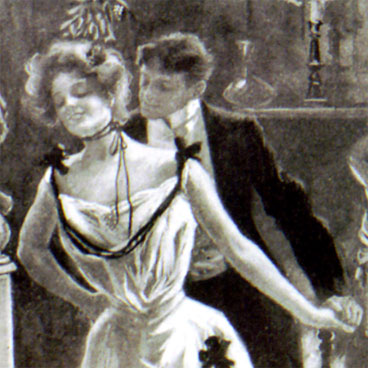
Saturday Evening Post cover 1900, from website 
Mistletoe was believed to ward off fires and disasters, and was hung in some homes year-round for this protective property. It could also, some believed, open locks, although how that would work, who knows today? Wearing a twig around the neck was a talisman to ward off evil spirits and witches. Mistletoe would sometimes be burnt, and the ashes carried in a little bag to bring good luck. But some believed that feeding your holiday bunch to your cows would bring a good year for your dairy. Farmers also believed in some areas of Britain that a good year for mistletoe meant a good year for corn (not our kind of corn; in England wheat was called corn, and in Scotland and Ireland corn meant oats.)

In Wales, mistletoe growing on hazel orash trees was believed to have treasure growing under its roots. This apparently came from an ancient legend that under these trees there lived a snake with a ruby inside its head. Over time the snake in this story was forgotten, but the treasure lived on. Interestingly, in early Christian churches mistletoe was banned from the church decorations, and this custom continues to this day in some places.

In the Victorian era, mistletoe really came to the fore as part of the holiday festivities. Washinton Irving captured the spirit of the Victorian Christmas in a few lines: "The Yule log and Christmas candle were regularly burnt, and the mistletoe, with its white berries, hung up, to the imminent peril of all the pretty housemaids."

What to do with your mistletoe once the holidays are over? Don't throw it out! Leave it in your house until the coming year if you want your good luck and good fortune to continue all year.

The plant has found its way into poetry too:

MISTLETOE
by Walter de la Mare

Sitting under the mistletoe
(Pale-green, fairy mistletoe),
One last candle burning low,
All the sleepy dancers gone,
Just one candle burning on,
Shadows lurking everywhere:
Some one came, and kissed me there.

Tired I was; my head would go
Nodding under the mistletoe
(Pale-green, fairy mistletoe),
No footsteps came, no voice, but only,
Just as I sat there, sleepy, lonely,
Stooped in the still and shadowy air
Lips unseen—and kissed me there.


Some intriguing sources for more on mistletoe:
Encyclopedia of Superstitions by M. Radford, 1949.
Pocket Guide to Superstitions of the British Isles by Steve Roud, 2004.


Copyright Susanna Holstein. All rights reserved. No Republication or Redistribution Allowed without attribution to Susanna Holstein.

Saturday, November 28, 2009

The Mistletoe Hunt

Once upon a time there was a tree that grew in a multiflora rose briarpatch on the side of a ridge road that shall remain nameless to protect the green-gold wealth it harbors.


The hunter packed gun, shells, gloves and mate into his chariot and sallied forth in search of treasure of the golden green variety.

The trusty hunter looked far, far up into the blue sky and saw the prize he was seeking--mistletoe. But how to get to it? The tree stood over 40 feet tall, and the hunter was not even five and a half feet tall. The trunk rose as straight as Cupid's arrow from the forest floor, surrounded by the steel-thorned roses.

With shotgun in hand, the hunter made his way gingerly over the road bank, too aim, and fired.

The shot echoed between the hills, but no one noticed. Not because no one was listening but because these days the forest is full of deer hunters and the sound of gunfire is frequent.

Success! The pellets of shot loosen sprigs of mistletoe which the hunter picks up as his mate takes photos with a camera that has a grandchild's finger smudge on the lens (sorry, friends!).
Hunter and mate are aware that they made a folkloric faux pas but not bringing a sheet to keep the mistletoe from touching the ground. Both are hopeful that the druid guards of superstition were not paying attention to the goings-on on a remote ridge in West Virginia at the moment.


The hunter's mate uttered encouraging words from the safety of the road ("There's some." "You missed a piece under that stickerbush.").


The hunter returned with a satisfying gamebag. The holidays are guaranteed to be filled with teenagers doing body contortions to avoid being caught by Granny (or worse, Poppa Larry) under the kissing ball. Granny Sue will nonchalantly stand in the doorway, supposedly unaware of the green magic hanging over her head. Poppa Larry, the great hunter, will lurk in corners waiting for the unsuspecting teens to stop under the mistletoe bough to answer a text message.
The holiday season has officially begun.

Tuesday, December 16, 2008

Mistletoe! Story, Legend and Lore

While searching for folklore and legends about mistletoe, I came upon a reference to a ballad called "The Mistletoe Bough." Of course that sent me searching for lyrics, melody and more information.
What I found was intriguing: a ghost story, set at Christmas time, that is also a tragic love story, written as a poem that was later set to music. Opinions differ on the location of the story's events, the time they supposedly occurred, when the poem was written and even if it is a true story or merely a romantic tale.

The story apparently struck a chord with many people over the years. The ballad has been recorded by artists even recently (and available as a ringtone!). The story has been performed as a play and as a pantomime.

Something else that I found interesting was that the name of the young lady's lover, Lord Lovell, is the title of yet another ballad. Is it one and the same man? Proably not, but an odd coincidence all the same.

The ballad/poem continues to draw lovers of old mysteries and the singers of today. And if you should happen to buy an old English trunk, you might find that what you have was the final resting place of the young lady in the song.
This is the ballad version of the poem:
The Mistletoe Bough

by Thomas Haynes Bayley


The mistletoe hung in the castle hall
The holly branch shone on the old oak wall.
The Baron's retainers were blithe and gay,
Keeping the Christmas holiday.
The Baron beheld with a father's pride
His beautiful child, Lord Lovell's bride.
And she, with her bright eyes seemed to be
The star of that goodly company.
Oh, the mistletoe bough.


"I'm weary of dancing, now," she cried;
"Here, tarry a moment, I'll hide, I'll hide,
And, Lovell, be sure you're the first to trace
The clue to my secret hiding place."
Away she ran, and her friends began
Each tower to search and each nook to scan.
And young Lovell cried, "Oh, where do you hide?
I'm lonesome without you, my own fair bride."
Oh, the mistletoe bough.

They sought her that night, they sought her next day,
They sought her in vain when a week passed away.
In the highest, the lowest, the loneliest spot,
Young Lovell sought wildly, but found her not.
The years passed by and their brief at last
Was told as a sorrowful tale long past.
When Lovell appeared, all the children cried,
"See the old man weeps for his fairy bride."
Oh, the mistletoe bough.

At length, an old chest that had long laid hid
Was found in the castle; they raised the lid.
A skeleton form lay mouldering there
In the bridal wreath of that lady fair.
How sad the day when in sportive jest
She hid from her lord in the old oak chest,
It closed with a spring and a dreadful doom,
And the bride lay clasped in a living tomb.
Oh, the mistletoe bough.

Here is the poem:

The Mistletoe Bough

by Thomas Haynes Bayly (spelled variously in different documents, as you can see)

The mistletoe hung in the castle hall,
The holly branch shone on the old oak wall;
And the baron's retainers were blithe and gay,
And keeping their Christmas holiday.


The baron beheld with a father's pride
His beautiful child, young Lovell's bride;
While she with her bright eyes seemed to be
The star of the goodly company.

'I'm weary of dancing now," she cried;
"Here, tarry a moment - I'll hide - I'll hide!
And, Lovell, be sure thou'rt first to trace
The clew to my secret lurking place."

Away she ran - and her friends began
Each tower to search, and each nook to scan;
And young Lovell cried, "O, where dost thou hide?
I'm lonesome without thee, my own dear bride."

They sought her that night! and they sought her next day!
And they sought her in vain while a week passed away!
In the highest, the lowest, the loneliest spot,
Young Lovell sought wildly - but found her not.

And years flew by, and their grief at last
Was told as a sorrowful tale long past;
And when Lovell appeared the children cried,
"See! the old man weeps for his fairy bride."

At length an oak chest, that had long lain hid,
Was found in the castle-they raised the lid,
And a skeleton form lay moldering there
In the bridal wreath of that lady fair!

0, sad was her fate!-in sportive jest
She hid from her lord in the old oak chest.
It closed with a spring!-and, dreadful doom,
The bride lay clasp’d in her living tomb!


So there's the story. Now for all the background sources:
Information and the melody of the ballad can be found at this website.
This site offers a brief background of the song and its origins, but for a full, detailed history of the song from the book, Stories of Famous Songs, go here.
One version of the ballad, and a link to a sung version that didn't work for me; perhaps you will have better luck.
A little more trivia about the poem and the place where the events supposedly happened.
The poem arranged as a play--an interesting idea for a Christmas play, if a bit on the dark side.
A New York Times article from 1877 about a pantomime performance of the story.
Today you can have the song as a cell phone ringtone performed by Nick Cave and the Bad Seeds.
Anthony Trollope's story of the same name speaks more of romance than folklore.
An entirely different poem by the same name, by American poet Ellis Parker Butler (b.1869, d.1937).
There you have it: The Mistletoe Bough in many shapes and forms. It wasn't what I started to research, but I found myself following the trail of this old story, and thought many of you might find it as interesting as I did.

Wednesday, December 12, 2007

My Kissing Ball


It only took about 20 minutes to make this kissing ball. We don't have mistletoe on our land, but a mile up the ridge there is a tree that is full of the vine and berries. We called for permission, then Larry went out with his shotgun and shot some out of the tree--the time honored way to gather it in the mountains.


I did not have an embroidery hoop, even though I'd bought one over the weekend. The storekeeper evidently forgot to put it in my bag, so I had to find an alternate way to make my ball. I used 4 pieces of florist stem wire (only 96 cents for a good-sized package), shaped to form two hoops which I put together with florist tape. I used something like doublestick tape around the hoops, a product called Grip 'n' Stick that was for sale beside the florist wire, on the outside edges of the wire. This gave me a sticky surface that I could attach ribbon to.


I used 1" ribbon around the wires, then wrapped with other ribbon and beads, leaving long ends hanging after wrapping. Then I used a piece of red ribbon to for the hanging loop, attached the mistletoe with florist tape, and the ball was ready to hang.


It would have been much simpler with the embroidery hoop--simply intertwining the two hoops and wrapping them with ribbon and beads--but this worked too. If I'd had a wire coat hanger, I could have cut it and used it to make the hoops, but I'm fresh out after last night's wreath making!


Sunday, November 25, 2007

The Kissing Ball


One of my favorite books for this time of year is called The Winter Solstice, by John Matthews. It's a compilation of legend, lore and history about traditions. legends and lore of the solstice, and even includes a few recipes (my favorite is the one for Soul Cake).


The book also includes poems, and here's one I thought you might enjoy, by John Gay, written in 1713:


When rosemary and bays, the poet's crown,

are bawled in frequent cries thoughout the town,

then judge the festival of Christmas near--

Christmas the joyous period of the year.

Now with bright holly all the temples strow,

with laurel green and mistletoe.


Got your mistletoe ball up yet? The book gives directions on how to make one. My mother, who was from England, made a kissing ball every year, intertwining two circles and wrapping them with ribbons and greens before hanging the mistletoe in the center. The directions linked above to Martha Stewart's page are very different from the ball my mother made.


Mom took two or three circles of wire and put them together to make an open ball. She'd wrap the wires (or sometimes she used embroidery hoops) with ribbons and lace, occasionally adding small shiny ornaments or strings of beads for glimmer. Then she'd add a loop at the top for hanging and suspend a sprig of mistletoe in the "cage" created by the ribbon-covered wires.


I wonder if she knew just how ancient that tradition was. According to Funk and Wagnall's Standard Dictionary of Folklore, Mythology and Legend mistletoe has been believed to have mystical powers "since the earliest of times." The custom of kissing under the mistletoe is thought by some scholars to be linked to the festivities of Saturnalia, although others speculate that the tradition originated in Britain.
Sometimes referred to as "the golden bough" because of the color of the dried plant, it was believed by many cultures to be unlucky to cut the branches, or to let the harvested pieces touch the ground--rather it should be shot or shaken out of the oak or apple tree in which it grows, and caught or gathered on sheets held up to catch the falling pieces.
Wikipedia offers detailed information about folkloric beliefs and sources for stories and legends about mistletoe, and The Holiday Spot includes lore and a European myth about the origins of mistletoe's power.
I will wait a couple more weeks before venturing out to collect this plant for my kissing ball. Mythology aside, I just like being kissed!


Related Posts Plugin for WordPress, Blogger...