Pages

Showing posts with label Christmas folklore. Show all posts

Thursday, December 26, 2024

Boxing Day or St. Stephen's Day?

Forgot to check the morning temperature,  but today warmed up to 56°f, or 13°C. Nice day, lots of sunshine. Rain expected to move in overnight.

Did you celebrate Boxing Day in any way? My mother always said it was a day for visiting and taking boxes of cookies to neighbors. I don't remember us boxing up and delivering cookies anywhere though, but I do think we went visiting sometimes, before there were so many of us children. Taking 13 kids visiting, can you imagine?  Historians say that it was the day that the wealthy gave gifts to tradesmen and servants, and sometimes boxed up leftover food from their Christmas feasts to give to the poor and their servants. 

Then there were St. Stephen's Day customs in the UK, one of which was "hunting the wren". According to some sources,  a wren supposedly betrayed the hiding place of Stephen to his pursuers. Today no one actually hunts the poor bird, thank goodness, although a fake wren may be paraded about on top of a pole.  I actually really like this song about the custom, called "Wren in the Furze".

Along this line, I do have a "bird tree". Somehow over the years I ended up with enough bird ornaments to decorate a small tree.


Below the bird tree is where I put the creche this year. Somehow we have managed to misplace the stable, so the poor folks are out in the cold. At least Baby Jesus arrived on time; last year i couldn't find him until several days after Christmas. My mother would always March the Wise Men around the living room until January 6th, when they would finally arrive at the stable. I used to do that too, when my boys were little. (Once I caught my youngest son using the manger scene pieces as action figures, waging a mighty battle. I never did find out who the bad guys were in that war.)


My mother had a real heavenly host of over 100 angels in her creche, and Dad built a special corner shelf to hold it all. In May it became the May altar, with a statue of Mary and fresh flowers all month. My creche seems to be a combination of a couple different sets of figures although I don't recall doing that. I like it though.

But I digress. Back to Boxing Day: these days, people hustle to the stores for the after-Christmas sales. I used to do that when my boys were young and money was so tight. I would stock up on wrapping paper, ribbon, lights, etc. Some friends even waited until after Christmas to do their shopping, then would have gift exchanges on New Year's Day or Old Christmas. They saved a lot of money that way, and avoided the pre-Christmas frenzy.

I admit to doing none of the above today. I stayed home while Larry went out to deliver a load of firewood (trading for some work on his truck). I took care of some ebay business and just enjoyed the nice weather and quiet. 

Tomorrow Little Boy will go to the vet to be neutered, poor little guy. I will stay home while Larry takes him in, as it really doesn't need us both to go. My oldest son and his wife and daughter are coming Saturday, so I will get ready for their visit. And maybe I will have a little time to read the book I started two weeks ago. Maybe?

Copyright Susanna Holstein. All rights reserved. No Republication or Redistribution Allowed without attribution to Susanna Holstein.

Tuesday, December 21, 2021

Solstice Fire

Tonight we lit a fire in the firepit and sat outside, drinking hot chocolate and watching a glorious sunset. What a way to end the year, with a fiery display both above and below.


This is the night to burn your mistletoe saved from last year's celebrations, so we took ours out to the fire and let it burn. I still have a few leaves in the house, as the old folklore says it provides protection from a great many bad things. I need to get a twig of holly too, also a strong protector, so the old ones said. 


We watched the fire in front of us, and the spectacular show above.


I loved seeing the progression of color intensify until it spread almost horizon to horizon.


Until at last, there was this great show, then all ebbed to gray. 


It was time to come inside, to yet another fireside, where we will spend the rest of this beautiful evening. A perfect way to welcome winter. 

Copyright Susanna Holstein. All rights reserved. No Republication or Redistribution Allowed without attribution to Susanna Holstein.

Saturday, January 4, 2020

Twelfth Night


Re-posting this piece I wrote in 2009, with a few songs added. Enjoy!

Twelve nights after Christmas, Twelfth Night arrives. It is also called Old Christmas because the holiday was celebrated on January 6th in older times, under a different calendar. More on this later in this post.

Bill Baker, on his website about Old Christmas, describes some of the beliefs of the Appalachian people about this day:


"Mountain people knew the Day of Epiphany as "Old Christmas". One of their beliefs concerning the Day of Epiphany was that a person should never lend anything to anybody on Old Christmas Day, because the lender would never get it back. Also, they regarded the Eve of Epiphany as a night when the Holy Spirit would manifest Itself upon the earth in many subtle ways. Upon that night, mountain folk believed, that no matter how hard the ground was frozen ... elder bushes would sprout up out of the ground."

I remember celebrating it as "Epiphany" when I was young and my family followed the Catholic customs. Epiphany, my mother explained, meant "baptism." In my reading, the word, of Greek origin, seems to have many meanings--sudden realization, awakening, or manifestation. Under the Julian calendar, this was the day on which Christmas was celebrated.

In Ireland, the day is known as "Little Christmas," or Nollaig Bheag. The men would on this day take on all the household duties for the women, so it was also known as "Women's Christmas." What a great idea! Except, of course, my husband often does my housework when he's laid off and I'm working....I'm blessed every day :-)

Because the Magi brought gifts, my mother also gave us gifts on Little Christmas. Sometimes we also gave each other little gifts like pencils, pieces of bubble gum, etc. With twelve siblings, these little trinkets could make quite a pile by our dinner plates. It was yet another way to extend the happiness and giving of the season.

Twelfth Night is the night that apple trees were wassailed. (What is wassail? Read about it on my blogpost from last year).

The trees were honored by revelers for the good food they provided. Warm wassail was poured over their roots or hung in the branches, and merrymakers circled the trees singing songs.


One song is not only praise, but also a veiled threat:

Apple-tree, apple-tree,
Bear good fruit,
Or down with your top
And up with your root.


Chamber's Book of Days describes the activities this way:
"'In the south hams [villages] of Devonshire, on the eve of the Epiphany, the farmer, attended by his workmen, with a large pitcher of cider, goes to the orchard, and there encircling one of the best bearing trees, they drink the following toast three several times:


Here's to thee, old apple-tree,
Whence thou mayst bud,
and whence thou mayst blow!
And whence thou mayst bear apples enow!
Hats full! caps full!
Bushel—bushel—sacks full,
And my pockets full too! Huzza!

"This done, they return to the house, the doors of which they are sure to find bolted by the females, who, be the weather what it may, are inexorable to all entreaties to open them till some one has guessed at what is on the spit, which is generally some nice little thing, difficult to be hit on, and is the reward of him who first names it. The doors are then thrown open, and the lucky clod-pole receives the tit-bit as his recompense. Some are so superstitious as to believe, that if they neglect this custom, the trees will bear no apples that year." Gentleman's Magazine, 1791, p. 403.


A modern-day apple tree wassailing can be found on Mara Freeman's blog.

What is considered the "real" twelfth night varies from one place to another. Twelfth night under the Gregorian calendar is January 6th (and it is so listed in Chamber's Book of Days) ; some sources place it on January 11th or 12th; Ireland's Own places it on January 13th. Still others use Old Christmas as the starting day and place it on January 17th.

Robert Herrick described the old way of celebrating Twelfth Night in his poem of the same title, also known as "King and Queen":

Now, now the mirth comes
With the cake full of plums,
Where bean's the king of the sport here;
Beside, we must know
The pea also
Must revel as queen in the court here.

Begin then to choose,
This night, as ye use,
Who shall for the present delight here;
Be a king by the lot,
And who shall not
Be Twelve-day queen for the night here!

Which known, let us make
Joy-sops with the cake;
And let not a man then be seen here,
Who unurged will not drink,
To the base from the brink,
A health to the king and the queen here!

Next crown the bowl full
With gentle lamb's wool,
And sugar, nutmeg, and ginger,
With store of ale, too;
And this ye must do
To make the wassail a swinger.

Give then to the king
And queen, wassailing,
And though with ale ye be wet here,
Yet part ye from hence
As free from offence
As when ye innocent met here.


What Herrick referred to in the first verse (and what the alternate title also refers to) was a cake baked with a bean and pea inside. Whoever got the bean was the king of twelfth night partying, and whoever got the pea was the queen. There are many places online to find the recipe, but this one sounds delicious, and the article's introduction offers more lore about the holiday.

Will you celebrate Old Christmas, Little Christmas, Epiphany, or any other alternate holiday? You could surprise your family with small gifts on January 6th, or perhaps drink a toast to your apple trees on the 11th or 13th. You will extend the good feelings of the holidays and brighten winter with a little more cheer, and who doesn't need that?

To help celebrate this special time, here are two old Appalachian songs, Old Christmas Morning by Dwight Diller of Pocahontas county, WV and a fine preservationist of old mountain music:


and Breaking Up Christmas, featuring one of my favorite bass players, Joe De Jarnette.


Friday, January 6, 2017

Breakin' Up (Old) Christmas

Merry Old Christmas!

Today is Little Christmas, as my English mother called it. It is also called Old Christmas by many, including the Amish. And article explaining the origin of Old Christmas appeared in The Pinecraft Pauper, an Amish newspaper from Sarasota, Florida:
"January 6th is still widely observed as a holiday by many plain folks, who commemorate the Epiphany with rest and fasting.  The Epiphany, traditionally, is the day in which the wise men brought gifts to Jesus.  However, January 6th is called “Old Christmas” because in 1582 Pope Gregory XIII deleted ten days, eleven minutes, and fifteen seconds from the calendar, to realign it with the seasons of the year, thus technically moving Christmas from Dec. 25th to Jan. 6th. The Scotch-Irish Mountain folks up in Tennessee still call the 6th “Old Christmas”.  Their tradition has it that one ought never lend anything to anybody on that day, for the lender will never get it back."

I had never heard this about not lending anything on Old Christmas,  but I guess now we're forewarned.

The Irish call it Little Christmas (in Irish: Nollaig na mBan) , same as my mother called it, and also Women's Christmas.According to Irish Central: 

"Traditionally in Ireland (and apparently in Puerto Rico also), Nollaig na mBan is the day on which all the Christmas decorations must come down—not before or after—or else risk bad luck for the rest of the year. When holly was the only decoration in Irish homes, it was taken down on this day and burnt.
Nollaig na mBan can be translated from Irish (Gaelic) as "Women's Christmas" and in this lies the biggest Irish tradition on January 6. On this day, the last day of Christmas, women would, finally, get a much-needed rest after catering to everyone during the festivities. An article from the Irish Times in 1998 joked that even God rested on the seventh day, Irish women didn't stop until the twelfth!"

Many people here in the mountains continued to celebrate Christmas on this date as well, although the tradition seems to be dying out. And of course, there were superstitions attached to the celebrations.Spirits were believed to be out walking, elderberry bushes were said to bloom, and animals would talk in their stalls, along with many others. 

The website  Roadside Theater has a long list of appalachian Christmas superstitions, including these that are spcific to Old Christmas:

Children born on January 6 are special and often develop powers for healing the sick.

Coals and ashes from the Christmas fire should never be thrown out that day, and no coal of fire or light should be given away. (The Druids believed that each individual coal represented the spirit of a dearly departed kinsman and that they protected the home during the Yule season.)

Bees hum from dusk until dawn on Old Christmas (January 6). Some say they sing the hundredth Psalm, come out of the hive at midnight, and swarm as they do in summer.

Roy Helton's poem about Old Christmas includes many of these superstitions; it's a haunting tale to be sure:

Old Christmas Morning
by Roy Helton (1886-1977)

"Where you comin' from, Lomey Carter,
so airly over the snow,
What's them pretties you got in your hand,
Where you aimin' to go?
"Step in, honey, Old Chrismas mornin',
I ain't got nothin' much,
Maybe a bite of sweetness and cornbread,
A little ham meat and such,
But step in, honey,
Sally Anne Barton is hungerin' after your face,
Wait till I light my candle up,
Sit down, there's your old place,
Where you been so airly this mornin'?"
"Graveyard, Sally Anne,
Up by the trace in the salt lick meadow,
Where Talbe kilt my man,"
"Ole' Talbe ain't to home this mornin',
I can't scratch up a light,
Dampness gets on the heads of these matches,
But I'll blow up the embers bright.."
"Needn't trouble, I won't be stayin',
Goin' a long way still..."
"You didn't see nothing', Lomey Carter,
Up on that graveyard hill?"
"What should I see there, Sally Ann Barton?"
"Well, spirit's do walk last night..."
"There were an elderbush a'bloomin'
While the moon still give some light..."
"Yes, elderbushes, they bloom, Old Christmas,
And critters kneel down in the straw...
Anything else up in that graveyard?"
"One thing more I saw,
I saw my man with his head all bleedin'
Where Talbe's shot went through...
"What did he say?"
"He stooped and kissed me..."
"But what did he say to you?"
"He said the Lord Jesus forguve your Talbe,
He told me another word,
He said it soft when he stooped to kiss me,
That were the last I heard..."
"Ole Talbe ain't to home this mornin'..."
"I know that, Sally Anne,
I met him upon the meadow trace
Where Talbe kilt my man,
I met him upon the meadow trace
And the moon were faintin' fast,
I had my dead mean's rifle-gun
And I kilt him as he come past,"
"I heard two shots."
"Twas his was second,
He kilt me 'fore he died,
You'll find us at daybreak
Sally Anne Barton,
I'm lyin' there dead at his side."
(Poem written in Appalachian dialect by Roy Helton)

Well, that was a bit dark! 

Today we will celebrate by having eggnog and fruitcake by the fire, and taking down our decorations at last. It has been a lovely Christmas season, and I am sad to see it go. I guess it will be a breaking up Christmas party for two here as we pack away ornaments and memories.

To help with today's un-decorating, here's the Appalachian tune, Breaking Up Christmas:


Good-bye. Christmas, for another year!


Copyright Susanna Holstein. All rights reserved. No Republication or Redistribution Allowed without attribution to Susanna Holstein.

Thursday, December 8, 2016

More About Mistletoe

A few years ago I posted a little bit about mistletoe, but there is much more about this small parastic plant that plays a large role in our holiday festivities.

For example, did you know that if you kiss someone under the mistletoe, you are supposed to remove one berry from the bunch? That might be difficult if your bunch is plastic, as much mistletoe is these days. And what if your twig has no berries at all? Does that mean no kisses? And if a single woman should not be kissed under the bough during the winter holiday, she would likely remain single the rest of the year.

Why the kissing tradition? According to this site, mistletoe once offended the gods, who therefore comdemned it to have to look on while pretty girls were being kissed." Poor mistletoe!

Mistletoe Collector
by Adrien Barrere, 1874-1931,
from Wikipedia
According to some sources, mistletoe should only be collected on the sixth night of the sixth moon after the winter solstice--which would make it mid-June, by my calculations. Considering the holiness with which the summer solstice was regarded, this does make some sense, although the twigs would be pretty dry by the time of winter celebrations. The mistletoe was always cut carefully and was not allowed to touch the ground during the harvest, as that was thought to remove some of its magic. As far back as 77 AD, Pliny the Elder noted that Druids cut it with a golden sickle ,althoug later historians question Pliny's assertion.

Keeping the mistltoe from falling to the ground might explain why it was thought to be a cure for epilepsy: since epilepsy made people fall to the ground, and mistletoe not being allowed to touch the ground, the epileptic who carried it was protected from falling. The Druids called mistletoe "all-healer," considering it one of the most powerful of plants. Mistletoe that grew on oaks was considered the most powerful of all bit if the plant touched iron or steel, it lost its power too, just like touching the ground.


The White Goddess website tells this story of the Norse connection to mistletoe: "The Norse god Balder was the best loved of all the gods. His mother was Frigga, goddess of love and beauty. She loved her son so much that she wanted to make sure no harm would come to him. So she went through the world, securing promises from everything that sprang from the four elements--fire, water, air, and earth--that they would not harm her beloved Balder. Leave it to Loki, a sly, evil spirit, to find the loophole. The loophole was mistletoe. He made an arrow from its wood. To make the prank nastier, he took the arrow to Hoder, Balder's brother, who was blind. Guiding Holder's hand, Loki directed the arrow at Balder's heart, and he fell dead. Frigga's tears became the mistletoe's white berries. In the version of the story with a happy ending, Balder is restored to life, and Frigga is so grateful that she reverses the reputation of the offending plant--making it a symbol of love and promising to bestow a kiss upon anyone who passes under it."

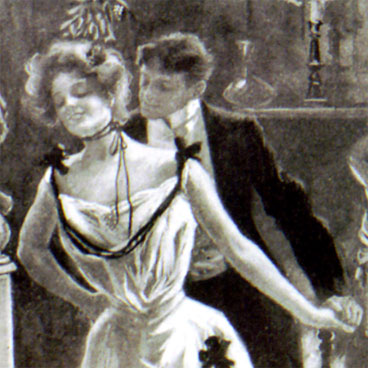
Saturday Evening Post cover 1900, from website 
Mistletoe was believed to ward off fires and disasters, and was hung in some homes year-round for this protective property. It could also, some believed, open locks, although how that would work, who knows today? Wearing a twig around the neck was a talisman to ward off evil spirits and witches. Mistletoe would sometimes be burnt, and the ashes carried in a little bag to bring good luck. But some believed that feeding your holiday bunch to your cows would bring a good year for your dairy. Farmers also believed in some areas of Britain that a good year for mistletoe meant a good year for corn (not our kind of corn; in England wheat was called corn, and in Scotland and Ireland corn meant oats.)

In Wales, mistletoe growing on hazel orash trees was believed to have treasure growing under its roots. This apparently came from an ancient legend that under these trees there lived a snake with a ruby inside its head. Over time the snake in this story was forgotten, but the treasure lived on. Interestingly, in early Christian churches mistletoe was banned from the church decorations, and this custom continues to this day in some places.

In the Victorian era, mistletoe really came to the fore as part of the holiday festivities. Washinton Irving captured the spirit of the Victorian Christmas in a few lines: "The Yule log and Christmas candle were regularly burnt, and the mistletoe, with its white berries, hung up, to the imminent peril of all the pretty housemaids."

What to do with your mistletoe once the holidays are over? Don't throw it out! Leave it in your house until the coming year if you want your good luck and good fortune to continue all year.

The plant has found its way into poetry too:

MISTLETOE
by Walter de la Mare

Sitting under the mistletoe
(Pale-green, fairy mistletoe),
One last candle burning low,
All the sleepy dancers gone,
Just one candle burning on,
Shadows lurking everywhere:
Some one came, and kissed me there.

Tired I was; my head would go
Nodding under the mistletoe
(Pale-green, fairy mistletoe),
No footsteps came, no voice, but only,
Just as I sat there, sleepy, lonely,
Stooped in the still and shadowy air
Lips unseen—and kissed me there.


Some intriguing sources for more on mistletoe:
Encyclopedia of Superstitions by M. Radford, 1949.
Pocket Guide to Superstitions of the British Isles by Steve Roud, 2004.


Copyright Susanna Holstein. All rights reserved. No Republication or Redistribution Allowed without attribution to Susanna Holstein.

Saturday, November 26, 2016

Oh the Holly Has a Berry...


Re-posting a post from 2009. I'd forgotten I wrote this one. Enjoy!

Like many people, I like using holly as one of the greens to be used as decoration during the holidays. And like me, I wondered about the folklore and superstitions connected with this prickly plant. And as with many of our Christmas customs, the traditions have roots in ancient cultures, and were incorporated later into Christian and modern celebrations.


My mother always waited until Christmas Eve to bring in the greens, or to "bring in Christmas," as some people say. I thought this was because she didn't want the greens to dry out, and that was probably at least part of the reason. If you have ever tried to use hemlock branches as decoration, for example, you learned the error of your ways quickly, I bet. The needles drop almost as fast as the branches enter the house.


But holly retains its green color and red berries quite well. And the pine boughs we carried in lasted until after Old Christmas too. Today while researching holly, I found perhaps another reason Mom delayed bringing the evergreens into the house: having holly in the house before Christmas Eve or after Twelfth Night could cause quarrels in the family, and a misfortune for every leaf and branch! Goodness, I'd want to avoid that too--although I can see why quarrels might ensue--the dried-out leaves are so prickly that the one who had to remove them was probably not in a good mood for the rest of the day.


In pagan times, there was a ritual of a battle between the Holly King and the Oak King at winter and summer solstice; at winter solstice the Oak King was victorious and at summer solstice the Holly King would be triumphant.


The holly had its place in the Christian tradition too. It was and still is believed by some that the cross was made of hollywood and that the crown of thorns was made with holly. According to this legend, the holly's white berries were turned red by Jesus' blood. The Christianized version of "The Holly and the Ivy" refers to this story:


4. The holly bears a prickle
As sharp as any thorn;
And Mary bore sweet Jesus Christ
On Christmas day in the morn. Chorus

5. The holly bears a bark
As bitter as any gall;
And Mary bore sweet Jesus Christ
For to redeem us all. Chorus

6. The holly and the ivy,
When they are both full grown,
Of all the trees that are in the wood,
The holly bears the crown. Chorus

[7. The rising of the sun
And the running of the deer,
The playing of the merry organ,
Sweet singing in the choir. Chorus]

One version collected by ballad scholar Cecil Sharp, however, is probably closer to the original song:

Holly hath berries red as any rose,
The forester, the hunter, keep them from the does.
Nay, ivy, nay, it shall not be I wis;
Let holly have the mastery, as the manner is.
Ivy hath berries black as any sloe;
There come the owl and eat him as she go.
Nay, ivy, nay, it shall not be I wis;
Let holly have the mastery, as the manner is.
Holly hath birds a fair full flock,
The nightingale, the popinjay, the gentle laverock.
Nay, ivy, nay, it shall not be I wis;
Let holly have the mastery, as the manner is.

In ancient times, holly was considered "male" and ivy "female." Probably this is because of the winding, supple nature of ivy and the strong, sturdy shape and sharp prickles of the holly.


It's not really surprising that plants that manage to remain green in the winter months would be thought to have special powers. In Wales, it is considered unlucky to pick holly when it has berries, and bringing it into a friend's home could cause death to an inhabitant. Some people collect the berries after the holidays and keep them as good luck charms.


Other superstitions about holly:
  • Carry a piece of holly in your pocket and you will never be struck by lightning
  • Holly flowers were thought to be able to freeze water.
  • Holly wood was believed to control animals, so many whip handles were made from holly
  • If you bring a branch with holly berries into the house, it will bring good luck, but for every berry that falls before New Year's a little of the luck will leave.
  • The Zoroastrians believed the the sun never cast the holly's shadow
  • new babies were sprinkled with water in which holly was soaked to ward off evil spirits (which makes me wonder--holly water=holy water?)
  • The Irish believed that decorating with mistletoe and holly in winter kept the fairies happy and won their favor
  • Smooth holly brought in for the holidays means the wife will rule the house in the coming year; rough holly means the man will be dominant. (Keep the peace--bring both inside!)
  • To cure a child of illness, pass the child through a cleft holly tree
Now, go gather ye holly while ye may (or was that rosebuds?). Just be sure to take it out again before Twelfth Night, don't lose any berries, and don't carry it into your neighbors house and all shouls be well...I think.
Sources:
Trees for Life website
Encyclopedia of Superstition, Folklore and the Occult Sciences of the World by Cora Linn Daniels and C. M. Stevans
The Book of Christmas Folklore by Tristram Potter Coffin
The Winter Solstice: The Sacred Traditions of Christmas by John Matthews
A Book of Christmas by William Sansom
Caer Feddwyd website
Encyclopedia of Superstitions 1949 by Mona A. Radford
The Cottage Smallholder blog
Irish Superstitions for the Christmas Season

Friday, December 11, 2015

The Belsnickle Will Get You If You Aren't Good!

When I was a child, we had to watch out for the Christmas Elf. Because if Santa didn't see us doing something naughty, the Elf surely would. Mom moved him around the house so we never knew where he was, and it kept us looking over our shoulders to see if he might be watching.

 
In some parts of Maryland, Pennsylvania,Virginia and West Virginia--and probably in other places where there were many German-American settlers--it wasn't the elf of Santa that children feared. It was the Belsnickle, also known as Pels Nicholas and other names with a close pronunciation (pelz means fur, or pelt).


This creature, a sort of strange Saint Nicholas and is believed by some historians to pre-date that Christian saint, arrived at the holidays dressed in dirty, torn rags and/or furs and a mask. He often had a very long tongue, and he carried switches with which to switch naughty children. His pockets, however, were also full of fruits, nuts and small gifts for good children.


There were belsnickles in the parade we attended last weekend in Shepherdstown, WV, and a treat it was to see these folkloric creatures in action. According to the announcer, belsnickles were common in the eastern panhandle of West Virginia until recent years and some of the older people watching the parade remembered them and perhaps still felt the sting of their sticks or switches on their hands!

My friend Matthew Burns wrote a fine article about belsnickles on his blog some years ago. In his area of West Virginia, belsnickling resembled wassailing, with people dressing in costumes and going house to house, singing and shouting and being given treats instead of handing them out.

I have a Belsnickle who comes out every Christmas to watch over my house. He is dressed in fur, carries switches and a bag of gifts, and there are bells on him too.


There are also (of course) Belsnickle ornaments to be had (just check out all of these on Amazon) to add to your holiday decorations. Why not get one to give that Elf on the Shelf some assistance? After all, who doesn't need a little extra help to keep children in line!

Copyright Susanna Holstein. All rights reserved. No Republication or Redistribution Allowed without attribution to Susanna Holstein.

Thursday, December 10, 2015

A Strange Kind of Christmas Tale

I first came across the story of "The Cat on the Dovrefjell" in a collection of Christmas stories, where it was titled "The Christmas Cat." It's an old Danish tale, with trolls and bears, and no Santa or reindeer. Enjoy!

There once was a man who caught a great white bear. How he caught it I don't know, but he was well pleased with himself.

"I'll  take this to the King of Denmark," he said. "What a fine gift he will think it, and I will have it there just in time for Christmas too."

As it happened he found himself at the Dovre-Mountain just about Christmas Eve. But a snowstorm blew up and made travel difficult.

"We will not get to the King after all, with this storm," he thought.

The man, with his bear on a lead behind him, could barely see where he was going, but suddenly there was a lighted cottage in front of him.  He struggled through the snow to the house, where a man named Halvor and his family lived.

"Please," he begged when Halvor opened the door, "do you have a place where I can get out of this storm, somewhere warm for my bear and me? I promise you my bear will be no trouble. He's quite tame, and worn out from traveling in this storm."

"I wish I could!" said Halvor, "but we can't take in anyone right now. You see,every Christmas Eve the  trolls come and we have to leave and find some other place to spend the night. They are terrible, those trolls! They eat all our food, drink all our drink. We were just getting ready to leave."

  "Let me stay," said the man. "We are too exhausted to go further. My bear can sleep in that corner by the stove, and I will sleep here on this rug."

 "Very well," said Halvor. "But the trolls won't like it. We have to leave everything just so for them so that they will not be angry and destroy our house. Try to stay out of their way or I don't know what might happen to you. We are going to my father's house until the trolls are gone. We have left food on the table for the trolls, so do not touch it, please!" He looked so worried that the man promised he would not touch a thing, though his stomach was growling with hunger.

After Halvor and his family left, the man curled up in a corner on a rug, and the bear took another corner.

It was not long before the door opened, and in came trolls of every kind. There were tall ones and small ones, fat ones and skinny ones, trolls with tails and trolls with none,

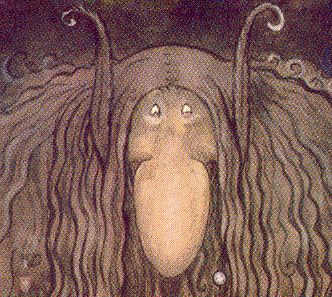
By John Bauer, 1882-1918
trolls with very large, long noses and trolls with funny little ears. They rushed to the table and began gobbling everything in sight.

 "What is that?" asked one of the smaller trolls. He walked over to where the bear was sleeping and squinted. "I think it's a cat!" he shouted. He put a piece of meat on a fork and poked the bear's nose with it.

"Here, Kitty! Have some sausage!" He poked harder and harder. "Kitty kitty!" Suddenly the great white bear rose up onto his hind legs and growled. His roar shook the tiny house, and the troll fell over backwards trying to get away.

"Run! Run! It's the biggest, meanest kitty I've ever seen! Run for your lives!"


The trolls rushed out the door with the bear close behind them. The bear chased the trolls far into the woods, then returned to Halvor's house, curled up by the fire and went to sleep. After laughing until he could hardly stand, the man ate and drank his fill, then he too went to sleep. The next morning when Halvor and his family returned he told them what had happened, and they all had a good laugh. The man continued on his journey to see the King, who was well pleased with the gift of the white bear.

 A year later Havlor was out cutting wood on Christmas Eve when he heard a voice calling his name.
"Halvor! Halvor?"

  "Yes. I am right here. Who are you and what do you want?"

  "Do you still have that big white cat you had last Christmas Eve?"

  I not only have her, "said Halvor,"but she has had seven kittens and they are all BIGGER and MEANER than she is!"

  "Well then, we trolls will never come to your house again!"

And ever since that Christmas Eve, the trolls never bothered Halvor and his family again.
 
Trolls and their mischief play a large role in stories from Europe and other countries. To learn more about trolls, check out Sacred Text's article on the topic. MythEncyclopedia has a short piece about trolls with links to other sites. This site offers more extensive research with a good bibliography at the end so you can read more about these strange creatures. And of course, Wikipedia offers a lot of information on the topic. 

The image above of the bear chasing the trolls out of the house is from the book, Popular Tales from the Norse, by George Webbe Dasent, published in 1904. You can read his text of this story and others in the book at Sacred Text.

Just make sure you don't make a troll angry while you're reading!


Copyright Susanna Holstein. All rights reserved. No Republication or Redistribution Allowed without attribution to Susanna Holstein.

Monday, December 23, 2013

The Yule Log

It's almost time to start the Christmas fire and if you know the old traditions, you'll have saved a bit of log from last year to start your fire this season.

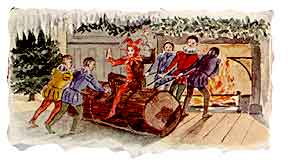
Cutting an burning a special log during the Solstice/Christmas season dates back to pagan times, when the return of light was celebrated with merrymaking, food and song much like our Christmas holidays today. The Yule log began as a Viking tradition; a special log, preferably from one's own land, according to the website History.UK.com. The log would be cut and dragged to the fire, sometimes requiring a team of horses to drag the log! The ideal was to find a log large enough to burn for twelve days. I once saw a photo of a Yule fire with the log extending out into the room,  so it burned end-first! A bit of obstruction to set over, I'd think, but I feel sure that log burned as long as needed.


According to Tomm Larson at NoelNoelNoel.com, "The burning of the Yule log marked the beginning of Christmas celebrations. In Appalachia, as long as the log, or "backstick" burned you could celebrate. Often a very large "backstick" was chosen and soaked in a stream to ensure a nice long celebration. In the early nineteenth century, American slaves didn't have to work as long as the Yule log burned, so they would choose the biggest, greenest log they could find. If they did have to work while it burned their master had to pay them for the work.

T


Come Bring the Noise by Robert Herrick


Come bring the noise,
My merry, merry boys,
The Christmas log to the firing;


While my good dame, she
Bids ye all be free,
And drink to your heart's desiring.


With the last year's brand
Light the new block, and
For good success in his spending,
On your psalteries play,
That sweet luck may
Come while the log is a teending.


Drink now the strong beer,
Cut the white loaf here,
The while the meat is a shredding
For the rare mince-pie
And the plums standing by,
To fill the paste that's a kneeding.


I hope your fires are bright, both in your hearth and in your heart, and that all preparations for Wednesday are moving smoothly and joyfully!


Copyright Susanna Holstein. All rights reserved. No Republication or Redistribution Allowed without attribution to Susanna Holstein.

Wednesday, December 11, 2013

Why Red and Green at Christmas? And the Holiday Table


 Have you ever wondered why red and green were the predominant colors of this holiday season, which occurs at the outset of winter when in many places the world is mostly gray and white?

There are several possible explanations, according to folklore. One is that in the ancient Celtic culture evergreens represented continuing life in a time of dark and cold. Much importance was attached to these plants by the Druids, who believed that holly, ivy and other evergreens had spiritual powers and could bring good luck if used correctly.

Early Christian missionaries sought to win over pagan culture by incorporating Christian teachings into existing traditions, so they taught that red berries were symbolic of the blood of Christ, and that the thorns of the holly represented the crown of thorns. Since the pagans already had established celebrations around the Winter Solstice, the Christians selected that time of year to celebrate the birth of Christ, eventually replacing the solstice celebrations with Christmas. While Chrisitianity became in time the dominant religion, certain vestiges of earlier traditions clung to the winter holidays as holly, evergreens and mistletoe all became standard parts of our decorations and continue to be important even today.

So  am right in keeping with ancient traditions with my love of red and green at the holidays. This year's holiday table uses my vintage red and green glass, along with crystal pieces and touches of white. 


I picked branches off my bridal wreath spirea bush and spray-painted them gold and silver for the center arrangement, and added a few pyracantha berries and some fake glittery berries for color. Simple and fast.

I bought the green berry bowls below to go with this Anchor Hocking boopie burple bowl one at a time (that really is what this pattern is called--don't you love it?). I have a crystal set that I assembled the same way, finding the bowls at thrift shops and yard sales. My sister Theresa gave me the diamond point goblets, and the footed ruby tumblers (also Anchor Hocking) came from that estate we bought in May.


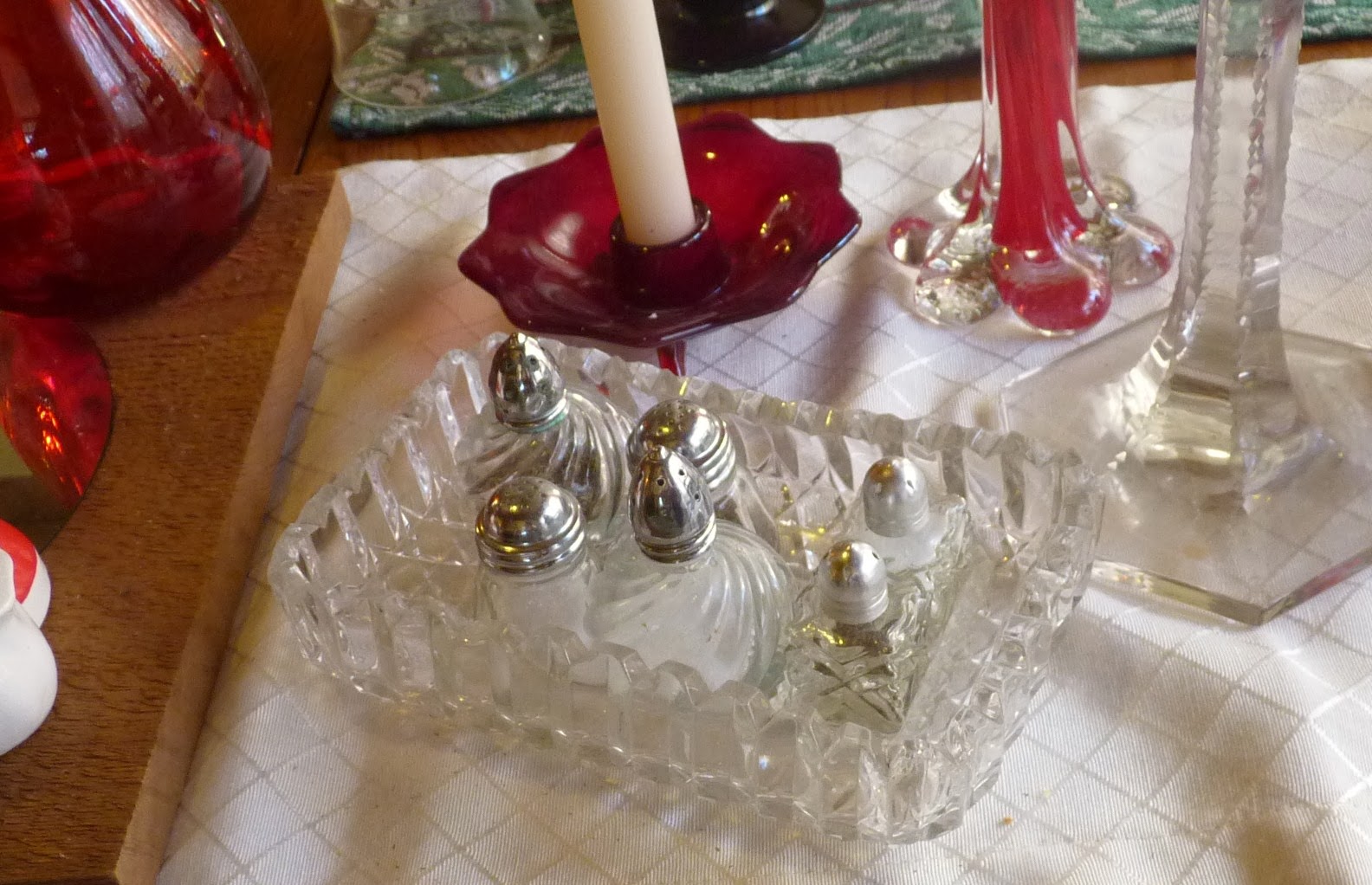
I like having individual salts and peppers on the table; it simplifies things. My sister Liz gave me several sets and I found a dish to hold them until needed.


The tall red vase is also Anchor Hocking. That company made a lot of affordable, beautiful and functional glassware, and what I liked best is what they made in the 40's-60's. The red decanter may be Blenko, or perhaps Viking, it's difficult to tell. It had no stopper when I bought. I buy stoppers whenever I find them reasonably priced, so I have a container of various sizes now. When I buy a decanter or cruet that needs one, I just go through my collection! Of course, often it turns out that I don't have the right size, and the hunt begins again.

The little bowl with the red knob on top on the left in the above photo is a recent find. The knob is red bakelite, and the bowl is perfect for cinnamon sugar--and this is perfect cinnamon toast weather.

The Santa candle holder below is 60's vintage, by Howard Holt. These are surprisingly collectible these days. Who would have thought it? I found this pair last week at Goodwill. The mirrored board under the Santa is another Godwill find and makes a good "center" for my table.


I think I have a thing for candle holders because I certainly seem to have plenty of them. The deep ruby ones are by Fenton glass; I found them at the end of an auction at a bargain price. The red twist vase is one of a pair; I do not know the maker. The ruby is cased in clear glass and the base is quite heavy. I bought these on eBay recently and was pleased with how beautiful they are--much prettier than their photo. I would guess them to be Kanawha Glass or perhaps Italian Murano, but do not know for sure. The clear candle holder in the foreground is another mystery. I feel fairly sure this pair is by Heisey, but have not been able to verify that. They are heavy, beautiful crystal that sparkles in the light.


I am looking forward to seeing my table surrounded by smiling faces, loaded with good food, and filled with the cheer of the coming season.

Copyright Susanna Holstein. All rights reserved. No Republication or Redistribution Allowed without attribution to Susanna Holstein.

Friday, December 6, 2013

Get Ready for Winter, the Folklore Way


 Did you know that if sun shines through the apple trees on Christmas day, it will guarantee a large apple crop the coming fall? That’s what the old folklore says. Apparently the sun shone brightly through apple trees last year where I live because there were apples galore this year.  Folklore also says that “the nearer the new moon to Christmas day, the harder the winter.” This year the new moon shown on us on December 2nd, with the next one die on January 1. We might be in for some weather if the January moon is the predicter.

We might also be able to determine the weather for coming months by paying attention to the wind on New Year’s Eve:

If New Year's Eve night-wind blows south, It betokeneth warmth and growth;
If west, much milk, and fish in the sea; If north, cold and storms there will be;
If east, the trees will bear much fruit; If north-east, flee it, man and brute!"

Farmers need to be watchful at calving, because if the first calf born during the winter is white, the winter will be a bad one. We can find out just how bad by counting how many days have passed since the new moon; the number will tell us how many big snowfalls we can expect during the season. And when it does snow, the same thing holds true as it does for rain--if the sun appears during the snowfall, there will be more snow the next day. There is some good that can come of a bad winter however, because a snowy winter is believed to bring a rich summer and fall. Old-timers would say that “a foot of snow will make things grow.” (Thanks to freeirishphotos for this perfect picture.)

Even though we may complain of winter’s cold and snow, almost everyone wants a white Christmas. I like to bring greenery into my house at the holidays; there is nothing prettier than fresh greens on a door or in a window, and snow blowing by outside. The best evergreens to bring into your home at Christmas are holly (the symbol of eternal life), ivy, rosemary, bay leaves and, of course, mistletoe.

Whatever December’s weather may bring there is one thing that is certain, assuming the Mayan calendar does not really predict the end of time: New Year’s Day will come and we will be welcoming in 2012. There are some things you might want to think about when planning your New Year’s celebrations. First, wear something new on New Year’s Day so that you will be more likely to receive new things in the year to come. And be sure you do something related to your work on the first day of the year. This doesn’t mean go to work or start a major project, but do something –and do it successfully—to ensure a good work year ahead.  Hold on to your money, too; don’t pay bills or lend money on January 1, otherwise you are sure to be paying all year long.


Folkloric wisdom is a lot remember if we want to ensure wealth, good weather and good luck by following the old folklore. Perhaps the best thing to do is let the weather and luck take care of themselves and focus on making our lives merry and bright in the coming winter months. I think I'll get back to work on my Christmas decorating. That will surely keep the cold and dark at bay.

Copyright Susanna Holstein. All rights reserved. No Republication or Redistribution Allowed without attribution to Susanna Holstein.

Thursday, December 6, 2012

Storytelling and Peanut Brittle

Today started early for me. I was up before daylight to get ready for three things: first, practice with my friend Jeff Seager as we put the finishing touches on our program of Christmas carols. Second, presenting a pared-down version of the program at my uncle's assisted living center. And third, making peanut brittle with my aunt.

I had stops to make on my way to Jeff's. Gas, molasses and gift bags, to be exact. Gas because my car was sucking air, molasses for the peanut brittle and gift bags for small gifts for the residents of the center since today is, after all, Saint Nicholas Day. I hustled to get out the door here and get all my stops made so I could be at Jeff's early enough for a run-through of our program.

Jeff and I first did this program last year, and it went well. But we wanted to change it up with some new material and as we researched we found pieces dovetailing together. I will be putting up posts in the next two weeks based on my research and the stories we found. For each carol I tell the story of its origin and the folklore surrounding the song. Then one of us sings it, often with audience sing-along. It's great fun, educational and many of the pieces I have found surprisingly moving. It has added a layer of richness to the carols for me and I hope it does the same for our listeners.

After practice we headed to the assisted living center. I've been visiting monthly since July, and I love it. I've become attached to some of the people there, and learn things about them each time I go. For example, today we learned that Ray was an old-time musician who had played with many of the people Jeff and I know. West Virginia really is one big small town.

The program went well and I am very pleased with the flow of the stories and songs. We'll be on the road with it on Saturday doing three performances and that will be all for this year. Next year we'll add more carols and I will make a better effort to publicize it in hopes of getting more calls for performances. I especially liked two new additions: The Huron Carol and Christmas Bells spoke strongly to both of us and I think they also touched our audience.

Afterwards I went to my aunt;s house to learn how to make peanut brittle. She's a master of this art! She made it look so simple and yet I know that one must have a good sense of the right times for each of the crucial steps. Our end product was perfect, and I confess to eating my share of the bits and pieces broken off along the way.

I got home just after dark so I got to enjoy the Christmas lights Larry has put up around our house. Rarely do I get to see our lights since we are not often out after dark, and if we are, we don't leave the lights on. This year I added some of the big old (my grandson called them ugly!) lights remembered from my childhood. I love the way they look! I'll post pictures soon.

It was a day filled with good things, the kind of day that makes me thankful for this eclectic life. I'll be sleeping in tomorrow for sure, but I would not trade today for anything.


Copyright 2012 Susanna Holstein. All rights reserved. No Republication or Redistribution Allowed without attribution to Susanna Holstein.

Saturday, December 3, 2011

Holiday Traditions, Recipes, Crafts, and Folklore

I have compiled a list of posts I've written since beginning this blog that have ideas, stories, crafts, folklore, traditions and more about this holiday season.

I hope this post helps you get in the mood.
From Yule and Solstice to Old Christmas to elves and paper stars and simple gifts to make, there is a bit of something for everyone in the list below.
Enjoy!


Pumpkin Butter, a quick and easy gift to make
The Passing of Christmas

Hmmm, I'm feeling more in the spirit already! 
Related Posts Plugin for WordPress, Blogger...