Pages

Showing posts with label recycling. Show all posts

Saturday, August 15, 2020

Covid Journal, Day 150: A Post from a Friend: Recycling and Sky-Diving

 70 this morning, muggy and cloudy after a stormy night--the kind of storms that are all noise and light show, but little rain. Still, the plants and I were both happy with it, and glad it wasn't a deluge that does more harm than good. Nice.

The following was posted by my longtime blog friend Nance--some of you that have been readers for a while have probably seen Nance's comments on my blog. She posted this on Facebook last week, and I thought it was wonderful and something all of you would also enjoy reading. So, with Nance's permission, I share it today, which is actually her birthday. What a nice coincidence.


"TUESDAY, FEBRUARY 15, 2011
Repurpose
I like the word "repurpose".
There are other words that go right along with repurpose -- like recycle, reuse, rerun, redo. I like them all too. In fact, I'm sure I've posted before:
Use it up
Wear it out
Make it do
or do without.
This was a long ago motto. Maybe it has been around forever but I think of it as coming out of the Great Depression or World War II. I grew up with it as a way of life.
My Mama didn't drain the potato water down the sink drain. She drained it into a bowl and used it to mash the potatoes instead of milk. Milk was better kept for drinking for growing children. Mama used the paper off the stick of oleo that went in the cookie dough, to grease the cookie sheet. Left over mashed potatoes became potato patties and left over boiled potatoes became fried potatoes. Left over stale bread was turned into bread pudding or dressing or even fed to the birds. But never thrown out in the trash.
My Mama cut buttons off of old worn out shirts. This was after the shirts outlived being a "good" shirt. A shirt or dress went from being "good" and going to town, school or work to being "everyday". Everyday shirts might be patched and miss a button but they were there to put on after school, to wear to the garden or to do the laundry. Ever day saved your "good" shirt for better things.
After a shirt was demoted from "ever day" it became a rag. Mama (or her daughters) cut the buttons off and ideally removed the thread and any fabric stuck to that button. The buttons went in the button box to be used later. The shirt went into the rag bag at the bottom of the boys' closet. Someday I'll write about the rags in the rag bag and what all those rags were repurposed for but for now, I better stick to this subject.
My Mama bought laundry soap in the big round economy box and every wastebasket in our house started life as a box of soap. One girl or another would need a 4-H or rainy day project and out would come the empty ALL detergent box and the patterned contact paper and soon there was a color-coordinated waste basket for whatever room was needing one! Repurposed strikes again!
Newspapers were repurposed big-time. Newspapers became pirate hats, drawer liners, mats for muddy wet boots and they also lined the bottom of Petey, the canary's, cage. Newspapers were, of course, a source for the "current event" that your social studies teacher requested each week. Newspapers were used to start fires, wrap coffee grounds and potato peelings. Folks paid good money for those newspapers and they were bound to get their money back out of them. I know my folks did.
White butcher paper that came home clean from the grocery store could be saved for art projects. When I was small, JC Penney's often wrapped your purchases and tied them up securely with a nice long piece of string. When you got home and unwrapped the packages, you got the ball of string already on hand, tied the new string onto the leading end and rolled it all back up together. The ball of string was an indicator of the economy. The better the economy, the better the shopping. With more shopping there was more string. So a big ball of string meant a good economy and a little ball of string meant no money to spend!
Shoe boxes were always saved and had a gazillion uses. They were used as drawer dividers, paper files, containers for small toys and paper dolls, They were used to organize my Mama's kitchen and my Dad's garage. Even with nine children, 2 adults and 22 feet at home, we never had enough shoe boxes. Of course, even with all those feet we usually only each had one new pair of shoes a year -- so only eleven new shoe boxes per year. No wonder there was a shoe box shortage!
Match boxes, wooden spools, bread wrapper twist ties, rubber bands, orange juice cans, glass jars -- the "to save" list goes on and on. Now, after all this, you might be wondering where I'm headed.
When I was in high school, it was fashionable to have long, long hair. Some girls liked the straight, "ironed" look and some of us wanted a little body in that long mop top. If you remember the pink foam or the pink plastic rollers, they weren't very big and if you had wrapped your head full of those little curlers, you would have looked like the naturally curly red-headed step child with hair uncontained and curling in all directions.
Something larger was needed. Large rollers or curlers that would give body but no frizz or curl and that was when we went to our Mama's surplus item box and dug out all the condensed orange juice cans. Now, they would have been washed and both ends cut out. With clean, mostly dry hair, you would roll it up and secure the cans with a super duper hair pin or two. Girls were known to suffer sleepless nights with a head-full orange-juice cans . . . but oh how nice to get up the next morning, shake the cans and the hair out and have all that straightened hair with body!"

Thank you for letting me share these good memories, Nance!

And here, friends, is what Nance did for her birthday. What a lady. Happy birthday!


Copyright Susanna Holstein. All rights reserved. No Republication or Redistribution Allowed without attribution to Susanna Holstein.

Friday, January 20, 2017

Making Do and Making Waste

I found this compote at the local thrift store. It's a cobbled together affair, made from the base of a lamp and part of a glass compote.

The lamp could have been an old whale oil lamp, predecessor of the oil lamp we know today. The compote was probably broken, and maybe the lamp was too, so some enterprising and thrifty soul put the two together to make one useful piece. They did a good job too. The compote is sturdy as can be, if a little rough at the seam.

photo from pinterest
The compote, and a radio ad promoting new appliances for people ready to upgrade their kitchens, made me think about the fridge we had when I was a girl. I believe it was like this one in the photo, a Philco with a domed top and a straight up-and-down handle. We loved to open that heavy door and just stare at whatever was in there, feeling the cold blasting our faces. Of course if our parents caught us we were in trouble for wasting electricity and making more work when it was time to defrost.

We opened, and apparently swung on, the door so much that the handle broke off, leaving only a short nub. We knew we were in trouble then! I can vaguely remember the explosion when Dad found out. And I remember how he fixed it, with a piece of copper pipe bolted to the stub. It worked.

In fact, the old fridge lasted for years. I think it was replaced finally just before I left home when I was 17. It was ugly and beat up, the white enamel finish scrubbed down to the metal in places, but it still worked. I remember how much Mom hated it because it was ugly and the freezer was tiny and it seemed to need defrosting so often, a job she didn't like and often passed off to us kids to do. We didn't mind although I expect the mess we made doing it caused her more work anyway.

People kept things back then. they kept them until the appliances were worn out. Coming out of the Depression and World War II when metal and many other things were scarce, people made the best of what they had and wastefulness was considered a sin. This applied not only to appliances but to everything they used. Cars, furniture, even clothing were repaired and stayed in use rather than discarded. Getting rid of good things was almost showing off your affluence. People had only a few sets of good clothes, then they had work clothes and around home clothes. A new dress for Easter and maybe Christmas or a birthday was about the norm for adding to your wardrobe for most people.

The ad for upgrading appliances really pointed up the difference today. We shed belongings regularly as we redecorate or see new features we want. The world is awash is discarded clothing, piles and piles of it--according to an Atlantic article, we buy 5 times more clothing now than we did in 1980, and even in 1980 we were probably buying 5 times as much as we were in the 40's and 50's. All those clothes have to go somewhere, and the fact is a lot end up in the hands of textile recyclers--even those we "donate" to charities like Goodwill and Salvation Army. I remember being in a Goodwill one day and overhearing a staff member say that "the ragman is coming today." I'd never thought about what they did with all the stuff that didn't sell. Now I know.

The thing is, those old appliances worked better and lasted longer. They were built for 20 years of service, I think! Most lived up to that standard anyway. The clothing was for the most part biogradable natural fabrics until mid-century when the synthetics were discovered. So they rotted away once they made it to the dump. Today's clothing will last for decades, maybe centuries, in landfills. It doesn't rot away. Appliances have a large percentage of plastic now, and again, they don't biodegrade.

We've come a long way but in this area, I think perhaps we've taken a wrong turn. Those of us into vintage and antique furnishings and clothing are in our way recyclers, reclaiming the discards of society and making them new and useful again. I doubt manufacturers will change their ways, but the more we know about what happens to our waste the more aware we will be about what goes out our doors as trash.


Copyright Susanna Holstein. All rights reserved. No Republication or Redistribution Allowed without attribution to Susanna Holstein.

Saturday, August 15, 2015

Table: in Process and Completed

I picked up a pair of these tables at a junk shop. They're oak and veneer, the legs were wobbly and the tops stained. I thought I'd post a little step-by step of the transformation process.

 Here's the table, just as I started sanding.


Step 2: I painted a base color of General Finishes Milk Paint in Chocolate Brown. I almost left them this color, it was so rich.

Step 3: Painted the final color, Annie Sloan's Chalk Paint in Provence. In this photo, I've already started distressing. (The General Finishes Top Coat in front? I was also working on some smaller projects while the table was drying between steps.) I wet-distressed, meaning I rubbed...and rubbed...and rubbed...with a wet cloth to get the look I wanted. I sanded lightly after each coat of paint throughout the project.


Step 4: After distressing, I coated with a light coat of Top Coat, then used General Finishes Van Dyke Brown Glaze to give depth to the paint and distressing. To apply the glaze I put on a pretty heavy coat, then rubbed off most of it, leaving just enough to get the look I was going for. Lots of rags gave their lives in this step! I like to use wet wipes better, but ran out of them after the first table, and since it was near midnight at that point, I used rags on the second one, sometime damping the rag a bit to get the glaze how I wanted it.


Step 5: The tables were finished with General Finishes High Performance Top Coat in Flat for a soft sheen. Before the Top Coat I rubbed over the tops with a crumpled brown paper bag to smooth any rough places.

That's basically the process. It takes time and lots of patience. The second table top gave me fits to get the finish looking right and I ended up sanding it off twice and repainting until I was satisfied.

Step 6: Into the booth and staged to show them to good advantage. The whitish look on the front table is actually reflection from the chrome coffee service.


How many hours into this? It's hard to say because I'd do a step, go work on something else--canning, painting, cleaning, laundry, etc--and then go back to it. My guess is probably something like 6-8 hours total.
But in the end it was worth my effort. These junk store banged-up, sad tables will one day grace someone's home again. That's my reward for my work, and that makes me happy.

Copyright Susanna Holstein. All rights reserved. No Republication or Redistribution Allowed without attribution to Susanna Holstein.

Saturday, May 23, 2015

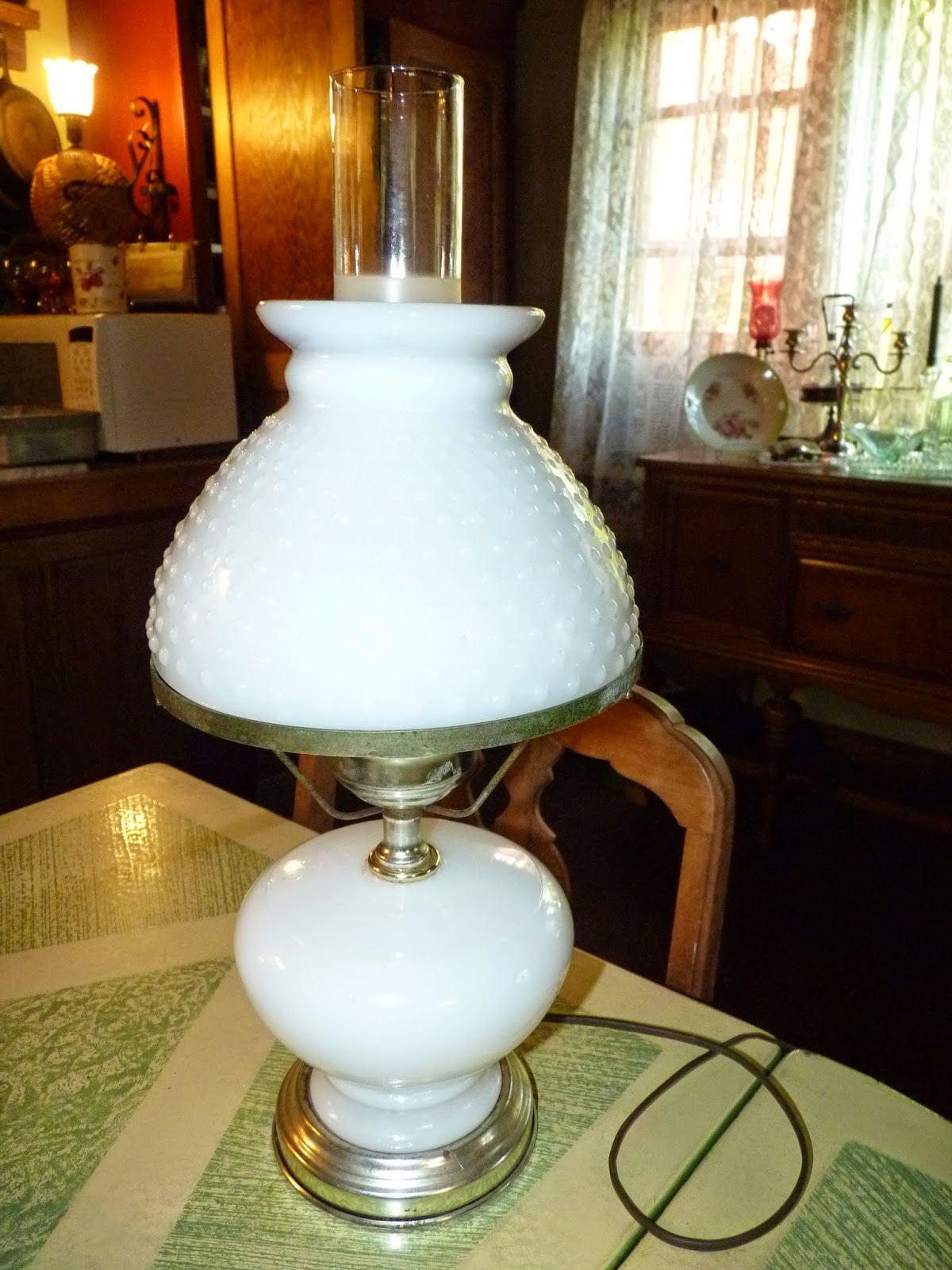
The Johnny Cash Lamp

It actually has nothing to do with Johnny Cash, but more to do with his song about the Cadillac that a guy built "one piece at a time". This lamp was the same way.

I had the chimney first. I buy glass lamp chimneys whenever I find them for a dollar or less because I always seem to need them. Maybe because I like kerosene lamps?

Then I found the hobnail shade--two of them actually. I stored them away, waiting for a lamp without its glass shade to show up. Eventually they do, and eventually one did, at the Habitat for Humanity ReStore.

Now it's complete and ready for a booth. I might make a little more than I have into it, but I get such pleasure from making things useful again.

So here it is--the Johnny Cash Lamp, which joins a long line of lamps, bowl sets, casseroles, Hoosier cabinets and other vintage things we've put together, one piece at a time.

Copyright Susanna Holstein. All rights reserved. No Republication or Redistribution Allowed without attribution to Susanna Holstein.

Monday, August 4, 2014

The Rag Bag

Do you still have a rag bag? I remember my mother having one, and it was the place to go for cleaning rags, shoe polishing needs, wax buffers, car polishers and all kinds of other tasks. Our wet mop was a wood-handle with a metal spring loaded top that could be opened to put in a new rag mop head--or rags, which is what we used.

I still have a rag bag, and it's as indispensable today in my home as it was in my mother's household. The rag bag is where we get rags for putting polish on the furniture, for removing stripper when we're refinishing and for putting on wood stain. We use rags to clean up spills and to wash the car. And I still have one of those wood-handled mop with the spring-loaded catch, and I still use rags in the mop when I'm mopping the floors. No Swiffer or whatever the latest craze is here. My mophead is recyclable. I wash my rags and reuse them many times before they are discarded. Old tee shirts, towels and other cotton fabrics fill my ragbag.

Many people saved rags for quilts, patches, dolls, rugs and anything else requiring fabric. Log cabin owners used rags to stuff in the chinking and around doors as insulation.

An old crazy quilt I bought 10 years ago, and still use. It is
made from scraps of upholstery material and velvet, with a
blanket serving as the filler.
This quilt was made in the 1950's of old silk neckties.

Ragpicker in France, from wikimedia commons

Rags were even worth money, as ragpickers came and bought used clothing and worn out blankets and such to be sold to pulp mills for use in paper-making. 

Feed sacks were often made of pretty cotton fabrics and were carefully saved to make clothing, underwear, kitchen towels and other useful household items.

Today rags don't get much respect. Most clothing is not made of natural fibers anymore so paper mills probably couldn't use them if the rags were available. Paper towels, wet wipes, microfiber mops and other more modern and convenient tools have replaced the rag as a cleaning device in many homes. Quilts are made with newly bought and carefully matched fabrics, and made more for their artistic value than for the basic need to keep warm.

With today's focus on living "green" I wonder if people are reconsidering the rag bag. Is it making a comeback in the homes of this century?

Copyright Susanna Holstein. All rights reserved. No Republication or Redistribution Allowed without attribution to Susanna Holstein.

Tuesday, February 18, 2014

Readers, Advice Needed!

Help! I need your advice on this chair.

It was one ugly chair. Painted black but pretty knocked around and scratched and with an orange plastic seat, it couldn't even draw a bid at the auction last year. So the auctioneer gave it to me. I am finally getting around to fixing it up and decided that it needed a new life: it needed to be red!

But I am stumped as to what fabric to use on the seat, so I am going to ask for the combined wisdom of my readers to determine the choice. Here are the fabrics I have on hand:


This is actual upholstery material. It has a nice geometric pattern, more colorful than the photo. This shows it a little better.


Next is a white fabric with embroidered black daisies. This is actually a skirt.


And here it is on the chair:


The seat itself, you might have noticed, isn't on the chair--it's out in Larry's shop. Might have looked better to put it in place, but I hope you get the idea of what these will look like. Here's fabric #3:

This is one of those quilted pillow covers, for a king-size pillow from the size of it.

I would have to be sure to position this piece correctly so that the squares were evenly placed.

Number 4: another skirt.

Bright vibrant colors! But on the chair, I'm not so sure:


And last, #5:

Another pillow cover is soft old-looking floral.

So those are the choices. What do you think? Do any of them look absolutely right to you, or should I continue the search?

I also thought about painting the circle section of the chair a contrasting color. Thoughts?


Copyright Susanna Holstein. All rights reserved. No Republication or Redistribution Allowed without attribution to Susanna Holstein.

Tuesday, April 10, 2012

Painting Projects: Recycling Old to New

Here are some of the things my granddaughter Grace and I painted this weekend:

This little shelf (it really is little, about 6 inches wide and 10 inches tall) was plain wood with a very small little lily of the valley painted on the top. The problem was that although the flower was pretty, the rest of the shelf needed a lot of help. I reluctantly painted over the flower with a fresh spring green color, then cut wallpaper to fit into the back of the shelf to dress it up. What is funny is that I gave all this effort for a little shelf that I paid 25 cents for, but it came out so well that I am glad I did.

The black tray behind the little shelf was in a bad way too. It was wood with stained, faded green velvet lining in the bottom of each of the three sections. I tried to remove the velvet but it was well glued, so I decided to just spray paint the whole thing with Killz black paint and see what happened. What happened was very good. The tray looks great and, like the little shelf, is once again attractive and useful.

 Some of you might recall this photo of some thrifting finds last December. The 4-drawer shelf wasn't exactly pretty, was it? But I thought it might clean up well...

 and it did! We chose soft pink and cream for our paint job on this unit, and I am pleased with the result.


Our last project was a small stool I found at a thrift shop. The top was painted with roses but someone had dripped white paint on them and I wasn't sure I could clean it off. I decided to try dabbing it with nail polish remover and it worked. Whew. The base of the stool was wood finish that was not in good condition. Since we already had the pink and cream in use, we went ahead and painted the edge of the top with pink, and the base with cream.


Next project was a wood basket that Grace painted. This too was a wood finish, and it had a red rose drawn on it with magic marker. We sanded it and then painted over the rose. We were dismayed when we saw the marker had bled through the paint but then decided we liked the softened look of the rose so we left it that way:


This chair is a work in progress. It will need several more coats of paint before it is ready for the seat to be replaced.

I still have things to paint but it was good to get some of it done. There is nothing quite like a fresh coat of paint to brighten up a worn piece, is there?

Sunday, February 26, 2012

Life in the Eclectic Lane

There is nothing like variety, at least for me. I think I thrive on it.While family, storytelling, writing and gardening should have been enough to keep me busy in retirement, I seem to have added a part-time job: re-selling. But the rest of my life also continues and is just as interesting to me as it ever was. This weekend is a good example of how eclectic our days can be.

Friday was a "work day" for me--listing items on eBay, packing and mailing and adding to and rearranging my booth at the antique mall. While working on the booth, another vendor stopped by. She was complimentary about how it looked--and ended up buying the little green wicker shelf and the wicker chair, along with a few other items. That meant I needed to add another shelf for display and I also needed a place to stack linens for sale since I had them on the green chair. I noticed several other things had sold too, so I left feeling pretty happy about how things were going. We met two other vendors at the mall, and checked out the new booth that came in last week. This is a small mall with about 20-24 vendors; I'm not sure exactly because several of them have more than one space. The ones we spoke with seemed pleased with their sales and one lady was moving to a larger space. Even more encouraging.

Larry has been busy with his own list of work. He took a load of scrap metal to the scrapyard and sold it. It is amazing how much metal we can collect without really trying--my old washer of course was in the load, and Larry has been collecting the odd bits of copper wire and saving those to sell along with all sorts of other oddments. A load in our truck may bring between $50 and $100 depending on what's in it; not a lot of money but I like that this stuff that otherwise might go to the dump is now being re-used.

He has also been working on his cabin and has two more courses of logs to go before the roof goes on. He's been hunting for windows--then realized we had two from the cabin we took down in 2010 that would work just fine. He still needs to find doors; those may have to come from ReStore if we don't stumble on some freebies. On his way home from selling his scrap he stopped to talk to a man who had just replaced his porch. The old porch roof was out in the yard and the guy said Larry could have it for the hauling off! There's the porch for his cabin. The wood and tin are in great shape, not more than 10 years old. More recycling

While he was off taking care of those things, I had another project to try. Boy did I make a mess! But it turned out well in the end. I'm still not finished. Here's what I was up to: last summer at a yard sale I bought a grocery bag full of those complimentary soaps you get at motels. The whole bag was 50 cents--I guess the lady traveled a lot and took the unused soaps from each motel stay. Now those small soaps are a pain to use and generally a lot goes to waste because they get so small so fast they end up getting tossed. I decided to try making all those little bars into standard size bars. First I tried melting them in the microwave. NOT a good idea. They didn't really melt and they smelled so strong from the perfumes in them that I had to abandon that idea pretty quickly.

The next try was melting them in a pot on the stove. I put a bunch of them in the pot and added a little water, turned the burner on high and stirred just in case they might stick. I'd never cooked soap before! Well, they did soften but I had to add a lot more water. I kept cooking and stirring for about 20 minutes; then I decided to take some of the liquid out, cool it, and put it into an empty liquid soap container I had--just to see if it would work, you know.

It did! The soap came out foamy and just fine for use. I continued cooking the other soap until the liquid was really thick and most of the soap chunks had melted. Not all of them had, surprisingly--soap is made from fats or oils so it would seem to me that it would melt easily but that was not the case for some of it. I ladled it out into a plastic-wrap lined square pan and let it cool. I wasn't optimistic at this point, I can tell you--some of it was hardening but some was sort of gooey and stringy. But after 2 hours it all hardened and I cut it into bars.

So from batch #1 I have nine big bars of soap and a bottle of hand soap. That "liquid" soap also set up and I thought I had a mess on my hands with hard soap in a squirt bottle, but it's more like gel and it still works fine.

We had a lot on our to-do list for Saturday. I needed to go to Sistersville to check out the theater and other arrangements for next weekend's storyteller retreat and I needed to take more things to my booth and replace the chair and the wicker shelf so they could go to their new owner. I also needed tires BAD--I was pretty much riding on air held in by thin, thin rubber. I have never been good about tires; I keep them until they are so worn out even strangers point out the fact to me. Last week I realized I'd pushed my luck as far as it would go, so we went in early Saturday morning to get them replaced. After leaving a painfully large amount of money behind we were riding in style again.

Next stop was the flea market that's been running a half-price sale all week. I've bought a lot from them but there was a cabinet I really wanted. They weren't open. Bummer. We waited a bit to see if they would open but no luck. So we left for Sistersville, and there I found a sweet little resale shop with all sorts of great stuff. Best find was a stack of 5 Tepco Banana Leaf platters. I remembered that this pattern was highly collectible so I bought them, a gorgeous modernistic blue glass bowl, an old jewelry box and several other really neat things. We went over to the Gold Derrick Gallery to meet with owner Terry Wiley, checked out the theater and made arrangements for the storytelling concert, then headed over to the Wells Inn for a delicious lunch. I checked with Kim Winslow while there to be sure we had the spaces needed for our retreat.

Then it was time to return to Ripley then to see if the flea market was open. It was--but the cabinet I wanted was gone. Bummer again. However, I did find a shelf that would work so we drove back to Ravenswood to rearrange my booth yet again. I noted more items missing which meant more sales. Happy dance! I got everything re-done and we added still more items. The booth is getting pretty full but I still see areas that could hold more so I'll go back this week and add to it.

By the time we got home, we were both tired, and tired of being cold! It was a bitter day yesterday and we were in and out all day so we were chilled to the bone. A nice fire and some peppermint tea fixed us up nicely. Some early daffodils were about to open so I picked them and brought them inside to bloom, afraid the night's cold would freeze their stems. Now the house smells heavenly and the daffodils are a delight for our winter-gray eyes.

Today we both had projects to do: Larry worked on taking apart the porch roof he'd been given and I worked on sorting some of the things we've bought recently. Two of the Tepco platters sold quickly on eBay and I also needed to pack the 8 amethyst plates that sold, as well as the Dansk placemats. I made a good Sunday dinner of ham, cauliflowoer and broccoli in cheese sauce, and baked potatoes. Then we took a road trip.

This time we drove to Spencer, a small town about 24 miles from home, to check on an antique mall there. I am thinking about opening another booth and this is the closest to home except for the mall where my first booth is. The drive was beautiful--the sun shining brightly and signs of spring everywhere. The mall is beautiful too, full of great booths and so much to look at. I talked to the lady who worked there and was surprised to hear that the city of Spencer actually owns and runs the mall. That's an unusual setup but it has worked well for them and the mall made it through the recession in good shape. Their arrangements for vendors seemed good so I agreed to start a booth there in April. That gives me time to find shelves and prepare my stock without feeling rushed.

We took the long way home because we needed to stop by my son's house on the way home to pick up his female dog. Larry will take her to the vet tomorrow to be spayed. She's spending the night with us tonight; Tillie is such a sweet girl she's no trouble to have at all.Larry built a fire and we all enjoyed relaxing in front of it at the end of this long busy day.

That was our weekend: junking, selling, organizing, recycling, road trips, experimenting, and cooking. I hope your weekend was just as interesting as ours was!

Wednesday, February 23, 2011

Upcoming Project

In our living room there is an area that is dropped down from the rest of the room, with built-in couches. When we built this house, I remembered some new "California-style" houses that had been built near where we used to live. Those houses had built-in couches surrounding a fireplace and hearth, and I liked the concept. We didn't plan to build a fireplace (this was when I was married to my first husband and he was no mason. I had to marry a mason to get a fireplace built. Um--that's not serious, yall!)

So we built our version of the Virginia sunken seating areas, with a wood stove instead of a fireplace. Over the years (and after I married him!) Larry put in a brick floor and a brick hearth. Once every 5 years or so, I had to re-cover the seating areas. At first, I used carpet, but that was so hard to do I started using fabric. That wasn't much easier and I was never satisfied with my handiwork.

The couches needed covering again this year, in a bad way, and in just as bad a way I did not want to do it. But what else could I do? Then I had an idea: rather than going through the struggle and dissatisfaction of the whole re-covering process, what if we just stripped off all the padding and cloth and covered the couches with wood? They would become more like benches and I could toss pillows on them to soften them up a bit. The more I thought about the idea the better I liked it.

Last week Larry stripped down the couches (and found a shocking amount of dirt--if you've ever pulled up carpet, you know what it's like). Even now, with nothing but the framing showing, they look better! We measured and figured out what wood we would need for the project.

Enter ReStore, the Habitat for Humanity place that re-sells building materials. We had gone in to pick up a couple of small filing cabinets for my home office when a pile of wood caught my eye. It looked like knotty pine. I investigated.

What I found was a stack of knotty pine cabinet doors, 21 in all, and all marked $1 each. Would these work for my couch project? I thought they would and Larry agreed.

So the cabinet doors will become the wood that covers the couches. I don't think this is going to be easy, or fast either. But I sure do think it will look beautiful when we are done. What do you think?

And $21--can't beat that price :) and the good feeling that comes with recycling. Of course, by the time we're finished, sanding and finishing, staining, etc. we will have a little more into it. It will take a while to get done, but when it is, I will share the "after" photos.

Have you ever tried using used building materials for a project? Got a story to share with us?

(That's Charley wanting in the door. I love the way cat's eyes gleam for the camera.)

Tuesday, November 24, 2009

Around the House

I was looking at the dishes in the sink on Sunday and thought how pretty they were--and how lucky I am to be able to use them every day, and not just "for good" as my mother used to do. Dirty dishes aren't typically something we enjoy looking at, but I admit I like doing dishes now. With only two people in the house most of the time, and pretty dishes to use, what's not to like? Almost all of my dishes came from secondhand stores or yard sales and flea markets. The fun is in the finding, isn't it? And again later in the using.

The sink of dishes made me think of how much in my house is "recycled." Pretty much everything, when I think about it. I've shown some parts of the house on this blog in the past. Here's a quick tour of parts of two rooms, the kitchen and the living room:


Here is one of the two new furniture items in the house--the dining table and chairs. The other is a couch in the log room. Both are sturdy and destined for years of use. But everything on the table was bought used or gifted to me, except the little poinsettia--that was gift to myself!

In my kitchen, the jelly cupboard in the corner was obtained through a trade of an Aladdin lamp. It's chestnut wood and I used it as a pantry. The drying rack was on the trash heap when an old house was being torn down in Ripley about 30 years ago. The buffet was bought at an auction in Virginia in 1970 for $50. It's leaving soon to go to my son Derek's house--I bought another big cupboard that I sorely need for storage in my kitchen and Derek was supposed to get the buffet in my will. Why not give it to him now so he has more years to enjoy it?

Also in the kitchen, the cast iron wood cookstove we bought in 1975 for $75. It is not hooked up right now, but when we get the big storage cabinet in place, the stove will move and we'll be able to build a new chimney and put it back in use. I used it for quite a few years, but when the bank made us get fire insurance, we had to disconnect it because they didn't like the way we had the stovepipe.

By the front door, the wardrobe in the corner serves as our coat and boot closet. The oak chair is honestly just a catchall, but it's handy for putting on boots.

This cabinet came from an antique mall in Weston, WV that was going out of business. It's not in the best shape, but I love its wavy glass, and it holds a LOT of books. And other odds and ends too. The little green couch is a single-sized hide-a-bed and Hannah's favorite place to sleep when she visits. The quilt pattern pictures are made from different types of wood inlaid to make the pictures, and the red cushion covers were a surprise find in the bottom of a box of junk from an auction.

The big bookshelf was one of the first things we built in this house. I own many books on storytelling, folklore, history, poetry, gardening and so on. I am constantly buying and having to weed out books that aren't being used. They have to earn their keep--even though we've added other bookshelves, I still run out of space regularly.


The sunken section of the living room was inspired by homes built around us when we lived in Virginia. We like the way it allows the heat from the woodstove to be at floor level so the floors stay warmer than they wood if the stove was at the same level as the floors. Larry built the brick surround when Tommy was a baby to keep him from getting burned. The afghans were 25 cents at a yard sale.
The built-in couch is not my favorite--it's hard and a little too narrow. It's been in place since we built the house and I've recovered it, for my sins, many times in those 35 years. I'd like to remove all covers and padding and line it with pine shelving boards, sanded and stained and then add loose cushions so that it's more like a bench--which is what it feels like anyway. That might be a project for this winter. In the lower left corner you can see one of the three baseboard heaters we had to put in to get fire insurance--wood could not be our primary heat source. We only use them if we're going to be away overnight in winter.

That's the quick tour. Ignore the dust and dirt--I've been on the road a lot and behind on cleaning, but it will get done before Christmas, I hope. Too late to do it for Thanksgiving!

Sunday, September 28, 2008

Packing Lunch a Little Greener

Many of us are finding new ways to save, recycle, and re-use. Here's a few things I've been doing when I pack my lunch. None of them are earth-shattering, but little things that take little time and reduce waste:


1. Instead of buying yogurt in the little containers, we buy it in big tubs like cottage cheese. It's a lot cheaper, and less plastic goes into the environment.


2. To pack the yogurt for my lunch, I'm using 1/2 pint canning jars instead of plastic containers. They wash up, I have plenty of them, and they're not plastic. Other recycled jars would work too. This isn't a good idea for kids lunches, of course, but most of us adults can manage to carry a glass jar without breaking it (note that I said most!)


3. Ditto for cottage cheese or other liquid-type stuff for lunch.


4. I have always liked wax paper sandwich bags but I have not been able to find any for years. I finally searched online and found that at Webstaurant. com you can buy them 1000 at a time! They're cheap too (15.49/1000)--until you add shipping (12.28). But even with shipping I think they are a little cheaper than plastic sandwich bags.


There are two kinds available, "dry" and "wet." That refers to what you plan to pack in them, not the bags themselves! I opted for the "wet" bags because you never know when a sandwich will leak.


1000 bags should last me a long, long time. Once a bag has been used, it can go in recycling. Cool.


5. Paper lunch bags are a given, of course. And sometimes they can be re-used for several days. I sometimes use the paper bags, but mostly I use a canvas tote bag these days--it washes and can be re-used over and over.


6. I make my morning coffee and take it with me. That saves a stop to buy coffee and one more throwaway cup in the environment. If you don't have time to make coffee, bring your own cup and fill it up instead.


What simple things are you doing to reduce the amount of waste your family creates? I'd love to hear some more ideas.

Friday, June 6, 2008

My Carbon Footprint

I've been hearing about "carbon footprints." It's a measure of our personal greenhouse gas emissions, based on our response to a few questions. Today, after attending a Green Building seminar, I checked on my footprint at the Environmental Protection Agency's site.

For a country dweller, the test is a little difficult. Question #1, for example, asks how I heat my house. There are three choices: gas, oil, electric. No category for "other." We heat with wood, so where does that fit?

I left the button pushed on "gas." Well, we will hook up to the free natural gas from our gas well this year, so I'm projecting future use. But wouldn't a wood stove produce some greenhouse gas?

Then I'm asked my monthly gas bill. Hmmm. I don't have one, and won't even when we hook up. But what about the gas and oil for tractor, truck and chain saw? How does that factor in?

So I found this quick test to be a bit of a puzzle. Based on what I decided might be good answers, my score for our household of 2, even with the extensive amount of driving we do, is 31,742. Average for a two-person household is 41,500.

There are other parts of my life that were not included--like, we raise a major portion of our food. That should reduce our footprint because of the costs of transporting food. I buy used--almost all my clothing, furniture, housewares, tools, etc. Shouldn't that be as valuable as, say, recycling paper? I pack my lunch most days, carry my coffee in a reusable cup, recycle food scraps and egg shells to the animals, use wood ash in my gardens, save cottage cheese and yogurt and those plastic "clamshell" containers to re-use in the greenhouse. These activities should have some impact on my footprint, but apparently there is no way to measure all the many "other" categories in my life.

The goal is to have a rating of "0". Maybe one day, when I am finally not driving over 100 miles a day, I can get closer to that goal. Re-calculating to reflect 100 miles a week instead of 100 miles a day, my footprint drops to 11,691.

One day it will happen. It's a goal, not a dream.

Have you checked your footprint lately?


For information on green buildings, go to the EPA's site, or to the US Green Building Council site.

Friday, March 28, 2008

Ultimate Recycle

Chickens need calcium to make eggs with strong shells.

Chickens need grit in their craws to grind their food for digestion.

Chickens lay eggs with shells high in calcium.

Chicken egg shells can be crushed to provide grit for the craw.

So there it is: the ultimate recycle.

From the chicken to the table and back to the chicken.

The shells need a little processing. Giving "raw" shells to them can cause chickens to peck at fresh-laid eggs in the coop. That's not good. The reason they will do this is that with raw shells, there are bits of egg white still clinging to the shell and the chickens can develop a taste for it.

To avoid this problem, bake the shells at a low temperature for about 15 minutes. The baking will make the shells more brittle and will completely cook any remaining egg in the shell.


Once the shells have been baked they can be crushed easily into little pieces and fed to the hens.

They love it! I like it because the shells get used and my chickens are happy.

A win-win situation.
Related Posts Plugin for WordPress, Blogger...