While working on research for the first ghost walk, I came upon a two-line mention of a young soldier who was killed by the Home Guard in our town and buried in a shallow grave on the banks of Mill Creek.
The first year, I worked with that small amount of information to create a very short story that was mostly conjecture. Since then I have researched enough to finally have the whole story, or at least as much of it as has surived in written records or oral transmission. This is the story, as best as I can put it together.
The year was 1862. War between the states was just beginning to move into more remote areas, and western Virginia was no exception. Here the scant population was divided in their loyalties. Some, partlcularly the well-to-do and those who owned larger tracts of arable land, favored the Confederacy. There were others less affluent who saw the war as an act of aggression on independent people and joined the cause of the South. And then there were those pressed into service in the Confederate army unwillingly; this happened more than we might think on both sides because many men saw the war as no business of theirs and wanted to remain at home and care for their farms and families.
And then there were the renegades. These were roving bands of men who saw the war as an opportunity to plunder and take what they wanted. They claimed a loose affiliation to one side or the other and gave themselves military rank that suited them. Such a group was the Mocassin Rangers who operated in central and western counties of what is now West Virginia.
The Mocassin Rangers were led by a man from Calhoun county named Daniel Duskey. His sons Andrew and George were members of Duskey's band and so was Josiah Parsons. Josiah (called Joe) hailed from the West Fork River region of the county; his father was one of the first, if not the first, settlers in what is now the town of Spencer. "Devil Bill" was one wild man, and perhaps the fruit didn't fall far from the tree.
After a notorious raid on Ripley in December 1861 Joe, Daniel and George Duskey and other Mocassin Rangers were taken prisoner by Union soldiers in a surprise attack a few months later. The Rangers were taken to Wheeling and put in jail, but George Duskey and Joe Parsons managed to escape by claiming to be sick. They were taken to a hospital but made their escape en route. Joe made his way back home to the West Fork.
For some reason I have not been able to discover, Joe Parsons took a trip to Ripley. He was followed by some of his West Fork neighbors who apparently didn't like his politics or his sctivities with the Rangers. Perhaps he was making his way to Ohio with a view to heading west to wilder lands; perhaps he was going to visit family still in the area. Whatever his reason for the trip, it was a fatal choice.
As he was traveling along the old Ripley-Ravenswood Pike in the area around what is now 7th Street, he was accosted by the Ripley Home Guard. The Home Guards were usually composed of local men who were too young or to old to join the military, so they became defenders of their local communities. Some were as renegade in their actions as the guerilla groups. I am pretty sure that there were none too happy to see one of the men that had raided and embarrassed their town only months earlier.
There is no record of what transpired when Parsons, the Home Guard, and the people from the West Fork met. But the result was violent. A gun was put into Parsons' mouth, and in the words of some local historians, "they blew his head off." The Home Guard were thrown into confusion as to what to do next, so they carried the body of Parsons to the home of Enoch Staats, the leader of the Guard, and asked what they should do. Staats advised them to bury the dead soldier by the creek behind his home, and that is what they did.
So somewhere along the banks of Mill Creek, behind the Sheriff's office built on the site of the Staats' home, there lies the remains of Josiah Parsons. He was only 23 years old.
Perhaps, though, young Joe is no longer in that shallow grave. Mill Creek frequently comes out of its banks and there have been many floods over the years that might have carried his remains all the way to the Ohio River. There are those who claim that while the location of his body might be in question, his spirit still roams the banks of Mill Creek.
Copyright Susanna Holstein. All rights reserved. No Republication or Redistribution Allowed without attribution to Susanna Holstein.
Showing posts with label Civil War. Show all posts
Thursday, October 11, 2018
Friday, April 7, 2017
In Ravenswood
I mentioned a couple weeks ago that we went to a Civil war batter re-enactment in Ravenswood, WV but never posted the rest of my photos from that day.
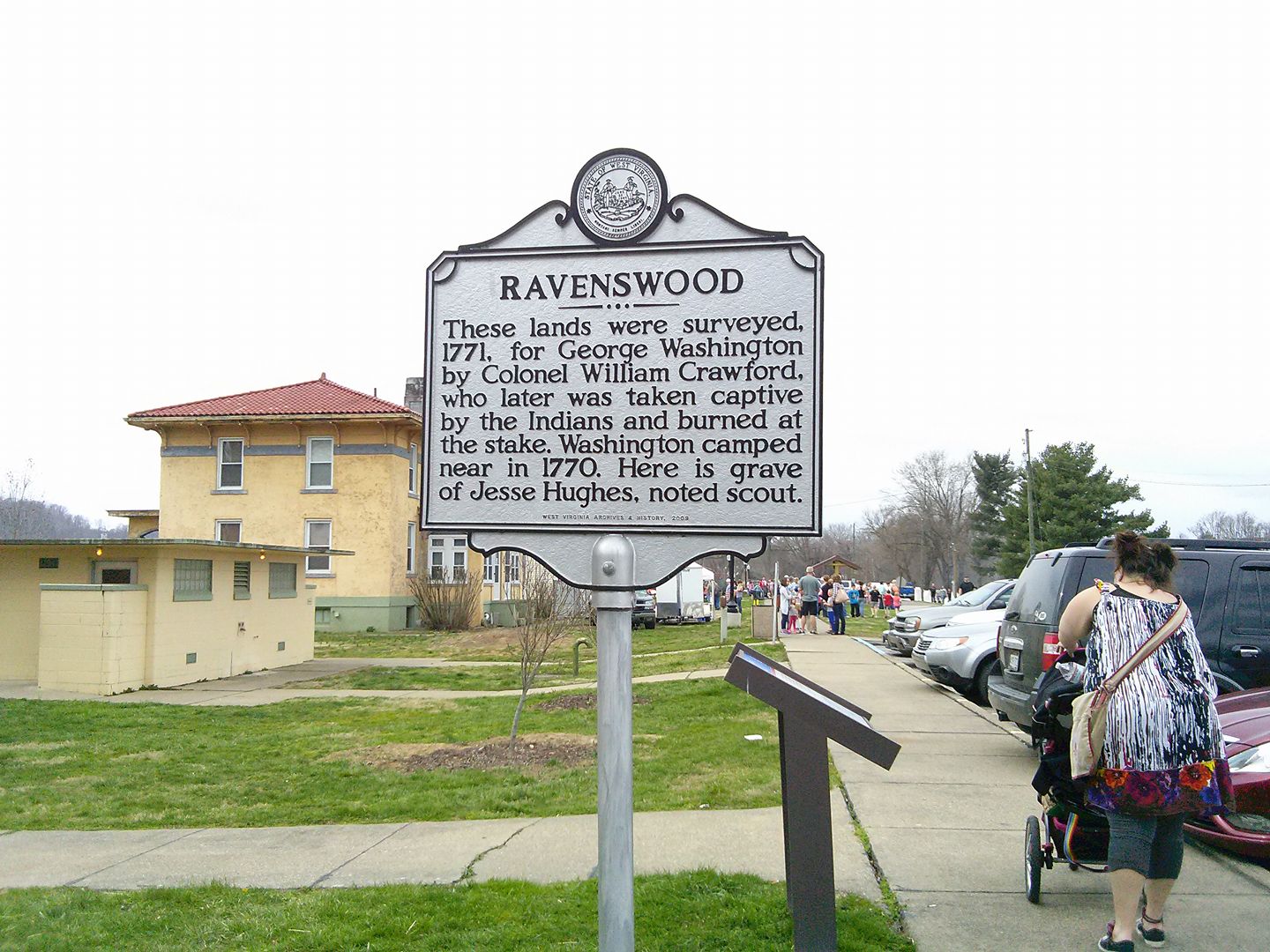
Ravenswood is a pretty Ohio River town, once a bustling center for river traffic, then the bedroom community for the local aluminum plant. George Washington claimed many lands along the river, and his camp was just upriver on the Ohio side. We visited there last August, a beautiful, quiet spot.
The ladies, dressed in period attire, had set out a lovely tea. I so wanted to go and look at all the pretty dishes, but Larry restrained me. Not polite, to turn over dishes and look at the markings!
I had never been in the log cabin located in the park. It was open so we joined others in poking around in there,
| Photo from the Jackson County Historical Society page. |
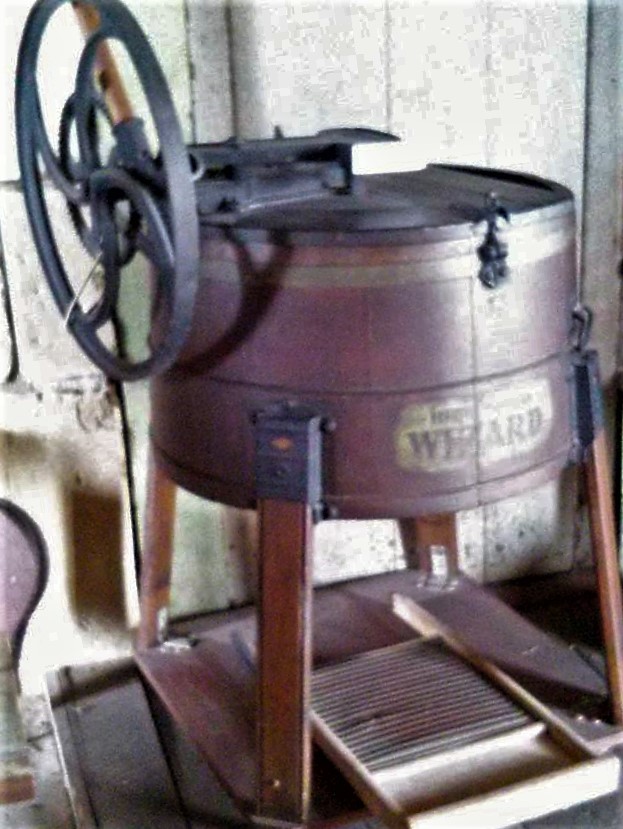
I once had a washer similar to this, and used it! A woman can get strong arm muscles with one of these things.
You can see a bit of mine here. Sadly it fell to pieces and is now in a corner of the garage, a pile of wood and iron.
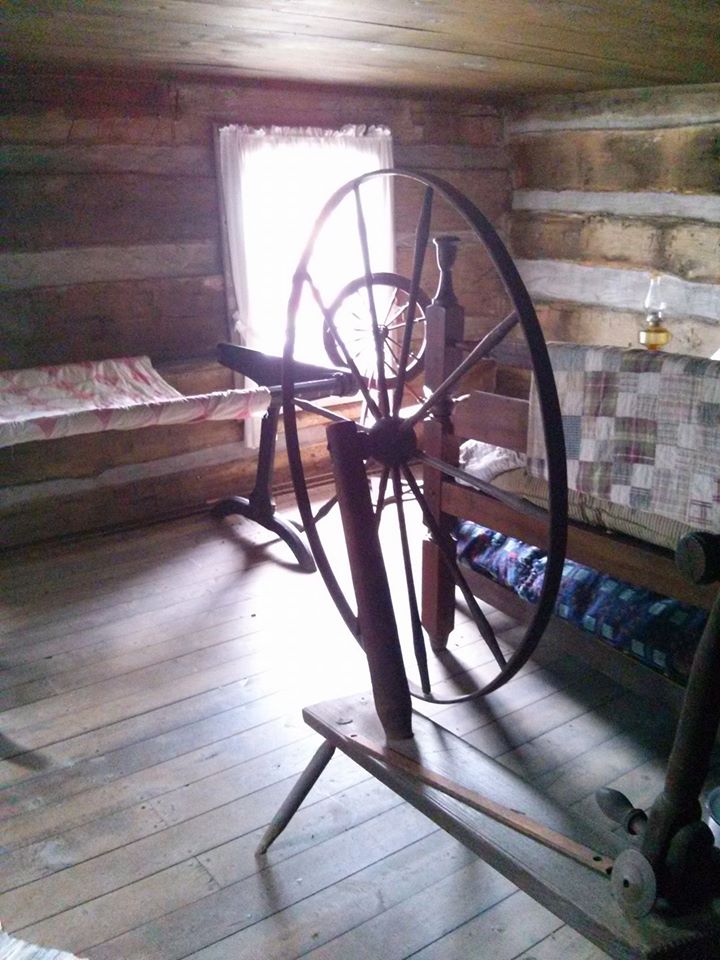
A quiet corner for the woman of the house to do her spinning. In the left corner is the quilting frame.
The museum was also open, and had many visitors while we were there. This photo is from the Jackson County Historical Society page.
Looking down.
The street ends at gthe old ferry landing. The ferry was still in use when I moved here, but the new bridge over the river put it out of service.
Copyright Susanna Holstein. All rights reserved. No Republication or Redistribution Allowed without attribution to Susanna Holstein.
Tuesday, July 26, 2016
Ghosts of Our Past: The Surprises of Family History
This is Antietam Creek. The photo is from a post I wrote in 2013 about a storytelling trip to several places, including the eastern panhandle of West Virginia. We stopped briefly to visit a few sites on the Antietam Civil War battlefield which was not too far away in Maryland. At the time it was just an interesting historical location, although the description of this creek running red with blood during the battle chilled my own blood. It was horrible to imagine. I wanted to stay and wander here, to think about the men and the lives lost, but we had places we needed to be so we drove on.
The relation who lost his life is a distant one, the son of a great-great--great uncle, but he comes to life in letters that were preserved and posted on Ancestry.com. His allegiance is clear:
| Battle for Antietam bridge, from Wikipedia |
Then this summer I learned from my sister Judy, who has been hard at work on our family genealogy and history, that one of our ancestors died at Antietam, and that his blood, along with that of hundreds of other soldiers, ran down this creek when he was killed at the terrible fight at the bridge. Until she found the records in her searches, I had no idea that we had a family connection to this place.
The bridge today is calm and peaceful, yet stories abound of ghosts and hauntings there. It's not hard to understand why. Here is one tale of events at the bridge, from the website Military Ghosts:
"Those who have spent time at the area known as Burnside Bridge on the battlefield, especially those park rangers and Civil War re-enactors who have been at the location after dark, say that there are strange things going on there as well. Historians and experts report that the fighting which took place here in 1862 left a number of fallen soldiers behind and many of them were hastily buried in unknown locations near the bridge. Could these restless souls be haunting the area? Visitors to the bridge at night have reported visions of blue balls of light moving about in the darkness and the sound of a phantom drum that beats out a cadence and then fades away."
The relation who lost his life is a distant one, the son of a great-great--great uncle, but he comes to life in letters that were preserved and posted on Ancestry.com. His allegiance is clear:
If you can read his writing, he congratulates his mother on getting married again :"Did not think that I was A goent to have another Dadey." It is heart-breaking to read this, and to know this young man never got to fulfill his own desire to be married.
Another surprise turned up by my sister in her research (thanking the stars for a sister who is like a terrier dog in digging up--and verifying--these records!) was that our great-great-grandfather Dominick Connelly was a prisoner at Andersonville prison in southern Georgia. (Dominick was a cousin of George Washington Connelly, the one who died at Antietam):
Dominick was one of the fortunate ones; he survived when almost 13,000 other prisoners there did not. Possibly the fact that Dominick had dysentery and was confined to hospital for much of that time actually saved his life.
Dominick was young when he enlisted, about 16; he got sick and was sent home, re-enlisted and was captured and sent to Andersonville, where he was one of a prisoner exchange just before the war ended. He was a musician--a drummer, according to the records--so why on earth he was worth capturing is beyond me.
One hundred and fifty years later my sister Theresa and I found his grave at Arlington National Cemetery. (You can read about our trip here.)
Another story pulled together from photos, documents and memories has been developed by my cousin Julie in England. We knew our English grandfather was killed when he was hit by a car in 1930, but beyond that we knew little about him. Then another English cousin sent me a copy of a poem that he believed my grandfather, Ernest Thomas Hagger had written when he traveled to Canada as a young man.
Wait. My grandfather went to Canada? Why? When? What for? Questions piled up; I went back to my old photos and posted one of Ernest on our family Facebook page.
That started a flood of information as cousin Julie shared what she knew and asked her mother, my 96-year-old Aunt Grace, what she remembered of her father. Bits and pieces came together into a story of adventure, a young man seeking his fortune in the frontier of northwestern Canada--and also a tale of young love, as he gave up his dream to return to England because his betrothed (my Granny) was not allowed to join him in the Canadian wilderness. We learned much about Ernest (or Thomas as I have always thought of him), of his practical planning, his care for his family, his advancement from farm laborer to farm manager, his foresight in buying a life insurance policy at a young age. He came to life, fully three-dimensional, this man we never had the chance to meet.
I am glad that I got to visit his grave when I was in England in 2013; a circle, in a way, completed.
When I was younger I never thought much about our family history. I never thought that we might have had relatives in the Civil War; I never realized that my great-great-great-grandparents lived at 3254 O Street NW in Georgetown, Washington DC, and that they must have been in an uproar when Booth shot Lincoln at Ford's Theater on 10th Street NW, just a few short miles away. Just like the story of my granny in England and her first husband, these old family stories would have been lost had not people like my sister Judy and my cousin Julie got interested and began asking questions, searching records and looking for documents and related history.
If you've been wondering about your family, start looking now, especially if you have older relatives who might remember names and places, or have old letters and photos that will help you in your search. We almost left it too late, and so much would have been lost.
Another surprise turned up by my sister in her research (thanking the stars for a sister who is like a terrier dog in digging up--and verifying--these records!) was that our great-great-grandfather Dominick Connelly was a prisoner at Andersonville prison in southern Georgia. (Dominick was a cousin of George Washington Connelly, the one who died at Antietam):
Dominick was one of the fortunate ones; he survived when almost 13,000 other prisoners there did not. Possibly the fact that Dominick had dysentery and was confined to hospital for much of that time actually saved his life.
Dominick was young when he enlisted, about 16; he got sick and was sent home, re-enlisted and was captured and sent to Andersonville, where he was one of a prisoner exchange just before the war ended. He was a musician--a drummer, according to the records--so why on earth he was worth capturing is beyond me.
One hundred and fifty years later my sister Theresa and I found his grave at Arlington National Cemetery. (You can read about our trip here.)
Another story pulled together from photos, documents and memories has been developed by my cousin Julie in England. We knew our English grandfather was killed when he was hit by a car in 1930, but beyond that we knew little about him. Then another English cousin sent me a copy of a poem that he believed my grandfather, Ernest Thomas Hagger had written when he traveled to Canada as a young man.
Wait. My grandfather went to Canada? Why? When? What for? Questions piled up; I went back to my old photos and posted one of Ernest on our family Facebook page.
![]() |
| Ernest Thomas Hagger, date unknown |
I am glad that I got to visit his grave when I was in England in 2013; a circle, in a way, completed.
When I was younger I never thought much about our family history. I never thought that we might have had relatives in the Civil War; I never realized that my great-great-great-grandparents lived at 3254 O Street NW in Georgetown, Washington DC, and that they must have been in an uproar when Booth shot Lincoln at Ford's Theater on 10th Street NW, just a few short miles away. Just like the story of my granny in England and her first husband, these old family stories would have been lost had not people like my sister Judy and my cousin Julie got interested and began asking questions, searching records and looking for documents and related history.
If you've been wondering about your family, start looking now, especially if you have older relatives who might remember names and places, or have old letters and photos that will help you in your search. We almost left it too late, and so much would have been lost.
Sunday, April 24, 2016
At Green Bottom
We have passed it by for years, this place of swamps. It is along West Virginia Route 2 between Point Pleasant, that place of Mothman fame and site of the creepy Richard Gere movie, the Mothman Prophecies, and Huntington, home of Marshall University and the site of the excellent movie, We Are Marshall with Matthew McConaughey.
This is a long, mostly straight stretch of road, probably the straightest in the state outside of the interstates, and travels alongside of the Ohio River and the railroad tracks. Route 2 was probably an early Native route and one traveled by frontiersmen and settlers. Today this area is largely rural with a smattering of small factories and plants, but mostly one travels through wheat, corn and produce fields. It's a peaceful, beautiful drive, and our route of choice when Larry needs to go to the Veteran's Administration hospital in Huntington for tests or whatever.
This swampy place I mentioned is called Green Bottom, the name given to it by the Jenkins family, who moved to the area from "old" Virginia and developed a thriving agricultural enterprise here. William Jenkins owned 4900 acres here of good rich river bottomland and even in 1850 the farm was valued
at $80,000. The family (slaveowners with quite a few slaves, unfortunately) produced corn, wheat, barley, sweet potatoes, potatoes, wool and beef and in later years grew tobacco and other crops. I was once told that they also tried to grow rice, which might explain the swamps, but my research has not proved that to be true.Albert Gallatin Jenkins was the son of the founder of this plantation. A Harvard law graduate, he entered the Confederate Army when the Civil War broke out, and left his estate in the hands of his father-in-law. Sadly, Jenkins lost his life in the war, and his estate eventually was divided up amidst much family controversy.
We found a rutted gravel track that led to a parking area and a boardwalk through the wetlands to an observation platform. The walk was almost ethereal, with the lush greens, overhanging vines, and birdsong everywhere. It is unfortunate that the noise of the nearby highway can still be heard but otherwise this is a place apart from the world of man.

Here you can see a beaver dam, and we saw a large beaver lodge as we passed by on the highway--no photo of that, but maybe next time.
We saw several varieties of ducks, some Canada geese, redwing blackbirds and many other birds as we followed the boardwalk. We also heard lots of splashes as little frogs dived underwater at our approach, and the croaking of some bullfrogs that sounded like mighty big fellas.
In this photo, you can just see the Jenkins mansion in the distance. This house was 50 feet long and 25 wide and there were many outbuildings during its heyday. Today only the house remains, and it is slowly being renovated to be a museum, although work on this state project seems to have come to a halt. At one time tours were offered, but now the windows are boarded up and the house is not accessible to the public.
It was such a peaceful place, and I tried to imagine how it might look in early morning, as the mist rises from the river. One day I'd like to see that.
Somewhere under this water are those sneaky little frogs that would not let me see them.
I could barely see the slow trickle of water through this swampy patch, stirring those brown bits that looked to me like larvae of some type.
If you'd like to know more about Green Bottom and its history, I can recommend Archival Research on the History ofthe Albert Gallatin Jenkins HouseGreen Bottom, Cabell County,West Virginia , and excellent and well-researched online document. For more about Albert Gallatin Jenkins and his part in the Civil War, see this article by the West Virginia Division of Culture and History.
Copyright Susanna Holstein. All rights reserved. No Republication or Redistribution Allowed without attribution to Susanna Holstein.
Thursday, October 29, 2015
Part 3, Wait For Me: Homecoming
And now the conclusion of my story, Wait For Me. I hope you have enjoyed it so far.
“This ol’ hen’s gone broody on me.
I’m goin’ to put her in that barrel in the cellar and break her out of it. I
need eggs, not chicks.”
The soldiers laughed. “First time I
ever heard of anyone doing that,” the Captain said.
“It works. Try it sometime.”
“I’ll take your word on that.”
Granny got to the cellar, went
inside and whispered, “Told you I’d come back. Brought you some company.” She
put the chicken into the barrel, then handed down the food and other supplies.
Leave the ol’ chicken in the basket. She’ll be quiet in there.”
“I don’t know if I can git out here
again. Them soldiers are still here. As soon as they leave, I’ll fix those
wounds for you. I brought you a candle and matches, in case you need a light.
But be careful. I don’t think any light will show through the cellar walls, but
I can’t be sure.”
“I just want to go home,
ma’am…just… home….”
“I know. I’ll do what I can. I’ve
got to go.. they’re watching me. God bless you, boy.”
She closed the lid and made her way
back to the house. The soldiers didn’t pay no attention to her. One of ‘em had
a banjo and they were laughing and singing.
Grandpa made it home a little
later. Granny told him about the young soldier and they were awake all night
trying to think what to do. Come morning, the soldiers packed up and left—took
two young shoats with ‘em, that made Grandpa mad. It was over an hour before
Granny felt it was safe to check on the boy in the barrel.
Might as well have waited all day,
it made no difference. Sometime in the night the young man breathed his last.
Grandpa said that was the loneliest death he’d ever seen. They carried the boy
up on the ridge that evening and buried him. I could show you where his grave
is, if you want. It’s by a cedar tree, and there’s a stone marker
They never did know who he was.
Looked through his saddlebag but his name wasn’t on anythin’. So they left it
in the attic. It’s still there, I think, if it ain’t turned to dust by now.
Well, that’s the story. Granny
couldn’t look at the cellar without thinking about that boy. A few months after
he died, strange things began happening out there. Jars would fly off the
shelves and bust on the floor. The potato bin would be turned over and the potatoes
smashed like they’d been stomped. Then one night the light started. First it
was just a puny little light, like a candle might throw, but each time they saw
it, it got stronger. Light would stream out around the door bright as sunlight.
Neighbors saw it too, it wasn’t just Granny and Grandpa. No one knew what to
make of it. No one would go in the cellar after dark. Grandpa said there
weren’t no use testin’ what we don’t understand.
Finally one terrible night it all
ended. Jars were smashing and there was a roaring sound in the air even though
the wind wasn’t blowing. The light glowed brighter and brighter ‘til it seemed
like it was pushing against the door. Then the door flew right off and a great
ball of flame busted out the opening. Flames reached over fifty feet high,
Grandpa said. They tried to douse it but it weren’t no use. When it finally
burned out, Grandpa went to inspect the damage. He found the oddest
thing—nothing was burnt except the cellar. The grass around it was still green,
even the flowerbed right against the walls was untouched.
Granny wouldn’t go near the cellar
after that. She wouldn’t let Grandpa fix it either. She got a start of
grapevine and had Grandpa plant it so it would grow over the stones. She never
mentioned what happened, and she would not allow anyone to speak of it in her
presence. I guess she didn’t want to be reminded of how she failed that boy.
Even though there was nothing she coulda done to help him. She blamed herself,
just how she was.”
*
Mary looked at the cellar, almost
expecting to see a Rebel soldier standing there. It seemed quiet enough now.
“That’s quite a story, Mr.
Patterson. An amazing story.”
“Yep, I told you it would take a
while to tell. Hope it was worth your time.”
“It was, it truly was. You know, I
was wondering…would you ever consider selling those stones? I really need a
cellar. Those stones would be perfect…” She paused, her face stricken. “I
shouldn’t have asked, should I? That’s your family history…”
“Well now. I’ve never thought about
it. As for family history, you’re right. But I’m the last of my family, and
there’s no one but me—and now you—who knows that story. How about a trade? Them
stones for, say, a few jars of apple butter every year?”
“Are you sure? Really? That’s a
deal! I’ll bring you all the apple butter you need, and biscuits to put it on!”
“Come and load ‘em up anytime. I’d
be right pleased to see them used again. I’ll help you just as much as I did
today.” Patterson’s eyes twinkled.
*
It took a few months to get the
stones moved, and by then it was winter. When spring came, they began building.
The finished cellar was just what Mary wanted. That summer she filled the
shelves with jars. The potato bin overflowed; crocks of pickles and bushels of
apples and pumpkins sat on the floor, and onions hung from the rafters. Mary
sighed with satisfaction each time she opened the door.
One warm autumn evening Mary and
Andy sat out on the patio. It wasn’t late, not even nine o’clock, Mary
remembered. A sudden noise startled them. It sounded like a jar breaking.
“What was that?” Mary asked in
surprise.
“Sounds like a jar fell,” Andy
said. He walked over to the cellar. There was another crash just as he reached
the door.
“Don’t go in there,” Mary called.
“Might be a skunk!”
“You’re
right. I’ll get a flashlight so I can see. I don’t feel like tangling with a
skunk tonight.” He trotted toward the house. Mary stared uneasily at the
cellar. What was it Mr. Patterson had said about breaking jars?
Andy returned in less than a
minute, pulled the door open a few inches and held the flashlight to the crack.
“I don’t see anything,” he said. At
that instant another jar crashed. Andy jumped back, dropping his light.
“Whoa! What the hell…”He picked up
the light and jerked the door open.
All was quiet in the cellar. The
rows of jars stood undisturbed, and the floor was clean. No glass, no broken
jars, no spilled fruit.
“This is weird,” Andy muttered. He
looked at Mary. “You heard those jars breaking, didn’t you? It wasn’t just me,
was it?”
“I heard it,” Mary said, her voice
shaking. “Remember that story Mr. Patterson told me? He said that jars would
break and…”
“What story?” Andy slammed the door
and walked back to the patio.
Mary’s forehead creased in thought.
“Remember the soldier that died in there? It was after they buried him. Stuff
fell and there was a light…”
The words were barely out of her
mouth when she saw it. Faint at first, then stronger and brighter, a pulsing
light seeped out around the edges of the cellar door. Andy jumped up and ran to
the cellar again.
“Get out! Get out of here! Now!”
At the sound of his voice, the
light faded and disappeared instantly.
“Let’s get inside, Mary. We can
check this out in the morning. I’m not about to go in there right now.”
In the kitchen, Andy sat with his
head in his hands. “This is crazy,” he said. “Spirits don’t hang around a
hundred years or more. That’s just crazy.”
“Got any other explanation?” Mary
asked him. “I can’t come up with one myself.”
“Let’s talk to Patterson and tell
him what’s going on. He might know what to do. The cellar might burn down just
like it did before,” Andy said, “unless we can figure out how to stop this
thing. Look at my hand—the door was so hot when I closed it that it burned me.”
*
Patterson was surprised to see them
at his door so early in the morning.
“To what do I owe the pleasure of
this visit?” he asked. “Don’t figure it was my lovely face that brought you all
the way out here so early. Care for some coffee?”
“You remember the story you told me
about the cellar?” Mary asked. “You said there were problems with broken jars
and smashed fruit, things like that. And that a light appeared in the cellar
sometimes, until it finally burned down.”
“Yep, that’s what my Grandpa told
me. Why?”
It’s happening again,” Mary said.
“We’re afraid the cellar is going to burn down. The door was so hot last night
it burned Andy’s hand.”
Patterson frowned. “Never heard
tell of a haint that moved with a building,” he said. “I don’t know what to
tell you. Never saw it myself, just heard the tale, that’s all. No one ever
disturbed those stones ‘til you moved ‘em. Reckon we woke something up?”
“Seems like it. I was wondering…”
Mary began. “You said there was a saddlebag that belonged to the soldier…”
“Yep, it’s still up in the attic I
believe. Can’t see how that would help, though.”
“I don’t either,” Mary confessed.
“I’d like to take a look at it anyway.”
They went into the hall. Andy
pulled down the folding attic stairs and they climbed up.
“Been years since I been up here,”
the old man muttered. “Now where was it I saw that bag? Ah yes, over here.” He
walked towards the brick chimney. “It was behind here….” His arm disappeared
into a hidden alcove and came out holding a dark bag. “Let’s take this down to
the kitchen where we can see a little better.”
In the kitchen, Patterson put the bag on the table. Stiff
with age and green with mold, it looked every bit its age. Mary turned the bag
upside down and emptied out the contents.
It was a
pitiful sight—a battered tin cup, a bent spoon, a sewing awl, and one photo,
brown with age. Andy grabbed the cup as it rolled across the table while Mary
picked up the photo and examined it. She could just make out the image of a
young woman. Turning the photo over, she squinted at the spidery handwriting.
“What’s it
say?” Andy asked. “Does it tell his name?”
Mary
replied slowly, “I can’t…I can just barely…Ah, I see it now. It says ‘To my
Jeremiah. I will wait for you forever. Your Jenny.’” She looked up. “That’s
all. ‘I will wait for you forever.’ Poor girl. I wonder if she really waited.”
Andy looked
thoughtful. “Mr. Patterson, didn’t you say your grandparents buried that
soldier on this farm?”
Patterson
was holding the sewing awl. “What did you say? Oh, yes. They buried him up on
the ridge, under the big cedar tree.”
“Would you
take us up there?” Mary asked. “I know it seems corny, but I’d like to bury
these things up there with him. Won’t help with our problem, but it seems like
he ought to have them….” Her voice trailed off, and she looked at Andy as if
expecting him to laugh at her.
“I like
it,” Andy said. “ It seems right, somehow.”
“Does,
doesn’t it?” said Patterson. “Stuff’s been in the attic for years. Soldier
might need it.” He grinned at them, turned and led the way to the kitchen door.
“We can take your truck. There’s a little farm road that ain’t in too bad a
shape.”
On the
ridge the cedar stood like a lone sentinel against the morning sky. Mary
touched the stone at the tree’s base.
“That’s his
gravestone,” Patterson said. “Grandpa put it there.”
Andy got a
shovel from the truck. “Think this is where I should dig?”
“Good as any,” Patterson replied.
Mary took the saddlebag and its
contents and laid them in the hole, covering them gently with dirt. “There you
go, Soldier,” she said softly. “There’s your Jenny.”
*
All was quiet for a few weeks after
that visit with Patterson. It seemed that whatever had been disturbed had gone
to rest again.
One evening Mary and Andy were
working late, putting up firewood in the woodshed next to the cellar. A sudden
brightness almost blinded them. Light streamed out around the cellar door.
Inside they could hear jars crashing and stomping feet.
“Oh no,” Andy groaned. “Not again…”
The door of the cellar bulged as if
something enormous was pressing against it. Andy grabbed Mary’s hand and ran
just as the door exploded outward with a rush of hot air and fire. Mary and
Andy were flung to the ground as flames rushed over them. Mary closed her eyes.
So this is how they would die. Burned to death by a soldier who had been dead a
hundred years.
The disturbance ended as abruptly
as it started. Mary opened her eyes hesitantly. Beside her Andy was sitting up,
his eyes on the cellar.
“What the…what happened?”
“Andy…look…”
Andy stared. A ball of fire streaked
across the sky, rising into the blackness until it disappeared from sight.
“The cellar…is it burned?” Mary
asked. They turned together, expecting to see a blackened ruin.
The cellar stood still and cool,
the door closed primly. I did not imagine that flame, Mary thought. I did not
imagine it. She looked at her husband.
“No one will believe us,” he said.
“No one. I hardly believe it myself, and I saw it.”
“You know what I think?” Mary said.
“I think that young soldier is gone. He found his Jenny, and he’s gone back to
her.” She looked up at the dark, serene sky. “She said she’d wait for him. She
said she’d wait forever.”
“I think you’re right,” Andy said
softly, taking her hand. “I think you’re exactly right.”
Copyright Susanna Holstein. All rights reserved. No Republication or Redistribution Allowed without attribution to Susanna Holstein.
Wednesday, October 28, 2015
Part 2, Wait For Me: The Soldier
This is Part 2 of my story, Wait For Me. Please come back tomorrow for the conclusion.
Mr. Patterson began his story.
“This was my Grandpa’s farm. He built the
house, the barn too. Had it all done before he asked Amanda Carpenter to be his
bride. She said yes, on one condition. She wanted a cellar house. Not just any
cellar house, either. She wanted a cut stone cellar with a smokehouse on top so
she could store their food properly. Grandpa promised to build it before their
first anniversary, so she married him. She was hardheaded, was Granny. But a
worker. Everyone said she could work rings around most men. That’s probably
what attracted Grandpa, come to think of it.
Grandpa built the cellar just as he
promised. It was good-sized, 14 feet deep and 10 feet wide. Folks laughed about
that, said Grandpa was making sure he didn’t go hungry! He had it ready for the
fall harvest, and they almost filled it up that first year.
Now this was in 1861. They didn’t
get to town much, but they heard a little news here and there. Folks were
talkin’ about a war back east, some trouble over slaves. Well, around here
there was some owned slaves, but most didn’t. Those as had them needed the
hands to work their fields—owned big bottomlands, you know. No one had very
many, anyways. Grandpa and Granny didn’t own slaves and didn’t think
God-fearing people ought to. But they kept out of other folks’ business. Granny
said they had enough to do tending to their own souls. So the talk of war was
around, but it might as well have been in Europe for all my grandparents cared
about it.
It got tougher when men started
joining up. That’s when it began to hit home. You see, some boys went for the
Union and others went for the South. Sometimes in the same family! There was a
family lived next farm over, they had a boy who went with the Confederacy. Down
the road not even a mile was another family whose son joined the Union Army. So
it was like that, and it made for hard feelings and high words.
More and more men left for war, but
Grandpa didn’t go. He wanted to, wanted to fight for the Union, but Granny
didn’t see the need. They argued about it. He felt it was his duty; Granny said
his duty was right there on the farm, not going off to get killed. Then Grandpa
broke his leg real bad in a haying accident and that ended the argument. The
Army didn’t want him with that bad leg.
Them two kept on farming, even when
there was fighting right here in Jackson County. Yes ma’am, that war even
reached these backwoods hollers. Grandpa couldn’t do the work he had before he
broke his leg, but they managed.
One day he had to drive some cattle
he’d sold to a neighbor’s farm. The trip took all day, and he would not be back
‘til midnight. Granny went about her work that day with no idea that the war
was coming right to her very farm.
There was a little skirmish that
day, up between Ripley and Spencer at the mouth of Big Run. It wasn’t much,
nothing that even made the history books far as I know, but it was a right
dust-up. Confederates got ambushed by a bunch of Union boys. One Confederate
soldier was wounded, but he held onto his horse somehow and escaped. Someone
seen him and told the Yankees, and they sent a few men after him.
Granny was milking in the barn when
this horse come flying up the road, a man slumped over the saddle horn. When
Granny hollered the horse come to a stop and that soldier fell off. He was hurt
bad, blood all over the place. He looked up at her. “Help me,” he said.
“They’re after me.” Granny didn’t hesitate. Rebel or Yankee, he needed help.
Politics didn’t have nothing to do with helping someone in trouble.
Granny knew where to hide him. She
had a big barrel in the cellar that she used for cider. It was big enough to
hold that poor boy—he wasn’t very big anyways. So that’s where she took him.
“Climb in here,” she told him. “You
can hide here until it’s safe. I’ll come back when it’s safe and take care of
those wounds. I promise.” Grandpa said she never forgot the look the boy gave
her when she put the lid back on the barrel. Haunted her for the rest of her days.
But she had to leave him. She had to cover up any sign he’d been there.
She worked like a crazy woman. Put
the horse in the barn and brushed him down. Took the saddle and saddlebag up
into the attic. There was a hidey-hole behind the chimney. She threw his stuff
in there and hid it with crates and old quilts. Then she ran outside, swept
away the tracks and blood. Just finished when she heard horses coming.
The soldiers rode into her yard as
if they owned the place. Stopped right in front of her. The leader of the
bunch—arrogant feller, way my Grandpa told it—pranced his horse around a little
before he spoke to her.
“Ma’am.”
“How can I help you, sir?”
“I’m Captain Ansted, ma’am, US
Army. We’re tracking a Rebel soldier and his tracks led us to your place.” He
stared at her, and Granny stared right back.
“You see any rebel soldier, here,
young man? All I see is a few chickens myself.”
That didn’t please the
Captain none. “We’ve been told by several people that he was traveling this
way, ma’am. I have no reason to suspect them of lying.” Way he said it, Granny
knew he suspected her, all right.
“Suit yourself, Captain. Search the
place. I’ll be as surprised as you if you find him here.”
The Captain bent down and looked at
Granny’s apron. “You got blood on your apron, ma’am. Cut yourself?”
“Dressed out an old hen, Captain,
and she’s boilin’ on the stove. You’re welcome to inspect her.”
“Very well, you won’t mind if we
just have a look around then?”
“I can’t stop you, can I?”
Well, those soldiers searched the
place. They made an awful mess. They didn’t just check the pot of chicken on
the stove, they took it outside and ate it. That was why they didn’t find the
boy in the barrel, Grandpa said. See, one soldier was supposed to search the
barn and cellar. He just got through with the barn when the Captain came out of
the house with the chicken and two loaves of bread. Soldier knew the food would
be gone if he didn’t hurry, so he just threw a quick look around the cellar and
skedaddled back to the others.
“Nothin’ in the cellar, Captain.”
“You sure?”
“Yes, Sir.”
By then it was getting dark and
them soldiers decided to make camp right there. They built a fire, set up their
bedrolls, and settled in for the night. Granny was plumb worried—that young
soldier needed help. How was she going to get it to him?
Finally she had an idea. She filled
her apron pockets with food, bandages, salve and whatnot. Grabbed a basket and
went to the chicken house, got a hen. Put it in the basket and covered it with
a cloth. Then she headed toward the cellar.
“Hey! Where you goin’, lady?”
Copyright Susanna Holstein. All rights reserved. No Republication or Redistribution Allowed without attribution to Susanna Holstein.
Tuesday, October 27, 2015
Wait For Me, Part One
This is the first part of a three part story. Come back tomorrow for Part Two!
It started simply enough. But how
was she to know that disturbing the stones could also disturb the dead? How
could she have known that it was possible to wake the dead? She certainly never
intended to bring a spirit home to haunt her days and nights. But that’s what
happened.
She needed a cellar. She was a
gardener, and folks said she had a way with plants. Her gardens produced
abundantly, so she canned quarts and quarts of fruits and vegetables every
year. All those jars had to be stored somewhere. First she filled the shelves
in her pantry, then boxes that were stored under beds. Jars overflowed from
cabinets and closets. Now the jars of tomatoes on her counter had nowhere to go.
“This is nuts,” Mary told her
husband. “We need the food, but this is driving me crazy. We have got to build
a cellar. All these jars could be stored there instead of all over the house.
We really need a cellar, Andy.”
“I’ll add it to my list of things to do,” Andy
replied. “We’ve got to have a new barn first. The old one will fall down by
itself if we don’t pull down.”
“You’re right. But promise you’ll
build the cellar as soon as the barn is done.”
He promised, and that’s where they
left it. The new barn was built the next summer but the cellar had not even
been started. She sighed as she ran her eyes over the pantry shelves. There was
no room for even one more jar. She’d have to pick up boxes the next time she
was in town. More jars, too. She was almost out of empty ones, and there were
still apples to be put up. She made some coffee and sat down to read the paper,
scanning through the want ads.
Mason jars, free. Don’t can
anymore.
Free! What was that number? She
grabbed the phone.
“Hello?”
“Hi. I’m calling about the jars you
advertised …”
“You and everyone else! My phone
ain’t quit ringin’ since the paper come out. If you want ‘em, it’ll be
first-come-first served. I ain’t promising ‘em to no one.”
“That’s fair. I’ll come right away
if you can give tell me where you live.”
Mary scribbled directions as the
old voice scratched on.
“Thank you. I’ll be there in about twenty
minutes. My name is Mary. I’ll see you soon.”
“Don’t blame me if the jars are
gone before you get here. Dang people callin’….”
“I won’t. Good-bye.”
“Bye.”
She hung up and
hurried out to the porch. Andy was sitting in the swing, reading the sports
section.
“Andy, I’ve got to go out. This guy
had an ad in the paper for some free canning jars. I’ve got to go now or
they’ll be gone.”
“ Okay, honey. Drive it slow.
You’re a speed demon when you’re in a hurry.”
“Look who’s talking! See you in a
little while.”
*
The door opened before she had a chance to
knock.
“You’re Mary, ain’t ye? And you’ve
come for the jars.”
“They’re still available?”
“Oh, some feller took the ones in
the basement. But there are more in the shed out back.”
“Wonderful! I thought I’d have to
buy new ones, and they’re pretty pricey these days.”
“Well, the price is right on these,
then. My name’s Patterson.” He stuck out his hand.
“Nice to meet you, Mr. Patterson,”
Mary said. “I’m Mary Marshall.”
“Well, Mary, let me show you them
jars.”
The shed was looked no better than
the house. Patterson opened the door and warned, “Mind your step. And keep an
eye out for snakes. Used to be a big black one lived in here…”
Mary stepped inside and looked
around. Boxes of dusty jars lined the walls.
“Well, here’s you go. You want ‘em
all?”
“Sure do. I like to make apple
butter and give away a lot of it. Sometimes I get my jars back, sometimes not.”
“Apple butter! I haven’t had
homemade apple butter in years.”
“I’ll bring you some next time we
make it,” Mary promised.
“Now that would be mighty kind of you. I’d not
turn it down!” The old man’s voice was wistful.
“I’d better get to work. I’ll be
washing jars ‘til midnight!”
Patterson grinned and pulled a
chair out of the shed.
“Reckon I’ll just sit here and
watch you work,” he said. “Can’t stand dust in these old lungs.”
Mary nodded. “That’s fine. I’d
appreciate your company.”
It took a while, but when the job
was done there were twenty-nine boxes of jars in the back of the truck. Enough
to finish out the canning season, she thought. Exhausted, she flopped down on
the grass beside Patterson.
“Would you like a glass of sweet tea?” he
asked. “Made it myself.”
“Why yes. Thank you!” Mary gazed
around the yard appreciatively. Mr. Patterson certainly knows how to grow
flowers, she thought. A tumble of stones caught her eye. It looked like on old
stone cellar with no roof. Obviously it had not been used in years, because it
was almost completely hidden by a sprawling grapevine.
The creaking of the screen door
announced Patterson’s return.
“Here ya go! Come on over and sit
on the porch. Rest yer legs awhile.”
Mary followed the old man to the
porch and took a long drink of tea. “Ummm! Just what I needed.” She smiled at
the old man and asked, “What was that building over there, Mr. Patterson? Looks
like it was a cellar.”
“Yep,” Patterson said. “I’m
surprised you noticed it. It caught fire and burned the smokehouse that was on
the top of it. Happened when my grandparents were first married, over a hundred
years ago. My grandfather built that cellar himself. Quarried the stone from
the rock cliff down the road.”
“It burned? How did that happen?
Seems a shame they never tried to fix it up again”
“Oh, Granny didn’t want no part of it after
what happened. She planted that vine to cover it up so’s she wouldn’t see it
and be reminded. Sad, that was.”
“What happened?”
“This is going to take a while, so
might as well get comfortable.” He settled deeper into the rough oak chair,
then looked up at Mary. “Do you believe in ghosts?”
Tomorrow: Part 2: The Soldier
Subscribe to:
Posts (Atom)