I'm off again tomorrow, this time to West Virginia's Northern Panhandle and the first ever Grand Vue Storytelling Festival, to be held at Grand Vue State Park.
The festival begins Tuesday evening at 6:00pm at the Moundsville Public Library with a showcase featuring all the storytellers that will be performing Wednesday at the park. Then Wednesday at 9:30am we'll be telling stories at Grand Vue. I am so looking forward to this. Grand Vue is one park in our state I have not visited; and a new festival? What could be more fun?
I hope that if you're in the northern panhandle of WV, or maybe over the border in Ohio or Pennsylvania that you will join us for a fine day of storytelling with some of West Virginia's best tellers. It's sure to be a great time, and you will go home with stories to tell and memories to cherish.
For directions to the Moundsville Library, click here. For directions to Grand Vue State Park, try this link.
Copyright 2012 Susanna Holstein. All rights reserved. No Republication or Redistribution Allowed without attribution to Susanna Holstein.
Showing posts with label Northern Panhandle. Show all posts
Showing posts with label Northern Panhandle. Show all posts
Monday, May 27, 2013

Wednesday, July 20, 2011
Wordless Wednesday: Hundred to Cameron and Mannington
Some of my favorite photos from my trip to the northern panhandle of West Virginia:
Littleton, WV:
 I think this used to be a boarding house, perhaps?
 Probably a bank building at one time, with buildings to either side. Now it stands alone and empty.
 The old bus station at Littleton.
 Rounding a curve on the way to Cameron.
 The restoration project at Cameron. The depot will be lovely when completed.
 Abandoned bridge at Hundred, WV,
 and a covered bridge still in daily use, also in Hundred.
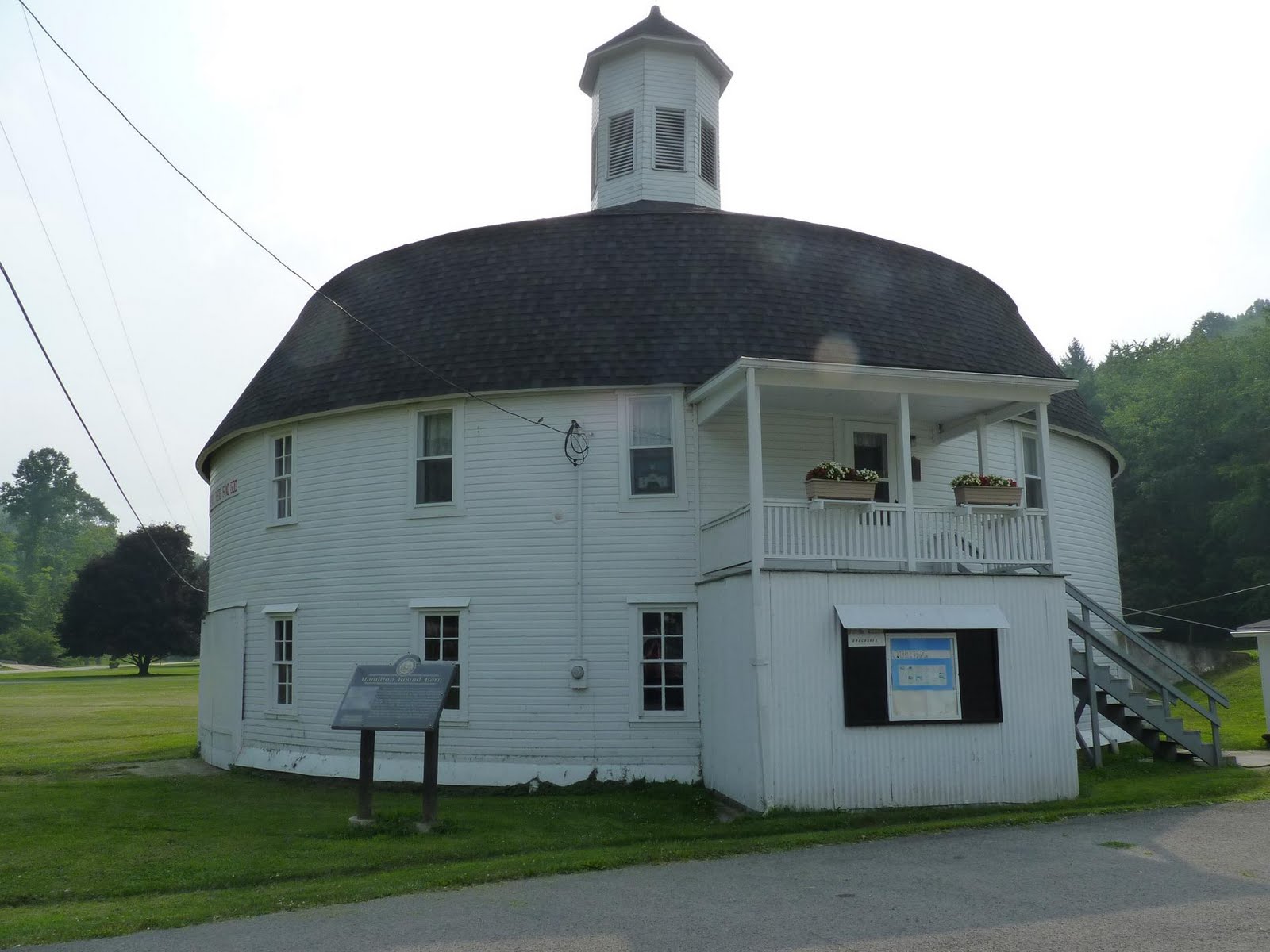
 The Round Barn near Mannington, WV.
 Inside the barn. It's a museum now, and was closed when I was there. I got this shot by pressing the camera lens to the window glass.
 An old school building, re-purposed as a youth center, in Mannington. I think there must have been a turret on top of the clock tower at one time. The clock still chimes the hour. I wonder how long the city will be able to keep up with this amazing building--it must be costly to maintain. What a treasure, though.
There were many more photos to share. I will try to post more tomorrow.
Littleton, WV:




There were many more photos to share. I will try to post more tomorrow.
Tuesday, July 19, 2011
A Story Old, and Stories New

Back roads,

high ridges,

abandoned buildings


and struggling towns,

friendly, helpful librarians, incredible cheesecake at a small town restaurant, sweat, heat, thunderous storms and rain-lashed interstate, drilling rigs, oil leases, lush vegetable gardens--it was a day of visual and sensory variety, one of those road trips that has its own special atmosphere, in an area where the sense of place cannot be denied.
Northern West Virginia has had many economic ups and downs: the rush of the oil and gas boom in the early 1900's, the rush to industrialization with steel mills and glass factories, the exodus of people after World War II when men saw there were other places with more opportunities for their families, the downward spiral as West Virginia was bypassed by interstates and businesses relocated to places with better access, the struggle to retain the remaining factories and workers, the coming of Chinese steel and the loss of more jobs, and now a second drilling boom as the Marcellus gas field is being developed. Some things remain the same, like growing vegetable gardens to provide for one's family, church, and for those who continue to live here, holding on to home and all that it means to West Virginians. They preserve what they can--a railroad depot, a round barn or former school--so that future generations will know who they were and what was once here.
Many of the jobs for this new boom in the gasfields are held by people from out-of-state, just as happened in the first boom. The difference this time is that there are local people in need of the work, while in the 1900's boom the local population was scarce and most owned farms that keep them employed (although many left the farms for the more lucrative work in the oilfields). The Wheeling newspaper has a long list of new oil leases on its front page, so similar to the Oil Review that was published in Sistersville in the early 1900's, where drilling activity was the main trust of the daily news--and the activity was extensive, covering several columns each day.
Even with this boom and the income being generated, it will take a while for the impact to be felt. Not everyone benefits, of course--those with mineral rights to lease and many businesses are seeing revenue flow, but others can only watch the trucks passing by and continue to find their livelihood elsewhere. Town and county leaders, I am sure, are looking for ways to protect their communities' interests and environment while still reaping some economic benefit from this whirlwind that will not last forever. Like many, I worry about what the hydrological fracturing is doing to the land and water. The process involved setting off nitroglycerin charges deep beneath the surface, to "frac" the rock so that oil or natural gas can seep into the wells and be extracted. This may well be yet another instance where West Virginia is the source for the wealth of those outside its borders as another extractive industry takes our natural resources and leaves behind a damaged land--like the coal and timbering industry did in the past, and as coal continues to do today.
Some towns have found a way to thrive without reliance on the drilling boom. Small manufacturing and retail businesses have surfaced; some residents are commuting to Pittsburgh, Morgantown or Fairmont where the jobs picture is bright and opportunities are available for those willing to drive. Commuting may not be an ideal solution but it will keep some places going as they rebuild to meet new realities.
Storytelling seems a simple pursuit in the midst of such economic complexity. And yet, as everywhere, people in this region too were ready to hear stories. We journeyed together through tales from many lands--India, China, Japan, Africa, South America and Mexico, sharing songs and laughter and magic. One young man of fourteen helped me load my car, talking almost non-stop about the stories we had told that morning. He said, "It's a special day when you get to help your favorite storyteller!" He remembered when I came to his library almost ten years ago, and the stories I told then. At another library, the librarian said, "This has been wonderful. I'm just sorry we didn't have you here before now." Music to the storyteller's ear, and a reminder to keep finding stories and songs that others will want to hear, that might have meaning for someone who needed just that story, just that song.

I left at 6:30 in the morning, before the sun was full risen. I drove home in the dark through thunderous rains and lightning, often able to drive only 30 miles an hour and struggling to see the lines on the road. (We need the rain, but maybe not so much at one time.) When I finally turned onto my road at 10:00 pm it was a relief to see we had gotten only light showers and not the damaging downpours. As I drifted off to sleep, my mind was on those children and adults who came out on such a hot, humid day to listen to stories. I will never get over my amazement that people come to listen. I will never stop being inspired and motivated by faces looking up expectantly as the stories begin.
Subscribe to:
Posts (Atom)
