Pages

Showing posts with label Spring wildflowers. Show all posts

Monday, May 3, 2021

Joe's Run Wildflowers

59 this morning, and rain showers.

Our little road is bursting with flowers these days. It's tempting to just meander along slowly every time we go out.

Here, wild geranium and larkspur happily share the same roadbank. Just last week this bank was covered with wild phlox.


A recent ditching project probably took out some of the flowers, an unfortunate but necessary loss.


I can never remember the name of these pretty, low-growing yellow flowers. They dot the grass like little stars. Five-petaled, and not cinquefoil, buttercups or sorrel.


Golden Ragwort in full glory.


A smaller patch straggles down to the tiny run that is Joe's Run here near its head.


Larry waited patiently while I ambled along, camera in hand. fortunately there is not too much traffic on our road.


This is toadwort, not easy to see. I look in this spot for it each year; it doesn't grow in many places around here. 

I missed getting photos of the trillium this year, and I hope I can still get some of the wild iris on the other fork of Joe's Run where there are several large patches. Hawthorns are also in full bloom now, filling the woods with their white blooms and replacing the fading dogwoods. I have to rely on Larry's willingness to slow down and stop when I take photos as we are almost always traveling together anymore, and he thinks I'm a little nuts about wanting to take so many photos. But as I told him yesterday, someday we won't be able to get out and about like we do now, and we will have this blog to look back on and see all the things we might be missing. He kind of understood that.

Copyright Susanna Holstein. All rights reserved. No Republication or Redistribution Allowed without attribution to Susanna Holstein.

Monday, March 29, 2021

Ruminations

43 this morning with bright sunshine. Big storm blew through yesterday, lots of wind and rain.

Random thoughts today. 


*Why this children's picture book? Well, that big ship in the Suez Canal--did you see the photos of the tiny excavator trying to get it loose? 


And in the "Global is Local" category, my grandson's Navy ship was to go through the canal, and might have been held up by this massive problem, but fortunately they hadn't quite got there, so all is well. He's on his way home after about 9 months at sea and I know he must be anxious to see his wife--they were married only 6 months when he was deployed.

*It is amazing what people get into after retirement. We got into furniture flipping and booths in antique malls. My cousin and his wife got into whitewater rafting, fishing, then most recently stained glass and boat-building. A neighbor got into farming on his homeplace. Another friend took up knitting, and yet another became president of the local library board, joined a quilting guild, and became more active in a local theatrical company. So if you're considering retiring but are afraid you might not have anything to do, don't let that worry you. I am betting you will find yourself busier than you've ever been in your life.


*It's the time of the tiny flowers. Coltsfoot, 


spring beauties,


bluets, 


violets, shepherd's purse, chickweed, wood anemones and so many more are showing their shy faces. Yellows, blues, and whites reign supreme right now, and soon pink will be added with redbuds, Deptford pinks, and wild phlox. The flowers of summer are big and showy--the many varieties of sunflowers, daylilies, wild roses, but right now it's the tiny ones that catch our eyes, and our hearts.


*I used to listen with amusement and some boredom when older people discussed their health and their medications. But here I am, doing just that with my friends and sisters and find it quite interesting, actually. How differently we see things when it's personal.

*Larry and I were discussing how old we feel--like, what age do we feel like we are? We both said we feel like we're 50, with just a few additional aches and pains. When I retired, at 60, I felt 60. But now, 10 years later, I feel younger than I did back then. More sleep, moving at my own pace, and less stress have made a lot of difference to my health. Another benefit of retirement.

*If you haven't tried it, do make that Chocolate Zucchini Bread I posted here a while back. I promise you, it's incredible. Like a good rich brownie. Put ice cream on it for a real treat.


*We spent several hours today trying to find brown mulch. Everyplace was out of it, until one place where we had to pay a dollar a bag more for a more expensive brand. All this spring the story has been the same. There's plenty of black and red mulch available, but not the brown, which is, of course, the most popular color, at least around here. So why don't the stores order twice as much of it, and less of the others? It's the same story every year.

Enough randomness for one day!

Copyright Susanna Holstein. All rights reserved. No Republication or Redistribution Allowed without attribution to Susanna Holstein.

Sunday, May 3, 2020

Covid Journal, Day 50: Back to Joe's Run

62 and raining this morning. It was very warm overnight, and now today we've had thunder, a little sun and a lot of rain and heavy clouds. A good day to stay inside.

I feel like I've been a slug this weekend. I can't seem to get up the energy to get into anything much. So I sorted books and packed some up to send to various people, cooked, finished my book, little things like that. Yesterday was a beautiful, warm day and I got out and did some weeding in the flowerbeds but that's about all.

I still have photos from my walk the other day to share, though, so here we go.

The wild larkspur are finally coming into their own. This beauty is growing right at the edge of the pavement.


Here it mingles with wild phlox. This roadbank used to be carpeted in the phlox but time changes what grows where in the wild.


I do not know what this tiny bluish-white flower is. It is growing with the roadside grasses, and has at least a 6-inch stem. It lines one part of Joe's Run.


I kept hearing a goat, I thought, as I was walking, and assumed it must be in a nearby field. But no, it was a young lady out walking her 4-h lamb, getting it ready to show at the county fair this summer--if there is a county fair this year. We had quite a traffic jam: a neighbor coming home from work, the girl and her lamb, and me with my camera.


Mayapples, or mandrake, is also a common plant here. It is often harvested for its many medicinal uses.

 Here is the mayapple's flower. So shy, hiding beneath the plant's big umbrella leaves.


Here's a bit of lore I collected last year for my wildflowers workshop:

The botanical name Podophyllum peltatum comes from the greek podo and phyllon meaning "foot-shaped leaves" and Peltatum meaning "shield".
Folklore:
Allow the bearer to work in secret, or to allow his or her actions to not be revealed too soon.
The whole root can be tucked under the mattress to ensure the fertility and virility of the couple who sleep upon it.
Kept in a high place in the home, Mayapple root is said to draw prosperity to the home and protect it from bad luck.
Uses: Modern medicine has found compounds in the rhizome that are useful against cancer and it is used in the treatment of genital warts and skin cancers in Asia. It is also under study for use against dropsy, dyspepsia, biliousness, and various liver conditions.
According to lore, Native Americans used this plant for its healing attributes but also to commit suicide.
Listed as "unsafe" by the FDA and most experts agree that its action is too strong for self-medication even by experienced herbalists. Every part, excepting the ripe fruit, is deadly poison and can kill an adult human within 24 hours.
Symptoms of mayapple poisoning are salivation, vomiting, diarrhea, excitement, fever, headache, coma, and death.
Culinary Use: Only the ripe fruit or "apple" of the mayapple is edible. The fruit is ripe when it is yellow and slightly soft. Despite its name, the flavor is more like lemon than apple. Mayapples may be eaten raw, but they are best cooked or made into jelly. They may also be juiced and mixed with sugar and water to make a beverage similar to lemonade(remove all seeds before juicing). These fruits should be eaten only in moderation and only when perfectly ripe.
Has been known to cause technicolor diarrhea. Can you just imagine that!!

I need to find out what this shrub is called. It's plentiful here, and has berries later on. I have wanted to learn about it, and if the berries can be used to make jam, jelly or tea.


Sweet white violets mixed with cleavers, grass and a bit of dead-nettle.


The trilliums are nearing the end of their run for this year. My friend Carmen has found several varieties of this beautiful flower in her area of West Virginia, but in this region we have only the one. That's quite enough to make me happy. Years ago I tried to transplant some, but now I prefer finding it in the wild.

A bank covered in trillium.

Two hemlock trees, not that common around Joe's Run, and in front the invasive kind of mustard.


 Stonecrop can make itself at home anywhere, even on a drainpipe! That's coltsfoot leaves in the foreground.

One of many little wet-weather waterfalls along the road.


Two beech trees seem to be hugging each other.


And so back to ridge and to home. I still have a few more photos to share; perhaps tomorrow.


Copyright Susanna Holstein. All rights reserved. No Republication or Redistribution Allowed without attribution to Susanna Holstein.

Friday, April 27, 2018

Violets: Stories, History, and More

What can you make with two spears of asparagus and one morel mushroom? Not much you might think. But add some violet flowers leaves, some chives, some dandelion leaves, some thyme, some chopped tomatoes and grated cheese, and some eggs--and there's an omelet fit for a king.

That was our lunch yesterday. I sauteed the mushroom and asparagus, added the greens and herbs and cooked only long enough for the greens to wilt. Then beat the eggs, sprayed a skillet with olive oil and when it was hot, poured in the eggs. Added the rest of the ingredients, flipped one half over the other, flipped again, and omelet! It was so good. Larry got out the ketchup but I must have looked shocked because he put it back. A wise man.


I picked enough of the wild violets for a little bouquet for one of the milk glass pitchers I keep just for this use--and began thinking about violets. What do I know about this plant, I wondered--especially the uses of it, its history, and the folklore and superstitions about it?

As for uses: I've made violet jelly, and have to say it's not worth ruining so many pretty flowers. It takes a lot of them to make the jelly, and while it's a very pretty color, it doesn't have a flavor distinctive enough to warrant the use in this way. Far better to put them in a vase and enjoy them, in my opinion.

You can sprinkle the flowers over a salad. They add a nice, almost citrus-y flavor, somewhat like that of redbuds. Add the raw leaves to the salad too, for more green goodness. Today was the first time I tried cooking the green leaves in any way, and I must say they were  excellent, milder than spinach in my opinion. According to my reading, violets are a good source of vitamin C. One book suggested making a soup from the roots; the nodules resemble tiny root crops in a way, so I suppose one could gather enough of them for soup. I don't think I'll ever try it though.

Violets can be used to make syrup, or can be sugared and used as decoration, a nice edible trim!  In the past, poultices and other medicinal uses were made of the plant, including treatment of ulcers, as a pain relief tonic and more.

 If you're interested in more ways to use violets, check out The Nerdy Housewife.

According to the old book, The Language of Flowers, blue violets mean faithfulness; sweet violets mean modesty, and yellow violets mean rural happiness.

Because of its deep purple color, the Romans considered the violet the flower of mourning, which means that the connection between the color and sadness goes back a long way indeed.

In Greek mythology, Zeus fell in love with the nymph Io. To hide her from his wife Hera, Zues changed Io into a white heifer. Poor Io, suddenly confronted with having to eat grass! She appealed to Zeus, who took pity on her and changed her into the violet. Another version of the story is that Hera is the one who changed Io into the heifer, which sounds quite likely to me, because a jealous wife is a force to be reckoned with. In the Greek language, Io means violet.


The French have a special place for violets in their history too. The supporters of Napoleon Bonaparte chose the violet as their symbol, as Napoleon reportedly said he would return from Elba when the violets bloom--and he kept that promise.
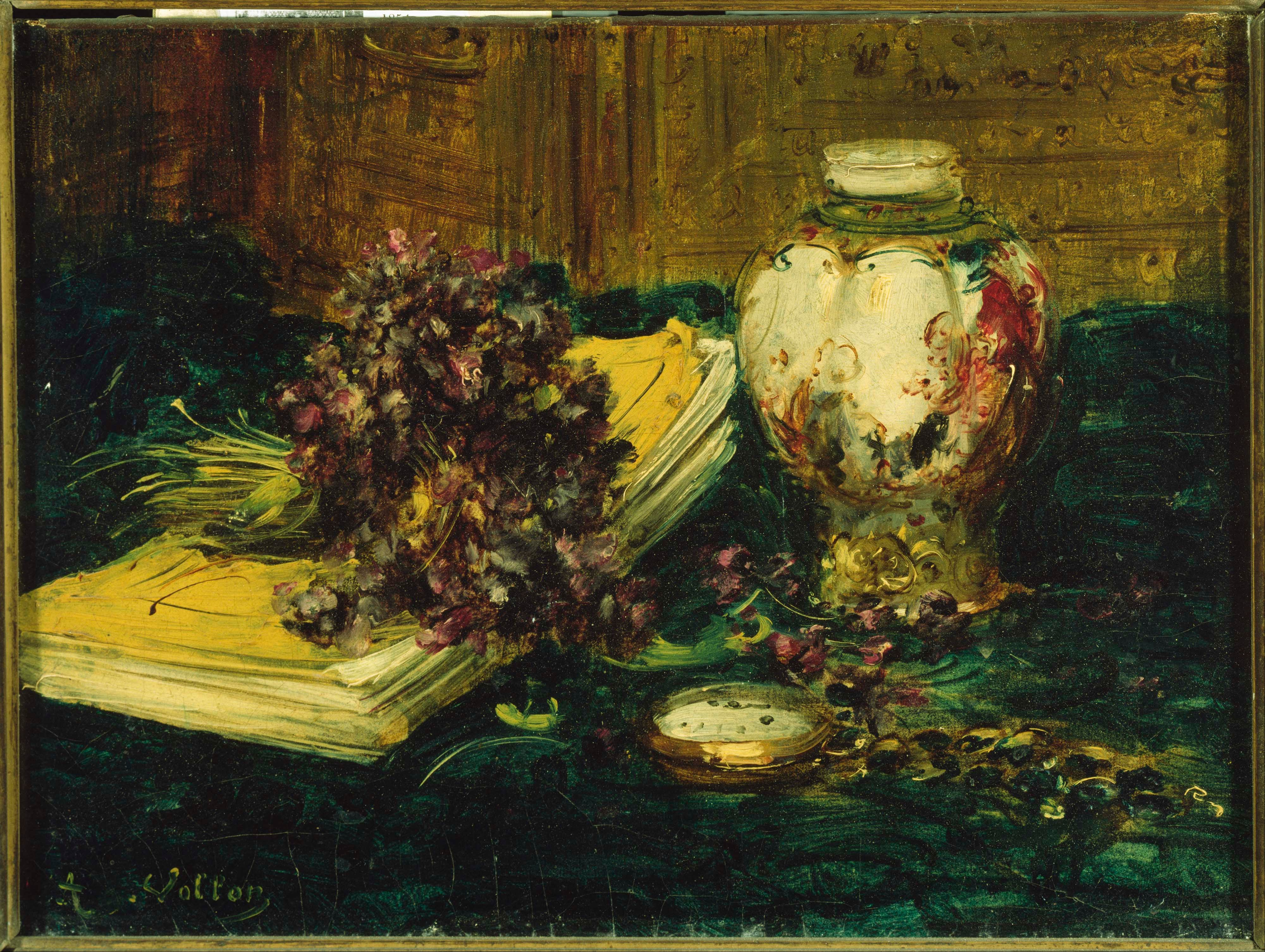
Antoine Vollon [Public domain or Public domain], via Wikimedia Commons


The violet seemed to have strong significance for Shakespeare, as he often referred to them in his writing:

From A Midsummer Night's Dream:

"I know a bank whereon the wild thyme blows,
 Where oxlips and the nodding violet grows,
 Quite over-canopied with luscious woodbine,
 With sweet musk-roses and with eglantine.
 There sleeps Titania, some time of the night,
 Lull'd in these flowers with dances and delight."

And Sonnet 99:

The forward violet thus did I chide:
Sweet thief, whence didst thou steal thy sweet that smells,
If not from my love's breath? The purple pride
Which on thy soft cheek for complexion dwells
In my love's veins thou hast too grossly dyed.
The lily I condemned for thy hand,
And buds of marjoram had stol'n thy hair:
The roses fearfully on thorns did stand,
One blushing shame, another white despair;
A third, nor red nor white, had stol'n of both
And to his robbery had annex'd thy breath;
But, for his theft, in pride of all his growth
A vengeful canker eat him up to death.
   More flowers I noted, yet I none could see
   But sweet or colour it had stol'n from thee.

Shakespeare wasn't alone in his love for the sweet violet; check Bartleby's for many other quotes about this little flower. The frequent referral to the scent of the violet makes me wonder if earlier humans had a stronger sense of smell than we do, for while I think the violets are sweet-smelling, many poems refer to their perfume as something quite heady.

In the United States, violets are so well thought of that they are the state flower of Illinois, Wisconsin, New Jersey and Rhode Island.

But what of superstitions about this shy little flower? In Wales, it was once believed that to take less than a full handful of violets into the house of a farmer would spell death to his poultry.

A couple of pretty plates in my collection.

Dreaming of violets is considered good luck; to find out if a sick man will recover, place a bruised violet on his forefinger. If he sleeps well, he will recover; if not, well...see the Romans' belief about the flower above.

Violets have been used in herbal concoctions of all sorts, and are believed to aid in healing mouth and throat cancers, fevers and headaches, sore or chapped skin, and for inflammation. Many beauty preparations, from perfumes and colognes to bath salts and more, have been made with this little spring flower.

In my yard I have some white violets, some bi-colored, and the usual blue (I'd call them purple) ones. On Joe's Run I have found yellow violets and some stemmed ones with multiple flowers on one stem. What kinds grow where you live?

Copyright Susanna Holstein. All rights reserved. No Republication or Redistribution Allowed without attribution to Susanna Holstein.

Thursday, April 27, 2017

Joe's Run Wildflowers

I think I must post photos of this stretch of our road every year, but every year it just takes my breath away. Wild phlox, larkspur, mustard, and geraniums blend so beautifully, who would not want to stop and take photos?


Complementary colors on the color wheel so why not in nature? Yellow wild mustard, purple larkspur.


Wild geraniums and larkspur.


Flowers line the road but if you're driving too fast, you might not see them.


Morning sun creeps through the trees, casting shadows.


A play of dark and light.


Wild geraniums, larkspur and phlox.


Shy mayapple flirts with larkspur.


while Joe's Run meanders its way to Mill Creek.


I apparently disturbed a resident frog in this puddle--the muddied water is the only sign of him I saw.


In a nearby puddle a lone leaf floats ghostlike on the water.


Stones covered in moss lined a small cut in the hill that would be a little waterfall if it was raining.


Mullein spreads its large, fuzzy leaves, getting ready to send up its tall central shoot soon.


I hope to get back down the road soon to take photos of the trilliums and the buttercups. It's such a privilege to see this beauty, all for free!

Copyright Susanna Holstein. All rights reserved. No Republication or Redistribution Allowed without attribution to Susanna Holstein.
Related Posts Plugin for WordPress, Blogger...