Pages

Showing posts with label old books. Show all posts

Friday, January 3, 2020

The Kingdom of Home


I bought this beautiful book from one of my pickers last summer. The cover captivated me, and I know I leafed through it quickly before putting on one of my bookshelves. There was no time then to actually read it or even look at it closely, but this morning I pulled it from the shelf and sat down with it.

Oh. My.

What a beauty this book is! My copy was published in 1882 but the condition is incredible. The pages are of heavy, low-sheen paper, and are filled with poems about home, and the most beautiful Victorian illustrations.


There are 249 pages in all, and included are poems by some poets we all might recognize: Elizabeth Barrett Brown, Robert Burns, William Wordsworth, Sir Walter Scott, John Greenleaf Whittier, Samuel Coleridge, Robert Herrick, Alfred Lord Tennyson, and many others.


There are poets whose names are not familiar to me, too: Helen Hunt Jackson, Samuel Sumner, May Riley Smith, etc. While most of the poems are rhyming and written in standard forms, there are some more experimental pieces too. The creators of the engravings in the book are identified for the most part, although some seem to be anonymous pieces.


It is hard to believe this lovely book survived in such good condition; the gold on the cover shines like new, and the binding is surprisingly tight.

I spent a happy hour or two just browsing, reading pieces here and there and marveling at the engravings. A pleasurable way to spend a rainy, foggy morning.


There is only one copy available on Amazon, and although the condition doesn't sound quite as good as mine, still for $15 I think it is a fine buy for anyone looking for something to remind them of the pleasures of home. And those illustrations are worth every penny.

Copyright Susanna Holstein. All rights reserved. No Republication or Redistribution Allowed without attribution to Susanna Holstein.

Tuesday, January 5, 2016

Finally Winter, and Books and Reading

Winter took its time getting to us this year. Until yesterday, when flurries blew around all day, mixing with the sunshine, and then last night temperatures dropped into the teens.

It's about time. I admit, I've enjoyed the long autumn. We had time for lots of cleaning up and putting away, tasks that usually are hard to complete because storytelling keeps me busy and on the road for most of the season. I began to wonder last week if we'd need to get the mower out again because the grass was getting so tall!


An odd thing about this winter is that we have not yet had any juncos, or snowbirds as we call them. There are always flocks of them coming to the feeders but not this winter. Perhaps this cold snap will bring them in.

Winter gives me time for something I love: reading. I often have 3 or 4 or more books in my reading pile, along with several magazines. I like getting up early in winter, when it's still dark outside, and cozying up on the couch or in the rocker with my morning tea (Bewley's Irish Breakfast, please) and my reading. Here's the current reading list:

Ted Kooser's Winter Morning Walks. I know I've written about this book before, but the short, quiet poems written when Kooser was recovering from cancer and taking two-mile, early morning walks in the cold Iowa landscape brings me peace every time I read them. I read one each day, on the dates he wrote them. Here's today's entry:

Eighteen degrees at sunrise.

Hung from the old loading chute
is a lasso of rusty wire,
and caught in the grain of its boards
is a wisp of red hair, and the heavy,
dead knocking of hooves.

See why I like his poetry? Simple, yet filled with much to see and consider.

Comstock's West Virginia Heritage Encyclopedia. I am reading through this 50-volume set one book at a time. I use them frequently for research and have read through several of them at various times, but now I am reading them methodically and flagging pages that have topics I will probably want to go back to. These books' downfall is that they are not indexed, so finding information can be tricky. My post-it flags will help. Today's volume included the story of the hole in the Cheat River, and Lemuel Chenoweth, the mane who built many of West Virginia's covered bridges--and a lot more. The set was published in the late 70's and is hard to find. I feel fortunate to have found a complete set about 10 years ago.

The Adventures of Molly Whuppie and Other Appalachian Folktales. These are a modern take on old tales and as entertaining as the Jack tales. These aren't stories I can re-tell because this is copyrighted work, but they sure are a fun read. There is a traditional Molly Whuppie story you can read online at Sacred Texts. It's a great tale of a resourceful young woman.

The Solstice Evergreen by Sheryl Karas. I have known about this book for years but never owned a copy. The series of Christmas stories shared by storytellers included one from Robin Reichert that was published in the Solstice Evergreen, and that reminded me that I needed to get this book. It's an intriguing look at the history, legend and lore of trees, evergreens in particular, leading up to our current Christmas tree tradition.

Goldenseal magazine. West Virginia's journal of folklife is always filled with information about the people and places of our state. The current issue features fiddler Blind Ed Haley among other fine articles.

I was sorting one of our bookshelves last week, trying to make space for a small stereo system, and found books I'd forgotten I had. I had to make some decisions on what to keep and what to send on to a new home, and it wasn't easy! I've been told, "Oh, just check them out at the library! No need to keep copies of all of these old books!" As a retired librarian, I like the sentiment--but most of my books are out of print, and most are copies that have been discarded from libraries so there is no guarantee that a library will actually have these on their shelves.

I'm not an e-book user either, for several reasons. First, internet service here is not great and I have to be careful about data usage on my satellite. My cell phone works sometimes, if I'm in the right spot, but the signal is weak here at home. Second, computers and phones are not permanent--they crash, lose stuff, get replaced, etc. I don't want to have my research library suddenly disappear on me. And third and most important, I just like books. I like the feel of them, the smell, the look of them on shelves and scattered around my house. Eventually I may begin using e-books but physical books will always have a place in my home.

That's my current reading list. What's on your reading table today?

Copyright Susanna Holstein. All rights reserved. No Republication or Redistribution Allowed without attribution to Susanna Holstein.

Monday, September 24, 2012

A Ghost of Christmas Past


I cannot resist used book sales. In any store I enter, I am drawn like a magnet to racks of books with tattered covers and long outdated publication dates. Today was no different. A visit to a local thrift shop turned up this title: Christmas in Colonial and Early America. For a quarter, I bought a peek into history. The book has recipes, songs, and even a few simple craft projects.

It also had a inscription, and I am typing it in full here because, well, you'll understand after you read it. I've left out the name, although I supposed it doesn't matter at this late date.


Merry Christmas, M---  1975

Dearest Granddaughter,

I hope you will like your Corn Husk Doll for your Xmas tree. I'm sure this book won't mean much to you now--but perhaps in future years you will read gthis and remember your Granny gave it to you when everyone was talking about the Bicentennial Celebration of our country--You are only 3 years old--but you have brought so much joy and happiness to me, and I love you so much--I'f I could I'd tie the whole world with a beautiful red ribbon & give it to you to hang on your Xmas tree.

Loads of Love,

Granny

It was worth the quarter just to read the inscription.


Copyright 2012 Susanna Holstein. All rights reserved. No Republication or Redistribution Allowed without attribution to Susanna Holstein.

Wednesday, October 26, 2011

Recent Reading

My reading the past few days has been a bit eclectic. Besides reviewing ghost stories for this week's programs, the following have been on my table:


This stack kep me occupied for several hours. These are entries in the local library's Fall writing contest. I am one of the judges so I've enjoyed reading a wide variety of stories and poems.


The pile eventually narrowed down to this, but there is still more reviewing to do and decisions to make with the other judges. It's fun, I have to say.


This little cookbook fell out of the cabinet when I was looking for something else. It's full of old-tim-y recipes, like this one:


That last line would give a cook pause, wouldn't it?

And then there's this, my favorite monthly publication: 

Of course, one reason it's my favorite is because I write my column, Granny's Front Porch, for them. Last month's column was about persimmons and included folklore, a story, and other ruminations. Click here to read it. You can subscribe online to Two Lane Livin' too; it's full of articles for those of us who live beyond the interstates.

That's what I've been reading. How about you? Anything interesting on your reading table this week?

Tuesday, February 8, 2011

My New Used Bookstore

It's virtually true, anyway. I am now selling used and collectible books online at Amazon. My collection is getting too large for my shelving, and I keep buying more books! So something had to give, and I decided to start selling some of my books online. Amazon has a simple to use interface that allows me to list my books and pay them a modest fee if something sells. Last night was my first sale! To one of my sisters, but hey, it was a sale :) Thank you, Maggie!

I will continue to add books as I sort through my collection. You can see what I have for sale at any time by checking the widget in the side bar called Railey Ridge Books (that's my "store" name). Clicking on a title will take you to the book on Amazon. You can also find me on Amazon at: http://www.amazon.com/shops/raileyridge

As retirement comes ever closer (3 months away!), I'm still exploring other things I can do, and books is one thing I know a lot about, so this seems like a natural. I hope you'll take a look from time to time as I add more books to the store.

Tuesday, November 16, 2010

Books, Books, Books

I bought a bookshelf at ReStore, the Habitat for Humanity resale place yesterday (if you haven't been to one of these, you've missed out! Building supplies and all kinds of other stuff). I needed it. My shelves were overflowing and there were three boxes of books in the floor. Where do they all come from, I ask? And then I remember. Oh yeah, the big used book sale, Amazon, Alibris...I buy a lot of books. Another one showed up today, a ballad book that is one of the definitive works--which is great, but where will I put it?

For the past two evenings I've been sorting and rearranging, making a place for the new shelf, cleaning out piles of paper or at least moving them to new locations. I found my license plate renewal form that I would have sworn had never arrived, and a stained glass window hanging that had mysteriously disappeared so I assumed it had been broken and quietly spirited away. There is some value to stirring up all this dust.


Still, there is not enough space. I had to double up the books on the thankfully deep shelves in order to get them all put away. What will happen when I buy--and I will--more books? Those who say hard copy is going the way of dinosaurs haven't met some of us dinosaurs apparently. The thing is, I buy older, out-of-print and possibly rare books. I buy old history, folklore, ballad and even poetry books. I buy books for Larry, my war buff. I buy cookbooks. And craft books. And old fiction books with cool covers.

Have I read them all? Are you kidding? These books are part of my retirement plan! They will be my porch reading, fireside reading, bedtime reading, cup-of-coffee reading, travel reading. I have read many of them and used many others for research, but there are still those I have yet to dive into, and they stand by in anticipation of a future with more time to read. Bliss. If I never read them, I can sell them on eBay and since most have some value, they could be considered my investment plan, couldn't they?

I have not yet succumbed to the attractions of the e-book and I'm not sure I ever will. Like Twitter, it just doesn't seem important enough to my lifestyle...yet. The time may come but for now I am content to pack a bag of books when I travel, spread them around me in the car, and flip pages with delight. Old books have neat illustrations, heavy paper pages, cloth bindings with gilt letters, a richness in my hands. The ebook is light and can slip in a pocket, but where, I ask, is the gilt? As my sister Julie said, we Connelly women tend to be ADH--oooh look sparkly!--D, so pretty book covers are like bling to me.

Is this perhaps a generational difference? Am I really a dinosaur in my pleasure in real books, and will the hardback book die out with the passing of my generation? It's possible, but I wonder, are there younger readers out there who share my passion for books (and especially old books)? Or will all of the valuable, rare books be digitized and only accessible with some kind of electronic reader? Many are already available in that format, and yet when I find one I am looking for, I will browse the e-text, decide yep, that's what I want--and go searching for the real book.

What say you, younger-than-me people? Will you be buying books, or will you be looking online for downloads and leaving the dusty old volumes in the archives to be pored over by grayheads with thick reading glasses?

Saturday, January 30, 2010

Snowy Day Projects

It snowed--not a lot, but enough and cold enough temperatures to go with it to keep us indoors all day. I knew exactly what I wanted to do. It's a project that's been waiting for months. Well, maybe a few years.

The big bookshelf in the living room needed attention. It needed all the books taken off and dusted, the shelves washed and polished and then all the books re-set in some kind of reasonable order. This isn't a quick project. It takes hours because who can resist browsing when there are so many books to look at?

We got them off the shelves pretty quickly. Larry was sure he'd never seen the big shelf empty, but that's not true. I'm pretty sure I've cleaned it a few times in our 25 years of marriage! Sometimes I just do one shelf at a time, though, and maybe he wasn't here when I did the big clean like I did today.

Dusty, dusty

Then I got sidetracked. A friend and I are writing a storytelling grant together and it's due Monday. We have a lot of pieces to put together to make the grant application together and we did a lot of it over the phone and by email. Of course, phone calls to people who are involved always means a longer conversations because we have to catch up. I tweaked documents, figured a budget and a schedule and put together plans. We got a lot done and I think we can finish tomorrow.


Miss Charley thought she was helping with the grant by staring at me.

That inspired me. I recalled that another grant opportunity was available for a professional development grant for artists. I downloaded the forms and got to work on that grant, one I had not really planned on applying for but since I had time today--and didn't want to get back to work on the big shelf project--I decided to give it a try. Two hours later the application was complete and now it's ready to be mailed. Will we get either one? Who knows? I expect there will be plenty of competition this year with money as tight as it is now.


By 9:00pm the grant was finished and the books were staring at me. I had to get back to it; who would want to look at that mess in the morning?

I cajoled Larry off the couch and we dug into the pile.


The thing is, it's not just putting them back--it's establishing some kind of order. I'm a librarian but I'm not fanatic about my own books being in Dewey order (actually, I prefer Library of Congress cataloging, but that's a different story). I try to organize them loosely into categories: books about storytelling process, folklore, mythology, storytelling for children. Collections of stories from different cultures, ghost stories, British stories and folklore, music and ballads, poetry and writing. Gardening. History. West Virginia (although the bulk of that collection is in my office, I don't have room for all of it in there). Larry's masonry and carpentry books. (Cookbooks are in the kitchen). Et cetera, et cetera.

I ended up with two piles that will not go back on the shelves. One pile is for Goodwill, the other is books that I need to give away to someone. Some of the second pile already have homes--I know who wants those. Others, I'll have to think about. Only 2 books hit the trash, books so far gone and falling apart that they weren't worth saving, and one of them I'd already replaced anyway.

We finished at 11:00pm. The shelves look fine, organized and tidy. I think I know where everything is, although time will tell. One thing is sure: there is no dust anywhere on those shelves or books and that is an accomplishment indeed.

Saturday, November 29, 2008

The Jar of Rosemary: A Christmas Story


From the book The Story-Teller by Maud Lindsay (1874-1941)


This book is no longer copyrighted and is available full-text online in several places. This particular story is a Christmas story, and may be useful for some of you who are looking for new stories to tell, or tales suitable for use with your Sunday school classes.


I found my copy of the book at a friend's antique shop in Weston, WV. How could I not buy it with a title like that! The stories are a bit on the "sweet" side, as many children's story books were during the time Lindsay was writing, but they are well written tales. Several copies are available for sale at Abebooks.


There was once a little prince whose mother the queen was sick. All summer she lay in bed, and everything was kept quiet in the palace. But when the autumn came, she grew better. Every day brought color to her cheeks and strength to her limbs, and by and by the little prince was allowed to go into her room and stand beside her bed to talk to her.
He was very glad of this, for he wanted to ask her what she would like for a Christmas present. As soon as he had kissed her and laid his cheek against hers, he whispered his question in her ear. 'What should I like for a Christmas present?' said the queen. 'A smile and a kiss and a hug around the neck. These are the dearest gifts I know.'


But the prince was not satisfied with this answer. 'Smiles and kisses and hugs you can have every day,' he said. 'But think, Mother, think. If you could choose the thing you wanted most in all the world, what would you take?' So the queen thought and thought.


At last she said, 'If I might take my choice of all the world, I believe a little jar of rosemary like that which bloomed in my mother's window when I was a little girl would please me better than anything else.' The little prince was delighted to hear this.


As soon as he had gone out of the queen's room, he sent a servant to his father's greenhouses to inquire for a rosemary plant. But the servant came back with disappointing news. There were carnation pinks in the king's greenhouses and roses with golden hearts and lovely lilies, but there was no rosemary.


Rosemary was a common herb and grew mostly in country gardens, so the king's gardener said. 'Then go into the country for it,' said the little prince. 'No matter where it grows, my mother must have it for a Christmas present.'


So the messengers went into the country here, there and everywhere to seek the plant. But each one came back with the same story to tell. There was rosemary enough and to spare in the spring, but the frost had been in the country. There was not a green sprig left to bring to the little prince for his mother's Christmas present.


Two days before Christmas, however, news was brought that rosemary had been found-a lovely, green plant growing in a jar right in the very city where the prince himself lived. 'But where is it?' said he. 'Why have you not brought it with you? Go and get it at once.'


'Well, as for that,' said the servant who had found the plant, 'there is a little difficulty. The old woman to whom the rosemary belongs did not want to sell it, even though I offered her a handful of silver for it.'


'Then give her a purse of gold,' said the little prince.


So a purse filled so full of gold that it could not hold another piece was taken to the old woman, but presently it was brought back. She would not sell her rosemary; no, not even for a purse of gold.


'Perhaps if your little highness would go yourself and ask her, she might change her mind,' said the prince's nurse.


So the royal carriage drawn by six white horses was brought and the little prince and his servants rode away to the old woman's house. When they got there, the first thing they spied was the little green plant in a jar standing in the old woman's window.


The old woman herself came to the door, and she was glad to see the little prince. She invited him in and bade him warm his hands by the fire and gave him a cookie from her cupboard to eat. She had a little grandson no older than the prince, but he was sick and could not run about and play like other children. He lay in a little white bed in the old woman's room. The little prince, after he had eaten the cookie, spoke to him, took out his favorite plaything, which he always carried in his pocket, and showed it to him.'


I wonder if you can guess what the prince's favorite plaything was?


"It was a ball, which was like no other ball that had ever been made. It was woven of magic stuff as bright as the sunlight, as sparkling as the starlight, and as golden as the moon at the harvest time. When the little prince threw it into the air or bounced it on the floor or turned it in his hands, it rang like a chime of silver bells.


The sick child laughed to hear it and held out his hands for it. The prince let him hold it, which pleased the grandmother as much as the child. But pleased though she was, she would not sell the rosemary. She had brought it from the home where she had lived when her little grandson's father was a boy, she said, and she hoped to keep it till she died. So the prince and his servants had to go home without it.


No sooner had they gone than the sick child began to talk of the wonderful ball. 'If I had such a ball to hold in my hand,' he said, 'I should be contented all the day.' 'You may as well wish for the moon and the sky,' said his grandmother.


But she thought of what he said, and in the evening when he was asleep she put her shawl around her. Taking the jar of rosemary with her, she hastened to the king's palace. When she got there, the servants asked her errand, but she would answer nothing till they had taken her to the little prince.


'Silver and gold would not buy the rosemary,' she said when she saw him. 'But if you will give me your golden ball for my little grandchild, you may have the plant.'


'But my ball is the most wonderful ball that was ever made!' cried the little prince. 'And it is my favorite plaything. I would not give it away for anything.' And so the old woman had to go home with her jar of rosemary under her shawl.


The next day was the day before Christmas, and there was a great stir and bustle in the palace. The queen's physician had said that she might sit up to see the Christmas tree that night and have her presents with the rest of the family. Everyone was running to and fro to get things in readiness for her.
The queen had so many presents, and very fine they were, too, but the Christmas tree could not hold them all. So they were put on a table before the throne and wreathed around with holly and with pine. The little prince went in with his nurse to see them and to put his gift, which was a jewel, among them.


'She wanted a jar of rosemary,' he said as he looked at the glittering heap. 'She will never think of it again when she sees these things, you may be sure of that,' said the nurse.


But the little prince was not sure. He thought of it himself many times that day. Once when he was playing with his ball, he said to the nurse, 'If I had a rosemary plant, I'd be willing to sell it for a purse full of gold, wouldn't you?' 'Indeed, yes,' said the nurse, 'and so would anyone else in his right senses. You may be sure of that.'


The little boy was not satisfied, though. Presently, when he had put his ball up and stood at the window watching the snow, which had come to whiten the earth for Christ's birthday, he said to the nurse, 'I wish it were spring. It's easy to get rosemary then, isn't it?' 'Your little highness is the king's parrot that knows but one word, with your rosemary, rosemary, rosemary,' said the nurse, who was a little out of patience by this time. 'Her majesty the queen only asked for it to please you, you may be sure of that.'
But the little prince was not sure. When the nurse had gone to her supper and he was left by chance for a moment alone, he put on his coat of fur. Taking the ball with him, he slipped away from the palace." And where do you think he was going? I think you've guessed.


"He hastened toward the old woman's house. He had never been out at night by himself before, and he might have felt a little afraid had it not been for the friendly stars that twinkled in the sky above him. 'We'll show you the way,' they seemed to say. He trudged on bravely in their light, till by and by he came to the house and knocked at the door.


Now the little sick child had been talking of the wonderful ball all evening. 'Did you see how it shone, Grandmother? Did you hear how the little bells rang?' he said. It was just then that he heard the little prince knocking at the door.


The old woman made haste to answer the knock, and when she saw the prince she was too astonished to speak. 'Here is the ball!' he cried, putting it into her hands. 'Please give me the rosemary for my mother.'


And so it happened that when the queen sat down before her great table of gifts, the first thing she spied was a jar of sweet rosemary, like that which had bloomed in her mother's window when she was a little girl.


'I should rather have it than all the other gifts in the world,' she said. And she took the little prince in her arms and kissed him."

Wednesday, November 19, 2008

What's Wrong With This Picture?


I love these things. According to the note at the bottom of this picture from The Book of Knowledge published in 1912, there are 17 things wrong in this photo. I don't think I've ever found all of them. And the answers are in the next volume--which I don't have! Oh, the frustration.

I found the book in the trash and it is just full of vintage pictures, historic photos and miscellaneous useful and not-so-useful information. The cover and binding are rough which is why it was tossed, I suppose, but I'm more interested in what's inside the cover anyway.


If you think you know what's wrong in the picture, put your answer in the comments. I'll draw one name from those who try to guess, and that person gets a copy of my CD!

If you click on the picture, you can see a much larger version.

I sure hope someone gets all of them right--or maybe this will take a group effort?

Tuesday, October 14, 2008

Books for Sale!

Well, some things gotta go to make room for the books I brought home from the used book sale this weekend. Email me if you are interested in any of these titles:

The Monster Stick by Bil Lepp (autographed) , paperback. Tall tales by West Virginia's biggest liar. Funny, well-written and original. (Got a copy autographed to my hubby so this one can go.)
$3.00 plus shipping SOLD

Green Hills of Magic: West Virginia Folk Tales from Europe by Dr. Ruth Ann Musick, paperback, small amount of water damage but otherwise in good condition. Musick was one of the premier folklore collectors in West Virginia in the last century. Great stories. (I have two or maybe three copies; I'm never sure how that happens! So I need to sell one.)
$4.00 plus shipping SOLD

The Berkshire Hills: A Federal Writers Project. 1939. B&W photos , slight rubbing to the cover, but in good condition. Ex-library, usual marks. Lists for $20 and up on AbeBooks. Great book for New Englanders.
$10 plus shipping

Forty-Niners: The Chronicle of the California Trail by Archer Butler Hulbert. 1931. Good condition, ex-library with usual marks. B&W illustrations throughout. Stories, first-person narratives, songs, lots of lively information about the rush to the West.
$5.00 plus shipping

Folk Songs of Central West Virginia, vol. 5 by Michael E. "Jim Bush. I ended up with two copies of this little spiral-bound book. Bush collected these ballads in the 1960's while a college student. The pages are his neatly hand-printed work, reproduced and spiral-bound.
$6.00 plus shipping

Myth and Cult among Primitive Peoples by Adolf E. Jensen. Trade paperback. Scholarly, interesting.
2.00 plus shipping

Treasury of American Folklore by B.A. Botkin. The standard work, and somehow I ended up with two copies! Great short stories, folklore, humor and more. Hardcover in good condition.
5.00 plus shipping

Best of Hillbilly by Jim Comstock. Anyone who lives in West Virginia has probably heard of Jim Comstock, the editor of the former West Virginia Hillbilly newspaper, an irreverent publication that combined humor, news, facts, gossip and whatever else Mr. Comstock felt like publishing. This copy is in excellent condition, and includes the dust jacket. I had two copies of this too.
12.00 plus shipping

Eneas Africanus by Harry Stillwell Edwards. 1951 copyright, originally published in 1920. Small, unusual hardcover book in good condition. Supposedly true story (from AbeBooks: "Reprint of this (politically incorrect) Southern classic. "This story of the devotion of a Southern darky to his "white folks" is one of the great classics of Southern literature - a book beloved by hundreds of thousands.It was in 1865 [sic., i.e. 1864] that Eneas became separated from his master and started out to look for the home plantation. For eight years he wandered the South - a veritable pilgrimage through the wilderness. His adventures are humorous, yet tug at the heart strings, and he and the people he encounters emerge vivid and real. The whole brilliantly portrays an attitude and a way of life of a time not so long past, and does it with unforgettable charm, whimst and brevity.").
6.00 plus shipping

Haints, Witches and Boogers: Tales from Upper East Tennessee by Charles Edwin Price. 1992. Great ghost stories! First edition, I think--there is no edition noted. The book is in excellent condition, with dust jacket also in good shape.
10.00 plus shipping SOLD

Science & Stories: Integrating Science and Literature. Large paperback, ex-library so it has applied hard plastic cover that protects it. Library markings. Good book for elementary teachers and librarians.
2.50 plus shipping

That's the list! Please pass it on to friends and family. Space is at a premium around here!

Monday, September 29, 2008

So Many Books...


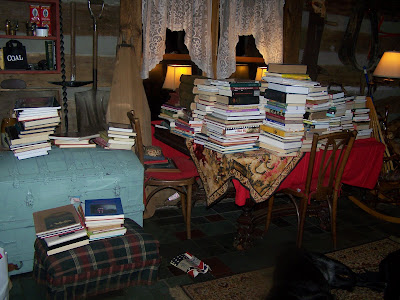
...just waiting for me to be home more to read them. How many of you have stacks like this?

I swear I buy books almost weekly, either online or at a used book sale or something. Like I don't already have enough books. But I see something that catches my interest and next thing I know it's on top of yet another teetering pile.


I weed my books too. I don't keep every book I buy forever and ever. There's just no space to do that, and my interests change. I remember when I had a copy of every single Agatha Christie paperback! Loved 'em.


I seldom read fiction any more because real life is so intriguing. Unless you count folk and fairy tales. But libraries have those cataloged as nonfiction! (I love it--ol' Dewey knew a thing or two).

It's hilarious how many people think that if you work in a library you actually get to read all those books. Who has time? Even the shelvers are hard-pressed to find time to sit down and read.

Books have to be re-shelved after someone brings them back, and if you consider that even a small library will check out 400-1000 or more items a day, you can see the size of the shelving job. In my job, I'm removed from the collection now--I read stuff like OSHA and ADA regulations and cooling tower RFPs. Thrilling, I assure you.

The teetering piles will have to wait a little while longer. But when the time comes I plan to dig in and just read and read and read.

And probably buy more books. Especially old ones. I just can't resist.

Thursday, March 20, 2008

Talking about Old Books

Imagine this: I was shopping at a used book store about 7 years ago. I ended up with a pile of books, total cost over $100. There was one additional title I wanted. I flipped through the pages--there were many stains throughout. But the book was old, published in 1864. Reluctantly I put it aside.

The shop owner saw me waivering and said, "You've bought so many, i'll throw that one in for free." Was he kidding?

No.

I grabbed my bag of treasures, thanked him and left.

A few days ago I saw the book on my shelf. Seaside and Fireside Fairies, translated from the German by George Blum and Louis Wahl. I idly looked it up on Abebooks. Whoa! This little freebie was worth...what? $350.00?

Okay, my copy isn't in great shape. The cover is separating at the spine, there is some foxing and the odd blue stains throughout, the cover is bumped on all edges. I look on Google. An Amazon listing has it for $175.00, with the following notes: Good with numerous small flaws. A marvelous book and now Rare. Binding and text block are quite good. There is wear to cover with fraying, front hinge is broken, small chip to ffep, some spots throughout. 1864 pon. Red and black title page. A collection listed in all the sources for "important" early Fairy Tales. Beautifully written. 15 tales which include: The Kalabater Sprite, The Fox King, The Amber Witch, The Ghostly Light on the Shore, The Magic Drum. 292 pages.

So how often does this happen? Is every old book valuable? It depends.

One of the things I've been doing at work lately is searching the value of old books that have been donated to the library. It's fun, kind of like a scavenger hunt. Some books that look valuable are worth no more than a dollar; others that seem unimportant may be worth $30-$300.

What's the difference? What makes one book valuable and another not so much? I am not the person to answer that definitively, but I've made a few observations:

*anything published before 1920 needs to be looked at. Anything published before 1900 definitely needs to be searched.

*wartime books (World War II) often have surprisingly low values. Why? Perhaps it is the low quality of paper and binding used during those years. What I find when I look these up is that their value is often under $2.00.

*Books with good quality covers (leather, embossed, fancy detail, good fabric) often demand higher prices. These are usually well-made--crafted really. Decorators are buying books like this simply for display purposes. But often the books are rare, limited edition printings, and that adds value.

*Books with gilt edges to the pages or gilt title lettering, color illustrations usually have a higher value. They look nice and are probably higher quality.

*Books with limited print runs. The fewer published, the more valuable. I have a set called The Ocean of Story that was published in 1924. Mine is set 32 of 1500; ten volumes with gilt-letter spines and uncut pages. Even with library markings, the set values for between $400 and $1500.

*Topics that are specialized and limited in scope or likely audience. A book of political campaign buttons that was donated to our sale had a surprisingly high value. So did a volume of poetry by the "New York" poets. Some older books of china markings were not so valuable--perhaps the impact of the internet?

*High quality art books. You can feel the quality when you pick them up--they're heavy, the stitching that holds the pages together almost looks hand-done, and the paper is heavy. Even in less-than-perfect condition, these volumes can command a good price.

*Local history and authors, older the copyright the better. Self-published, recent titles are not worth much at all; but self-published back in 1920? Worth a look.

That's just a bit of what I have learned as I've worked on this project. I will be handing off responsibility soon, but what I have learned will stand me in good stead as I continue to build my personal collection.

And I now know the meanings of foxing, ex librus, bumped, duodecimo, and BOMC. If you want to learn this secret language, Abooksearch.com defines all these and more.

For a lot more, in-depth information, Your Old Books offers answers to many questions such as "what makes a book rare? are all old books rare? how can I get my books appraised? and much more.

Where do I look for a book's value? Abebooks is the best place I've found online to get information quickly. I type in the title (or use the advanced search) and a list of books for sale pops up. From that list and the descriptions of the books' condition, I can estimate the value of the book in question.

So if you have a few old books, why not look them up? You might, as I did, get a very pleasant surprise.

Monday, January 21, 2008

Old Cookbooks


This was my first real cookbook. I had Volume II of the Meta Givens cookbook, and always wanted Volume I.

Volume II taught me how to bake bread, date bars and cakes of all kinds. The section on bread baking included black-and-white photos so I could see exactly how the dough was supposed to look. I felt confident in my abilities because no recipe I tried from that book ever failed.

I used it regularly, and my old faithful cookbook finally fell to pieces. By the time it died, I was no longer cooking as much because I was in college and my sons were growing up and leaving home. I didn't have time to cook, and they had no time to eat it if I did. The old cookbook disappeared.

It was when I was looking for the recipe for date bars this Christmas that I realized my old book was gone. I searched everywhere, sorted out all the cookbooks and looked behind the pots and pans in the cabinet. It was just...gone.

I found a date bar recipe that was close to the one I remembered, and although the cookies were good, they weren't quite the same. I got online and started looking.

Who knew that old cookbooks could be so expensive? I was amazed at the prices I found until I got on eBay. There I found not one but THREE copies of my beloved cookbook. I put in a bid on a two volume set and waited. Sure enough, I won! The cookbooks arrived last Friday, and I opened them quickly. But wait...these weren't right. The two books were from different years. So I have an index that is only half right.

Now I have to decide--go back on eBay and try to find the matching volumes? Or be satisfied with what I have now? The photos of bread making are the same, and the date bars are there.

But if I go back into the hunt, I'll end up with 2 sets! Which isn't necessarily a bad thing. I wore out my first Meta Givens cookbook, so it may take two sets to get me through the rest of my life.

Wednesday, October 10, 2007

Old-time Apple Cider: Strange Ingredients

We didn't make any cider this year. The apple trees were hit hard by frost, and the drought that has continued from summer into the fall months ruined any crop there might have been.

But at Rachel's Antiques in Ripley I happened on a 1919 text called Homemade Beverages, by Albert A. Hopkins. The variety of drinks offered to an industrious maker is astounding. A whole chapter is devoted to cider--and not just apple cider. There is orange cider, cherry cider, pineapple and quince cider, raisin cider, cheap cider (hey, that's what the author calls it!) and artificial cider.

The apple cider recipe had ingredients that raised my eyebrows--isinglass, (in cider?) calcium sulphite (to keep it sweet) and olive oil. And then bisulphite of lime to stop the fermentation when it's reached the proper point. And glucose to sweeten if desired. Sounds like a chemcial bath!

The "artificial cider" is really interesting: something called Catechu, alum, honey, water and yeast are suggested to make "a very pleasant drink."

(Catechu, according to the Wikipedia is "(also known as cutch, cashoo, or Japan earth) an extract of any of several species of Acacia—but especially Acacia catechu—produced by boiling the wood in water and evaporating the resulting brew.)

Then when fermentation of this artificial cider is complete, the author advised the addition of a solution of oil of bitter almond, oil of cloves, caramel, and alcohol (which can be replaced by "any good Bourbon whiskey"--ouch).

Now if this entire concoction doesn't sound deadly to you, it sure does to me. I wonder how on earth people got their hands on such ingredients? I doubt that today we would have access to most of them--and probably a good thing!

A quick search online revealed that this book was reprinted in 2001. Scary thought, although there are other recipes in it that sound pretty harmless.

A safer-sounding recipe called Apple Water Ice that actually might be very refreshing is offered in another tome from Rachel's called Household Discoveries and Mrs. Curtis' Cookbook, published in 1908.

Here's the recipe. Try it at your own risk:

6 large tart apples, 2 cupfuls sugar, 4 cupfuls water, 2 lemons. Put the apples, sugar, and water on to boil, added the grated yellow rind of one lemon. Cook until the apples are reduced to a pulp, take from the fire, drain carefully without squeezing. Add the juice of the lemons. When cold, freeze.

There are lots of other recipes for "ices" too and all of them sound like they might be tasty--or at least, safer than the cider recipe above!

She offers a Cider Ice too--combine 1 quart cider, 1 cupful orange juice, 1/2 cupful lemon juice. Dissolve 1 1/2 cupfuls sugar in the cider, add the juices, mix the ingredients and freeze. Sounds simple, and somewhat similar to my own favorite fall punch.

The Cider Punch I make is a recipe given to me by my friend Suzy McGinley. It's quick and easy and kids love it:

Combine cider, orange juice and ginger ale to your taste. Add apples and oranges sliced crosswise and cinnamon sticks to float in the punch bowl for garnish, and there it is. How easy can it be? And it sounds a lot safer than Mr. Hopkins' concoctions!
Related Posts Plugin for WordPress, Blogger...