Pages

Showing posts with label Appalachian ghost stories. Show all posts

Saturday, October 13, 2018

Ghost Walk Tonight

The first ghost walk for this October in Ripley, WV is almost sold out!


The walk starts on the courthouse steps at 7:00pm. I am really excited about this year's walk as I have several new stories to add to the mix and new information on the old stories so it will be a different walk than in past years.

We also have more character appearances than in past years: a grieving mother, a woman who survived a murderous attack, a Confederate soldier, a graveyard ghost and a stern sheriff. Added to the mix will be more Civil War stories from our town, an area I've wanted to explore before--this year I dug into the research and turned up some interesting tales.

It will be a cool evening, with temperatures in the low 50's down to the 40's, so I'll be bundling up!

We will repeat the walk on Halloween, October 31, at 7:00pm so if you miss this one, there's one more chance this year.

Copyright Susanna Holstein. All rights reserved. No Republication or Redistribution Allowed without attribution to Susanna Holstein.

Tuesday, October 9, 2018

Now Available! Beyond the Grave II

It's here! It's here!


My latest CD, Beyond the Grave II: More Ghost Stories from West Virginia. Want one? Here's 3 ways to get yours: 1. Message me and I'll send you a Paypal invoice! Or 2. Send $15 to my Paypal: susannaholstein@yahoo.com Or 3. mail me a check, and your CD will be in the mail pronto. Stories include The Last Public Hanging, Gamble's Run, Ikie's Tomb, The Haunting of Cale Betts and many more! Music by the fantastic duo Born Old.


Copyright Susanna Holstein. All rights reserved. No Republication or Redistribution Allowed without attribution to Susanna Holstein.

Saturday, August 12, 2017

A Simple Hello, A Memory, and a Ghost

I thought I recognized the lady getting in her car across from mine. Only I remembered her as a teenager, and this woman was middle-aged. I debated whether to speak; after all, I hadn't known her well, and she probably didn't remember me at all.

But I got past my reservations and asked, "Are you L***?"

And I was right, this was the grown-up version of the girl I knew. She remembered me too, surprisingly. We talked a few minutes, just catching up, and she asked what I've been doing. I mentioned storytelling, and that soon I'd be busy with ghost stories. Her husband chimed in then, saying that where he grew up in coal country there were all kinds of ghosts; there were lots of things, he said, that happened down there.

Then his wife spoke up. "I remember when we lived on Bucket Run. It's haunted down there, all right. I heard it myself.:

Bucket Run borders the back of our property--or used to border, before we sold part of our land. And I'd heard a tale about the place myself. The lady went on, "We used to walk out the road to catch a ride to church, and it would be dark when we came back. When we passed the Fulmer place, we'd hear a baby crying, and a woman too. I heard it many times. It always scared me so bad!"

The holler that runs down our land to Bucket Run is known to the old-timers as Fulmer holler. I thought it was named for the people who once lived just below where our house now stands, because there was an old cellar there before we moved here. Someone dug it out with a backhoe, looking for treasure, I guess. We figured if there was a cellar there, there must have been a cabin nearby, and since no one remembered who had lived here, the name of the holler must have come from those long-forgotten residents. But apparently there was a house on Bucket Run where our little creek joins that one, and that house was the Fulmer house. And it was haunted. Wow.

The story I heard was a bit different, or perhaps I remembered it wrong, as it was told to me about 40 years ago by my friend's aunt. She said that some men were coon-hunting on Bucket Run and that the dogs started digging and whining under the old schoolhouse that once stood there. The dogs dragged out something wrapped in a blanket; when the men unwrapped it they found it was a little dead baby. No one ever knew whose baby it was, but people always said they heard a baby crying when they passed the schoolhouse.

Was this two different stories of haunting, or the same story being remembered incorrectly by me or by the lady who told it to me? I don't know, but it was satisfying to hear confirmation of the story told to me so long ago.

Bucket Run is an abandoned road now--indeed, it has been ever since I have lived here, although I remember there was one family living along that holler for a while. I think all the old houses have fallen down or been torn down. I haven't been down there in almost ten years, and last time I was there I hardly recognized the road. But I have this story, and now I have a name for the house, and someone who remembers how it was.

I am so glad I got over myself and said hello.

Copyright Susanna Holstein. All rights reserved. No Republication or Redistribution Allowed without attribution to Susanna Holstein.

Monday, March 6, 2017

A Ball of Fire

I've had a long break from storytelling--since the end of December in fact. It's been nice in some ways. Having time to do little things that get put off, time to enjoy being home, time to work on furniture again and organize my booths better, time to cook and read and clean. I have to admit that a ball of fire I have NOT been even though I have been busy.

But I have missed storytelling. There is something about sharing stories with others that just makes my heart sing. The history, the folklore, the humor and magic of stories bring people together in a way no other art can do.

I have not been slacking altogether. I've been planning my summer program for libraries and mailing out publicity, organizing my ghost stories at last into a book that I may publish this year, reordering CDs and reading, reading, reading to develop new stories.

But today I was back out telling tales and talking about ghost stories with college students in a class at the University of Charleston. It felt so good! It also made me realize again that when I do this presentation, as I have been twice a year for the past 5 years, I am trying to compress a whole semester's work into one hour. How to crowd in the background of storytelling in our region, the heritage and beliefs that lead to a belief in spirits, the process and research of developing an anecdote into a full story, the sources, and then actually telling a few stories and singing a few ballads? Somehow it gets done, and I come away feeling satisfied and yet wishing I could have more time to really get into the process and the tales.


One of the stories we explored today had to do with a ball of fire. I have heard from multiple people who say they have seen a random ball of fire just roll down a creek or across a field, with no apparent reason or source of the fire.


In several of these stories, the ball of fire was an omen of impending death. Superstitions about balls of fire (some say this is ball lightning) abound in cultures around the world but it was new information to these students.

The picture above was a door prize at the WV Folk Festival's 60th anniversary festival, and I was the lucky winner. It's true folk art, made by a man who knew the story, its location and the book in which a version of the tale was published. I treasure this thing! The class I spoke with is studying Dr. Ruth Ann Musick's book, so the picture and the story fit right in to today's presentation.

The illustration in the Tell-Tale Lilac Bush that inspired the woodburned version.

I also brought with me a first-edition copy of the Telltale Lilac Bush that I recently bought online. I had not seen the original with its lilac-purple cover, and it was pretty cool to bring these two pieces together.

This story, along with another I told, led to a discussion of peddlers and their role in the early days of settlement in the mountains--which led to talking about the development of the Staunton-Parkersburg Turnpike and its role in the California Gold Rush and then on to another story of a haunted railroad tunnel. That's how it is with stories as one flows and overlaps into another.

I came home to emails and phone calls for possible future storytelling events, and I can see that this time of rest is a good thing as the summer and fall are already looking busy. I will continue to enjoy my time home, but my eye is on the calendar as the days fall away one at a time and the real storytelling work begins again. I can't wait.
Copyright Susanna Holstein. All rights reserved. No Republication or Redistribution Allowed without attribution to Susanna Holstein.

Thursday, September 1, 2016

Tailypo

I'm getting a jump on Halloween here (pun intended, as you will understand if you know this story!) This is a favorite of audiences everywhere, and right now might be a good time to learn it for your own Halloween fun. It's an old mountain tale that's been passed down and enjoyed by anyone who likes a good creepy tale.

Tailypo

An old man once lived alone in a cabin in the woods. All alone 'cept for his three dogs, Yuno, Ino and Cometickocalico. Them's his three dogs.

One day the old man went hunting, but he came home with his gamebag empty, no meat for the pot. He looked around in the cupboard but all he found was an old dried-up piece of cornbread. He threw it in a bowl, poured some water over it, but it was still too tough to eat, so he threw it outside for his dogs.

"No meat tonight," he muttered to himself as he settled into his chair by the fire.

It was just at that moment that he heard something over by the wall. A sound like scritch, scritch, scritch. He looked into the dark corner of the cabin and right at the crack between the logs and the floor he saw two pointy ears, then two red eyes, and then a l-o-n-g, furry tail.

The old man grabbed his hatchet and crept toward that creature. Just as he was about to grab it, it saw him and jumped back under the floor. But the old man reached out and grabbed its tail--and cut that tail clean off with his hatchet!

"There's meat for the pot!" He laughed as he threw the tail into the kettle of water boiling over the fire. Cooked it, he did, then took it out and put it in his bowl, tried to eat it.

"Pah! That tastes awful!" The old man spit it out.

He carried the bowl out to the porch and called his dogs. "Yuno! Ino! Cometickocalico! Here! Here!" He threw the tail out into the yard.

Them dogs come running, took one sniff of that tail, and dragged it under the porch.

The old man went back inside. "Goin' ta bed hungry tonight." He crawled into bed and pulled the quilts up around his neck.

He hadn't been asleep very long when a strange sound woke him up. It was right by his gate.

Scritch! Scritch! Scritch! 

"Tailypo! Tailypo. Comin' ta git my Tailypo!"

The old man called his dogs. "Yuno! Ino! Cometickacalico! Here! Here!" Them three dogs come running, chased that creature clear down into the woods. And that old man, he went back to sleep.

But he hadn't been sleeping very long when he heard it again. This time it was right out by his gate.

Scritch! Scritch! Scritch! All I wants is my Tailypo!"

"Tailypo! Tailypo! 
The old man called his dogs. "Yuno! Ino! Cometickacalico! Here! Here!" This time, only two dogs come running, but they chased that creature clear down into the woods. And that old man, he went back to sleep.

But he hadn't been sleeping very long when he heard it again. This time it was right by his cabin door.

Scritch! Scritch! Scritch! 

"Tailypo! Tailypo! Comin' ta git my Tailypo!"


The old man called his dogs. "Ino! Cometickacalico! Here! Here!" This time, only one dog come running, but Cometickaocalico chased that creature clear down into the woods. And that old man, he went back to sleep.

But he hadn't been sleeping very long when he heard it again. Now it was right out by his front door.

Scritch! Scritch! Scritch! 

"Tailypo! Tailypo! All I wants is my Tailypo!"

The old man called his dog. "Cometickacalico! Here! Here!" This time, no dog come running.

The old man pulled the covers up to his eyes.

He looked down at the foot of his bed and saw two little pointy ears, and two little red eyes.

SCRITCH! SCRITCH! SCRITCH! 

"TAILYPO! TAILYPO! TAILYPO! COMIN' TA GIT MA TAILYPO!"

"I-I ain't got yore ol' Tailypo!"

"You know...and I know...that you...

DO!" And that creature jumped on that old man.

No one ever saw that old man again. No one ever saw them three dogs again either. 

But if you stand quiet and listen on a moonlit night, you just might hear,

"Tailypo! Tailypo! Now I've GOT my Tailypo!"


You can find many versions of this story-and many varied spellings of the name--online and in print. It's a favorite of storytellers looking for a good jump tale for Halloween or campfire tellings. One article that I found particularly interesting explored the origins of the Tailypo story, right back to the Brothers Grimm. The first printed version of the story appears to have been collected by Joel Chandler Harris, the man we usually connect with the Uncle Remus tales.

For links to other versions of this story as well as other jump tales (and a brief explanation of the jump tale genre) check out this post I wrote back in 2008. 

Have fun!


Copyright Susanna Holstein. All rights reserved. No Republication or Redistribution Allowed without attribution to Susanna Holstein.

Thursday, October 29, 2015

Part 3, Wait For Me: Homecoming

And now the conclusion of my story, Wait For Me. I hope you have enjoyed it so far. 

“This ol’ hen’s gone broody on me. I’m goin’ to put her in that barrel in the cellar and break her out of it. I need eggs, not chicks.”

The soldiers laughed. “First time I ever heard of anyone doing that,” the Captain said.

“It works. Try it sometime.”

“I’ll take your word on that.”

Granny got to the cellar, went inside and whispered, “Told you I’d come back. Brought you some company.” She put the chicken into the barrel, then handed down the food and other supplies. Leave the ol’ chicken in the basket. She’ll be quiet in there.”

“I don’t know if I can git out here again. Them soldiers are still here. As soon as they leave, I’ll fix those wounds for you. I brought you a candle and matches, in case you need a light. But be careful. I don’t think any light will show through the cellar walls, but I can’t be sure.”

“I just want to go home, ma’am…just… home….”

“I know. I’ll do what I can. I’ve got to go.. they’re watching me. God bless you, boy.”

She closed the lid and made her way back to the house. The soldiers didn’t pay no attention to her. One of ‘em had a banjo and they were laughing and singing.

Grandpa made it home a little later. Granny told him about the young soldier and they were awake all night trying to think what to do. Come morning, the soldiers packed up and left—took two young shoats with ‘em, that made Grandpa mad. It was over an hour before Granny felt it was safe to check on the boy in the barrel.

Might as well have waited all day, it made no difference. Sometime in the night the young man breathed his last. Grandpa said that was the loneliest death he’d ever seen. They carried the boy up on the ridge that evening and buried him. I could show you where his grave is, if you want. It’s by a cedar tree, and there’s a stone marker

They never did know who he was. Looked through his saddlebag but his name wasn’t on anythin’. So they left it in the attic. It’s still there, I think, if it ain’t turned to dust by now.

Well, that’s the story. Granny couldn’t look at the cellar without thinking about that boy. A few months after he died, strange things began happening out there. Jars would fly off the shelves and bust on the floor. The potato bin would be turned over and the potatoes smashed like they’d been stomped. Then one night the light started. First it was just a puny little light, like a candle might throw, but each time they saw it, it got stronger. Light would stream out around the door bright as sunlight. Neighbors saw it too, it wasn’t just Granny and Grandpa. No one knew what to make of it. No one would go in the cellar after dark. Grandpa said there weren’t no use testin’ what we don’t understand.

Finally one terrible night it all ended. Jars were smashing and there was a roaring sound in the air even though the wind wasn’t blowing. The light glowed brighter and brighter ‘til it seemed like it was pushing against the door. Then the door flew right off and a great ball of flame busted out the opening. Flames reached over fifty feet high, Grandpa said. They tried to douse it but it weren’t no use. When it finally burned out, Grandpa went to inspect the damage. He found the oddest thing—nothing was burnt except the cellar. The grass around it was still green, even the flowerbed right against the walls was untouched.

Granny wouldn’t go near the cellar after that. She wouldn’t let Grandpa fix it either. She got a start of grapevine and had Grandpa plant it so it would grow over the stones. She never mentioned what happened, and she would not allow anyone to speak of it in her presence. I guess she didn’t want to be reminded of how she failed that boy. Even though there was nothing she coulda done to help him. She blamed herself, just how she was.”

*

Mary looked at the cellar, almost expecting to see a Rebel soldier standing there. It seemed quiet enough now.

“That’s quite a story, Mr. Patterson. An amazing story.”

“Yep, I told you it would take a while to tell. Hope it was worth your time.”

“It was, it truly was. You know, I was wondering…would you ever consider selling those stones? I really need a cellar. Those stones would be perfect…” She paused, her face stricken. “I shouldn’t have asked, should I? That’s your family history…”

“Well now. I’ve never thought about it. As for family history, you’re right. But I’m the last of my family, and there’s no one but me—and now you—who knows that story. How about a trade? Them stones for, say, a few jars of apple butter every year?”

“Are you sure? Really? That’s a deal! I’ll bring you all the apple butter you need, and biscuits to put it on!”

“Come and load ‘em up anytime. I’d be right pleased to see them used again. I’ll help you just as much as I did today.” Patterson’s eyes twinkled.

*

It took a few months to get the stones moved, and by then it was winter. When spring came, they began building. The finished cellar was just what Mary wanted. That summer she filled the shelves with jars. The potato bin overflowed; crocks of pickles and bushels of apples and pumpkins sat on the floor, and onions hung from the rafters. Mary sighed with satisfaction each time she opened the door.
           
One warm autumn evening Mary and Andy sat out on the patio. It wasn’t late, not even nine o’clock, Mary remembered. A sudden noise startled them. It sounded like a jar breaking.
           
“What was that?” Mary asked in surprise.
           
“Sounds like a jar fell,” Andy said. He walked over to the cellar. There was another crash just as he reached the door.
           
“Don’t go in there,” Mary called. “Might be a skunk!”

            “You’re right. I’ll get a flashlight so I can see. I don’t feel like tangling with a skunk tonight.” He trotted toward the house. Mary stared uneasily at the cellar. What was it Mr. Patterson had said about breaking jars?
           
Andy returned in less than a minute, pulled the door open a few inches and held the flashlight to the crack.

“I don’t see anything,” he said. At that instant another jar crashed. Andy jumped back, dropping his light.

“Whoa! What the hell…”He picked up the light and jerked the door open.

All was quiet in the cellar. The rows of jars stood undisturbed, and the floor was clean. No glass, no broken jars, no spilled fruit.

“This is weird,” Andy muttered. He looked at Mary. “You heard those jars breaking, didn’t you? It wasn’t just me, was it?”

“I heard it,” Mary said, her voice shaking. “Remember that story Mr. Patterson told me? He said that jars would break and…”

“What story?” Andy slammed the door and walked back to the patio.

Mary’s forehead creased in thought. “Remember the soldier that died in there? It was after they buried him. Stuff fell and there was a light…”

The words were barely out of her mouth when she saw it. Faint at first, then stronger and brighter, a pulsing light seeped out around the edges of the cellar door. Andy jumped up and ran to the cellar again.

“Get out! Get out of here! Now!”

At the sound of his voice, the light faded and disappeared instantly.

“Let’s get inside, Mary. We can check this out in the morning. I’m not about to go in there right now.”

In the kitchen, Andy sat with his head in his hands. “This is crazy,” he said. “Spirits don’t hang around a hundred years or more. That’s just crazy.”

“Got any other explanation?” Mary asked him. “I can’t come up with one myself.”

“Let’s talk to Patterson and tell him what’s going on. He might know what to do. The cellar might burn down just like it did before,” Andy said, “unless we can figure out how to stop this thing. Look at my hand—the door was so hot when I closed it that it burned me.”
*

Patterson was surprised to see them at his door so early in the morning.

“To what do I owe the pleasure of this visit?” he asked. “Don’t figure it was my lovely face that brought you all the way out here so early. Care for some coffee?”

“You remember the story you told me about the cellar?” Mary asked. “You said there were problems with broken jars and smashed fruit, things like that. And that a light appeared in the cellar sometimes, until it finally burned down.”

“Yep, that’s what my Grandpa told me. Why?”

It’s happening again,” Mary said. “We’re afraid the cellar is going to burn down. The door was so hot last night it burned Andy’s hand.”

Patterson frowned. “Never heard tell of a haint that moved with a building,” he said. “I don’t know what to tell you. Never saw it myself, just heard the tale, that’s all. No one ever disturbed those stones ‘til you moved ‘em. Reckon we woke something up?”

“Seems like it. I was wondering…” Mary began. “You said there was a saddlebag that belonged to the soldier…”

“Yep, it’s still up in the attic I believe. Can’t see how that would help, though.”

“I don’t either,” Mary confessed. “I’d like to take a look at it anyway.”

They went into the hall. Andy pulled down the folding attic stairs and they climbed up.

“Been years since I been up here,” the old man muttered. “Now where was it I saw that bag? Ah yes, over here.” He walked towards the brick chimney. “It was behind here….” His arm disappeared into a hidden alcove and came out holding a dark bag. “Let’s take this down to the kitchen where we can see a little better.”
           
In the kitchen, Patterson put the bag on the table. Stiff with age and green with mold, it looked every bit its age. Mary turned the bag upside down and emptied out the contents.

            It was a pitiful sight—a battered tin cup, a bent spoon, a sewing awl, and one photo, brown with age. Andy grabbed the cup as it rolled across the table while Mary picked up the photo and examined it. She could just make out the image of a young woman. Turning the photo over, she squinted at the spidery handwriting.

            “What’s it say?” Andy asked. “Does it tell his name?”

            Mary replied slowly, “I can’t…I can just barely…Ah, I see it now. It says ‘To my Jeremiah. I will wait for you forever. Your Jenny.’” She looked up. “That’s all. ‘I will wait for you forever.’ Poor girl. I wonder if she really waited.”

            Andy looked thoughtful. “Mr. Patterson, didn’t you say your grandparents buried that soldier on this farm?”

            Patterson was holding the sewing awl. “What did you say? Oh, yes. They buried him up on the ridge, under the big cedar tree.”

            “Would you take us up there?” Mary asked. “I know it seems corny, but I’d like to bury these things up there with him. Won’t help with our problem, but it seems like he ought to have them….” Her voice trailed off, and she looked at Andy as if expecting him to laugh at her.

            “I like it,” Andy said. “ It seems right, somehow.”

            “Does, doesn’t it?” said Patterson. “Stuff’s been in the attic for years. Soldier might need it.” He grinned at them, turned and led the way to the kitchen door. “We can take your truck. There’s a little farm road that ain’t in too bad a shape.”

            On the ridge the cedar stood like a lone sentinel against the morning sky. Mary touched the stone at the tree’s base.

            “That’s his gravestone,” Patterson said. “Grandpa put it there.”

            Andy got a shovel from the truck. “Think this is where I should dig?”

“Good as any,” Patterson replied.

Mary took the saddlebag and its contents and laid them in the hole, covering them gently with dirt. “There you go, Soldier,” she said softly. “There’s your Jenny.”

*

All was quiet for a few weeks after that visit with Patterson. It seemed that whatever had been disturbed had gone to rest again.

One evening Mary and Andy were working late, putting up firewood in the woodshed next to the cellar. A sudden brightness almost blinded them. Light streamed out around the cellar door. Inside they could hear jars crashing and stomping feet.
           
“Oh no,” Andy groaned. “Not again…”

The door of the cellar bulged as if something enormous was pressing against it. Andy grabbed Mary’s hand and ran just as the door exploded outward with a rush of hot air and fire. Mary and Andy were flung to the ground as flames rushed over them. Mary closed her eyes. So this is how they would die. Burned to death by a soldier who had been dead a hundred years.
           
The disturbance ended as abruptly as it started. Mary opened her eyes hesitantly. Beside her Andy was sitting up, his eyes on the cellar.
           
“What the…what happened?”

 “Andy…look…”
           
Andy stared. A ball of fire streaked across the sky, rising into the blackness until it disappeared from sight.
           
“The cellar…is it burned?” Mary asked. They turned together, expecting to see a blackened ruin.

The cellar stood still and cool, the door closed primly. I did not imagine that flame, Mary thought. I did not imagine it. She looked at her husband.
           
“No one will believe us,” he said. “No one. I hardly believe it myself, and I saw it.”
           
“You know what I think?” Mary said. “I think that young soldier is gone. He found his Jenny, and he’s gone back to her.” She looked up at the dark, serene sky. “She said she’d wait for him. She said she’d wait forever.”
           

“I think you’re right,” Andy said softly, taking her hand. “I think you’re exactly right.”


Copyright Susanna Holstein. All rights reserved. No Republication or Redistribution Allowed without attribution to Susanna Holstein.

Wednesday, October 28, 2015

Part 2, Wait For Me: The Soldier

This is Part 2 of my story, Wait For Me. Please come back tomorrow for the conclusion.

   Mr. Patterson began his story.

 “This was my Grandpa’s farm. He built the house, the barn too. Had it all done before he asked Amanda Carpenter to be his bride. She said yes, on one condition. She wanted a cellar house. Not just any cellar house, either. She wanted a cut stone cellar with a smokehouse on top so she could store their food properly. Grandpa promised to build it before their first anniversary, so she married him. She was hardheaded, was Granny. But a worker. Everyone said she could work rings around most men. That’s probably what attracted Grandpa, come to think of it.

Grandpa built the cellar just as he promised. It was good-sized, 14 feet deep and 10 feet wide. Folks laughed about that, said Grandpa was making sure he didn’t go hungry! He had it ready for the fall harvest, and they almost filled it up that first year.

Now this was in 1861. They didn’t get to town much, but they heard a little news here and there. Folks were talkin’ about a war back east, some trouble over slaves. Well, around here there was some owned slaves, but most didn’t. Those as had them needed the hands to work their fields—owned big bottomlands, you know. No one had very many, anyways. Grandpa and Granny didn’t own slaves and didn’t think God-fearing people ought to. But they kept out of other folks’ business. Granny said they had enough to do tending to their own souls. So the talk of war was around, but it might as well have been in Europe for all my grandparents cared about it.

It got tougher when men started joining up. That’s when it began to hit home. You see, some boys went for the Union and others went for the South. Sometimes in the same family! There was a family lived next farm over, they had a boy who went with the Confederacy. Down the road not even a mile was another family whose son joined the Union Army. So it was like that, and it made for hard feelings and high words.

More and more men left for war, but Grandpa didn’t go. He wanted to, wanted to fight for the Union, but Granny didn’t see the need. They argued about it. He felt it was his duty; Granny said his duty was right there on the farm, not going off to get killed. Then Grandpa broke his leg real bad in a haying accident and that ended the argument. The Army didn’t want him with that bad leg.

Them two kept on farming, even when there was fighting right here in Jackson County. Yes ma’am, that war even reached these backwoods hollers. Grandpa couldn’t do the work he had before he broke his leg, but they managed.

One day he had to drive some cattle he’d sold to a neighbor’s farm. The trip took all day, and he would not be back ‘til midnight. Granny went about her work that day with no idea that the war was coming right to her very farm.

There was a little skirmish that day, up between Ripley and Spencer at the mouth of Big Run. It wasn’t much, nothing that even made the history books far as I know, but it was a right dust-up. Confederates got ambushed by a bunch of Union boys. One Confederate soldier was wounded, but he held onto his horse somehow and escaped. Someone seen him and told the Yankees, and they sent a few men after him.

Granny was milking in the barn when this horse come flying up the road, a man slumped over the saddle horn. When Granny hollered the horse come to a stop and that soldier fell off. He was hurt bad, blood all over the place. He looked up at her. “Help me,” he said. “They’re after me.” Granny didn’t hesitate. Rebel or Yankee, he needed help. Politics didn’t have nothing to do with helping someone in trouble.

Granny knew where to hide him. She had a big barrel in the cellar that she used for cider. It was big enough to hold that poor boy—he wasn’t very big anyways. So that’s where she took him.

“Climb in here,” she told him. “You can hide here until it’s safe. I’ll come back when it’s safe and take care of those wounds. I promise.” Grandpa said she never forgot the look the boy gave her when she put the lid back on the barrel. Haunted her for the rest of her days. But she had to leave him. She had to cover up any sign he’d been there.

She worked like a crazy woman. Put the horse in the barn and brushed him down. Took the saddle and saddlebag up into the attic. There was a hidey-hole behind the chimney. She threw his stuff in there and hid it with crates and old quilts. Then she ran outside, swept away the tracks and blood. Just finished when she heard horses coming.

The soldiers rode into her yard as if they owned the place. Stopped right in front of her. The leader of the bunch—arrogant feller, way my Grandpa told it—pranced his horse around a little before he spoke to her.

“Ma’am.”

“How can I help you, sir?”

“I’m Captain Ansted, ma’am, US Army. We’re tracking a Rebel soldier and his tracks led us to your place.” He stared at her, and Granny stared right back.

“You see any rebel soldier, here, young man? All I see is a few chickens myself.”

That didn’t please the Captain none. “We’ve been told by several people that he was traveling this way, ma’am. I have no reason to suspect them of lying.” Way he said it, Granny knew he suspected her, all right.

“Suit yourself, Captain. Search the place. I’ll be as surprised as you if you find him here.”

The Captain bent down and looked at Granny’s apron. “You got blood on your apron, ma’am. Cut yourself?”

“Dressed out an old hen, Captain, and she’s boilin’ on the stove. You’re welcome to inspect her.”

“Very well, you won’t mind if we just have a look around then?”

“I can’t stop you, can I?”

Well, those soldiers searched the place. They made an awful mess. They didn’t just check the pot of chicken on the stove, they took it outside and ate it. That was why they didn’t find the boy in the barrel, Grandpa said. See, one soldier was supposed to search the barn and cellar. He just got through with the barn when the Captain came out of the house with the chicken and two loaves of bread. Soldier knew the food would be gone if he didn’t hurry, so he just threw a quick look around the cellar and skedaddled back to the others.

“Nothin’ in the cellar, Captain.”

“You sure?”

“Yes, Sir.”

By then it was getting dark and them soldiers decided to make camp right there. They built a fire, set up their bedrolls, and settled in for the night. Granny was plumb worried—that young soldier needed help. How was she going to get it to him?

Finally she had an idea. She filled her apron pockets with food, bandages, salve and whatnot. Grabbed a basket and went to the chicken house, got a hen. Put it in the basket and covered it with a cloth. Then she headed toward the cellar.

“Hey! Where you goin’, lady?”


That's all for today, Tomorrow---can you guess what happens?

Copyright Susanna Holstein. All rights reserved. No Republication or Redistribution Allowed without attribution to Susanna Holstein.

Tuesday, October 27, 2015

Wait For Me, Part One

This is the first part of a three part story. Come back tomorrow for Part Two!

It started simply enough. But how was she to know that disturbing the stones could also disturb the dead? How could she have known that it was possible to wake the dead? She certainly never intended to bring a spirit home to haunt her days and nights. But that’s what happened.

She needed a cellar. She was a gardener, and folks said she had a way with plants. Her gardens produced abundantly, so she canned quarts and quarts of fruits and vegetables every year. All those jars had to be stored somewhere. First she filled the shelves in her pantry, then boxes that were stored under beds. Jars overflowed from cabinets and closets. Now the jars of tomatoes on her counter had nowhere to go.

“This is nuts,” Mary told her husband. “We need the food, but this is driving me crazy. We have got to build a cellar. All these jars could be stored there instead of all over the house. We really need a cellar, Andy.”

 “I’ll add it to my list of things to do,” Andy replied. “We’ve got to have a new barn first. The old one will fall down by itself if we don’t pull down.”

“You’re right. But promise you’ll build the cellar as soon as the barn is done.”

He promised, and that’s where they left it. The new barn was built the next summer but the cellar had not even been started. She sighed as she ran her eyes over the pantry shelves. There was no room for even one more jar. She’d have to pick up boxes the next time she was in town. More jars, too. She was almost out of empty ones, and there were still apples to be put up. She made some coffee and sat down to read the paper, scanning through the want ads.

Mason jars, free. Don’t can anymore.

Free! What was that number? She grabbed the phone.

“Hello?”

“Hi. I’m calling about the jars you advertised …”

“You and everyone else! My phone ain’t quit ringin’ since the paper come out. If you want ‘em, it’ll be first-come-first served. I ain’t promising ‘em to no one.”

“That’s fair. I’ll come right away if you can give tell me where you live.”

Mary scribbled directions as the old voice scratched on.

“Thank you. I’ll be there in about twenty minutes. My name is Mary. I’ll see you soon.”

“Don’t blame me if the jars are gone before you get here. Dang people callin’….”

“I won’t. Good-bye.”

“Bye.”

She hung up and hurried out to the porch. Andy was sitting in the swing, reading the sports section.

“Andy, I’ve got to go out. This guy had an ad in the paper for some free canning jars. I’ve got to go now or they’ll be gone.”

“ Okay, honey. Drive it slow. You’re a speed demon when you’re in a hurry.”

“Look who’s talking! See you in a little while.”

*

 The door opened before she had a chance to knock.

“You’re Mary, ain’t ye? And you’ve come for the jars.”

“They’re still available?”

“Oh, some feller took the ones in the basement. But there are more in the shed out back.”

“Wonderful! I thought I’d have to buy new ones, and they’re pretty pricey these days.”

“Well, the price is right on these, then. My name’s Patterson.” He stuck out his hand.

“Nice to meet you, Mr. Patterson,” Mary said. “I’m Mary Marshall.”

“Well, Mary, let me show you them jars.”

The shed was looked no better than the house. Patterson opened the door and warned, “Mind your step. And keep an eye out for snakes. Used to be a big black one lived in here…”

Mary stepped inside and looked around. Boxes of dusty jars lined the walls.

“Well, here’s you go. You want ‘em all?”

“Sure do. I like to make apple butter and give away a lot of it. Sometimes I get my jars back, sometimes not.”

“Apple butter! I haven’t had homemade apple butter in years.”

“I’ll bring you some next time we make it,” Mary promised.

 “Now that would be mighty kind of you. I’d not turn it down!” The old man’s voice was wistful.

“I’d better get to work. I’ll be washing jars ‘til midnight!”

Patterson grinned and pulled a chair out of the shed.

“Reckon I’ll just sit here and watch you work,” he said. “Can’t stand dust in these old lungs.”

Mary nodded. “That’s fine. I’d appreciate your company.”

It took a while, but when the job was done there were twenty-nine boxes of jars in the back of the truck. Enough to finish out the canning season, she thought. Exhausted, she flopped down on the grass beside Patterson.

 “Would you like a glass of sweet tea?” he asked. “Made it myself.”

“Why yes. Thank you!” Mary gazed around the yard appreciatively. Mr. Patterson certainly knows how to grow flowers, she thought. A tumble of stones caught her eye. It looked like on old stone cellar with no roof. Obviously it had not been used in years, because it was almost completely hidden by a sprawling grapevine.

The creaking of the screen door announced Patterson’s return.

“Here ya go! Come on over and sit on the porch. Rest yer legs awhile.”

Mary followed the old man to the porch and took a long drink of tea. “Ummm! Just what I needed.” She smiled at the old man and asked, “What was that building over there, Mr. Patterson? Looks like it was a cellar.”

“Yep,” Patterson said. “I’m surprised you noticed it. It caught fire and burned the smokehouse that was on the top of it. Happened when my grandparents were first married, over a hundred years ago. My grandfather built that cellar himself. Quarried the stone from the rock cliff down the road.”

“It burned? How did that happen? Seems a shame they never tried to fix it up again”

 “Oh, Granny didn’t want no part of it after what happened. She planted that vine to cover it up so’s she wouldn’t see it and be reminded. Sad, that was.”

“What happened?”


“This is going to take a while, so might as well get comfortable.” He settled deeper into the rough oak chair, then looked up at Mary. “Do you believe in ghosts?”

Tomorrow: Part 2: The Soldier 

Copyright Susanna Holstein. All rights reserved. No Republication or Redistribution Allowed without attribution to Susanna Holstein.

Monday, October 26, 2015

The Unmarked Grave

“I will never forget that house. Never.”

Elaine Rowley  could tell a good story, and the one she told me in 1976 still brings a chill to my bones. Elaine, a widow, put herself through college by working nights and going to school during the day while raising seven children.  When I met her she had retired from teaching and working at the Ripley Library. This, as best as I can recall it, is her story of the house she lived in on Ravenswood Pike.

“I was in my early teens when we moved to Ravenswood Pike. My sister got a teaching position near there and Dad didn’t want her to live with strangers. I felt a foreboding the first time I saw our new home. The place was unfriendly, dark and cold inside.

The trouble started soon after we moved in. My mother would wake up in the night, thinking one of us was walking around the house, maybe sleepwalking. My oldest sister, the teacher, would not sleep alone in her room but she never said why. There was a feeling of eyes following our movements, especially in my sister’s room and one room downstairs. Often we’d catch a glimpse of a fleeting shadow, gone before we could tell what it was. Sometimes we’d hear whispers around the doors and windows but we could never make out what they were saying. It would raise goosebumps on my arms.

I got puny while we lived there. I was strong and healthy when we moved in, but soon I got kinda sickly, pale you know. My mother worried over me and tried to give me cod liver oil to strengthen me but I just kept getting thinner and paler.

A few months after we moved there, my sister got married and moved out. I thought I would take her room, but when I went in to look around, I got such a chill. I could not look in the mirror for fear of what might be looking back. I left the room empty. No one else wanted to sleep there either, although no one ever said why. We just didn’t discuss it.

One day my sister and her husband came for an overnight visit. I was watching for them--it was almost dark—when  a bright light came streaking across the field, right up to our house. I opened my mouth to call my mother but it was gone, just like that. Then I saw my sister’s husband carrying a flashlight as they walked along the very place the light had traveled.  I didn’t tell anyone what I’d seen.

A terrible scream woke us that night. My sister said she saw a gray mist come up under the bedroom door and form into a little girl who stared at them from the foot of the bed.  My sister, shaking from head and toe, refused to return to bed. No one ever slept in the room again.

One rainy day an old man stopped in to get out of the weather. He told us that a man named John Yost had built the house. Yost didn’t get along with people and was kind of quiet-turned. There was a daughter that Yost kept inside most of the time. The girl died, and the Yosts buried her in the yard under a big sycamore tree.  Mr. Yost and his wife died some years later and were buried in a cemetery, but the little girl remained in an unmarked grave in the yard.

My mother  insisted we move out of that place, and we did. I was so glad! When we moved away I recovered almost immediately, and was soon back to being a healthy, happy child. 

I went back to see it once, years later; the house was gone but the tree was still there, and I wonder, is the little girl was still there too, under the big sycamore?”

*

That was Elaine’s story. I did a little research  and found that a John Yost did live on a farm on the Ravenswood Pike in the late 1800’s to the early 1900’s. He was married and had nine children. Yost  changed his name from the original German spelling, Youst, dropping the “u”. His ancestors were Lutheran, so perhaps it was religious differences that created uneasy relations with his neighbors. He and his wife were buried in a cemetery near Sidneyville, on the Ravenswood Pike.  The little daughter is apparently still resting in her unmarked grave. Or perhaps she is really not resting at all.


I will be posting another ghost story  in segments , so come back for that later this week.

And be sure to visit Dustin Fife's blog for more ghost stories this week!

Copyright Susanna Holstein. All rights reserved. No Republication or Redistribution Allowed without attribution to Susanna Holstein.

Wednesday, October 7, 2015

It's Going to Be a Storied Month

October is always a busy month for storytellers and my schedule for the month certainly bears that out.
What better month to be traveling around our state, with the leaves changing and the air crisp and cool?
Add in a little swing north to Brooklyn, NY, and then down south to Miami to visit my son, and I'll be seeing a lot of interesting, beautiful sights while spinning tales.

Here's a look at the month ahead, starting with tomorrow night--yikes! Gory stories? Yes indeed, for the strong at heart. And I've got a brand new, chilling tale for it too.

October 7: Gory Story Theater! La Belle Theater, South Charleston, WV 7:00pm

Following the Gory Story event, it's:
October 10: Ripley Do You Believe? Ghost Walk, Ripley WV 7:00pm and 9:00pm
A ghostly mile-long stroll through the dark side of town! Lots of tales, lots of strangeness!
And then:
October 12: West Virginia Ghost Stories: for ages 3rd grade and up. At:
11:00am: St. Albans Public Library, St. Albans, WV
2:00pm Main Library, 123 Capitol St, Charleston, WV
6:00pm Dunbar Public Library, Dunbar WV. .
October 13: WV Ghost Stories, Clendenin Public Library, Clendenin, WV 11:00 am
A quick dash across the state to the Eastern Panhandle for 
October 13: Speak! Shepherdstown, WV, 7:30pm, Shepherdstown Community Club, Shepherdstown, WV. Information at Speak! Shepherdstown Facebook page.
And then back to present at 
October 14-15: WV Storytelling Festival, Jackson's Mill, WV.School event, with an evening concert for the general public on October 14 at the Assembly Hall for the general public. For information:
160 WVU Jackson Mill, Weston, WV 26452 (304) 269-5100
On the way home, I'll stop by Elkview for
October 15: WV Ghost Stories, Elk Valley Library, Crossings Mall, Elkview, WV 6:00pm
and once again--
October 17: WV Ghost Stories, Cross Lanes Library, Cross Lanes, WV, 12:00 noon.
October 17: Ripley Do You Believe? Ghost Walk, Ripley WV 7:00pm and 9:00pm
A short break the following week before the next event:
October 23: Full day storytelling, Jane Lew Elementary, Jane Lew, WV,
and then off to New York!
October 25: Bady House Concert, Brooklyn, NY. Appalachian ghost stories! Information at the BadyHouseConcert Facebook page.

And family time at the end of the month:
October 26-28: Miami, FL visiting my son smile emoticon
October 30-Nov 1: unavailable--if the weather is good, we'll be cooking down some apple butter!

I hope your October will be a fine month, and that maybe somewhere along the way our paths will cross.

Copyright Susanna Holstein. All rights reserved. No Republication or Redistribution Allowed without attribution to Susanna Holstein.

Thursday, October 31, 2013

Call for Help: A Story for Halloween

"What's that, Grandma? Did you hear that? It sounded like someone tapping on the window."

Grandma looked at the window. It was dark outside, but a light suddenly glimmered as the tapping came again.

"It's nothing. No one is there. Let me tell you a story."

"It was a favorite gathering place for the young people. The pool was deep, cool and secluded from prying eyes. They came often in the hot afternoons, but their favorite swimming time was in the dark of night, when the air was cool but the water still warm from the day's sun.

She was the most beautiful of them all: raven-haired, with cheeks like Maiden Blush apples and lips as red as the juice of blackberries. She did not come often to the swimming hole; her watchful father made sure of that. But this night he went to bed early, worn out form a double shift at the mines, and he was sleeping soundly when she slipped out the door. Her mother, a poor mouse of a woman, watched the girl leave without interest. From the shadows of the porch she watched her daughter carefully closing the door so that the latch made no click, watched her swaying walk down the path.

At the gate a boy's voice whispered, "Ready? Did you have any trouble gettin' out?"

The girl laughed. "None at all. He's asleep and she's too scared to wake him to say anything to me."

There were already a few people at the pool when the girl and her boyfriend arrived. She quickly stripped off her sundress, smoothed her swimsuit over hips that were already filling out to womanhood, and stepped to the diving rock.

"You gonna dive, or you wanna swing out on the vine?" a red-headed girl asked.

"Swing! It's more fun than anything!"

"I'll say! I'm after you."

The dark-haired girl grabbed the vine and took a running start. Her feet lifted from the rock and she soared out and over the bank, shining like an angel in the darkness. Her boyfriend caught his breath.

That was when it happened. The vine broke. With a high scream the girl plummeted towards the bank, and the sharp, broken branch that jutted upwards from a storm-struck sycamore tree. Her scream cut off as her body struck the branch and impaled on its sharp point.

The stunned silence was broken by a loud cry.

"Oh no oh no oh no oh no!!!" screamed her boyfriend. The others began to yell and run. Some jumped into the water to try to climb low-hanging limbs to help the girl; others raced to the tree and tried to clamber up.

"Someone go for help! Go for help!" someone yelled. Her boyfriend grabbed the lantern.

"I'll go! Get her down, please get her down!" He could hear her soft whimpering cries that tore at his heart. He raced off through the dark woods towards where he knew he would find the closest house."

Grandma paused. She looked again at the window. There was no light now, no tapping.

"He never made it. They found him the next day. He was so scared, so horrified by what had happened to his girlfriend that he had a heart attack and died on his way. He was coming here, you see. Ours was the closest house. But he never got here. The girl died too. It was all so sad.

"That's him tapping on the window, and that's his light. He's still trying to get here, and to get help for her. He's still trying."

Based on a story told to me yesterday by a 6th grade boy in Richwood, WV.

Copyright Susanna Holstein. All rights reserved. No Republication or Redistribution Allowed without attribution to Susanna Holstein.

Wednesday, October 9, 2013

Lottridge Storytelling Festival, October 26th

I am looking forward to this--a day of teaching storytelling, especially ghost story-telling, then telling stories, listening to stories and music, eating good food, and all in a beautiful small community in the Appalachian region of southeastern Ohio. Come join us for what is sure to be a good time with good people.

BOO and BUMP and SCARY THINGS!!!

Enjoy a full day of storytelling...

October 26, 2013
9AM to 4PM
Lottridge Community Center
2754 Lottridge Road (CR53), Guysville, OH


Have you always wanted to become a storyteller?

Learn from and work with three nationally recognized tellers...

Granny Sue – Folklorist, WV storyteller, author, real live granny
Fred Powers – Coal miner, school teacher, author, WV storyteller
Thomas Burnett – Founder of AOSP, Environmental Tech, OH storyteller

Newbies or learners with some experience will Master Class with the professionals in the morning. Limited to a maximum of 30 students – so register early! Class from 9 to 12.

In the afternoon everyone is invited to enjoy the pros and students
telling stories of the season. Starts at 12:30 and goes to ~4PM.

Cost: Master Class/full day $15 – 740-818-5243 to register
Afternoon Telling $ 5 – door opens at 12 noon

Kitchen by the Ladies of the Lottridge Community Center...yummy, good eats!

Sponsored by Appalachian Ohio Storytelling Project and Lottridge Community Center Association
Lottridge Community Center
2754 Lottridge Road, Coolville, Ohio 45723-9799


Copyright Susanna Holstein. All rights reserved. No Republication or Redistribution Allowed without attribution to Susanna Holstein.

Sunday, March 3, 2013

Yesterday's Workshop: Seeking the Spirits

 
Yesterday's workshop in Sistersville was just what I hoped it would be: 12 storytellers and 2 workshop leaders telling, exploring, discussing, working on and listening to ghost stories. I was one of the workshop leaders; with my friend Jason Burns we plumbed the depths of a good ghost story: what makes it compelling, where to find material, resources for research, framing the story, finding the universal meaning of the story, and finally telling the story.

Despite the advice of many websites on telling ghost stories, we did not hold flashlights under our chins. We did not make the listeners jump. We did not suggest something was going to get them, was creeping up behind them or any such things. To me, those are campfire stories and the techniques used when the goal is to scare people. I consider ghost stories those tales of inexplicable events that leave people wondering what could have happened, why did it happen, and if there really is such a thing as ghosts or spirits, if you prefer that term (I do).

How many of you reading this post have had such experiences in your life, or have heard of such things happening to someone you know and trust? I would bet that probably one in five are raising their hand, particularly if you live in the mountains or in a rural area. Many people keep such experiences to themselves lest their friends and family think they're crazy or weird. But the truth is, many people have had something happen to them, or seen something, that they cannot explain. I wish I had a count of the number of people who have told me stories about seeing or feeling a relative who has passed, or a beloved pet, or who have been in buildings where the sense of being watched or even touched was overwhelming.

Are these stories true or just overactive sensitivities? I do not attempt to answer that question; that is for each person to decide for themselves. What I do is research the background, particularly of historic stories or legends recorded somewhere in a book or other source, and occasionally one I have collected as an oral history. I provide the context for the tale and tell what I have learned, and then it is up to my listeners to decide on what is "true." And that, to me, is what makes these stories so intriguing-they leave us thinking, wondering, and occasionally, watchful.

Part of our day was to be a field trip, but that did not turn out as I had hoped. The weather was cold and snowy with a chilling wind and overcast sky.

Still, we ventured up the mountain to the Greenwood cemetery, a historic cemetery that holds the remains of many of Sistersville's most illustrious citizens and their families, along with those of the merchants, workers and farmers who settled and cultivated the land around this pretty river town. Our intent was not to ghost-hunt; that is not part of what I do as a storyteller. Our intent was to see the place as it once was, to pay respects to those who rested there and to get a feeling for the place and the history of one small town.

We also visited a grave that has been the source of many stories and legends. This family monument is a beautiful granite stone standing probably 8 feet tall, with a stunning woman bending over the stone with her arms stretched out protectively--or at least they used to. Vandals have broken the arms and disfigured her face, sadly, and the rumors of her vengeance on them make a compelling story. True or not, I can't say. I simply tell the story and provide the background of this hard-working family that became wealthy through their efforts and the foresight to buy mineral rights just before the first oil and gas boom in the late 1800's that made Sistersville one of the richest places in the world for a time.

(Storyteller Katie Ross stands beside, but not touching the statue, in the photo. You might wonder why.)

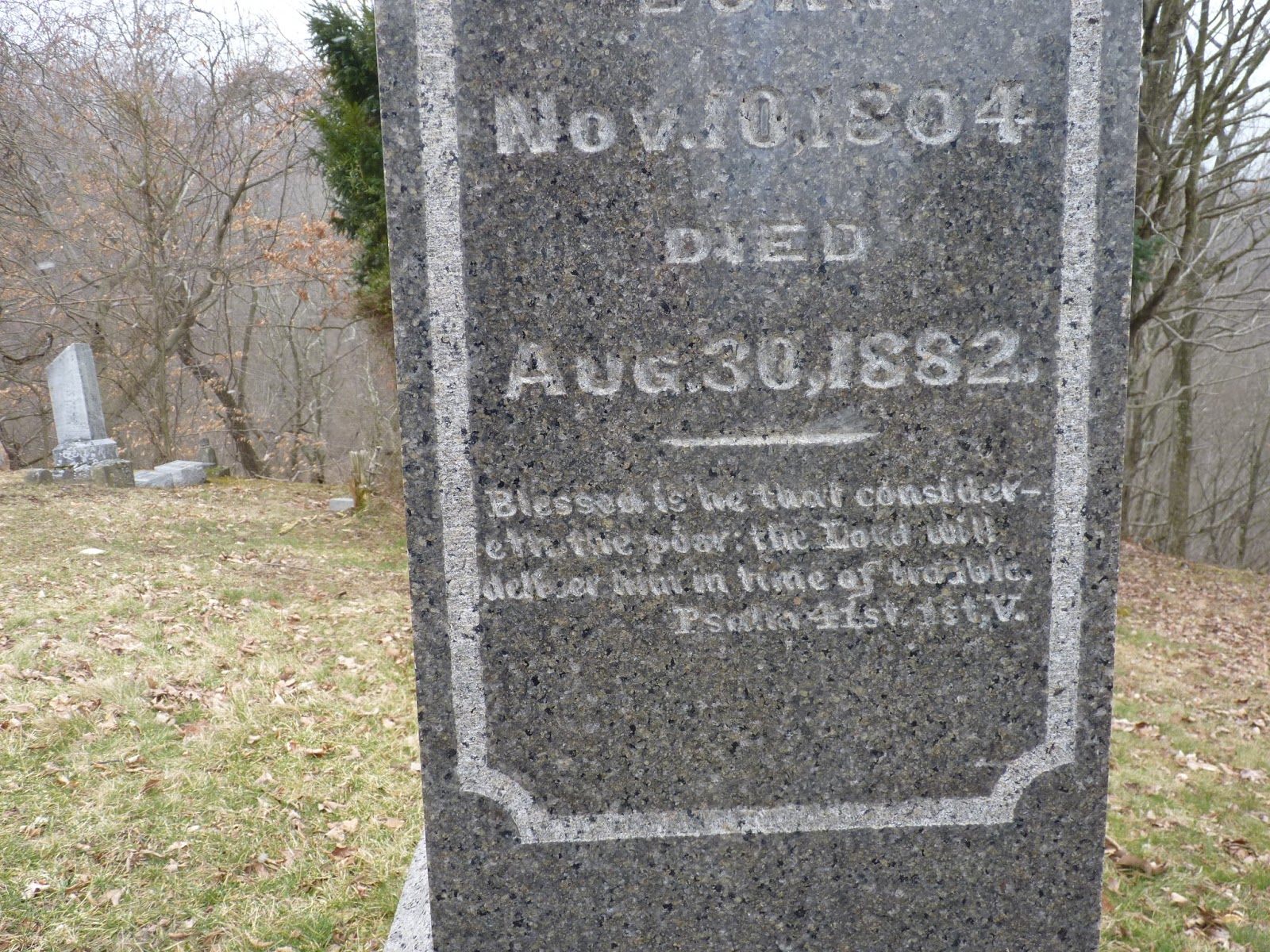
This is the stone of Philo Stocking, who moved from New York state to Wheeling, VA (at that time) and later to Sistersville to establish a flour mill and to attempt to drill (unsuccessfully) the first oil well. He became a wealthy, prominent man in the town and his son George carried on the family business later on. The inscription on the stone says much about the man it commemorates:

"Blessed is he that considereth the poor: the Lord will deliver him in time of trouble."

The key to telling ghost stories or historical stories about people of the past, I believe, is respect. Respect for the deceased and for their descendants. That is important, especially when visiting graves and other reportedly haunted sites. These people lived and loved; the places they lived still belong to someone (or at least the site does, if the structures are gone).


And the key to a successful workshop is not only willing and active participants who will trek out in less-than-ideal conditions, but also a place that is welcoming and supportive. Terry Wiley of the Gaslight Theater made huge efforts to make our concert there successful and we were glad to see some familiar faces in the audience; our storytelling guild seems to have a small but loyal group of listeners in the area. The Wells Inn also made our stay comfortable and it's like coming home to be greeted by Ann and the staff, to get messages from the owner letting us know that arrangements for our stay were in place, and to enjoy the good food and service.

How was this workshop funded? Through the generous support of the WV Commission on the Arts via a grant written by guild member Jo Ann Dadisman. It takes more than willingness to present or attend; it takes people like Jo Ann, and like Terry Wiley and Charles Winslow (of the Wells Inn), and guild supporter John Mullins who arranged our lodgings and food and even made homemade cheesecake, to make it work.

We told and heard many stories during our stay in the town, and I hope each person there went home thoughtful, inspired and ready to dig into their stories with new energy.


Copyright 2012 Susanna Holstein. All rights reserved. No Republication or Redistribution Allowed without attribution to Susanna Holstein.
Related Posts Plugin for WordPress, Blogger...