Pages

Showing posts with label Susanna Holstein. Show all posts

Friday, September 26, 2014

Tomorrow: Museum Day Storytelling in Marietta, OH


A beautiful autumn day. Soft waters of the Ohio River flowing by. Two museums on the riverbank. Four storytellers. Can it get any better than that?


Jeff and I, on the river in Pomeroy, OH
Tomorrow is Museum Day, a day to get out an enjoy what the museums in your neck of the woods have to offer. Two of Marietta's museums teamed up to celebrate with a day of stories and music. Campus Martius and the Ohio River Museum will be hosting events all day and I am happy to be part of the celebration. I'll be joined by storytellers Judi Tarowsky and Stephen Hollen and my sometimes-partner-in-crime, musician Jeff Seager.


Stephen Hollen as Mark Twain, 2011

If you're in the area, come in and say hello and have a listen to some memorable, funny, touching and spellbinding tales and songs. And if you can't make it to Marietta, be sure to stop by a museum wherever you are, and thank the people who work so hard to create a place of learning and beauty in your neighborhood.


Campus Martius Museum is located at 601 2nd Street, Marietta, Ohio, on State Route 7, minutes from I-77. The museum is just one block away from the Ohio River Museum. 

The Ohio River Museum is located at 601 Front Street, Marietta, Ohio, one block from Ohio State Route 7, and minutes from I-77. Free parking is available in the museum parking lot. Ohio River Museum is also wheelchair accessible, except for W.P. Snyder. 

If you need more details or directions, call the museums at 1-740-373-3750.   

Copyright Susanna Holstein. All rights reserved. No Republication or Redistribution Allowed without attribution to Susanna Holstein.

Wednesday, July 16, 2014

Come Tell Stories with Me August 3-8 at Augusta!

Once upon a time in the mountains, a family gathered by the fire and shared stories carried from one generation to another, perhaps even tales that crossed the ocean with their ancestors. Be part of the tradition of “passing it down” this week as we explore the Appalachian folklore, superstitions, and culture that weave together to create stories and a storytelling tradition that continues to be a lively part of life in the mountains we call home.

The class will be highly interactive with storytelling and lecture interspersed with class discussion. 

The Icehouse,  a unique pub on campus and site of much music.
We will view videos and listen to recordings of a variety of Appalachian region storytellers, take a nature walk to see native plants and learn about their uses and lore, 
Messages written by Civil War soldiers on the walls of the former
hospital are scattered throughout the building

take a field trip to historic Beverly to visit the house that was once used as a Civil War hospital and tour the Beverly museum. Students will be expected to work on one story per day for performance in class; this is not expected to be polished work but rather a beginning to putting flesh on a story’s bones. Class members will be expected to offer coaching and feedback as requested to help each other to a better understanding of their stories and to improve performance.

Cloggers competing during Old-Time Week.
The Appalachian region is a fascinating place. Expect to have fun, laugh much, talk much and listen, listen, listen as we immerse ourselves in the legends and lore of the mountains!

Hallihurst, one of two mansions on the Davis & Elkins College campus.
For more information about this week-long class and registration forms, visit the Augusta Heritage Old-Time Week page.

See you there!

Copyright Susanna Holstein. All rights reserved. No Republication or Redistribution Allowed without attribution to Susanna Holstein.

Thursday, July 3, 2014

In the Mountains of West Virginia, Part 3: Beartown

One of the field trips we took during our week of writing was a visit to Beartown State Park. This park was developed on land purchased with funds provided by the Nature Conservancy and a large donation from the Polan family to honor their son Ronald Keith Neal. Neal often visited the area before he was deployed and later died in Vietnam. This young man in always on my mind as I walk through the haunting trails and rocks of Beartown.


Copyright Susanna Holstein. All rights reserved. No Republication or Redistribution Allowed without attribution to Susanna Holstein.


Tuesday, July 1, 2014

In the Mountains of West Virginia, Part 1

I was away all last week at a creative writing workshop that is part of a music-and-writing camp called Allegheny Echoes. Talk about restful! Writing while surrounded by the beauty of the mountains and rivers, and evenings with musicians who play old-time mountain music--it was just what I needed to get back to writing more poetry and fiction. Here is the first installment of posts about last week. (This week will be all about cleaning, weeding, and such mundane activities).

I stayed in a camp on the Greenbrier River that belonged to friends. The Greenbrier River Trail ran right in front, following what was once one of the busiest railroad tracks in America.The house was an old "section house," meaning that it was once the home of the man who took care of that particular section of the railroad tracks; there may also have been a telegraph office in part of the house. I was intrigued by the work put into the porch supports. There was no need to be artistic, really--plain columns would have worked as well, but the carpenters took time to cut designs, like this circle, into the rough wood that was probably milled on site or close by.


The view out back--restful and quiet. We were visited regularly by two pairs of courting hummingbirds. And lightning bugs! I haven't seen so many in years.


A gate at the rear of the property,


and a pile of useful junk.


Another view out back,


and a close-up of an opening into the crawlspace under the house.


I caught this not-very-good photo of a beaver making his way upriver from the old metal bridge that spanned the water. The bridge, I heard, is slated for replacement and that will be a sad day.


The beautiful Greenbrier, a perfect place for fishing, canoeing, swimming, kayaking, or just daydreaming.


Copyright Susanna Holstein. All rights reserved. No Republication or Redistribution Allowed without attribution to Susanna Holstein.

Thursday, June 19, 2014

24 Hours

That's how long we were away from home, but it feels like much longer than that. The house is quiet, almost alien when we come inside, dark and cool and fairly tidy. The dogs look at us with reproach, as if asking how we could go off and leave them...again. The cats are nowhere to be seen, but will assuredly resurface when they realize we're back.

In that 24 hours, here's what we did:

 1.bought a quilt from a young man on our way out of town (Facebook meet-up). Not an old quilt, but nice and in very good condition.

2. Took the back way across Divide Ridge down to Eleanor, enjoying the scenery and finding surprisingly many new houses along the way. It's been a few years since we were out that road. I recalled some incidents from when I carried mail on part of that road, and the time a car was wrecked in one turn and the owner, one of the boxholders on my route, gave it to us for our oldest son. The car wasn't much but we traded it up for something better.

3. Took a side trip to look at the Homestead community created by Eleanor Roosevelt and named for her. The little homes were easily identifiable. More about the town of Eleanor in a future post.

4. Found our way to Camp Asbury Woods to tell stories to the young adults there for work camp--they do repairs on homes in the area for free. This is a church camp and I've been back several times over the years. It's always a pleasure to tell stories there, even on nights like last night when the temperature was 85 and sweat was dripping off my nose and down my back when I was done. But worth it--well worth it. CD sales were very good, too. Donated back half of the sales money, and left a CD for one young man who really wanted one but had no cash. What comes around goes around.

5. Back in the van to drive about 120 miles to Beaver, WV to our motel for the night. We arrived about 11:30 and stayed up for an hour watching American Pickers. How dumb can we be, right? But we don't have television at home, and you know how I love picking myself!


6. Up early for breakfast and on the road to Shady Springs.

We were early so we explored a little:

found a lovely lake we didn't know about and an old building that we later learned was once a general store upstairs, with hay and feed stored and sold downstairs.

We also found the old log cabin that was the original post office in the region.

7. Storytelling! This was a library program for the summer reading program, so we were into folktales and science experiments again. The audience was excellent and great participants in the stories. Too. Much. Fun.

Before the program a young girl of 7 told me stories of her encounters with snakes. One was especially fascinating: at three years old, she found a snake in the yard where she was playing. It was green, she said, with slitty eyes that looked red and strange (her words). It moved like this (she made a slithering motion with her hand) but she said it was really dancing. Three times she repeated that it was just dancing. She did not know better and played with it and the snake bit her. It didn't hurt but it surprised her. She told her father, who was so upset he killed the snake. I could see that she wasn't happy about the snake being killed; it was just dancing, after all. From the mouth of babes sometimes come the most extraordinary tales.

8. On the way back to Beckley and the interstate we again opted for the back way and found an amazing junk shop. We loaded the van with chairs, doors, dishes, and more for under $30.00. This turned out to be a nonprofit community center, and they also had teens there to work for the week. When they heard I was a storyteller, they asked if I might tell stories for their group. You know I did not mind at all! The teens gathered quickly and we had an impromptu session. I gave away two more CDs to teens with birthdays in June. I think the others were a little envious but the leader assured me all of the kids would have a chance to listen.

9. We got to Beckley and saw a place where we just had to have lunch. How cool is this? A drive-in! The King Tut has been in that same location since 1944. They even hook your trays on your window. And the food--oh yeah, it was fine. I have never before eaten in a drive-in restaurant so it was a lot of fun.

10. Homeward bound through lots of traffic, very heavy for some reason today. We were tired and ready to get home, but there was this young woman carrying a gas can up the road, her vehicle on the shoulder. Larry made room in the back and back we went to the gas station. It turned out she had no money on her either; it did my heart good to make sure she had enough to get her home. If it had been one of ours, we'd have wanted someone to do the same thing for them. She was a college student, traveling about 80 miles one way to go to school. Blessings on her; may all her future travels be safe. Again, what comes around...

And finally home! Larry is outside, filling a washtub with water so Daisy, our golden Lab, can have a splash pool all her own. Then he'll unload the van and we'll sit on the porch and play with the dogs for a while before getting ready for tomorrow's adventure: The West Virginia Folk Festival.

Copyright Susanna Holstein. All rights reserved. No Republication or Redistribution Allowed without attribution to Susanna Holstein.

In Honor of Mothers

This was written for the May issue of the new local newspaper, The Jackson View. June seems an appropriate time to post it here; my mother's birthday was June 13 and Larry's mother's was June 12.

I watched her navigate the aisles of the grocery store, steering her cart with one child in the seat, another clinging to the side, and she herself pregnant with a third. She corrected her children, consulted her shopping list, compared prices and kept moving rapidly and efficiently through the store and finally to the checkout where she unloaded the cart, denied her children’s cries for candy, exchanged comments with the cashier, fished out her card to pay, and then steered the loaded buggy and her children out into the parking lot. Behold the young mother: the original multitasking machine.

Mom and Dad (June and Bill Connelly, Manassas, VA in 1959. That was
Grandma and Grandpa's car, and they probably took this photo since they
were into photography and had a color camera. The car later became ours.
 As I drove away my thoughts turned to my own mother. Married at seventeen to a dashing American from New Orleans who was stationed near her home as part of the Army Air Force, she left her life and family in rural England to come to a country where she knew just one person: her husband. Together they built a tiny house with few of the amenities we take for granted today, and started a family that grew to 13 children. In the 1970’s she went out to work for the first time since her days as a land girl during World War II. She sold Avon and Amway, babysat for neighbors’ children, and took a job as a nurse’s aide in the wing of the hospital she loved best, the maternity ward. She continued working for 20 years in a variety of jobs. Mom was always learning something new, interested in meeting people, and she would cross a street to see a baby in a stroller. Her love of life knew no bounds; everything fascinated her. She loved her new country but never gave up her British citizenship.

Dollie Holstein with Larry and his twin sister Mary, probably about 1954. Yes,
that's a big bruise on Mary's head, probably caused by that little guy on the left.
Those memories led me to my husband’s mother, who grew up in a coal camp in Boone County, WV and went on to marry a coal miner and live in Cabin Creek. She saw first-hand the struggle for the miners’ union and knew the hardships of coal camp living: the poorly built company houses, the company store and the dangers of using scrip for credit, the constant dust and dirt raised by passing trucks and coal trains. Yet she, like my mother, was determined to make the best of what life had brought her. She cared for her husband when he was injured in the mines and raised her four children to be able to take care of themselves, to work for what they got and to never lose sight of their heritage. She loved dishes with pretty flowers on them, and grew roses every year, carrying out her dishwater to wash the coal dust off their petals.

Mothers. They teach us grace and dignity, they show us by their example how to live lives of beauty and commitment. As our world gets increasingly complex and confusing, it is the mothers who provide the light that can guide their children to ethical, empathetic, and responsible living. Today we hear much about dysfunctional families, absentee parents, and troubled children. Yet the other story—the story of the quiet, steady mothers who work and care for their families and homes—that story is seldom told. It is not a headline grabber or tabloid material.


So here’s to the mothers who stand behind their families, guiding them like that young mother with her grocery cart, making wise decisions and teaching her children right from wrong. Happy Mother’s Day to her, and to mothers everywhere.

Copyright Susanna Holstein. All rights reserved. No Republication or Redistribution Allowed without attribution to Susanna Holstein.

Sunday, March 3, 2013

Yesterday's Workshop: Seeking the Spirits

 
Yesterday's workshop in Sistersville was just what I hoped it would be: 12 storytellers and 2 workshop leaders telling, exploring, discussing, working on and listening to ghost stories. I was one of the workshop leaders; with my friend Jason Burns we plumbed the depths of a good ghost story: what makes it compelling, where to find material, resources for research, framing the story, finding the universal meaning of the story, and finally telling the story.

Despite the advice of many websites on telling ghost stories, we did not hold flashlights under our chins. We did not make the listeners jump. We did not suggest something was going to get them, was creeping up behind them or any such things. To me, those are campfire stories and the techniques used when the goal is to scare people. I consider ghost stories those tales of inexplicable events that leave people wondering what could have happened, why did it happen, and if there really is such a thing as ghosts or spirits, if you prefer that term (I do).

How many of you reading this post have had such experiences in your life, or have heard of such things happening to someone you know and trust? I would bet that probably one in five are raising their hand, particularly if you live in the mountains or in a rural area. Many people keep such experiences to themselves lest their friends and family think they're crazy or weird. But the truth is, many people have had something happen to them, or seen something, that they cannot explain. I wish I had a count of the number of people who have told me stories about seeing or feeling a relative who has passed, or a beloved pet, or who have been in buildings where the sense of being watched or even touched was overwhelming.

Are these stories true or just overactive sensitivities? I do not attempt to answer that question; that is for each person to decide for themselves. What I do is research the background, particularly of historic stories or legends recorded somewhere in a book or other source, and occasionally one I have collected as an oral history. I provide the context for the tale and tell what I have learned, and then it is up to my listeners to decide on what is "true." And that, to me, is what makes these stories so intriguing-they leave us thinking, wondering, and occasionally, watchful.

Part of our day was to be a field trip, but that did not turn out as I had hoped. The weather was cold and snowy with a chilling wind and overcast sky.

Still, we ventured up the mountain to the Greenwood cemetery, a historic cemetery that holds the remains of many of Sistersville's most illustrious citizens and their families, along with those of the merchants, workers and farmers who settled and cultivated the land around this pretty river town. Our intent was not to ghost-hunt; that is not part of what I do as a storyteller. Our intent was to see the place as it once was, to pay respects to those who rested there and to get a feeling for the place and the history of one small town.

We also visited a grave that has been the source of many stories and legends. This family monument is a beautiful granite stone standing probably 8 feet tall, with a stunning woman bending over the stone with her arms stretched out protectively--or at least they used to. Vandals have broken the arms and disfigured her face, sadly, and the rumors of her vengeance on them make a compelling story. True or not, I can't say. I simply tell the story and provide the background of this hard-working family that became wealthy through their efforts and the foresight to buy mineral rights just before the first oil and gas boom in the late 1800's that made Sistersville one of the richest places in the world for a time.

(Storyteller Katie Ross stands beside, but not touching the statue, in the photo. You might wonder why.)

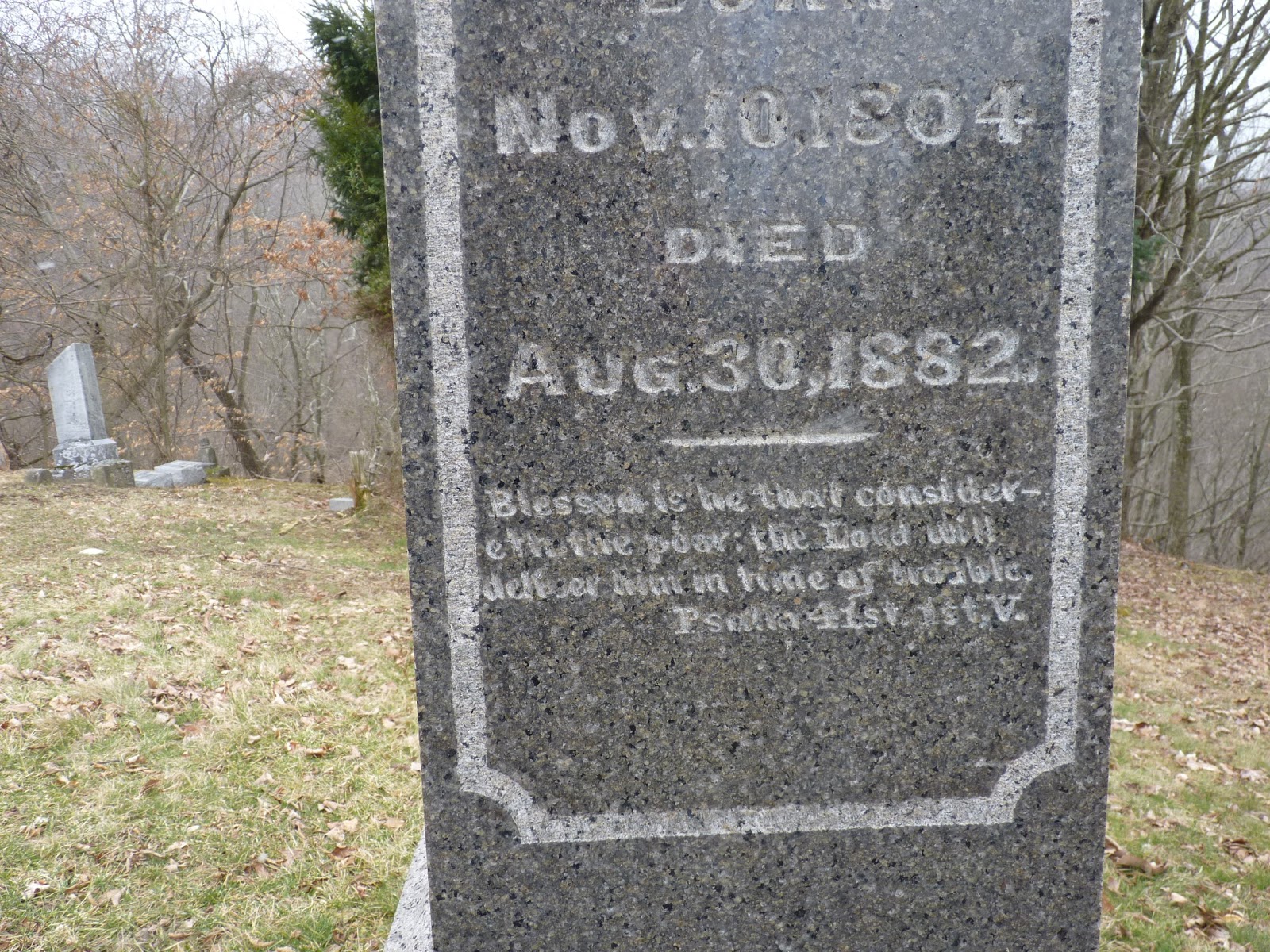
This is the stone of Philo Stocking, who moved from New York state to Wheeling, VA (at that time) and later to Sistersville to establish a flour mill and to attempt to drill (unsuccessfully) the first oil well. He became a wealthy, prominent man in the town and his son George carried on the family business later on. The inscription on the stone says much about the man it commemorates:

"Blessed is he that considereth the poor: the Lord will deliver him in time of trouble."

The key to telling ghost stories or historical stories about people of the past, I believe, is respect. Respect for the deceased and for their descendants. That is important, especially when visiting graves and other reportedly haunted sites. These people lived and loved; the places they lived still belong to someone (or at least the site does, if the structures are gone).


And the key to a successful workshop is not only willing and active participants who will trek out in less-than-ideal conditions, but also a place that is welcoming and supportive. Terry Wiley of the Gaslight Theater made huge efforts to make our concert there successful and we were glad to see some familiar faces in the audience; our storytelling guild seems to have a small but loyal group of listeners in the area. The Wells Inn also made our stay comfortable and it's like coming home to be greeted by Ann and the staff, to get messages from the owner letting us know that arrangements for our stay were in place, and to enjoy the good food and service.

How was this workshop funded? Through the generous support of the WV Commission on the Arts via a grant written by guild member Jo Ann Dadisman. It takes more than willingness to present or attend; it takes people like Jo Ann, and like Terry Wiley and Charles Winslow (of the Wells Inn), and guild supporter John Mullins who arranged our lodgings and food and even made homemade cheesecake, to make it work.

We told and heard many stories during our stay in the town, and I hope each person there went home thoughtful, inspired and ready to dig into their stories with new energy.


Copyright 2012 Susanna Holstein. All rights reserved. No Republication or Redistribution Allowed without attribution to Susanna Holstein.
Related Posts Plugin for WordPress, Blogger...