Pages

Showing posts with label audience participation. Show all posts

Thursday, November 6, 2008

Some Storytelling Photos from Last Week


Many people would not go near a roomful of 7th grade students. How many times have I heard, "Those who teach middle school kids are a breed apart!" It's true--they are. A special breed that loves and understands this age group, appreciates the delicate balance of their lives between young adulthood and childhood, a fragile place at best, often difficult but always unexpected. Can you tell it's one of my favorite age groups?

For seven sessions last Thursday, I told ghost stories to 7th graders at a school near Morgantown, West Virginia. Although teachers tried to warn me about the groups that were more difficult than others, I found each class to be attentive, interested and absolutely a joy to be with. What we had was an old-style front porch kind of storytelling, just 30 or so students in a group, sitting in a circle in the library and listening to stories. We talked too, a little give-and-take that I think enhanced the experience for all of us. As in the past, I found once again that children with behavior issues will listen to stories--perhaps their behavior stems from overactive minds that find plenty to work with in stories; perhaps stories offer them an escape vehicle from the messiness of their family life or personal problems. Whatever the reason, they listen and take the stories to heart.

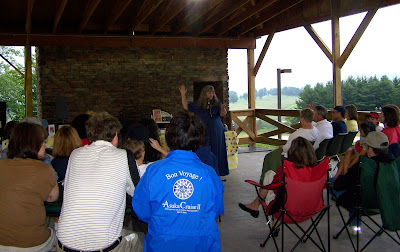
The next day, we were in Sutton, WV at an elementary school's Heritage Festival. Here the costumed children begin their parade into town before the storytelling, music, games and other activities of the festival.


I love using participation stories. Here we tell the Noisy House, a folktale that I tell based on a version created by storyteller Marilyn Kinsella that includes seasonal creatures--bat, cat, owl, ghost, etc. It was fun, noisy and a good way to channel some of the high energy of the day.


Here we are telling a Jack tale, one of my favorite story characters. The kids loved the story of how Jack defeated the Ol' Fire Dragaman. One thing about Jack--he entertains all ages. I saw several young fathers during the story sessions, and it was clear that storytelling was new to them--and that they liked it!


Yet another group telling of the Noisy House. The "little old lady" is almost swallowed up by her bonnet and apron, but she did an amazing job. For a little person, she had a big, expressive voice and got right into her part.
Working with kids in participation stories takes high energy, quick wits, and a willingness to go with the flow. Although the end of the story is supposed to be that the little old lady removes the creatures from her house one at a time, in one group the ghost decided it was his job to scare them out--so that's what we did! You never know where you might end up when the kids take an active role in the telling, and that is why I love to include them. What better way to make a story come alive.
Here are the bones of the Noisy House story:
A person is in their house. Something (a baby, a creaking chair, etc) is making an annoying, repetitive sound. Too much noise! The person goes to a wise one (can be a wizard or whatever you choose--I use a wise owl because I have a good owl puppet) and asks for help. The wise one advises to bring some other noisy thing in the house (farm animals, wild animals, whatever your imagination can bring to the story. The person follows the advice, the house gets noisier and the person gets upset with the wise one. So of course, the wise one advises taking the noisy things out of the house one at a time until all that is left is the original annoying sound--which, when compared to the noise of all the creatures, seems lovely and quiet!
For some other versions, visit Story-Lovers.com.


Saturday, September 20, 2008

Handsome, Big, and Strong


This story is based on an African tale called A Bear Went for a Walk. When I read the story, the participation possibilities were immediately evident. I could select children to play the parts of the animals (add more animals for more children). I could use the dialog in the text repetitively, with the audience calling out certain words.
The children/animals would all have the same line to say, and it was short enough to be easy to teach in a few seconds. Another adaptation also occurred to me. I could change the animals to those found in my area. Instead of lion, antelope, hippopotamus and zebra, I could use bear, deer, raccoon, and possum. That would regionalize the story and include animals more familiar to children here.

Before you start: Select audience volunteers for: deer, raccoon, possum, and mouse. Teach them their lines. All will be the same except for the mouse. Make sure the mouse knows that he/she must speak loud enough for everyone to hear them. Often the tendency is to speak in a tiny mousy squeak which may not be audible to all, and the story will lose its meaning for those who miss that last line.

A bear went for a walk in the forest. He came upon a little puddle of water in the path. Bear bent down to drink—and there in the water he saw his reflection!"Oh my!" he said. "I am the handsomest, biggest, strongest animal anywhere!No other animal is as...
(here teach the audience their part--go through a couple of practice runs to be sure their volume/inflection is right)
Handsome, Big, and Strong as I am!"
The bear went walking on, looking for another animal to compare himself with. He soon met a white-tailed deer.
"Deer," said Bear, "why is that you are not as (audience) Handsome, Big, and Strong as I am?”
"I don't know," said Deer. And Bear puffed out his chest and walked on.
It wasn't long before he met Raccoon.
"Raccoon," said Bear, "can you tell me why it is that you are not as
(audience)Handsome, Big, and Strong as I am?”

"Well," said Raccoon, "I don't know!"
Bear tossed his fine big head and walked on. There in the path ahead of him was a possum ambling along.
"Hello, Possum!" said Bear. "Can you tell me why you are not as
(audience) Handsome, Big, and Strong as I am?”
"No," said Possum. "I don't know."
The Bear puffed out his great chest and stalked past the possum.
At first, the Bear didn't see the next animal. He heard him--a teeny, tiny "aaaaah-chooo!"
The Bear looked down, and there in the grass at the side of the path was a tiny......mouse.
"Bless you!" said the Bear. "Umm, can you tell me, Mouse, how it is that you are not as
(audience) Handsome, Big, and Strong as I am?”
The tiny mouse looked up at the mighty Bear and said,
"I have been sick, that's why."
________________________________________________________________________
Other Options for Participation
Sing the repeated words to a simple melody.
Let the entire audience say the lines of the animals Bear meets.
Increase the audience lines to include all Bear’s repeated phrase.
Change the animals to reflect your area of the country/world.
Use puppets for the animal roles.

Do you have to use audience members in the animal roles? Of course not! The story could be told as easily without them, and just as effectively. But this is a simple story to try including participation. The way you tell the story is up to you, the storyteller!

Thursday, April 24, 2008

Storytelling Trip: Day 2

Baldwin Elementary!

What a school--many ESOL students, a library that is run by one of my best friends from high school, a beautiful day...it made for a good experience all around. The plan for the day was stories from around the world, a fitting choice since the children at this school come from a variety of backgrounds.

Here Raccoon works his magic on a large group of K-1 students. He can always be depended on to do a good job. He's so good, in fact, that I have a body double for him! Just in case something should happen to him, you know.


A lively bunch of volunteers works with me on another stand-by story: Uwungalema. What is it about those clip-on tails that kids love so much?
Later the librarian told me that these students were in the ESOL class. They did a fantastic job. Their teachers should be proud.


A dragon with attitude! The dragon helped tell the story about the man who loved dragons (from China).


Anansi is in trouble again in the story of Anansi Steals Wisdom. The thumb piano, or mbira, is used in the story to illustrate his climb up--and fall back down--the tree, and for some other sound effects. I have had this instrument for 10 years, and it's been dropped, played with and lugged around in suitcases regularly It's made from a gourd on the bottom, wood top with soundholes, and metal pegs that make the sounds when plucked with you thumb. This one has a lovely sound.


And below, my #1 fan watches from the lunch table. The library staff prepared a delicious lunch for us, and I enjoyed being able to talk with them while we ate.


Storytelling works well with children whose English is limited because a teller can modify the story to include definitions of unfamiliar terms as part of the story ("Anansi put the wisdom in a calabash--a gourd like this one my thumb piano is made from--and tried to climb the tree."). Within the context of a story, the unfamiliar words can be understood. A teller can opt to replace difficult words with simpler ones, and often the teller's gestures, facial expressions, and movements can aid in understanding the vocabulary and the story's action.


I have found that even children classified as ADHD can be good story listeners. I believe it is because they are very good at creating the mental images of the story as they listen. They probably add a lot more detail than other children because they are so active mentally. So for the them the story experience can be very rich. Many times these children can tell the story back to you days, weeks or even months later. I wonder if ADHD children might be excellent aural learners, but need more physical activity to keep learning on track.


I was tired by the end of the day (5 presentations of 45 minutes each) but I cannot describe the "high" that comes from a day when the stories flow, the audience responds, and we all enter the magic land of storytelling together.


Saturday, August 4, 2007

On the Road: Day 2--Capon Bridge and Moorefield

Capon Bridge might be a small town, but it produces big audiences who are a pleasure to work with. The young man at left handled his puppet gig very well. I asked him if he'd worked with them before, and he said he had, at church. He was older than most of the children at this performance, and he set the example of how to behave.


I also used my story bag, which had a variety of items that linked to a story. The bag was quite a hit at all performances.


Here my raccoon does his schtick again. He's another standard for most performances with small children, and I've learned that adults enjoy his story too.


Clayton and I telling No News together. He did
a great job with the "straight" part.


Friday, July 13, 2007

Daycares, Preschools: Storytelling for the Younger Set


Many tellers quiver with fear when asked to tell stories to children under five years old. Why? Because these can be the most difficult audience of all. They may crawl away in the middle of a story, come up to sit in your lap, interrupt with inappropriate, long stories of their own, or cry. It sometimes feels like you're doing an improv act as you adjust to the behavior and attention span of the group in front of you.

BUT--it's rewarding, exciting and fun. These little ones love to hear a story. You'll be teaching them how to listen, an important literacy skill. They will be learning how to interact with a storyteller, how a story is told and what signals a storyteller might give that invites group participation, and when it is okay for them to contribute to the story.

Some rules for survival for the storyteller and for a rewarding learning experience for the children:

1. Use shorter stories. Children in this age group need stimuli changes more frequently. Yes, some can listen to longer, more complex stories, but most will not have the skills for that. Give them shorter stories with a few characters and lots of action words.

2. Provide opportunities for them to be part of the story. By this I mean chants, songs, or actions they can do as part of the story. Look at your story from a different perspective. If someone pets a dog in the story, can you add that action so that the children all pet the dog, or hold up a treat for the dog, etc? In Goldilocks and the Three Bears, what actions and chants can you introduce so the children can join in?

3. Repetition, repetition, repetition. Cumulative tales, stories with repeated words and lines are excellent choices for the preschool age group. These kinds of stories develop learning skills they will need later on as they begin to read. Stories like The Old Woman and Her Pig are great choices.

4. Don't ask them a question, unless you want a long answer--and from several children! They will be happy to tell you at length why they think the old woman's pig won't jump over the stile.

5. Don't worry if they crawl under the tables--they're probably still listening! Don't have the same behavior expectations of them that you might have of older children. They'll learn, just give them time to grow up.

Need sources for stories? The following booklist is a good place to start:

MONDAY MORNING PRESS
Nursery rhyme crafts by True, Susan.
ABC puppets by Marilynn G. Barr
Animal rhythms, alphabet by Cindy McCord
Storytelling with puppets, props, & playful by Huff, Mary Jo.

ALLEYSIDE PRESS
Alleyside book of flannelboard stories by Bay, Jeanette Graham.
Sound and action stories by Jerry J. Mallet
The storyteller's cornucopia by Cooper, Cathie Hilterbran.
A treasury of Asian stories & activities for by Spagnoli, Cathy.

TEACHER IDEAS PRESS
Full speed ahead: stories and activities for children on transportation, by Jan Irving and Robin Currie
Frantic frogs and other frankly fractured fairy tales, by Fredericks, Anthony
Raising the roof : children's stories and activities on houses,By Irving, Jan,
Straw into gold: books and activities about folktales,by Jan Irving & Robin Currie

BY AUTHOR JEAN WARREN
Short-short stories, Everett, WA : Warren Pub. House ; c1987.
Storytime theme-a-saurus, Everett, Wash. : Warren Pub. House, c1993.
Teeny-tiny folktales, Everett, WA : Warren Pub. House ; c1987.
1-2-3 puppets : simple puppets to make for... , Everett, WA : Warren
"Cut & tell" : scissor stories for winter, Everett, WA : Totline Press, Warren
Make & take concept rhymes,Everett, Wash. : Warren
Toddler theme-a-saurus : the great big book, Everett, WA : Warren

By Author Valerie Marsh
A Treasury of Trickster Tales
Puppet Tales
Paper-Cutting Stories for Holidays and Special Events
Mystery-Fold : Stories to Tell, Draw, and Fold

OTHER TITLES FOR STORYTELLING TO YOUNG CHILDREN
Storytelling activities kit: ready-to-use techniques, lessons & listening cassettes for early childhood. Jerilynn Changar & Annette Harrison, Center for Applied Research in Education
Easy-To-Tell Stories for Young Children by Annette Harrison. National Storytelling Press, Jonesborough, TN
Stories to tell a five-year-old selected by Alice Low . Little, Brown, and Co

Thursday, July 12, 2007

Hundred, Paden City, and Middlebourne Storytelling

Monday was a busy day of storytelling. I left home at 8:00am (a lot later than my usual 6:00am leave time!) and headed north to three small libraries in West Virginia's northern panhandle. It was hot--so hot that I didn't take any outdoor photos. The air was steamy, blue with haze, and it made even breathing difficult. I drove through the tiny communities of Friendly, Grape Island, Ben’s Run, Long Reach, and Sistersville, occasionally running alongside the big river barges as they pushed their loads upstream.

First stop was Paden City. It’s the home of the marble maker Marble King. Most marbles have been made in West Virginia for years, and Paden City has been the chief source. It’s a pretty river town, hugging the banks of the Ohio.


Then it was on to Middlebourne, the county seat of Tyler County. I stopped for lunch in mid-town at Betty’s Diner. As I waited in line to be served, a small boy asked me, “Why are you wearing a red dress?” I explained that I liked red. “Oh,” he replied. “Do you have any blue dresses?” I assured him I did. “How about purple?” I had to think about that. “No, I don’t think I do,” I told him. “Well,” he said, “you should!” I thanked him for his advice.

The audience at Middlebourne had many children who attended a school I’d told stories at recently. To my surprise, they wanted me to tell the same stories, so I did. I added a few new ones too—“Like Meat Loves Salt,” (several variations on the theme here) and “Rindercella” (Archie Campbell's version is here) just for the fun of it.


Here, a young storyteller sprays the audience with the skunk
puppet. You can tell how sad she is to do it! I usually invite children to participate in telling the stories and handling
the puppets. My puppets know the rules: misbehave and it's back in the suitcase! So their child handlers are very careful that the puppets never fight or bite (the first thing most children who don't have puppets want to do with them is make them fight. This rule takes care of that problem).


Hundred is one of my favorite libraries. Only a few children turned out on that hot afternoon, so we sat around a table and swapped stories. I told a few Jack tales, and then we just talked—about snakes and outhouses and canning and other country things.

One lady told about her mother going into an old outhouse that began tipping over when her mother went in. Her mother felt it and shifted her weight so the outhouse tipped the other way. But every time her mother moved, so did the outhouse! Fortunately, the outhouse never tipped completely over and her mother got out safely.

On the drive home, I wondered what kind of purple dress that little boy thought I should wear. I should have asked him; he seemed quite certain about it.

Thursday, July 5, 2007

Canaan Valley Storytelling

As one of the Summer Performance in the Parks performers for the past three years, I've visited Canaan Valley Resort several times.

Each time I've had wonderful, attentive audiences. This year, however, I have to say that this was one of the best audiences I've ever had.


Most were from out-of-state; there were probably a dozen young children in the group of 60 who came to hear stories. Several told me they'd never heard a storyteller before, and came because they were curious.

After the performance, one lady told me that her father was a coal miner, that her uncle and cousin had died in the mines, and that her grandfather was killed during the unionizing attempts in the Farmington coalfields. She said she needed to talk to her father; my stories had raised many questions in her mind.


Another man mentioned that he was amazed at how much he enjoyed the performance. It does my heart good to know that I can awaken memories in people and encourage them to tell stories to their children to share memories.
I love doing what I do; but when I get this kind of feedback, I know that what I do is worthwhile, that it reconnects people with what's important in life (family, listening to each other, remembering that we're all human and have faults, and laughter).

There are not many jobs in this world that allow us to connect at these levels of commonality. Storytelling may not be a status position, but my goodness do people need it. My only regret is that I am not yet able to devote full-time to sharing stories, songs and laughter with people everywhere. I must bide my time, waiting until we are better situated financially.

My library job pays well, and provides the benefits and security we need. But it does not provide that lift to the soul, or the satisfaction of knowing that I have touched someone's life in a new and meaningful way. So I wait, and chafe, waiting for the time to jump ship, take the plunge or whatever metaphor suits. One day, one day...


Friday, June 22, 2007

Storytelling for "Get a Clue"

Telling Turtle of Koka with a volunteer named Derek, just like my son

Today it was storytelling performances at Ripley and Ravenswood libraries in my home county. Usually when I perform, it means at least a 2-hour drive one-way, but today I was right at home.

The libraries were using the national "Get a Clue" theme, so I focused on riddle and trickster stories. In the picture above, we're telling Uwungalema, which is more in the riddle category. I loved my drummer, who used my tongue drum very well from the comfort of his chair.


Still telling Uwungalema, granddaughter Hannah (back to camera) advises the turtle of the name of the tree. As usual, I prepared four times as many stories as I needed, but the flow depends on the audience in front of me, and having a wide variety of stories prepared to tell allows me a lot of latitude to change track as needed. One of the new stories I prepared (and a new favorite for me) is Hic! Hic! Hic! --a story from Turkey that closely parallels the Appalachian story Soap! Soap! Soap! It intrigues me that stories with such similar plots should be found in places and cultures so far apart.


It was a full house at Ripley, and the same at Ravenswood. What a day!

Monday, June 4, 2007

Tyler County Storytelling

Today it was up and out by 5:30 am, to drive the two and a half hours to an elementary school in Tyler County. The morning was perfect for driving, cool and just a little foggy.


The storytelling went very well. They liked Nasruddin, Anansi, Jack, and the other characters in the world folktales I told today. I think that the story that got the best reaction was Jack and the Beantree (English-Appalachian part of the cultures we touched on). Who would have thought that this variant of the classic tale would have them hanging onto every word? But the kindergarten class I told it to might not have heard that story before, and they were hooked.


Another favorite, told to the older classes, was Tam Lin, the Scottish ballad. I tell it as a story, singing only a few parts of the ballad (It has 52 verses or so, I think, and I doubt I'll ever learn them all!). They all liked Anansi Steals the Wisdom and of course the Kettle Song, which is good vocal warm-up.


Lots of interaction, puppets and singing today, not to mention clip-on tales! 6 sessions, 45 minutes a session, drained my voice and energy, but left me very pleased with the day.


These kids knew how to participate. A teacher told me that Beauty and the Beast Storytellers had been there last year, telling stories and teaching children and teachers to tell.


I think that helped prepare the group, because they knew how to listen and when to jump into the story with me. Who's in Caterpillar's House and Uwungalema (both from Africa) required student actors, as did Fox Guarding the Henhouse (Denmark), The Man Who Loved Dragons (China)--both from MacDonald's Three Minute Tales--and Filling the House (Armenia). Freedom Bird's chant (Thailand), and the soft African song Lie Lie Eh Lie Lie continued the participation.

On a teacher's request, I told the Ghost of Gamble's Run, a story with Tyler County connections. The tongue drum (made from a palm log), and the mbira (made with a gourd) seemed to intrigue the kids too, and added a different stimuli to two of the stories.

All in all, it was a very good day.

Sunday, March 11, 2007

Done! My Little Storytelling Print Shop

"I'll be mailing you an invoice next week," the email said. "Great," I thought. "She'll probably want a few CDs and maybe some books." The gig, a performance for Title I families, promises to be a lot of fun, with interactive stories and an informal, sharing atmoshpere. I thought the lady arranging the program planned to have copies of my materials there for use by the parents, perhaps, at a later time.

The invoice arrived Monday, just over a week before the performance: it was for 60 copies of Zinnia Tales, 60 copies of Homeplace:Poems from the Mountains, and 60 copies of my CD, Mountain Story, Mountain Song. Did I have all that on hand? Of course not.

I've been working on it ever since the invoice arrived. And tonight, the order is ready. The new laser printer made it much easier, and I discovered that the shrinkwrapping is more successful if I use a hair dryer instead of the heat gun provided with the impulse sealer. Live and learn.

Now I can concentrate on the stories I'll tell for this audience. The goal is to encourage them to tell stories with their children, so I know I will be telling Centreville, a story from my childhood. I want to include them in some of the stories, too, so perhaps I will bring the clip-on animal tails and have them take parts in the story of Ungawalema. A Jack Tale will have to be included too, because we're in his homeplace, after all--perhaps Jack and Strongman? That's usually a favorite. Sody Sallyratus is another good choice for audience particpation, and we'll sing the Kettle Song for silliness and to warm up my voice. What else? Tomorrow I'll decide the rest of the program.

That same day I'll also be telling stories to 5th-8th grade students in Wirt County. It will be a full day, certainly. The story choices for this group will be a sampling of the various kinds of stories people tell in the mountains--tall tales, family stories, historical tales, ghost stories, ballads, and traditional folktales.

For now, it's bedtime. Daylight Savings Time is here early, and I'm up late!
Related Posts Plugin for WordPress, Blogger...