Pages

Showing posts with label childhood. Show all posts

Monday, February 14, 2022

Puzzling about Puzzles

17 this morning, another light covering of snow. Flurries most of the day yesterday, then sun late in the day. The moon is waning now.

Are you playing Wordle? It seems like almost everyone is, and I have to admit, I enjoy it very much. It's not a complicated word game--you're given 5 blank squares in which to type a 5-letter word. There are no hints, nothing to guide your word selection. After entering your word, the game shows you which letters are correct, and which are also in the correct place. You continue entering words with that knowledge until you get it right--or not. Some days I can get it in two or three tries, and twice I never got it at all. 

I am a word game freak, I admit. I like crosswords, cryptics, word scrambles, and Scrabble. And now I am an addict to online Scrabble. Well, not quite an addict, but I can easily lose an hour playing the game. It's always been my favorite board game, but I seldom get to play because Larry is dyslexic and a poor speller to boot, and there's rarely anyone else around to play. So when I discovered the online version, I was thrilled. Now the trick is to discipline myself to play only for certain lengths of time, and at certain times of the day. Elsewise I'd get nothing done.

Math games, though. Brrrr. I am completely puzzled by Sudoku and any other game with numbers. My brain is simply not wired that way. I have always been all right with basic math, but in junior high, when faced with algebra, I tanked. I struggled through two years of it, grateful to come out with a D at the end of each year. Which was hard for me to accept, as I was a straight A student otherwise.

                                                                        Me at 15

Then in 10th grade, I had geometry and was failing miserably until the school arranged for a tutor to come a couple nights a week. After a week or two, the light clicked on. To do geometry one has to be able to do algebra, and Mr. Davis, the young teacher who tutored me, was finally able to make algebra understandable. After that, I loved geometry and took trigonometry the following year, coming through both with flying colors. I'd started calculus and was loving it too when I quit school to get married. 

Being married required only basic math--budgeting, bills, grocery shopping. I never had need of algebra or other math again until I started college in my mid-thirties. Then, because my degree program was Secondary Education--Social Studies, I was required to take only one math class, called A Survey of Mathematics. Each chapter of the book was a different type of math, and once again, I fell in love with the subject. Economics required some math and algebra, and in my Master's program the Statistics class also recalled those old skills. But after graduation and beginning my career as a librarian, it was back to basic math and budgeting. I prepared annual budgets for branch libraries and later for that complex department I managed called "Facilities", which included everything from janitorial and building maintenance services to vehicle fleet, security, staff safety training, and a whole list of other things. 

But all of those jobs and the math skills required have never translated into a love of number puzzles. For me those will always remain foreign territory, a mystery for others to solve. I'll stick with my word problems, at least for now. 

How about you? Can you do those math/number puzzles? If you can, my hat's off to you.

Copyright Susanna Holstein. All rights reserved. No Republication or Redistribution Allowed without attribution to Susanna Holstein.

Wednesday, October 6, 2021

Trains

64, cloudy and humid this morning, a possible shower might be in the offing this afternoon.


I have a thing about trains, I must admit. Our visit to Cass brought that love back full force, and I completely enjoyed watching the trains come and go while we were there. 

And the trains reminded me of a childhood memory.

When I was 5 we moved to Manassas, Virginia. Our house was about 200 yards from the railway tracks, possibly not even that far. I loved watching the trains go by, counting the cars and wondering about the people who got to ride them, and especially envied those in the dining cars. What did they eat? Was there a waiter, like on the TV shows I'd seen? Where were these people going? At night the cars would be lit up and we could see the people sitting in their seats, reading or talking. It was like a moving picture show to my young and fertile mind. I imagined svelte women stylishly dressed, men in dark suits and white shirts, with little mustaches. 

Once, when I was 12 or maybe 13, I can't recall, I got to ride the train from Manassas to Lynchburg. I'd been particularly difficult that summer. Hormonal changes had turned me into just a nasty mess of moods, and my mother seriously considered sending me off to my Aunt Dodo in Canada. So it must have been bad. Instead of Canada, the local priest offered to send me to a girls' summer camp at a convent called Villa Nova, in Lynchburg. And I would go by train.

It was beyond exciting, although terrifying too. I'd never been away from home for two whole weeks, and certainly not by myself. Usually if I went anywhere it was to my uncle's house while Mom had a baby, and one or more of my sisters went too. I dressed up for the train in my best Sunday dress and shoes, and I even had a suitcase. I remember how upset my mother was; she was crying and clinging to my father, but I was so scared I couldn't think about how my mother felt. I later learned that she'd had a miscarriage that summer and my shenanigans certainly didn't help her recover.

The train was not what I imagined. Maybe first class was all that I dreamed of, but I wasn't in first class. The train ride was bumpy and noisy, the seats hard and uncomfortable. Not that I minded--I was on a train! I had a packed lunch to eat, but I was so tempted by the man who came through carrying a tray of candy, gum and cigarettes. Since I had no money, all I could do was look. 

The most surprising thing to me was the bathroom. When I flushed, the bottom of the toilet opened, and all the waste went right out onto the ground! I was stunned. There was the gravel railbed rushing by, right there under the toilet. I flushed again to be sure my eyes had told the truth. As I made my way back to my seat, I was envisioning miles of railroad tracks strewn with toilet paper. In actuality I suppose the heat from the passing train burned it up, but even so it was a shocking discovery. Fortunately, trains have changed a bit over the years.

The time at Villa Nova was good for me. I learned a lot about my Catholic religion, and met girls from all over Virginia and other states. I was terribly homesick at first but soon got into the rhythm of the camp. Having breakfast and other meals served to us was a treat, and I was always curious about what we would have. While others complained about the food, I thought it was terrific. Dessert every day? Yes Ma'am! We played hard, and at the end of the two weeks we presented a skits we'd developed, along with songs and there were some girls who had talents to share, like piano, baton-twirling, etc. I had nothing to offer and was too shy anyway. 

I felt like a seasoned traveler when I got on the train to go home. Most of the girls had family that came and got them, and I think I was the only one traveling by train. I came home a different girl, calmer and happier, and thrilled to be back with my family.

But that train. I think it was worth being so badly behaved and being sent away just to ride that train.


Copyright Susanna Holstein. All rights reserved. No Republication or Redistribution Allowed without attribution to Susanna Holstein.

Sunday, August 5, 2018

Food

Our cellar, a few years ago. 
We are overloaded with food these days. The gardens are  beyond productive, and today will be spent in the kitchen putting up tomatoes, peppers, squash, onions, and if there is time, yet more pickles.

All of this bounty got me thinking about my childhood and also about my husband's childhood. Was food as plentiful for us when we were children at home? I put the question to Larry.

"Did you ever in your life has as much food as we have now?"

"Never," he replied.

"What was it like when you were a kid? Were there times when the next meal was in doubt?"

He thought about that, and then said yes, there was a day he recalled when they ate their dinner, but wondered, "Well, what are we going to do tomorrow for food?" He thought his mother must have borrowed some money from his grandfather to tide them over.

Food was not abundant in his childhood. They had enough, usually, but not like we have today with a cellar, freezer, and cupboards full of goodness. Sometimes they got commodities from the government, those staple foods that were packaged in very plain packages and distributed at some central distribution spot, usually once a month to those in need. Larry remembered people going to pick up their food with wheelbarrows, wagons or whatever they could wheel away. The coal camps had many boom and bust periods, so there were times when miners and their families got pretty hard up. Then there were strikes, and other times when a man was injured and the paychecks stopped--because there was no disability check or insurance back in those times.

Some people grew gardens, others had cows, chickens and/or pigs, and men also went hunting but in the mid-1950's there were no deer as they had been hunted out during the Depression, so small game was all that was available. Fishing was another source of food, and some people knew what wild plants and mushrooms were edible. Still, even with all of their efforts, food was  never something taken for granted.

My childhood was different. I grew up in a small town, surrounded by neighbors in a genteel middle-class neighborhood. We were not so genteel with 13 children, and bumped the bottom of middle-class pretty hard. But food was not scarce usually. I do recall one week when Mom was very worried about what we would eat, and one afternoon I remember her crying because she had nothing to make for dinner. All of us were hunting the house over for any change we could find, searching in pockets and drawers and in the copper mugs that stood on each end of the mantels. (I still have those mugs and think of that desperate day every time I look at them.) We managed to scrounge up enough to buy a loaf of bread, and I believe Mom borrowed a dozen eggs from a neighbor, so that was dinner. I don't remember what happened the next day. Maybe it was payday.

But other than that one time, there was always food. There were jars of canned food in the pantry, a huge chest freezer full, and a cabinet in the kitchen filled with spices and other cooking necessities as well as some shelves with bread, cereal, and other dry foods. We grew a garden in the summer, there was an herb garden in the front yard, fruit trees and grape vines all around the house. Mrs. Earhart brought 12 dozen eggs every week, and in the fall she'd bring scrapple, sausage and other pork if Mom could afford it. The neighbors had fruit too, and often shared it with us, and Mr. Lonas always shared a bottle of his homemade grape wine ("juice," he'd label it, and wink when he handed it to Mom). We picked blackberries every summer in the vacant lot at the end of the street, big canner-pots full of them for cobblers and jams.

I don't think I realized back then that I should have been grateful for the security of knowing there would be food on the table. Not that we could eat all we wanted; Mom kind of rationed it in a way. We knew not to ask for seconds unless it was offered. At dinnertime, Mom measured out our portions onto our plates as we stood in line. There were few sweets to be had, and pop and chips were a rare treat. But we ate well.

I didn't know back in those days about coal camps and Appalachia, and only vaguely knew about poor people. These weren't part of my reality.  While we weren't poor, we did not have nearly as much as other families in our area. We had no extended family close by, and even if we did my father would not have asked for help unless desperate. He also would not allow Mom to get commodities even though we certainly qualified. She did get them though--the lady who ran the distributions sometimes came by afterward with a trunkful for us, and Mom must have hidden them somehow from Dad.

When I hear Larry's stories, I realize how blessed I was. But even though times were often hard he never thought of his family as poor. In fact, they often had more than their neighbors because his family was small compared to most--four children as opposed to eight or ten or more like many families in the coal camp. He also had extended family in the camp, so even if rations were short at home, there were aunts and uncles and grandparents and older cousns who were good for a meal or even an extended stay.

Such different upbringings, and yet here we are today, doing pretty much what my parents did, stocking up and putting food by. It's hard work for sure, and the rewards are not something I can count in dollars. But then, dollars can't give the same satisfaction as looking in the cellar and seeing those rows of shining jars.

Copyright Susanna Holstein. All rights reserved. No Republication or Redistribution Allowed without attribution to Susanna Holstein.

Monday, July 2, 2018

So Hot That...

Looks like we're in for a few scorching days with temperatures in the mid-90's. I am no fan of hot weather--I'd rather deal with cold and snow anytime. We will be sweltering for sure at the flea market this week. Yuck. We will bring our good old fan with us, lots of water in a cooler, Gatorade, etc. to help us stay hydrated. Basically girding our loins to deal with this.

It's funny how when we were young the heat didn't seem to be a big issue. Behind our house was a narrow tar-and-chip street, more like an alley, really, and when it would get this hot the asphalt would seem to melt, and send up bubbles of tar. My brothers and sisters and I would pop the bubbles with our shoes for fun. Mom would get so mad because of course it made a mess of our play shoes. I guess it's a good thing they were play shoes because new shoes were a rare commodity and good shoes were treated with care.

I remember one summer, the temperatures were regularly over 100. The tar bubbled up as usual and  we thought it would be fun to pop them when we were barefoot. NOT a good idea. We got burned pretty good; the tar pretty much cooked the skin right off and left raw places. Poor Mom. She was probably pregnant as she usually seemed to be in my childhood, and having to deal with tar-footed children was surely not something she needed or wanted to do.

Temperatures went over 100 almost every summer in my childhood. Northern Virginia's climate in summer is not ideal; often the humidity was unbearable and the heat would rise in shimmers from the ground. Although I am at roughly the same latitude where I live now, our weather is more temperate, with less humidity and rarely does it go above 90-95 degrees--although it does happen and this summer is on track to be one of the hottest on record.
The big old house where I grew up. It sure suffered a lot when we lived there. The girls' bedroom was the top right window.

We never went to a pool when I was young. Swimming was something that only happened during the annual pilgrimage to "the beach." It wasn't a real ocean beach, but a park on the Potomac River, a few miles from its convergence with Chesapeake Bay. The water was salty though, and there were often jellyfish when we went, usually July or early August. We were watchful of them, but even so someone almost always got stung. But those were glorious days or sun and sand and shells...and sunburn. Back then no one had even heard of sunscreen as far as I know. I got so badly burned one time I had blisters on my back and the doctor had to come to the house to see me. After that we wore t-shirts when we went to the beach and wore them all day.
This was taken after I was married and gone, probably about 1970. Some of my younger siblings in the water--Julie in the life vest, which I am sure was put on at Mom's insistence.

We had ways of staying cool at home, even without air conditioning. There was the water hose and squirt pistols and a big galvanized tub we'd fill and use for a splash pool. We had to be careful about how much water we used because it was city water and there was a bill to be paid. Sometimes we'd take a cool bath in the middle of the day and just lie down in our rooms with the curtains drawn and the fans on. The old house had high ceilings and it was quite close to the neighboring homes so it stayed fairly dark and cool most of the day.

One thing we often did was to make mint tea. We'd pick some spearmint from the herb garden, smash it with a wood pestle in the bottom of a glass with a little water, then strain it off and add sugar, water and ice, along with a fresh mint sprig. It was delicious and cooling, a special treat. We also made popsicles in ice cube trays, using Kool-aid for the mix and sticks we saved from year to year. Of course, if we made popsicles then there would be less ice--but there was never enough ice in the summer. Kool-Aid was a constant presence in our old fridge, the white ball pitcher often full of bright red sweetness.
Summertime! Shorts and peddle pushers and me, for some reason, in a dress.

When the sun finally began its descent, the yard would cool down enough to go back out to play, or to sit on the front porch swing and talk. Fireflies by the hundreds would begin flashing and we'd grab jars and try to catch them to make a nightlight for our bedroom. At bedtime, we'd move our beds so we could lay our pillows on the windowsills and catch the cool evening breezes as we slept.

Copyright Susanna Holstein. All rights reserved. No Republication or Redistribution Allowed without attribution to Susanna Holstein.

Sunday, April 1, 2018

Easter Memories

Easter was an exciting time when I was young. Lent finally over and I could quit feeling guilty about eating the candy I was supposed to have given up for the season. There were special services at Church and we went to every one of them.

Easter 1954, at our first house in Centreville, VA

The services I remember the best were Palm Sunday when everyone was given a palm frond to take home--it would hang over our dining room door all year. Then there was Maundy Thursday, I think, and the Washing of the Feet? Elder men in the church would take off their shoes and socks and the priest would wash their feet. I was fascinated to see all those bony white feet, although I have to say the symbolism of the event escaped my notice.

There was the Stations of the Cross too. Our church had beautiful stained glass windows depicting the stations, and we would move from one to the other, saying the special prayers required for each.

And confession. Oh dear. Mine were pathetically the same almost every time I went: I was mean to my brothers, I fought with my sisters, I answered back to my mother...the sins of childhood hung heavy on my head.

Same Easter, 1954, at St. Timothy's Catholic Church in Centreville, VA

The Saturday before Easter was a busy day. The house had to be cleaned top to bottom, and then our dresses had to chosen and ironed, white ankle socks (hopefully with lace at the tops) and crinoline slips laid out, patent leather shoes shined with Vaseline, and our Easter hats refreshed with new fake flowers. We could buy sprays of flowers at the dime store for a dime, actually--we could really splurge and spend 19 cents or even (gasp!) 29 cents for really fancy ones. New ribbon trim was added too. Sometimes we had white gloves, and I remember once having a pair of pink ones--and sometimes we had little handbags too, dainty little things that just charmed me and probably didn't survive long after I got it.

I don't remember the boys being in the same uproar about getting outfits ready but for us girls it was a real flurry of excitement and anxiety.

Easter Sunday began early, with many of us going to the 9:00 am Mass. Dad usually went to the 7:30--I'm not sure why, but that was his habit. I think on Easter we all went together, filling a pew and then some. It had to have been stressful for Mom trying to keep us all behaving properly through the long service. But with Dad there, no one dared get too far out of line.

When we got home, there would be a big Easter breakfast and we would get our Easter baskets. Then our parents would disappear outside for a while. They would be hiding the eggs they'd dyed late the night before, about 12 dozen--really! The older children, me included, got to help with the dying when we no longer believed in the Easter Bunny, which meant that sometimes white gloves on Easter Sunday were for more than looks because our fingers were multi-colored.

Easter Sunday, sometime in the early 1980's
And then it was naptime for Mom and Dad and we were supposed to be quiet. The Easter finery was taken off and put away, play clothes came out and the ravaging of the baskets began in earnest with lots of trading of favorite candies, counting and stashing away--and eating. Dinner later was always the same: ham, potato salad, macaroni salad, green beans. I don't remember dessert but with so much candy floating around it wasn't needed.

Mom on probably the same Easter, early 1980's

By evening we were back to normal: squabbling, fighting over who took whose candy (confession the next week was far away at that point!), arguing over whose turn it was to wash the dishes. But the magic of the day, and the awe of the morning service and of the whole Easter story of tragedy, pain, redemption and exultation hung over us all for days to come.

Copyright Susanna Holstein. All rights reserved. No Republication or Redistribution Allowed without attribution to Susanna Holstein.

Tuesday, August 11, 2015

Bats and Bees

Somehow we got to talking about pets this morning. It started, actually, with Junebugs.  No, it started with the hummingbirds.

The birds were darting and quarreling back and forth between the feeders so thickly that it would have been hazardous to try to walk off of the porch this morning. We were content to sit in our rockers and watch the birds. The scene reminded me of a summer about 25 years ago when we were inundated with Junebugs. For two weeks they were everywhere, and it was a miserable to walk from the car to the house. I don’t know why they were so bad that particular year, but we never had them like that again.

“We used to catch Junebugs and tie a string to their leg,” said Larry. “They were as good as kites. They’d fly up and dart around but once they got so far, we’d pull in on the string so they couldn’t go any higher.”

“Wasn’t that kind of mean to the Junebugs?” I asked.

“Oh no, we’d let ‘em go when we were done.”

“Yeah, but how did you let them go?”

“Well, I’d cut the string and they’d fly off.” We pondered that for a minute, and then Larry said maybe that wasn’t so good because the string could get tangled up. And that made us think about how we don’t mind killing a bug in our garden but to hurt one in play seemed like a not-so-good thing.

We must have been up to something. Everyone looks guilty.
This is Judy, Theresa, Maggie, me in the back and Stephen, probably
around 1961-62. That was my favorite dress at the time.
 And that reminded me of the pet bat I once had. He wasn’t really a pet; my sister Judy and I found him in a construction ditch. His wing was broken and he (I suppose it was a he, but who knows?) couldn’t fly. I carried him home in my shirt and was so excited when I showed him to my brothers and sisters. Then my mother came in the room.

“A bat!” she yelled. “Get that thing out of here now!”

“But his wing is broken,” I explained.  “We’re going to…”

She didn’t listen to my plans to splint the wing. Instead I was marched out the back door and told to take the bat out of our yard. Forlornly I put him in the ditch at the edge of the back road; I thought my mother was being remarkably heartless. We hung out around the ditch for a while but the bat didn’t do anything interesting so we ran off to play. The next morning when I checked on him, the poor thing was dead. We had a proper funeral for him, as children do.

Not long after that I had a pet wasp. He also had something wrong with his wing because he couldn’t fly. We put him in a shoebox with something over the top to keep him in (I can’t remember what it was) and we put grass and twigs and flowers and a bottle cap of water in there. We puzzled over what wasps might eat so we put bits of food in the box too. We named him Buzzy, and I would take him out and let him walk on my arm. Mom either never knew about this pet or didn’t care. She probably figured I’d wise up when I got stung. But Buzzy never stung me and one day he walked up my arm and then flew away. We were thrilled—we thought we’d healed him.

Living in town limited our access to wild animal pets and I suppose that was just as well. We did the best we could with what we had to work with. Which is why we always built a turtle house in the summer. We’d catch box turtles and put them in the house, which was really just a two-cinderblock-high pen, and spend hours watching them, feeding them, or taking them out to race or whatever. A turtle race can take a long time, by the way.

One summer we had over 30 turtles so we painted numbers on their backs so we could tell them apart. They had names too, but the only ones I can remember are Judge Black (he was unusual, a long, low, solid black turtle), Slow Joe who was missing part of one foot, and Whitey, so named because his shell was had white places on it.
Cookout time! I don't see a turtle house in this photo, but it was usually somewhere near here. Maybe by this time--1965--we'd grown out of catching turtles. That's our English Granny on the left; this was taken during her last visit to the States. I'm in the red shorts. Our fancy cookout grill worked great--and you can see the Radio Flyer served many purposes, here hauling material for the fire.
We wanted to keep our turtles when summer was over but Dad said they needed to hibernate. We had an idea, though. We’d put some of them in the dug-out-dirt part of our basement and let them hibernate there. We put seven turtles in the basement, I think. But in Spring we could find none of them—except for the empty, bone-rattling shell of Whitey. That made us sad, and we felt like murderers.

Another funeral was held for the departed Whitey. We got pretty good at funerals growing up, even though none of us ever attended a real one. We always had a preacher, usually Tom or Joe, and the rest of us were the mourners. Our Radio Flyer wagon served as a hearse. Shoe boxes made pretty good caskets. We’d weave through the back yard to the selected burial site, the preacher would say a few words about the departed, and we’d make a cross of popsicle sticks and strew dandelions or other wildflowers on the new grave.

Then we were off again. Such sad events didn’t keep us down for long. 


Copyright Susanna Holstein. All rights reserved. No Republication or Redistribution Allowed without attribution to Susanna Holstein.

Tuesday, August 4, 2015

Guardian Angel

image by Lindberg Heilige Schutzengel,
German artist, c 1900
Did you have a guardian angel when you were growing up?

My husband and I were talking this morning about a movie we watched last night (Fern Hill, a coming of age movie with a great story line). In the movie, the boys were camped out and, as people often do when camping out, talked late into the night. Their topics ran to discussion of God, and that reminded me of nights on our hill with our grandchildren, watching the stars. They often began talking about spiritual things, God and angels and heaven. Perhaps it is when our minds finally slow down, when the bigness of nature reminds us of how small we are, that we move easily into consideration of the infinite and unfathomable.

As a child, I found comfort in the idea of a guardian angel watching over me all the time--except, of course when I was doing something I knew was wrong. Then I would be looking over my shoulder and hoping the angel didn't see. I remember talking with my sisters about our angels, about what they might look like, and where they were exactly (over us? beside us? in front of us?).

I wondered how much the angel could actually see--i.e. how much I could get away with without my actions being reported to God, and if the angel ever slept. At one time I worried that our bed was so crowded that there was no room for the angel. There were often three to five of us little girls in the same big double bed--three sleeping across the top, and two in the opposite direction at the foot. It was great for playing pedal-foot, but pretty cramped otherwise. How could our angels have possibly squeezed in there, or even be able to tell who was who? Uneasy thought for a youngster!

I asked my husband if he had a guardian angel as a child, and he said no, he did not remember that being part of his upbringing. So I am wondering, are guardian angels just a Catholic thing, or do other religions also teach of the watching, guiding angel? According to Wikipedia, there seems to be widespread acceptance of this guiding spirits in other faiths.

I think I gave my angel a run for her money when I was a child. She must have been weary by the end of every day. I wonder, what would I have been like without feeling those angel eyes on my movements?

Today I feel the presence of my mother, my son and my father with me every day. Perhaps guardian angels are those who have passed on, who watch over us and intervene in our behalf. I don't pretend to know the answers, but there is still comfort in the thought.

Copyright Susanna Holstein. All rights reserved. No Republication or Redistribution Allowed without attribution to Susanna Holstein.

Wednesday, June 3, 2015

My Fair Lady

I remember the album cover well. Audrey Hepburn and Rex Harrison under a parasol. When I was a young teen we played this record so many times we could sing along.

 I remember many albums of musicals in our home: The Mikado was one of our favorites, and we spent an entire summer planning to put on a production of it at our house starring, of course, us children. The plan gradually faded away but the memory lingers.

Then there was My Fair Lady. I believe my parents went to see the movie when it was released in 1964 and that is probably why they bought the album.They did not attend many movies; with 13 children the money was always tight at our house. But this movie I feel certain they went to see because I remember them both singing lines from various songs in the show.

We children listened to the recording so many times I'm sure we wore it out. I could sing right along with Just You Wait, Henry Higgins, I Could Have Danced All Night and Get Me to the Church on Time.

But I do not remember ever seeing the movie. This past weekend I picked up a DVD at a thrift shop and memories of listening to the record flooded back. I knew the story well enough, probably from reading the album's liner notes. But had I ever actually seen it? I could not recall, so I bought the CD and Saturday night I popped it in the player. And I was mesmerized.

I had never seen this movie before, and I loved it! While certainly politically incorrect on many levels for our times, it was absolutely enjoyable. I was fascinated by Audrey Hepburn--her beauty, her humor and comic face, her dancing and her delivery of her lines was just a perfect combination for the role she played. Larry watched it with me for a bit, but was too tired to watch the whole thing. But he was intrigued enough to want to see the rest of it, so Sunday night we watched it again. And I was not one bit upset about that.

It's funny how watching an old movie can remind a person of so many things. I could still sing along with many of the songs, and recognized things my father would say that I did not know came from the film. It was a trip back in time, really. As for Larry, he's been saying his vowels all day today, and we're both still laughing about the scene at Ascot.

It also made me think about my parents, their pleasure in the movie and their romance during World War II. I know Dad identified with Henry Higgins--Dad was a bit of a curdmudgeon himself and he liked characters like Rhett Butler, Zorro and Maverick. Mom was a romantic heart, and she often spoke of how Dad swept her off her feet. Then there was the adversity they faced as a couple from his family and probably from other people as well. I've heard stories of how people believed English women chased Americans, believing they were all rich, and of how Americans took advantage of pure English girls. So I would guess they had some of that to contend with. Yet their unlikely meeting and marriage lent romance to their lives, even when there were many children and little money. The spark and sparkle never left, and movies like My Fair Lady seemed to reinforce their deep love and appreciation of each other.

A trip back to the thrift shop yesterday turned up two more DVDs of old musicals: The Sound of Music and West Side Story. I think movie-watching will be of the musical variety for the next few nights. And I am looking forward to the memories and thoughts that might surprise me as I watch these old favorites.

Copyright Susanna Holstein. All rights reserved. No Republication or Redistribution Allowed without attribution to Susanna Holstein.

Tuesday, January 27, 2015

Mozart's Birthday

I didn't realize this was the day Mozart was born. I remember when I was first introduced formally to his music. It was my first semester of college; I was 36 and uncertain about being in college among so many younger people. I took a music appreciation class and one of the pieces we listened to was Eine Kliene Nachtmusik. It remains one of my favorites, a melody to lighten any heart.

I  listened to this piece when I was a child,too but didn't realize what it was or who Mozart was. My parents had many classical recordings given to them
when my grandparents moved back to New Orleans. They gave my parents many things when they broke up housekeeping to go live with their youngest son: books, encyclopedias, furniture, dishes, and a record player and many albums in the old, heavy, multi-disc cases that were probably recordings from the 30's and 40's. We listened to them all, indiscriminately flipping discs and choosing ones we thought were best for dancing.

And did we dance! We would put on the record and glide around the dining room or big entrance hall, swooping our imaginary regal skirts, curtsying and bowing. It was a grand time on rainy or snowy afternoons; we'd crank it up as loud as Mom would allow and play record after record. One of our favorites, I remember was a 45 with a tune called Tango Militaire--now that was one we could really cut up to! I can still remember the beginning of that piece, and now I can hear it again, courtesy of YouTube, and so can you!

I wonder, do children still play-act like we did? Do they play songs and pretend to be grand ladies and gentlemen and swing around the house in lively marches and moves? Or has the earplug replaced the record player completely, and watching replaced doing?


Copyright Susanna Holstein. All rights reserved. No Republication or Redistribution Allowed without attribution to Susanna Holstein.

Tuesday, November 19, 2013

The Convent: Visiting My Past

I made my annual fruitcake-making pilgrimage over the weekend, but there was a side trip that was completely unplanned, a trip that took me back 55 years to my early elementary days and the nuns of the Benedictine order who taught our school.

I picked up my granddaughter Grace on my way across West Virginia so that she could be part of our annual bakefest. Grace is 15 and I hope that she and our other children and grandchildren might continue this tradition. First step is to have them be part of our day and learn to make the cakes. So Grace and I drove on to my sister Judy's, who lives not far from Grace actually, in eastern West Virginia. We spent the night there and drove together to Virginia Saturday morning.


It was on the way home that we made an unexpected detour. Our easiest route took us past the entrance to Linton Hall. This was a private military school for boys run by the Benedictines when I was a child, but our church (All Saints in Manassas, VA) decided to start a school, and the best available space was at the Benedictine convent. The nuns would be our teachers and the school would have 2 grades, kindergarten and first. The second year we had 2 grades again, this time first and second. I attended the first year (1957-58), and Judy attended first grade the next year (58-59).

In fall of 1959 the school moved to rented space at the National Guard armory and added 2 more grades so we had grades K-4. That year a new school was under construction and we moved in for the next school year. My class grew a little each year. We started with 7 students in 1957, but as the school grew to have 8 grades (K-7th), my class grew to 14 children at graduation. Each year we were doubled up in the classrooms, two grades to a class, so Judy and I were always in the same classroom together which suited us just fine. But Linton Hall was the place I always called to mind and the place that holds many memories. So as we were driving home and approaching the entrance to Linton Hall, I asked Grace, "Want to see where we went to school when we were little?"

It hasn't changed much. The piney woods where we had end of the year picnics is still there; the military school is now a private K-8th grade school but it is the same red brick building. The convent and chapel looked the same too. And down over the hill we saw the sign to a place we both recalled vividly--the grotto.


We pulled over and ventured down the path, memories flooding back as we walked. A gaggle of geese honked overhead, heading south on that chilly morning.


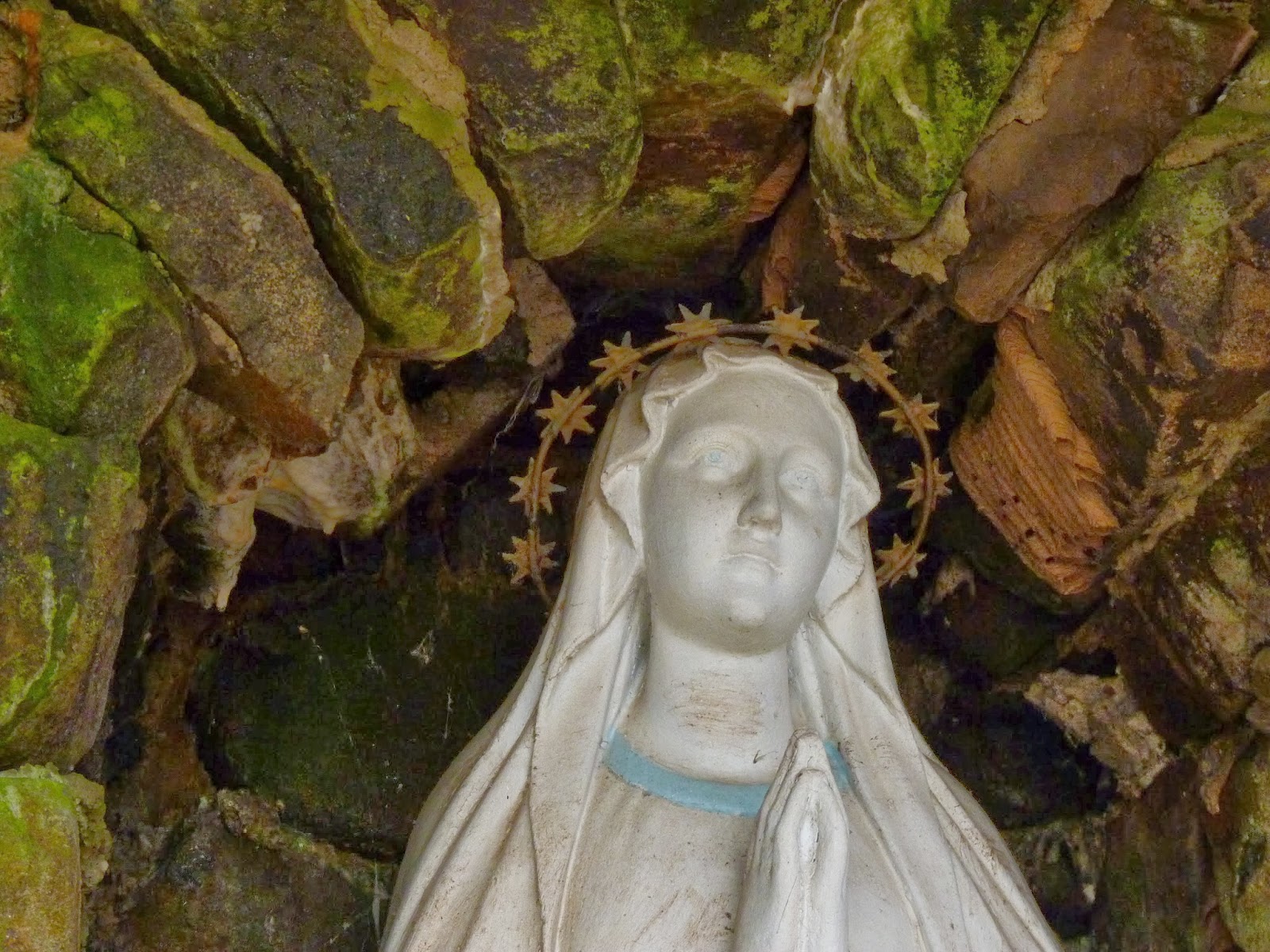
There was the wall of round stones, there the damp cave,


there the statue of Mary and the kneeling girl.


I did not remember it being a shrine to Our Lady of Lourdes, or the memorial plaque in the wall.

I thought there were more flowers but perhaps there are when the weather is warm. We were pleased to see that the shrine had been maintained; both of us remembered getting in trouble one day for sneaking down to the grotto during recess, and having to stand with our faces to the brick wall of the convent during the rest of recess. I can still feel the shame and misery of that! Other than that time, however, my memories of the nuns are of love and laughter, nothing like the grim tales we often hear about Catholic schools.

We thought we'd walk over to the chapel, a place I remember as hushed and sacred, filled with wood and brick and stained glass. But to get to the chapel we had to pass the convent, and there was a doorbell. Was there any possibility, we wondered, that one or two of the nuns still living who were our teachers?

"One way to find out," I said. And pressed the bell. No one came and we started to leave, but then a nun came down the hall and let us in. She didn't look like the nuns I remember with their stiff wimples and black habits. She was dressed in casual clothing, with short hair and really could have been anyone on the street.

"Yes," she said. "Sister Lawrence is still here. She's 88 now, you know. I'll see if she's up to visitors."

We looked at each other. Eighty-eight. She was probably in a wheelchair, I thought, or at least using a walker. She might have Alzheimer's; she might not even remember us. We read the history of the convent while we waited; I don't think I ever knew much about it before.
The door opened and a white-haired lady walked briskly toward us. She was trim and moved with ease, eyes alert behind her glasses. 

"So, you're the Connelly girls!" She remembered us with ease, and we spent a half hour with her, talking about our family, the school and our memories. She told us about her visit to Germany to meet her family; her parents were immigrants to the U.S. She described a bunch of roses they gave her on her arrival, and how the roses held well enough that she could bring them back with her on the plane.

I was sad to hear that Sister Ernestine and some of the other nuns who taught us passed away some time ago. My mother had urged me to go see them but whenever I was in Virginia my time seemed so crowded there was never an opportunity. I am very glad Judy and I took the time this weekend to go back--back in time, back in memory, back to when we were little girls. And I am very glad Grace was with us to share in those memories.


Copyright Susanna Holstein. All rights reserved. No Republication or Redistribution Allowed without attribution to Susanna Holstein.

Tuesday, September 10, 2013

Briar Creek


By the quiet water run young feet, black with dust


and young hands wrapped around bamboo poles, 


towels over thin brown shoulders,


and laughter as thick as the dust raised by passing coal trucks.

Photos taken along  Briar Creek in southern Kanawha County, WV. Words inspired by my husband and his rich store of childhood memories of growing up in the coal camp called Olcott.


Copyright Susanna Holstein. All rights reserved. No Republication or Redistribution Allowed without attribution to Susanna Holstein.

Friday, June 14, 2013

Cherries and Childhood

It's cherry-picking time! I managed to get Larry to wait until most of the cherries were ripe. He gets impatient and wants to pick fruit before it's ready and all you jam-makers know that for the best jam, the fruit has to be dead ripe. This morning was the day, though, and he picked me 3/4 or a two-gallon bucketful.

I sat on the porch to pit them, and the task brought back so many memories. When I was a child, our yard had five or six sour red cherry trees. They were loaded with cherries every year; the biggest tree was the parent of many smaller seedlings, and Dad planted some of those and gave small trees away to several people.

I wonder now what my mother thought as she watched us scamper across the yard with our buckets. She would send us out immediately after breakfast. Each of us had something to pick into, and we would dump the cherries into a large dark-blue granite canning kettle as our containers filled. But imagine the sight of five or six children running across green grass in an old Victorian neighborhood, buckets in our hands and our high voices filling the air with chatter. We were probably wearing shorts, and some of us had our hair in braids.

Mom was most likely standing in the kitchen in front of the sink, watching her brood and thinking...what? How fortunate she was to have such a large family? How noisy we were? How lovely the yard was with flowers in bloom and the vegetable garden showing early promise? Did she enjoy the slant of the sun through the large maple where we had our treehouse, or the distant glimmer of red against green at the end of the yard where the ripe cherries awaited our arrival? Did she worry about us falling out of the tree? Or did she simply go about her work, taking the morning's excitement as routine and not something she might have noticed for what it was, an iconic moment in time, a still-life of a simpler time that she could call back to memory when we were all grown and scattered and even the cherry trees were no longer hers?

I thought about these things as I sat alone on my porch, 300 miles away from my childhood home, pitting the first real crop of cherries from my tree. Red juice squirted on me and on the floor as one by one the cherries moved from colander to bowl and the seeds pinged against the pottery bowl set on the floor to catch them. I have a cherry stoner and it works quite well, but this morning I wanted to do it the way I remembered, to savor the sweetness of memories, to hear again the lost children's voices, and to see the tree bending under my impatient, scabby knees.


Copyright 2012 Susanna Holstein. All rights reserved. No Republication or Redistribution Allowed without attribution to Susanna Holstein.

Wednesday, October 12, 2011

The Five and Dime

To a kid, it was heaven. A candy counter filled with candy of all kinds, much of it within the budget of a child who relied on cashing in pop bottles for spending money.

Rohr's was about a half a mile from our house, but in the 1950's and early 60's no one thought anything about young children walking that far by themselves. We had a few shortcuts, some that our mother didn't like--through the "colored" neighborhood, and by some low-income apartments. When I type this, I think how odd it sounds today but that was my mother's reality at the time. What is really funny is that we certainly qualified as low income but Mom never saw us that way, and we never felt that way either. Our home was filled with books and records of classical music and popular musicals. The neighborhood was genteel and elderly, with Victorian 4x4 houses lining the street and sporting their gingerbread trim. Everyone had vegetable gardens, fruit trees and flowers, and some had chickens and bees. It was not what you might think of as low income and the neighbors were certainly not. But with 13 children and a lineman's salary, Mom stretched dollars to the breaking point.

Allowances were out of the question. There wasn't enough money for that. So pop bottles it was and we scoured the neighborhood and side streets for gthe precious glass bottles. A bottle was worth 2 cents, and 2 cents could buy 2 pieces of penny candy. Three bottles provided enough for a small bottle of Coke or Pepsi and a piece of candy. Five bottles could buy a pop and a Hershey's bar. Or a pop and a popsicle. Or 10 pieces of penny candy--heaven!

We took our bottles to the local market to cash in. Manassas Market actually delivered groceries back then, in a 1957 Chevy panek truck. The owner, whose name I do not recall, patiently took in or bottles, only objecting to the ones that were muddy or not a brand he could take. Once we had our cash in hand, we walked to Rohr's--it was shopping time.

My favorite kinds of penny candy had to be Kits. Why? Because you got 4 pieces of candy for your penny! Red Licorice whips, jawbreakers and Tootsie Rolls were favorites, too. And of course Double Bubble bubble gum with its comic strip inside. If I was lucky enough to have a dime, the choices were huge. Cracker Jacks and a pop? Twinkies? Candy bars, ice cream, or a little bit of something from the glass cases? A dime could buy a quarter pound of several things--chocolate stars were my favorite.

As I got older I learned that life held something other than candy. For 19 cents I could buy a tiny bottle of perfume called Atom Bomb--and yes, it smelled that strong. I could buy the prettiest hankies for a dime and Tangee lipstick for 39 cents. Pencils, pens, cheap toys, and many other things could be bought for under 20 cents.

I also learned to save at least a little of my precious pennies for Christmas gifts. One year I bought my mother a golden, round glass pitcher for 69 cents. I struggled to buy something for everyone else in the family with the little bit of money I could save. All of my brothers and sisters did the same. The pitcher I bought my mother, I now know, was a pattern called Lido by Anchor Hocking, I believe, and today it sells online for between $10 and $25. Mom was thrilled and astounded that I could afford such a thing. I wonder sometimes if she ever knew how hard we tried to get money and how much we enjoyed buying pretty things for her.

Eventually my sister would work at Rohr's, even behind the candy counter, while she was in school. I was not allowed by my parents to have a job--as the oldest daughter, there were many barriers in my way back in those days. But Judy, only a year and a half younger than me, was able to break some of them down and got her driver's license (another no-no for me) and a job. (Mom, I think, realized that it was helpful to have someone who could drive around--the older brothers were seldom home because they had jobs, and well, they were boys and had a lot more freedom to get out. A each sister reached teen years, the limits softened and they had much more freedom than was allowed to me.)

I do not know if Rohr's Five and Dime still exists, but I kind of doubt it. But the memory of the time I spent walking across its squeaking floors and being amazed at what was within my purchasing power is still strong. I doubt the malls of today provide that same level of excitement as the old five and dimes of my childhood.

Friday, January 28, 2011

1958


I am seven. 

My bike is passed-down, passed around, bent up and beat up 
but it rolls
And when you’re eight that’s all that really matters.

Golden broomsedge ripples in heat,
shimmers in the vacant lot;
blue-flowered chicory
lines the road and closes its petals in resignation.

It is August.

I am riding around our block,
along the sidewalk in front of the houses 
and kept gardens and trees bending 
under the weight of ripe damsons.
Tar bubbles glisten like my mother’s jet earrings
and pop under my tires,
like hot applesauce on the Tappan stove 
in Grandma Compton’s kitchen.

I pass behind her house, 
her orchard of apple trees as old as she is,
Then to the gravel road and the old dump
Where concrete chunks provide habitat for dragonflies and bamboo,
a hiding place 
for girls with sweaty hair and bare feet.
I watch the dragonflies skim over algae-green puddles
And dream of flying, cool in the water’s reflection,
Into the shadows of hidden places where my mother’s voice
Will not reach me. 

Back on my bike I ride
Into the shadow of mulberries, maples, apples and ash.
Dust turns me golden, ghost-like, 
a mirage that shimmers 
in five o’clock heat.

It is 1958.

On a back road in a small town all that matters
 is flying, flying, 
my sunburnt hair streaming behind
my face pushing eagerly ahead
while all the world is rushing by.

This poem was inspired by pulling words out of a bag of paper strips. Each strip contained a different word or phrase--in this case the words I pulled out were blue-flowered chicory, damsons, heat shimmers, bamboo and tar bubbles. Immediately I was back on my rattling bike, riding on a dirt road in mid-August. Funny how words can do that.
Related Posts Plugin for WordPress, Blogger...