Pages

Showing posts with label medicinal plants. Show all posts

Wednesday, May 11, 2016

Herbal Legend and Lore: Rosemary, Sage, Fennel and Marjoram

Maybe I should have followed the old song's lyrics and had parsley, sage, rosemary and thyme all together! But I did two of them yesterday, so today let's look at a few others.

Rosemary is the herb of remembrance.It is also a bringer of beauty, if one washes with it. English herbalist and writer Gervase Markham wrote in 1615 that "rosemary water (the face washed therein both morning and night) causeth a fair and clear contenance." The herb is also supposed to aid memory, and even as far back as ancient Greece students wove crowns of rosemary to wear when taking exams. A healthy rosemary plant might indicate some power struggles in families, as a good strong rosemary plant growing in the garden was thought to indicate that the woman was the head of the household. A strong plant and a weak plant might be a good plan to preserve family harmony!

In Catholic tradition, it was said that the flowers of the rosemary plant were once white, but when the Virgin Mary laid her cloak down on them, the flowers turned blue. While it is true that some rosemary flowers are blue, there are also white, pink and lavender varieties.


Ah, sage! What would sausage and stuffing be without this pungent herb? Another of the Mediterranean herbs, there is also a sage that is native to the southwestern regions of America and it is a sacred herb to many Native Americans, used in a variety of religious rituals and healing remedies. Smudging, or burning bundles of sage, is a purification ritual. 

Sage has long been considered the herb of wisdom--we refer to a wise person as a "sage" and to good advice as being "sagacious." Ancients also thought use of sage could prolong a person's life and thus it was considered the herb of immortality.

Fennel was never one of my favorite herbs. In fact, its licorice flavor did not appeal to me at all. Recently I've begun experimenting with using fennel in a few recipes and have been surprised to find that I like it. Maybe my tastes have changed? Fennel is a member of the carrot family and is yet another herb that originated in the Mediterranean region and then spread all over the world. One fairly creepy belief was reported by the Roman author Pliny who said that snakes would rub against fennel to improve their eyesight. Apparently the early Brits thought the same, for an old herbal included the following rhyme:


'Whaune the heddere (adder) is hurt in eye
Ye red fenel is hys prey,
And yif he mowe it fynde
Wonderly he doth hys kynde.
He schall it chow wonderly,
And leyn it to hys eye kindlely,
Ye jows shall sang and hely ye eye
Yat beforn was sicke et feye.'--from the website Botanical.com
Which says, basically, that is an adder (snake) is hurt in his eye, he needs only rub against and chew red fennel and his eye shall be healed. Hmmm. My fennel is copper fennel. I hope it doesn't attract sick snakes...

In Medieval Europe, fennel was thought to protect against ghosts and evil spirits. So, if you feel you need such protection, hang some fennel over your door and put some fennel seeds in your keyhole. Medicinally, fennel syrup was used for cough medicine, and fennel was also thought to repel fleas.

from Wikipedia
Sweet Marjoram, it was once believed, would only grow on the grave of a deceased person if the person was happy. However, if you lived in Portugal, you were likely to stay away from marjoram because smelling it could make your nose fall off!  Marjoram was used for whooping cough relief and for a mouthwash. It is another Mediterranean herb, One old love charm was  made with marjoram, marigold flowers, thyme and wormwood. These were simmered with honey and vinegar, and then used to anoint breasts, stomach and lips, repeating, "St. Luke, St, Luke, be kind to me, In dreamlet me my true love see." (Dictionary of Plant Lore). 

Marjoram was another herb considered to be the bringer of love and beauty. According to the website Mother Earth News, 

"The Greeks — who gave the plant the name Origanum, meaning "joy of the mountains" — crowned newlyweds with marjoram to wish the couple enduring happiness, and laid wreaths of the herb on graves to insure the contentment of the dead."

So there's four more of our familiar spice shelf herbs. Seems that there is much more to them than adding flavor to our spaghetti and fish!


Copyright Susanna Holstein. All rights reserved. No Republication or Redistribution Allowed without attribution to Susanna Holstein.

Tuesday, May 10, 2016

Herbal Legend and Lore: Basil, Parsley, Thyme and Dill

Sunday I planted a few herbs in a concrete planter. For years I've grown my annual herbs from seed planted in a garden, but this year I'm changing it up. I realized that I didn't need near as much as I was planting, and that I preferred to have the herbs close by and accessible. Perhaps it's a sign of aging, but planters have slowly been taking over as my planting choice for annual flowers too.

So into the planter went basil, dill, thyme, and parsley. I still have oregano, chives, thyme, fennel and a few others in the garden--the perennials. Rosemary and sage are in big planters on the deck that I can move indoors in winter to keep them alive. Our winters, with their extremes of temperature, are not kind to these tender perennials, and even thyme has a struggle to survive them.

As I planted I realized that I know little about these plants. Well, I know that most of them come from Mediterranean clime. And I know how to dry or otherwise preserve them and how to cook with them. But I don't know a great deal about their history, or the folklore attached to them. So I've been doing a bit of reading up, and here's some of what I have learned.

Our herb garden in 2011. Perennial weeds eventually took over this space, and it became impossible for me to keep up with it, so the herbs were moved to new locations in various flower beds. Except the fennel, which does not like to be moved, so it still occupies a small space in the center of this plot along with some chives.
Basil: to have a successful planting, you must cuss the basil as you plant. Really? Really. And if you want to attract the attention of the opposite sex, put a planter of basil on your balcony or doorstep (Romeo, Romeo, wherefore art thou? I wonder if Juliet had some basil on her balcony?). Basil might also cause the unwary to have scorpions in their brains. How that could possibly happen the folklore doesn't explain, but just so you know. Given that belief, basil was thought to be a harmful plant, but others considered it to be healthful and a bringer of happiness. Take your pick.

A basket of herbs, ready to dry, from a blog post in 2008
Thyme: Often used as a strewing herb, thyme was believed to have been in the bedstraw when Mary bore Jesus. Strewing herbs were scattered on the floor and around a room to remove unpleasant odors in bygone days, and you can imagine how nice they would smell when trampled underfoot. Fairies, the old lore says, could be found in patches of wild thyme. Thyme was also a key ingredient in at least one love potion, and was used in purification ceremonies. Wearing thyme in your hair might help attract a lover too, so along with basil on your porch, you might want to tuck some thyme in your hair.

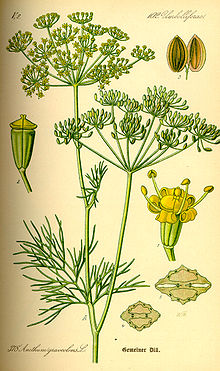
Dill: Sometimes called meeting herb because in colonial times ladies chewed the seeds during meetings to stay awake--a trick that we might need to revive! However, some think today that chewing on dill will induce a good night's sleep, so take your choice. Chewing dill seeds is also thought to cure hiccups, and to ease the pain of gout and arthritis. While other herbs are sometimes mentioned in folktales, I do not think I've ever encountered a mention of dill, but there are sure a lot of dill jokes.

Dried parsley
Parsley: While basil must be cussed at to properly germinate, parsley, according to the ancients, has to travel nine times to the Devil before it sprouts--one explanation for why it is so difficult to get the seeds to come up.  The seeds that don't germinate are the ones the Devil keeps! Whoa. I learned to plant in June, and cover the seedbed with newspaper kept moist to encourage good germination. There are some not-so-great associations made with parsley: "Welsh parsley" was slang for the gallows rope, and parsley was associated with other bad luck in many places. In several cultures it was connected with death, and used to scatter over a grave at a burial and to make funeral wreaths. However, the Romans fed parsley to their horses to keep them healthy, and its roots were considered an aphrodisiac. As we now know, parsley is full of vitamins and minerals and considered a healthy as well as attractive addition to foods.

This is just the tip of the iceberg where herbs and their lore are concerned. Here are a few websites to explore for more fascinating insights into the past and present of our culinary herbs:

Our Herb Garden is a compendium of myth and practical advice for the herb gardener.

Mother Earth Living provides history, folklore and growing tips.

The Sanctuary Gardener is a blog by a southern transplant that explores all kinds of gardening wisdom and homesteading, including herbs.

A booklist for further reading by Madronna Holden, Oregon State University.

Then use all those herbs you've grown to make your own bouquet garni for soups and other dishes.


Copyright Susanna Holstein. All rights reserved. No Republication or Redistribution Allowed without attribution to Susanna Holstein.

Monday, July 8, 2013

Roadside Weeds: Wild Bergamot, or Bee Balm

There are many plants in bloom at this time of year. Usually I am too busy to take notice, much less write about them. But there are some that just cry out for a post, like bergamot.


Every morning I drink Earl Grey tea. I love its floral fragrance and unique flavor. Earl Grey gets its distinctive qualities in part from a variety of citrus fruit, the bergamot orange. But there is also a member of the mint family commonly called bergamot, and its fragrance is very near that of Earl Grey tea, at least to me.

Many people grow this plant in their flowerbeds and may never realize the strong aroma carried in its leaves. Bees love it too, hence the common name bee balm.
Bergamot comes in several colors; I have a deep lavender in my garden.

The wild version is usually a paler lavender although I have also seen the red variety growing wild--probably an escapee from someone's flower bed.

Bergamot has been known for centuries for its herbal properties. Native Americans used it extensively for medicinal purposes. The USDA Plant Guide website offers the following information:

Ethnobotanic: The Tewa Indians because of the flavor it imparted cooked Wild bergamot with meat. The Iroquois used the plant in the making of a beverage. The plant has a wide variety of medicinal uses. 

The Ojibwe put a wad of chewed leaves of this plant into their nostrils to relieve headache. The tops of the plant were dried and used as a sternutatory for the relief of colds. The leaves were placed in warm water baths for babies. The Flambeau Ojibwe gathered and dried the whole plant, boiling it in a vessel to obtain the volatile oil to inhale to cure catarrh and bronchial affections. The Menomini also used this plant as a remedy for catarrh, steeping the leaves and inflorescences in a tea. The Meskwaki used this plant in combination with other plants to relieve colds.  

The Hocak (Winnebago) used wild bergamot in their sweat bath and inhaled the fumes to cure colds. A decoction of boiled leaves was used as a cure for eruptions on the face. The Cherokee made a warm poultice of the plant to relieve a headache. The Teton Dakota boiled together the leaves and flowers as a cure for abdominal pains. The Blackfoot made a tea from the blossoms and leaves to cure stomach pains. They also applied boiled leaves to the pustules of acne. 

The Tewa dried the plant and ground it into a powder that was rubbed over the head to cure headaches, over the body to cure fever, and as a remedy for sore eyes and colds. Early white settlers used it as a diaphoretic and carminative, and occasionally employed it for the relief of flatulent colic, nausea and vomiting. 

It would seem this plant is a cure-all to read this! Personally, I like it simply for its lovely flowers, aromatic leaves and the benefit to our honeybees. That's enough for me.


Copyright 2012 Susanna Holstein. All rights reserved. No Republication or Redistribution Allowed without attribution to Susanna Holstein.

Friday, April 9, 2010

Bloodroot


Every spring I look for bloodroot on the roadbanks along Joe's Run. It is one of the earliest spring flowers and its white blossoms are large and bright after a long winter. Some years I see it, others I don't. I knew of one place where I could almost always find it, but for the past two years it has not been there.
Wednesday as we drove into town for mulch, I spotted white flowers on the opposite side of the road from where I have found bloodroot before. There were a lot of them. Maybe it wasn't flowers, I thought. Maybe it's just dandelion seedheads. Because these flowers were in a sunny location and I knew bloodroot prefers moist, shady, rich soil. Definitely could not be bloodroot.

But what if...?

"Stop," I told Larry. "Back up." Familiar words in our car--he hears them a lot. "Please?" I added.

The please must have surprised him because he backed up. It was a good ways back that I had seen the flowers and my ruminations about whether they could grow in such a location meant that we'd traveled a few hundred feet down the road. Being a one-lane road between bank and hillside, there are few places to turn around, particularly in this stretch that borders the lake.

But there they were--bloodroot in full flower scattered under the dry remains of last summer's tall wildflowers and weeds. The flowers, a waxy white with yellow centers, were hugged by their leathery, mitt-like leaves. So pretty. Of course I took pictures.

When I got home I wondered about the uses of bloodroot. A friend mentioned that people in her area dig it to sell to root-and-herb dealers. What value did the plant have?

I started with the USDA site.

Hunh.

There I found taxonomic information but nothing about uses. Links on the USDA page led me to Wildflower.org, a website for the Ladybird Johnson Wildflower Center Native Plant Network. On this site I learned that the plant is considered toxic--specifically, "Warning: POISONOUS PARTS: Rhizome (thickened roots). May be fatal if ingested! Symptoms include nausea, vomiting, faintness, dizziness, dilated pupils, fainting, diarrhea, heart failure. Toxic Principle: Isoquinoline alkaloids."

O-kay. That's pretty direct. So why did some people dig it up for sale? Surely there aren't that many poisoners in the market for bloodroot? (I hope)


Well, there are a few other uses--as a red dye, for instance, as Native Americans used to do. They also used it as an insect repellent, but after reading the above warning, I think I'll stick with commercial products. Early settlers in America put a drop of bloodroot on a lump of maple sugar and used this as a cough medicine (1). Since the plant has known poisonous properties, this is not recommended today.


Native Americans also used the plant to make a tea for rheumatism, asthma and other lung ailments (2). Early New Englanders hung a piece of bloodroot over their beds as a cure for toothache (3), and in Voodoo practices bloodroot was believed to have magical properties to remove a hex, and as a protection for marital accord (4). More recent uses of bloodroot include: as a plaque inhibitor in toothpaste, in mouthwash, and rinses (5).


Given the strong warning against ingesting or otherwise using bloodroot, I think it's best to admire the flower and the strong red juice that will drip from its broken root, and otherwise leave the plant to its own devices.

Some gardeners like to use bloodroot as a groundcover in shade gardens because its fairly large leaves remain green most of the growing season. Collecting the seeds, according to my friend and herbalist Melissa Dennison, can be tricky because the seedpods are like those of touch-me-nots
(also called jewelweed) and burst when you touch them. However, you might be able to gather them by spreading a sheet on the ground under the plants.

I prefer to leave bloodroot in the wild and seek it out each spring when the first wildflowers are in bloom. There is something about the seek-and-find that I enjoy, and the surprise of the beautiful white blossoms of bloodroot is worth the time to stop, back up, and enjoy.

Those interested in Appalachian culture and folklore might want to check out Bloodroot: Reflections on Place by Appalachian Women Writers. It is not about wild plants, but rather about the way women in this region view their homes, families and culture. Like the plant, Bloodroot examines a place and a lifestyle that is both beautiful and painful.
Bloodroot: Reflections on Place by Appalachian Women Writers, published in 1998 by the University of Kentucky Press. I highly recommend it.

1. Coffey, Timothy. The History and Folklore of North American Wildflowers. Houghton Mifflin Company, NY: 1993.

2. Foster, Steven and James A. Duke. A Field Guild to Medicinal Plants and Herbs of Eastern and Central North America. Houghton Mifflin Company, NY: 2000.

3. Hatfield, Gabrielle. Encyclopedia of Folk Medicine" Old World and New Traditions. ABC-CLIO: 2003.
4. Bloodroot hubpage. http://hubpages.com/hub/Bloodroot
5. Foster, Steven and James A. Duke. A Field Guild to Medicinal Plants and Herbs of Eastern and Central North America. Houghton Mifflin Company, NY: 2000.


There is a book that those interested in Appalachian culture and folklore might want to check out: Bloodroot: Reflections on Place by Appalachian Women Writers, published in 1998 by the University of Kentucky Press. I highly recommend it.


Friday, June 6, 2008

Spring Wildflowers: Betony and Bluets

A road bank covered with Wood Betony in early spring. What a pretty sight.

This lovely little plant grows abundantly on Joe's Run. It has two common names in plant lore: Wood Betony, or Lousewort. Guess which one I prefer? Its Latin name is pedicularis canadensis, and it is a fairly widespread plant in parts of the US and Canada.


Wood Betony, according to Botanicals.com, was believed to have many healing properties. Native Americans also used the herb for ailments such as stomachaches, and in coughmedicines, according to Peterson's Field Guide to Eastern/Central Medicinal Plants and Herbs. However, Peterson's also notes that the plant is not currently being studied for medicinal uses.


(Although I enjoy reading the lore and history of wildflowers, I do not recommend use of any plant as a remedy.)


A close-up view of the flowers--look at the way the flowers form a whorl around the center.


Betony and Bluets (also called Quaker Ladies. Isn't that a fitting name for this modest little flower). These are another of my favorite tiny flowers of spring. Look at how these colors complement each other--a master painter at work here.


Wednesday, May 14, 2008

Spring on Joe's Run: Part 5


Wild ginger finds a fertile home in the crotch of a tulip poplar tree.


Above the ginger, the twin poplars soar into the blue above,


while a community of mayapples thrive in the shade below. Also known as mandrake because of the shape of its root, the mayapple has long been coveted for its medicinal uses. Settlers learned from the natives how to use this plant for ailments; today over $200 million worth of medications made from the mayapple are produced for use in chemotherapy for several types of cancer (source: Eastern/Central Medicinal Plants and Herbs by Steven Foster and James A. Duke--one of the Peterson Field Guides).

Orville's old home on the right fork of Joe's Run. The epitome of simplicity.

Monday, May 12, 2008

Spring on Joe's Run: Part 4

White violets hide beneath taller plants around them. What beauties these are! I have been searching for the stemmed variety, once prevalent in the area now occupied by the community center, and for the sweet yellow ones, but so far I have seen neither. Since my bad knee doesn't allow me to venture far from the road, I may not see either this year.
Young violet leaves are excellent in salads, and the flowers make a lovely, light-flavored jelly. The purple blossoms are best for jelly because they will lend their pretty color to it.

Here's a recipe for violet jelly:

Wild Violet Jelly
2 cups violet flower juice (see instructions on how to make this below)
Juice of 1 lemon, or 1 tbsp prepared juice
1 package powdered pectin
4 cups sugar

To make the juice: Tightly pack 1 quart jar full of violet flowers. Fill with boiling water, cover and let steep in the refrigerator overnight. Strain off the juice and discard the flowers.

To 2 cups of this juice, add the lemon juice and powdered pectin. Stir to dissolve the pectin. Bring to a boil and add the sugar all at once. Return to a full rolling boil and boil for one minute.

Skim off foam, ladle into jars and seal. Makes approximately 5 1/2 pints.


Wild ginger (Asarum canadense) bloom. Can you spot its flower? This is probably the best-camouflaged blossom in the woods. If you look closely at the base of the leaf that is turning to the left, you will see a spike of pink. That is part of the blossom. The tiny greenish circle below the pink spike is the center of the flower, and the brown spike is another of the three spikes that surround the liquid-y center. Wild ginger is pollinated by ground insects that crawl into its center, and by ants that are attracted to the sticky coating on its seeds.


Early settlers used wild ginger as a ginger substitute, and it will smell like ginger should you happen to step in it in the forest. The settlers ate the ginger's root fresh (crushed), dried (powdered), or candied.

Native Americans used wild ginger for many medicinal purposes. Some people today believe the plant may have antibiotic properties. I love it for its compact, lush growth pattern and heart-shaped leaves--and also because it makes me search for its flowers.


Trillium (Trillium grandiflorum) was almost finished its bloom season when I found this one. As the flowers age, they turn from white to pink to a reddish-purple. There is nothing prettier to me than a hillside clothed in trillium, especially when the flowers begin changing shades.

Picking trillium may cause the loss of plants, according to several websites I found. The leaves contain vital nutrients and their loss can mean the death of the plant. Although in the past the leaves were used in salads, it doesn't seem worth the loss of so much beauty for a slight addition to a meal.

Also called Bethroot (a corruption, perhaps, of birthroot), Trillium was used by the Native peoples for women's health issues and in childbirth. The plant was considered a sacred plant, and only women used it. It is listed as an "at risk" species by forestencyclopedia.net.
Related Posts Plugin for WordPress, Blogger...