I'm back, and I'm tired. A full week of storytelling, visiting family, and driving, driving, driving. All went well with the exception of one performance that had to be canceled due to car problems--a real disappointment, because it was in the town where my parents had lived, and my sister Mary, her daughter and grandchildren were planning to attend.
The good new is the performance has been re-scheduled for November 17th, Tellabration Day! So that will be a very fitting time to be there, telling stories.
Other than that, the week was magical, and I have many photos and memories to share. Reconnecting with old friends at the parks, meeting new friends at the libraries, running into connections in the oddest places--I'll begin posting it all tomorrow. Tonight, it's time to sleep in my own bed. What pleasure!
Tuesday, July 31, 2007

Friday, July 27, 2007
Telling Tales with Clayton and Grace
The past two days I've had some sub-contractors telling stories with me--my grandchildren Clayton (11) and Grace (9). This is a paying gig for them--$10 a day to help me load, unload, set up, take pictures etc.
Clayton has learned to tell a story with me and performed it at each place we've been--even at his sister's birthday party, in front of 30 or more family members. Any storyteller knows that those who know you well can be the toughest audience of all, but Clayton did a great job.
What's the story? Many storytellers know it as No News, made popular by the storytelling duo the Folktellers in the 70's and 80's. Here's a short version of the way Clayton and I tell it.
Clayton is returning from vacation and I pick him up at the airport. He asks about the news from home.
"What's the news from Grant County?"
"Oh, it's been real quiet. No news at all."
"No news at all? Nothing."
"Nope. It's been real quiet. Say, on our way home would you like to look at a new pickup truck. We can just stop at the Ford garage..."
"Why? I've got a good truck, just bought it last year."
"Yes, but your truck is all burned up."
"What? What happened to my truck?"
"Well, you left it in your garage, and your garage burned down and your truck was in there so it burned too."
"My garage burned down? How on earth did that happen?"
"Oh, that was a spark from the house. It was a real windy day and a spark blew over and lit on your garage. Burned it completely to the ground and your truck was in there so...do you want to stop at the Ford garage or not?"
"Wait. A spark from my house? Did my house burn too?"
"Yep. Burned completely up."
"But how did that happen?"
"Well, that was on account of the candles. It was a windy day like I told you and the wind blew the curtains into the candles and caught them on fire, and then the curtains caught the house on fire and that spark blew over to the garage...that's how your truck got burned up you see, it was actually on account of the candles."
"Candles? I don't even like candles! I never have them in my house! Why were there candles in my house?"
"Oh, that was on account of the coffin. We had the candles all around the coffin..."
"Coffin? You're telling me someone died? Who died?"
"Now that was your mother-in-law. She passed away while you were gone."
"My mother-in-law? But she was fine when I left! What happened to her?"
"Well, I don't know for certain, but folks say it was on account of she had a heart attack when she found out that she had burned up your winning 6 million dollar lottery ticket. But other than that, there's been no news.
So, you want to see about that truck?"
Grace had a role in the stories, too, playing the drum and helping set up props and puppets and taking pictures when Clayton was busy. We've made a good tea, and I'll be sorry to lose their help after today. I'll also be sad to lose their company. These two are great listeners who asked for stories and songs as we drove from place to place. It was a magical time, driving through the beautiful mountains, singing and talking about stories.
Today it's off to Hardy County to stay with my sister Judy, maybe stop at her stables, Hidden Trails Stables, at Lost River State Park, and stroke a few horses. Then tomorrow I'll leave early in the morning to drive to Fauquier County, Virginia, to tell more stories, sing more songs, and meet some wonderful library people in person. So far, they've been email friends, and it will be lovely to put faces to the names.
Clayton has learned to tell a story with me and performed it at each place we've been--even at his sister's birthday party, in front of 30 or more family members. Any storyteller knows that those who know you well can be the toughest audience of all, but Clayton did a great job.
What's the story? Many storytellers know it as No News, made popular by the storytelling duo the Folktellers in the 70's and 80's. Here's a short version of the way Clayton and I tell it.
Clayton is returning from vacation and I pick him up at the airport. He asks about the news from home.
"What's the news from Grant County?"
"Oh, it's been real quiet. No news at all."
"No news at all? Nothing."
"Nope. It's been real quiet. Say, on our way home would you like to look at a new pickup truck. We can just stop at the Ford garage..."
"Why? I've got a good truck, just bought it last year."
"Yes, but your truck is all burned up."
"What? What happened to my truck?"
"Well, you left it in your garage, and your garage burned down and your truck was in there so it burned too."
"My garage burned down? How on earth did that happen?"
"Oh, that was a spark from the house. It was a real windy day and a spark blew over and lit on your garage. Burned it completely to the ground and your truck was in there so...do you want to stop at the Ford garage or not?"
"Wait. A spark from my house? Did my house burn too?"
"Yep. Burned completely up."
"But how did that happen?"
"Well, that was on account of the candles. It was a windy day like I told you and the wind blew the curtains into the candles and caught them on fire, and then the curtains caught the house on fire and that spark blew over to the garage...that's how your truck got burned up you see, it was actually on account of the candles."
"Candles? I don't even like candles! I never have them in my house! Why were there candles in my house?"
"Oh, that was on account of the coffin. We had the candles all around the coffin..."
"Coffin? You're telling me someone died? Who died?"
"Now that was your mother-in-law. She passed away while you were gone."
"My mother-in-law? But she was fine when I left! What happened to her?"
"Well, I don't know for certain, but folks say it was on account of she had a heart attack when she found out that she had burned up your winning 6 million dollar lottery ticket. But other than that, there's been no news.
So, you want to see about that truck?"
Grace had a role in the stories, too, playing the drum and helping set up props and puppets and taking pictures when Clayton was busy. We've made a good tea, and I'll be sorry to lose their help after today. I'll also be sad to lose their company. These two are great listeners who asked for stories and songs as we drove from place to place. It was a magical time, driving through the beautiful mountains, singing and talking about stories.
Today it's off to Hardy County to stay with my sister Judy, maybe stop at her stables, Hidden Trails Stables, at Lost River State Park, and stroke a few horses. Then tomorrow I'll leave early in the morning to drive to Fauquier County, Virginia, to tell more stories, sing more songs, and meet some wonderful library people in person. So far, they've been email friends, and it will be lovely to put faces to the names.
Tuesday, July 24, 2007
On the Road Again!
I'm off for several days of storytelling in Virginia and West Virginia. I may not be posting much while I'm gone, but I hope I'll meet up with a few of my readers along the way.
Please check my other blog (www.grannysue.blogspot.com) for the complete schedule.
Ah, the stories I'll have to tell when I return!
Please check my other blog (www.grannysue.blogspot.com) for the complete schedule.
Ah, the stories I'll have to tell when I return!
Monday, July 23, 2007

10 Reasons why commuting 50 miles one way to work can be a problem;
1. The sunrise is too beautiful to walk away from.
2. A tree is blasted by a huge storm and blocks the road
2. A tree is blasted by a huge storm and blocks the road
3. The phone rings and it’s the son in Germany or Iraq or even just down the road.
4. Two young buck deer stand in the road in front of you, and you don’t have your camera.
5. The book you’re reading calls to you at 6am and you can’t put it down.
6. The morning sun filters just so across the porch.
7. The coffee is hazelnut or vanilla steaming in the cup.
8. The writing mood hits and there’s a poem at the other side of your brain.
9. Snowflakes stick like lace to the windowpanes.
4. Two young buck deer stand in the road in front of you, and you don’t have your camera.
5. The book you’re reading calls to you at 6am and you can’t put it down.
6. The morning sun filters just so across the porch.
7. The coffee is hazelnut or vanilla steaming in the cup.
8. The writing mood hits and there’s a poem at the other side of your brain.
9. Snowflakes stick like lace to the windowpanes.
10. Snowbirds pick the last seeds under the feeder.
Why Do We Tell Stories?
It's a question that comes up over and over again. Why do we do this? It's not easy--often we go into settings that have no concept of what a storyteller, or storytelling, is. Frequently we must explain that storytelling is not reading stories to little children. Sometimes we must listen to people tell us that they could tell some tales, too. Occasionally we must turn down an event because the organizers thinks we are sweet little old ladies who tell stories just to have something to do.
So why do we tell stories, and why do we keep facing the scenarios above?
Every teller probably has a different answer. For me, it's very clear: I tell stories to reconnect people with who they are and where they came from. Sure they live in suburbia today, but somewhere back in their heritage there are ancestors with their feet in the dirt, living on a farm or making their way across the mountains. That is what I want to recall, the links to heritage and history and family.
If I can make one person wonder about where they came from and go home to begin that search, I've been successful.
If I encourage one child to ask a parent, "when did you get in trouble?" I've been successful.
If I manage to recall to one person the little house they grew up in, that's success.
If one person goes home determined to learn more about their family, I did something good.
If one person suddenly sees a grandparent in front of them, it is worth every minute of effort I put into it.
That's what storytelling is--connecting, connectivity, remembrance and remembering.
That's why I tell stories.
So why do we tell stories, and why do we keep facing the scenarios above?
Every teller probably has a different answer. For me, it's very clear: I tell stories to reconnect people with who they are and where they came from. Sure they live in suburbia today, but somewhere back in their heritage there are ancestors with their feet in the dirt, living on a farm or making their way across the mountains. That is what I want to recall, the links to heritage and history and family.
If I can make one person wonder about where they came from and go home to begin that search, I've been successful.
If I encourage one child to ask a parent, "when did you get in trouble?" I've been successful.
If I manage to recall to one person the little house they grew up in, that's success.
If one person goes home determined to learn more about their family, I did something good.
If one person suddenly sees a grandparent in front of them, it is worth every minute of effort I put into it.
That's what storytelling is--connecting, connectivity, remembrance and remembering.
That's why I tell stories.
Not Even Done With the Last Trip...
...and I'm off again! This time to eastern West Virginia and northern Virginia to tell stories at libraries and parks, and to see some of my grandchildren along the way. To see my schedule, go to www.grannysue.blogspot.com
What kinds of stories for this trip? For the libraries, I'll be telling stories to fit their "Get a Clue" theme--riddle stories, mysteries,etc. For the WV parks, I'll focus on Appalachian stories and ballads.
I'll be visiting with my son and grandchildren in Grant County, WV, with my sister in Hardy County, WV, with my second son and grandchildren in northern Virginia, with numerous sisters, nieces and nephews in Fauquier County, VA, and then I'll be back home with three granddaughters! It will be an exciting week and I'll be sharing pictures and more when I can.
What kinds of stories for this trip? For the libraries, I'll be telling stories to fit their "Get a Clue" theme--riddle stories, mysteries,etc. For the WV parks, I'll focus on Appalachian stories and ballads.
I'll be visiting with my son and grandchildren in Grant County, WV, with my sister in Hardy County, WV, with my second son and grandchildren in northern Virginia, with numerous sisters, nieces and nephews in Fauquier County, VA, and then I'll be back home with three granddaughters! It will be an exciting week and I'll be sharing pictures and more when I can.
Sunday, July 22, 2007
A True West Virginian: Fred Noble

While we were at the John Henry Memorial, a pickup truck pulled in and stopped. I noticed the man inside was on his mobile phone, and figured that like many places in West Virginia, this might be a spot where people could get reception--often you will see people pulled off the road on top of a hill, talking on a cell phone and you know that it must be the only place with service for miles around.
But when he finished his call, this gentleman rolled down his window and asked if we knew how to get down to the tunnel entrance. (As we were talking to him, another truck pulled in. Seemed the second driver noted my sister's out-of-state tags and stopped to give her a brochure and tell her about John Henry Days!)
West Virginians are never shy about talking to strangers. Mr. Noble gave us directions down to the entrances to the two tunnels--the Big Bend and the Great Bend railroad tunnels are side by side. We talked about the old caboose at the monument site, and he asked where we were from. I told him that I was a storyteller, and he assured me he could tell a few lies himself--and I believe he just might!
Mr. Noble is a retired federal prison guard (we weren't far from Alderson Federal Prison, made famous by Martha Stewart's stay). His family has been in that part of West Virginia since the 1700's. He said one of his ancestors from that time period was buried in Summer's County, and that his "scribe" was buried beside him. According to Mr. Noble, a scribe was akin to an accountant in those days.
Meeting people like Mr. Noble is one of the greatest pleasures I enjoy when traveling in West Virginia. At 84 years old, he runs a fairly large campground on the Greenbrier River, drives himself around quite competently, is involved in several civic organizations, and seems as healthy as a man half his age. His interest in people and his surroundings will probably keep him going for many more years. He's no slacker when it comes to technology either--cell phone noted, and he sent me an email last night. This is a man who isn't afraid of change.
If you're ever in the Talcott area, look him up. He's full of stories, and he might talk you into taking a camp site too!
Stories at the River's Edge Article
Well, it's only a week or so old, but I found it tonight while looking online for something else! So here it is.
The John Henry Story

I had to go back. I wanted my sister, a kindergarten teacher, to see the place where one of America's folk heroes supposedly lived and died. I wanted to go again myself.
I remembered my last trip, on a rainy, foggy day. As I opened my car door at the tunnel, I heard the sound of hammer on steel. It was uncanny, surreal. I stood silent and listening, then finally realized that it was no ghost, but a man working on something on the other side of the screen of trees along the train tracks! So once again I made the short drive from Pipestem Resort to Talcott, West Virginia, to step back into history, this time with my sister, her husband and Larry.

Who was John Henry? Was he a real man? Did he really beat a steam drill in a contest, and die with the effort? Most school children learn the song but little about the man behind it.

No one knows all the answers about this American legend. That there was such a man who worked on the Great Bend tunnel in Talcott, West Virginia, seems to be fact. A freed slave, reports from people who claimed to know him said he was a mighty man of almost six feet, possibly from Virginia or North Carolina.

In southern West Virginia a monument to this legendary figure was erected over the tunnel where he supposedly lost his life. An annual festival called John Henry Days is held every July.
Want to know more? try these websites:
Pipestem: Storytelling

This is the third year I've been invited to perform at Pipestem Resort and State Park for the Summer Performers in the Parks series. The performances are sponsored by the WV Division of Natural Resources and bring a wide variety of performers to the parks for free events for park visitors.
Fred Powers, a storyteller in southern West Virginia, came by to listen. Fred is working on a program of coal mining stories. He performs in the clothing of a miner, complete with the coal-dust face and clothes. He tells stories from the perspective of one who has been a miner himself, and knows the dangers and rewards of a miner's life. I expect that his program will have strong demand for its timeliness and interest in the topic. His stories need to be told.
As usual, I stayed for almost an hour after the program was over, talking to attendees who had questions or stories to share. It was a beautiful evening, with deer grazing behind the amphitheatre as the sun went down. A fitting setting for stories that are as much a part of West Virginia as our mountains.
Pipestem and Celebration

Where to begin? Last year? Last September? Last month? Last month might be the best place.
It started with an email. When are you performing at Pipestem Resort? I checked my schedule: July 20th, I emailed back.
Last year my sister Maggie and her husband Roger surprised me by arriving at Pipestem just in time for my storytelling performance. They were on vacation and made a 150-mile detour to be there. We had a great time--Maggie lives in eastern Maryland and we don't get to see each other very often.
In September, disaster struck. Roger was badly burned in an explosion, a freak accident that left him with severe burns over 67% of his body. Survival, given the location and severity of the burns, was unlikely.
It was a tough year, but they made it through 18 surgeries, numerous skin grafts and infections and setbacks. This year our meeting at Pipestem was a planned celebration. Roger faces more surgery of the plastic variety, more skin grafts and more therapy in the coming months. But the outlook is 100% better than it was last September.
It started with an email. When are you performing at Pipestem Resort? I checked my schedule: July 20th, I emailed back.
Last year my sister Maggie and her husband Roger surprised me by arriving at Pipestem just in time for my storytelling performance. They were on vacation and made a 150-mile detour to be there. We had a great time--Maggie lives in eastern Maryland and we don't get to see each other very often.
In September, disaster struck. Roger was badly burned in an explosion, a freak accident that left him with severe burns over 67% of his body. Survival, given the location and severity of the burns, was unlikely.
It was a tough year, but they made it through 18 surgeries, numerous skin grafts and infections and setbacks. This year our meeting at Pipestem was a planned celebration. Roger faces more surgery of the plastic variety, more skin grafts and more therapy in the coming months. But the outlook is 100% better than it was last September.
Storytelling, Sisters, Sandstone and more
It was a very busy day, and a long drive home. I have a lot to tell, but I am tired, tired and it is late (or early, depending on your perspective!).
Tomorrow I will start posting about storytelling at Pipestem Resort, seeing my sister Maggie and her man Roger, going to the John Henry tunnel and Sandstone Falls, meeting Mr. Noble and much more.
For now, good night!
Tomorrow I will start posting about storytelling at Pipestem Resort, seeing my sister Maggie and her man Roger, going to the John Henry tunnel and Sandstone Falls, meeting Mr. Noble and much more.
For now, good night!
Thursday, July 19, 2007
Storm, and Kerosene Lamps
It was a big one tonight. Trees are down and branches broken everywhere. A big limb from the maple that shades the deck is now laying across the deck rail and we'll have to cut it first thing in the morning. Larry cut trees out of the driveway to get to the house tonight.
Yet miraculously nothing is really damaged except our trees; even the electricity and phone still work. In this country, that's amazing. Usually every storm will put them out of order and the kerosene lamps have to come out.
When we didn't have electricity here, we had many kerosene lamps to light the house. It would be very dim when the lamps were first lit at dusk, but as the evening got darker the lamps got brighter. I never did figure out how that happened. We used to read by them, work by them and even do chores by the soft gold light of kerosene.
I cleaned the lamps every week. I'd fill them up, then wash the outside of the bases with warm soapy water and dry them to a nice shine. Then the chimney would be washed and polished with newspapers. The wicks would be trimmed and turned up and the lamps returned to their places.
We kept two on the kitchen counter, two on the table, four in brackets on the living room walls, a couple on tabletops, one above each of the four boys' beds, one in the bathroom, four in our bedroom, and a few others here and there as needed. We had lanterns for chores, or flashlights if we were lucky enough to have live batteries--they never lasted long.
Most people did not notice the lack of electricity until evening, when we began lighting lamps. The house was bright enough with sunlight, we had a gas stove and hot water heater, running water and a gas refrigerator. We heated with wood, as we still do. So it wasn't obvious that Edison hadn't made it to this ridge until we needed light.
Even though living without electricity might sound appealing, it really was not much more energy efficient. We had to use kerosene; we had to buy gas for the generator that ran the pump bi-weekly; we used bottled gas for the stove, refrigerator, and hot water heater. So we were still using fossil fuels, we just weren't using commercially produced power from coal. Add to all that the necessity to drive to town to do laundry at the laundromat, and you can see that we weren't really saving money either.
I tried doing wash by hand, but have you ever used a hand-cranked washer to do laundry for 6 farming people? It's a life-consuming task. Great for muscles, but it took me a full day or more every week just to wash clothes. So I'd go to the laundromat, and bring everything home to hang out to dry. It took at least 4 hours to get it all done. When I wasn't working off the farm, that was okay, but once I started working, it became very difficult. And when I started going to college, living without electricity became a barrier to doing the things I needed to do--like homework.
There are many days when I miss those quiet times of no appliances humming, the freedom of not knowing when the power was off. But there are many more days when I load the washer, the dryer, the dishwasher and sit under the ceiling fan on the porch, looking out at the beautiful place I live. At those times, the electric bill is worth every penny.
I wrote this poem several years ago, and it fits tonight's thoughts.
Light
I miss the kerosene lamps
That once filled our house
With soft warm light
The chimneys grayed and
smoke-patterned every week
I’d wash and rub them clean
With newspapers
Like the old folks told me
Makes ‘em shine, they said
I lit the lamps
When the sun went down
Not waiting until full dark
The faint light first lost
In dark corners
But when the sunlight faded
The light inside grew stronger
So even from the top of the ridge
almost a mile away
A passerby might see
The glowing warmth within
Yet miraculously nothing is really damaged except our trees; even the electricity and phone still work. In this country, that's amazing. Usually every storm will put them out of order and the kerosene lamps have to come out.
When we didn't have electricity here, we had many kerosene lamps to light the house. It would be very dim when the lamps were first lit at dusk, but as the evening got darker the lamps got brighter. I never did figure out how that happened. We used to read by them, work by them and even do chores by the soft gold light of kerosene.
I cleaned the lamps every week. I'd fill them up, then wash the outside of the bases with warm soapy water and dry them to a nice shine. Then the chimney would be washed and polished with newspapers. The wicks would be trimmed and turned up and the lamps returned to their places.
We kept two on the kitchen counter, two on the table, four in brackets on the living room walls, a couple on tabletops, one above each of the four boys' beds, one in the bathroom, four in our bedroom, and a few others here and there as needed. We had lanterns for chores, or flashlights if we were lucky enough to have live batteries--they never lasted long.
Most people did not notice the lack of electricity until evening, when we began lighting lamps. The house was bright enough with sunlight, we had a gas stove and hot water heater, running water and a gas refrigerator. We heated with wood, as we still do. So it wasn't obvious that Edison hadn't made it to this ridge until we needed light.
Even though living without electricity might sound appealing, it really was not much more energy efficient. We had to use kerosene; we had to buy gas for the generator that ran the pump bi-weekly; we used bottled gas for the stove, refrigerator, and hot water heater. So we were still using fossil fuels, we just weren't using commercially produced power from coal. Add to all that the necessity to drive to town to do laundry at the laundromat, and you can see that we weren't really saving money either.
I tried doing wash by hand, but have you ever used a hand-cranked washer to do laundry for 6 farming people? It's a life-consuming task. Great for muscles, but it took me a full day or more every week just to wash clothes. So I'd go to the laundromat, and bring everything home to hang out to dry. It took at least 4 hours to get it all done. When I wasn't working off the farm, that was okay, but once I started working, it became very difficult. And when I started going to college, living without electricity became a barrier to doing the things I needed to do--like homework.
There are many days when I miss those quiet times of no appliances humming, the freedom of not knowing when the power was off. But there are many more days when I load the washer, the dryer, the dishwasher and sit under the ceiling fan on the porch, looking out at the beautiful place I live. At those times, the electric bill is worth every penny.
I wrote this poem several years ago, and it fits tonight's thoughts.
Light
I miss the kerosene lamps
That once filled our house
With soft warm light
The chimneys grayed and
smoke-patterned every week
I’d wash and rub them clean
With newspapers
Like the old folks told me
Makes ‘em shine, they said
I lit the lamps
When the sun went down
Not waiting until full dark
The faint light first lost
In dark corners
But when the sunlight faded
The light inside grew stronger
So even from the top of the ridge
almost a mile away
A passerby might see
The glowing warmth within
Wednesday, July 18, 2007
Storytelling Friends


 With storyteller Donna Wilson for today's Stories at the River's edge performances.
Often it seems like months go by that I do not see a single storyteller friend. This summer has been like that--without the capability to talk online with other storytellers, I would not have had contact with any of them.
So it was a fine surprise to be paged last Wednesday evening because a "man" had stopped by the library to see me. (I shouldn't have been there, but I stayed to finish up a few things.)
Turned out to be liar extraordinaire Rich Knoblich, who was in town for a conference. We had an hour or so to catch up over a glass of wine, and the time passed far too quickly. Rich placed second in the state's liar's contest this year--he's almost always in the top three. He told me that he has a book if his stories in the process of publication. I'll add a link here as soon as the book is available. It's certain to be a good read if his storytelling is any indication.
Tuesday evening storyteller Ilene Evans came to spend a couple of nights with us while she does performances and workshops in Charleston. We've had wonderful conversations, shared some ballads and caught up on the news in each other's lives.

Then I spent today with Donna Wilson of Middleport, OH, for the second day of our series Stories at the Rivers Edge. Today was my day to perform at Middleport and at Mason, WV. It was a wonderful day--good, diverse audiences, reasonable weather, and good company. It can't get much better, can it? And to top it off granddaughter Hannah was with me today.
This evening Ilene and I sat out on the deck and enjoyed the evening as we talked and talked about stories, storytelling, and ballads. She knew many Irish versions of the same songs I know, and the differences and similarities will always intrigue me.
A full day of stories and storytellers. Now that is living.
Tuesday, July 17, 2007
Appalachian Books and Resources
I prepared this bibliography for a workshop I presented at the WV Writers Conference last month. While not in any way all-inclusive, the titles below offer a sampling of Appalachian stories and storytelling.
Folktales
Musick, Ruth Ann. Ballads, Folk Songs & Folk Tales from West Virginia. Morgantown: West Virginia University Press, 1960.
Green Hills of Magic : West Virginia Folktales from Europe Parsons, WV : McClain Printing Co., 1989.
Barden, Thomas E. Virginia Folk Legends
Charlottesville: University of Virginia Press, 1991.
Extensive collection of originally collected by the Virginia Writers Project under the WPA.
Chase, Richard. Grandfather Tales: American-English Folk Tales. Boston, Houghton Mifflin,1948
The Jack Tales. Boston: Houghton Mifflin, 1943.
Traditional mountain folktales and Jack tales, collected by Chase in the 1930’s and 40’s.
Tall Tales, Lies and Mountain Humor
Sutherland, Herbert Maynor. Tall Tales from the Devil’s Apron
Johnson City, TN: Overmountain Press, 1970.
You may recognize some popular internet jokes in this collection. I’ve wondered if this is the source of those stories. Creative writing by a newspaperman from southern Virginia.
Credle, Ellis. Tall Tales from the High Hills
New York: Thomas Nelson & Sons, 1957.
Tales collected by Credle in the Carolina mountains.
Harshman, Marc. Rocks in My Pockets New York : Cobblehill Books/Dutton, 1991.Based on a tale told by WV storyteller Bonnie Collins
Lepp, Bil. Inept, Impaired, and Overwhelmed. Quarrier Press, 2001.
The Monster Stick & Other Appalachian Tall Tales Little Rock, Ark. : August House Publishers, 1999. Great lying by West Virginia’s best liar.
Dent, James F. The Dog with the Cold Nose
Parsons, WV: McClain Printing, 1981
A collection of short anecdotes and jokes.
Ghost Stories
Jones, James Gay. Haunted Valley: and More Folk Tales of Appalachia. Parsons, WV: McClain Printing, 1979
Ghosts and spirits and strange legends, most of them set in WV.
Deitz, Dennis. The Greenbrier Ghost and Other Strange Stories
South Charleston, WV: Mountain Memories, 1990 (2nd ed) West Virginia’s most famous ghost story and other tales collected by Dietz and recounted in the source’s words.
Musick, Ruth Ann. Coffin Hollow and Other Ghost Tales University Press of Kentucky, c1977.
The Telltale Lilac Bush, and Other West Virginia Ghost Tales.University of Kentucky Press,1965
More tales from the queen of West Virginia ghost stories.
Coleman, Christopher K. Ghosts and Haunts of the Civil War
Nashville: Rutledge Hill Press, 1999.
Just what it says.
Price, Charles Edwin. Witches, Haints and Boogers: Tales from Upper East Tennessee
Winston-Salem: John F. Blair, Publisher, 1992.
In other words, ghost stories from the Tennessee mountains.
Gainer, Patrick W. Witches, Ghosts, and Signs
Grantsville, WV: Seneca Press, 1975.
A fine collection of lore and stories from the Glenville State professor who established the Glenville Folk Festival.
Holstein, Susanna. Granny's Ghost Stories. 2004. My own collection of tales--original, local legends and stories from history.
Ballads
http://www.contemplator.com/ Online, extensive source of songs and ballads
Wimberly, Lowry Charles. Folklore in the English and Scottish Ballads. New York: Dover, 1965 (reprint). A scholarly study of the folkloric content of the ballads that form the basis of most Appalachian ballads.
Sargent, Helen, and George Lyman Kittredge. English and Scottish Popular Ballads. Cambridge: Riverside Press, 1932.
A condensed version of Francis James Child’s 10 volume collection of ballads.
Sharp, Cecil J and Maud Karpeles. Eighty English Folk songs from the Southern Appalachians. Cambridge, MA: MIT Press, 1968.
Remember the movie Songcatcher? These are the songs collected by the real songcatchers between 1916 and 1918.
Boette, Marie. Singa Hipsy Doodle and other Folk Songs of West Virginia. Parsons, WV: McClain Printing, 1971.
Fascinating source notes on songs collected in our state.
Monday, July 16, 2007
200,000 miles
200,000
I watched it roll over today--200,000 miles on my 2001 Nissan Sentra that I drive every day to work, to storytelling performances, to visit family and wherever else my travels might take me.
This is my fifth Nissan Sentra (well, actually the first was a Datsun 210, away back in 1984). All of them have been near 200,000 miles when they left us, but this is the first one I've actually seen roll over. It was impressive. I didn't stop and push it a mile, but the car deserved such a tribute. Instead, I continued on my way to work, just another day of many similar days.
What a car. I know it's past time to find something else to drive, but I'd feel like a traitor. It doesn't burn any oil, the 5-speed transmission and clutch are as strong as ever, and the only thing that doesn't work is the trunk latch that just started giving me problems over the weekend. It takes the 100-mile round trip to work every day as smoothly as the day I bought it.
So here's to my car, the trusted little companion that has carried me safely for so many miles.
I watched it roll over today--200,000 miles on my 2001 Nissan Sentra that I drive every day to work, to storytelling performances, to visit family and wherever else my travels might take me.
This is my fifth Nissan Sentra (well, actually the first was a Datsun 210, away back in 1984). All of them have been near 200,000 miles when they left us, but this is the first one I've actually seen roll over. It was impressive. I didn't stop and push it a mile, but the car deserved such a tribute. Instead, I continued on my way to work, just another day of many similar days.
What a car. I know it's past time to find something else to drive, but I'd feel like a traitor. It doesn't burn any oil, the 5-speed transmission and clutch are as strong as ever, and the only thing that doesn't work is the trunk latch that just started giving me problems over the weekend. It takes the 100-mile round trip to work every day as smoothly as the day I bought it.
So here's to my car, the trusted little companion that has carried me safely for so many miles.
Sunday, July 15, 2007
First Beans
A little later than usual, but here they come! The first load is in the canner as I write. I favor Tenderettes rather than the half-runner (string) beans almost everyone in this area grows. Here the jars are almost ready.. When is canning like turkey frying? When you use the turkey fryer to can! I have an electric stove in my kitchen and I can't can on it because it ruins the stove--trust me on this, I ruined my first electric stove that way. So what to do when natural gas isn't an option?
I hit on the idea when I saw a turkey fryer at the store. Perfect! Heavy construction for weighty canner, runs on propane, and I can do it outside, keeping the heat out of the house. One word of caution: it gets a lot hotter than a stove burner, so the heat must be adjusted 'way down or it heats up too fast and boils the liquid out of the jars--not a good thing.
Canning To-Do List
Fifty jars of golden peaches
one hundred of pickles, dill or sweet
fifty jars of stringless green beans
and twenty of the pickled beets
Three hundred pints of jam and jelly
fifty quarts of apple butter
good beef stew and spicy salsa
pickled peppers, tangy mincemeat
one hundred jars of canned tomatoes
and fifty more of juice
fifty corn and fifty peas
fifty more of applesauce
Hominy and canned potatoes
pinto beans and collard greens
venison and sage-y sausage
turkey, chicken, tender pork
Blackberries, pears and elderberries
candied crabapples, orange pumpkin
jars and jars of purple juice
from squeezed-out grapes and plums
One thousand jars to fill the cellar
with red and purple, green and gold
one thousand jars of winter comfort
one thousand jars that kept us whole
Today the shelves are not as full
some jars stand empty in the dark
but I remember times we faced
the winters with a thousand jars
When is canning like turkey frying? When you use the turkey fryer to can! I have an electric stove in my kitchen and I can't can on it because it ruins the stove--trust me on this, I ruined my first electric stove that way. So what to do when natural gas isn't an option?I hit on the idea when I saw a turkey fryer at the store. Perfect! Heavy construction for weighty canner, runs on propane, and I can do it outside, keeping the heat out of the house. One word of caution: it gets a lot hotter than a stove burner, so the heat must be adjusted 'way down or it heats up too fast and boils the liquid out of the jars--not a good thing.
I remembered a poem I wrote a couple of years ago, about the days before we put electricity in and canning was our main method of preserving food.
I found a list stuck in a cookbook that listed all the things I planned to put up in 1979, and that list led to this poem:
Canning To-Do List
Fifty jars of golden peaches
one hundred of pickles, dill or sweet
fifty jars of stringless green beans
and twenty of the pickled beets
Three hundred pints of jam and jelly
fifty quarts of apple butter
good beef stew and spicy salsa
pickled peppers, tangy mincemeat
one hundred jars of canned tomatoes
and fifty more of juice
fifty corn and fifty peas
fifty more of applesauce
Hominy and canned potatoes
pinto beans and collard greens
venison and sage-y sausage
turkey, chicken, tender pork
Blackberries, pears and elderberries
candied crabapples, orange pumpkin
jars and jars of purple juice
from squeezed-out grapes and plums
One thousand jars to fill the cellar
with red and purple, green and gold
one thousand jars of winter comfort
one thousand jars that kept us whole
Today the shelves are not as full
some jars stand empty in the dark
but I remember times we faced
the winters with a thousand jars
c Susanna Holstein 2004
The Bus on the Rock in the River and the Mystery Hole
Since I've already started down the weird trail of Mothman, here's a couple more strange sights/sites in West Virginia:
Anyone who's traveled US Rte 60 through Fayette County has probably seen the bus on the rock in the middle of the New River. I remember the first time I saw it--I had to do a doubletake.
Not too far away is the Mystery Hole. Gravity-defying antics abound in this strange place. The Volkswagen embedded in the wall is just for kicks--the really weird stuff is inside.
Anyone who's traveled US Rte 60 through Fayette County has probably seen the bus on the rock in the middle of the New River. I remember the first time I saw it--I had to do a doubletake.
Not too far away is the Mystery Hole. Gravity-defying antics abound in this strange place. The Volkswagen embedded in the wall is just for kicks--the really weird stuff is inside.
Saturday, July 14, 2007
Mothman Hunting!
 We had to go. I'd taken three other granddaughters to Point Pleasant, WV to visit the site of one of the most bizarre paranormal sightings in America. Haley and Hannah have seen the movie, and they wanted to see the place it happened.
So today we loaded up and made the trip. First stop, the new Mothman Museum in the heart of town. For a mere $10, all four of us got into the museum to view the various artifacts and documents. Many of them were from the movie; there were a lot of handmade replicas of the creature that supposedly haunted the town in the late 1960's, and copies of news articles, handwritten police reports of sightings, and videos made by various companies of the phenomena.
Who or what is Mothman? That has never been satisfactoril
 y explained. Those who saw the creature reported a large, birdman with wings and red eyes. Some reported feathers, others muscular human-like legs. Most agree that it/he was over 7 feet tall. A few said the eyes were mesmerizing. Some people suffered burns to their skin and around their eyes after seeing the creature. During the time of the sightings, there were multiple reports of UFOs in the area, and mysterious "men in black" who roamed the town and apparently made vague threats to those who persisted in investigating the events.
 The replica statue was made
 about 5 years ago, and soon after the town began hosting an annual Mothman Festival in September.

Hannah and Haley enjoyed having their photos taken with him. The statue is striking, made of polished metal with amber eyes that seem to look right at you.
Many sightings occurred in the old "TNT Area" where the US government manufactured munitions during WWII. The old bunkers used to store the explosives still stand, although they are now locked--but when I was there two years ago, we went inside one and found many empty, square cans.
We found the bunker or "igloo" area and walked  back to look at them. It was a bright sunny day, and they seemed tame after reading all the hype. Last time I was there it was rainy and overcast, will fog and mist rising from the ground and it was easy to imagine some strange creature inhabiting the area.
 back to look at them. It was a bright sunny day, and they seemed tame after reading all the hype. Last time I was there it was rainy and overcast, will fog and mist rising from the ground and it was easy to imagine some strange creature inhabiting the area.
 Today the area is mostly contained within the McClintic Wi
 ldlife Management Area. There are many ponds and other water habitat, and many test wells in the area. What are they testing for? Is the area still contaminated from the munitions, or something else? According to the report the area is clear of contaminants, but I don't think I'd trust that.
But not now. We were the anomaly in that wild, overgrown area today. The story will live on, of course, and be added to by new tellers of the tale, and that's how it should be. The facts are recorded in history. Whether Mothman existed then or now, none can say with certainty. Whether his coming predicted the collapse of the Silver Bridge in November 1967, we will not know. What we have are conflicting reports and opinions, and a legend that lives on, 40 years later.
Books about Mothman and The Silver Bridge:
Coleman, L. Mothman and Other Curious Encounters. (2002). ISBN 978-1931044349

Colvin, Andrew "The Mothman's Photographer: The Work of an Artist Touched by the Prophecies of the Infamous Mothman" (2007). ISBN 978-1419652653
Keel, John A. "The Mothman Prophecies" (2007). ISBN 0-7653-4197-2
Wamsley, Jeff "Mothman: Behind the Red Eyes" (2005) ISBN 978-0976436805
Wamsley, Jeff & Sergent, Donnie "Mothman: The Facts Behind the Legend" (2001) ISBN 978-0966724677
Unexplained! by Jerome Clark (1999)
The Silver Bridge by Gray Barker (1970)
Mysterious America by Loren Coleman (1983 / 2000)
Stargazing

I'd forgotten. How long has it been since I simply sat outside and watched the stars?
Granddaughters Haley and Hannh are here tonight, and we sat out on the porch looking up at the stars. I realized that the light pollution from the house was blocking some of our view, so we went up on the ridge. There are no streetlights and although there are 3 or 4 houses on the ridge now it is still very dark on my side of the hill.
We parked at the highest point, got out of the car with our blankets, and positioned ourselves to gaze upward. I told the girls about when I was young and would lay on the ground so long that I could feel the earth moving in its orbit around the sun. I still remember the sensation vividly.
They had to try it, of course. Huddled in quilts they laid down and waited. Soon they felt it too--the earth literally moves. We watched Mars sink over the horizon and the Milky Way become more defined as night got deeper.
Haley spotted the first shooting star. Hannah finally saw one too, as did I, just barely catching it out of the corner of my eye. We stayed for almost an hour, and only the chilliness of the night air sent us back to the house.
For the girls, it was an amazing evening that has them wanting to get to the library tomorrow for books about stars. For me, it was a trip back in time to when I first experienced the awe of the night sky.
I might get a book myself, just to remember all I used to know about the stars. Online, I found a site that allows me to produce a map of my night sky above Charleston, WV, constellations and all. Try it for your place on earth--it's neat.
Friday, July 13, 2007
Daycares, Preschools: Storytelling for the Younger Set

Many tellers quiver with fear when asked to tell stories to children under five years old. Why? Because these can be the most difficult audience of all. They may crawl away in the middle of a story, come up to sit in your lap, interrupt with inappropriate, long stories of their own, or cry. It sometimes feels like you're doing an improv act as you adjust to the behavior and attention span of the group in front of you.
BUT--it's rewarding, exciting and fun. These little ones love to hear a story. You'll be teaching them how to listen, an important literacy skill. They will be learning how to interact with a storyteller, how a story is told and what signals a storyteller might give that invites group participation, and when it is okay for them to contribute to the story.
Some rules for survival for the storyteller and for a rewarding learning experience for the children:
1. Use shorter stories. Children in this age group need stimuli changes more frequently. Yes, some can listen to longer, more complex stories, but most will not have the skills for that. Give them shorter stories with a few characters and lots of action words.
2. Provide opportunities for them to be part of the story. By this I mean chants, songs, or actions they can do as part of the story. Look at your story from a different perspective. If someone pets a dog in the story, can you add that action so that the children all pet the dog, or hold up a treat for the dog, etc? In Goldilocks and the Three Bears, what actions and chants can you introduce so the children can join in?
3. Repetition, repetition, repetition. Cumulative tales, stories with repeated words and lines are excellent choices for the preschool age group. These kinds of stories develop learning skills they will need later on as they begin to read. Stories like The Old Woman and Her Pig are great choices.
4. Don't ask them a question, unless you want a long answer--and from several children! They will be happy to tell you at length why they think the old woman's pig won't jump over the stile.
5. Don't worry if they crawl under the tables--they're probably still listening! Don't have the same behavior expectations of them that you might have of older children. They'll learn, just give them time to grow up.
Need sources for stories? The following booklist is a good place to start:
MONDAY MORNING PRESS
Nursery rhyme crafts by True, Susan.
ABC puppets by Marilynn G. Barr
Animal rhythms, alphabet by Cindy McCord
Storytelling with puppets, props, & playful by Huff, Mary Jo.
ALLEYSIDE PRESS
Alleyside book of flannelboard stories by Bay, Jeanette Graham.
Sound and action stories by Jerry J. Mallet
The storyteller's cornucopia by Cooper, Cathie Hilterbran.
A treasury of Asian stories & activities for by Spagnoli, Cathy.
TEACHER IDEAS PRESS
Full speed ahead: stories and activities for children on transportation, by Jan Irving and Robin Currie
Frantic frogs and other frankly fractured fairy tales, by Fredericks, Anthony
Raising the roof : children's stories and activities on houses,By Irving, Jan,
Straw into gold: books and activities about folktales,by Jan Irving & Robin Currie
BY AUTHOR JEAN WARREN
Short-short stories, Everett, WA : Warren Pub. House ; c1987.
Storytime theme-a-saurus, Everett, Wash. : Warren Pub. House, c1993.
Teeny-tiny folktales, Everett, WA : Warren Pub. House ; c1987.
1-2-3 puppets : simple puppets to make for... , Everett, WA : Warren
"Cut & tell" : scissor stories for winter, Everett, WA : Totline Press, Warren
Make & take concept rhymes,Everett, Wash. : Warren
Toddler theme-a-saurus : the great big book, Everett, WA : Warren
By Author Valerie Marsh
A Treasury of Trickster Tales
Puppet Tales
Paper-Cutting Stories for Holidays and Special Events
Mystery-Fold : Stories to Tell, Draw, and Fold
OTHER TITLES FOR STORYTELLING TO YOUNG CHILDREN
Storytelling activities kit: ready-to-use techniques, lessons & listening cassettes for early childhood. Jerilynn Changar & Annette Harrison, Center for Applied Research in Education
Easy-To-Tell Stories for Young Children by Annette Harrison. National Storytelling Press, Jonesborough, TN
Stories to tell a five-year-old selected by Alice Low . Little, Brown, and Co
BUT--it's rewarding, exciting and fun. These little ones love to hear a story. You'll be teaching them how to listen, an important literacy skill. They will be learning how to interact with a storyteller, how a story is told and what signals a storyteller might give that invites group participation, and when it is okay for them to contribute to the story.
Some rules for survival for the storyteller and for a rewarding learning experience for the children:
1. Use shorter stories. Children in this age group need stimuli changes more frequently. Yes, some can listen to longer, more complex stories, but most will not have the skills for that. Give them shorter stories with a few characters and lots of action words.
2. Provide opportunities for them to be part of the story. By this I mean chants, songs, or actions they can do as part of the story. Look at your story from a different perspective. If someone pets a dog in the story, can you add that action so that the children all pet the dog, or hold up a treat for the dog, etc? In Goldilocks and the Three Bears, what actions and chants can you introduce so the children can join in?
3. Repetition, repetition, repetition. Cumulative tales, stories with repeated words and lines are excellent choices for the preschool age group. These kinds of stories develop learning skills they will need later on as they begin to read. Stories like The Old Woman and Her Pig are great choices.
4. Don't ask them a question, unless you want a long answer--and from several children! They will be happy to tell you at length why they think the old woman's pig won't jump over the stile.
5. Don't worry if they crawl under the tables--they're probably still listening! Don't have the same behavior expectations of them that you might have of older children. They'll learn, just give them time to grow up.
Need sources for stories? The following booklist is a good place to start:
MONDAY MORNING PRESS
Nursery rhyme crafts by True, Susan.
ABC puppets by Marilynn G. Barr
Animal rhythms, alphabet by Cindy McCord
Storytelling with puppets, props, & playful by Huff, Mary Jo.
ALLEYSIDE PRESS
Alleyside book of flannelboard stories by Bay, Jeanette Graham.
Sound and action stories by Jerry J. Mallet
The storyteller's cornucopia by Cooper, Cathie Hilterbran.
A treasury of Asian stories & activities for by Spagnoli, Cathy.
TEACHER IDEAS PRESS
Full speed ahead: stories and activities for children on transportation, by Jan Irving and Robin Currie
Frantic frogs and other frankly fractured fairy tales, by Fredericks, Anthony
Raising the roof : children's stories and activities on houses,By Irving, Jan,
Straw into gold: books and activities about folktales,by Jan Irving & Robin Currie
BY AUTHOR JEAN WARREN
Short-short stories, Everett, WA : Warren Pub. House ; c1987.
Storytime theme-a-saurus, Everett, Wash. : Warren Pub. House, c1993.
Teeny-tiny folktales, Everett, WA : Warren Pub. House ; c1987.
1-2-3 puppets : simple puppets to make for... , Everett, WA : Warren
"Cut & tell" : scissor stories for winter, Everett, WA : Totline Press, Warren
Make & take concept rhymes,Everett, Wash. : Warren
Toddler theme-a-saurus : the great big book, Everett, WA : Warren
By Author Valerie Marsh
A Treasury of Trickster Tales
Puppet Tales
Paper-Cutting Stories for Holidays and Special Events
Mystery-Fold : Stories to Tell, Draw, and Fold
OTHER TITLES FOR STORYTELLING TO YOUNG CHILDREN
Storytelling activities kit: ready-to-use techniques, lessons & listening cassettes for early childhood. Jerilynn Changar & Annette Harrison, Center for Applied Research in Education
Easy-To-Tell Stories for Young Children by Annette Harrison. National Storytelling Press, Jonesborough, TN
Stories to tell a five-year-old selected by Alice Low . Little, Brown, and Co
Thursday, July 12, 2007
Friday the Thirteenth Coming Up!
Me? Superstitious? Nah!
But I will be extra careful tomorrow. After all, why take chances? Friday the Thirteenth didn't get its bad rep for nothing. Check out the link to Snopes for all sorts of history and lore about this day.
But I will be extra careful tomorrow. After all, why take chances? Friday the Thirteenth didn't get its bad rep for nothing. Check out the link to Snopes for all sorts of history and lore about this day.
Hundred, Paden City, and Middlebourne Storytelling
Monday was a busy day of storytelling. I left home at 8:00am (a lot later than my usual 6:00am leave time!) and headed north to three small libraries in West Virginia's northern panhandle. It was hot--so hot that I didn't take any outdoor photos. The air was steamy, blue with haze, and it made even breathing difficult. I drove through the tiny communities of Friendly, Grape Island, Ben’s Run, Long Reach, and Sistersville, occasionally running alongside the big river barges as they pushed their loads upstream.

First stop was Paden City. It’s the home of the marble maker Marble King. Most marbles have been made in West Virginia for years, and Paden City has been the chief source. It’s a pretty river town, hugging the banks of the Ohio.

Then it was on to Middlebourne, the county seat of Tyler County. I stopped for lunch in mid-town at Betty’s Diner. As I waited in line to be served, a small boy asked me, “Why are you wearing a red dress?” I explained that I liked red. “Oh,” he replied. “Do you have any blue dresses?” I assured him I did. “How about purple?” I had to think about that. “No, I don’t think I do,” I told him. “Well,” he said, “you should!” I thanked him for his advice.

First stop was Paden City. It’s the home of the marble maker Marble King. Most marbles have been made in West Virginia for years, and Paden City has been the chief source. It’s a pretty river town, hugging the banks of the Ohio.

Then it was on to Middlebourne, the county seat of Tyler County. I stopped for lunch in mid-town at Betty’s Diner. As I waited in line to be served, a small boy asked me, “Why are you wearing a red dress?” I explained that I liked red. “Oh,” he replied. “Do you have any blue dresses?” I assured him I did. “How about purple?” I had to think about that. “No, I don’t think I do,” I told him. “Well,” he said, “you should!” I thanked him for his advice.
The audience at Middlebourne had many children who attended a school I’d told stories at recently. To my surprise, they wanted me to tell the same stories, so I did. I added a few new ones too—“Like Meat Loves Salt,” (several variations on the theme here) and “Rindercella” (Archie Campbell's version is here) just for the fun of it.
Here, a young storyteller sprays the audience with the skunk  puppet. You can tell how sad she is to do it! I usually invite children to participate in telling the stories and handling the puppets. My puppets know the rules: misbehave and it's back in the suitcase! So their child handlers are very careful that the puppets never fight or bite (the first thing most children who don't have puppets want to do with them is make them fight. This rule takes care of that problem).

Hundred is one of my favorite libraries. Only a few children turned out on that hot afternoon, so we sat around a table and swapped stories. I told a few Jack tales, and then we just talked—about snakes and outhouses and canning and other country things.
One lady told about her mother going into an old outhouse that began tipping over when her mother went in. Her mother felt it and shifted her weight so the outhouse tipped the other way. But every time her mother moved, so did the outhouse! Fortunately, the outhouse never tipped completely over and her mother got out safely.
On the drive home, I wondered what kind of purple dress that little boy thought I should wear. I should have asked him; he seemed quite certain about it.
One lady told about her mother going into an old outhouse that began tipping over when her mother went in. Her mother felt it and shifted her weight so the outhouse tipped the other way. But every time her mother moved, so did the outhouse! Fortunately, the outhouse never tipped completely over and her mother got out safely.
On the drive home, I wondered what kind of purple dress that little boy thought I should wear. I should have asked him; he seemed quite certain about it.
Wednesday, July 11, 2007
Twin Falls and the Trip Home
The signs are correct--you really do feel like you're going backwards and forwards at the same time when you travel some of the twisting mountain roads in West Virginia! These are located on the road to Twin Falls State Park, where I told stories on Saturday night. 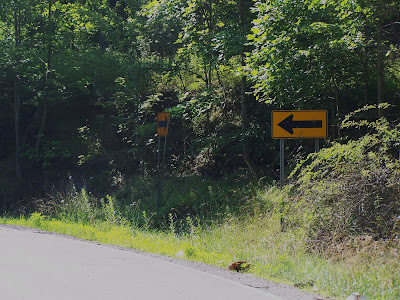 The park is remote, has beautiful scenery, a frontier farm and many walking trails. We sat outside in the evening listening to a fox bark a territorial warning on a far hillside as the stars came out.
The staff people were great too--friendly, funny, and very personable. When I called to be sure the activities director had reserved a room for us, the desk clerk said "I'll just have to skin him if he hasn't" in a cheerful southern mountain dialect that has to be heard to be appreciated. All West Virginians have accents, and it's distinct from one region to another. In Wyoming County where this park is located, the accent is a real treasure.
 This log school house is located on the road to the park. I love the angled logs in the gable, and the many windows. Those kids had lessons with a view.

The park is remote, has beautiful scenery, a frontier farm and many walking trails. We sat outside in the evening listening to a fox bark a territorial warning on a far hillside as the stars came out.The staff people were great too--friendly, funny, and very personable. When I called to be sure the activities director had reserved a room for us, the desk clerk said "I'll just have to skin him if he hasn't" in a cheerful southern mountain dialect that has to be heard to be appreciated. All West Virginians have accents, and it's distinct from one region to another. In Wyoming County where this park is located, the accent is a real treasure.

 This log school house is located on the road to the park. I love the angled logs in the gable, and the many windows. Those kids had lessons with a view.
The chutes at a coal tipple in Boone County, WV. My husband told me a story about a time he and his sister slid down one of these (a much shorter one at a small mine), thinking it would be like a big sliding board. It was a rough, rough trip--they didn't think about the heads of the bolts sticking up, or the 6-foot dropoff at the end onto a pile of coal. I think they were lucky to survive the trip, although Larry told me that their overalls were in tatters and their mother was mad as a hornet because their clothes were ruined.
It was a great weekend, filled with friends, stories, memories and travel.
Tuesday, July 10, 2007
Ballad of John Hardy
I've been learning the Ballad of John Hardy because it's local to southern West Virginia, and presumably based on the true story of a murderer who was hanged for his crime.
There are many recorded versions of the song, and of course several variations in the lyrics too. Here is my favorite--sung by a seven-year-old girl. She holds fairly close to the lyrics I learned from the Carter Family version.
John Hardy Was A Desperate Little Man
John Hardy was a desperate little man,
he carried two guns every day.
He shot a man on the West Virginia line,
and you oughta seen John Hardy gettin' away.
John Hardy, he got to the Keystone Bridge,
he thought that he would be free.
But up stepped a man and took him by the arm,
saying, “Johnny, walk along with me.”
He sent for his poppy and his mommy, too,
to come to go his bail.
But money won't go a murdering case,
and they locked John Hardy back in jail.
John Hardy he had a pretty little girl,
the dress that she wore was blue,
as she came skipping through the old jail hall,
said Poppy, I've been true to you.
John Hardy, he had another little girl,
the dress that she wore was red.
She followed John Hardy to the hanging ground,
saying Poppy I would rather be dead.
I've been to the East, and I've been to the West ,
I've been this wide world around,
I've been to the river and I've been baptized,
and now I'm on my hanging ground.
John Hardy walked out on his scaffold high,
with his loving little wife by his side.
And the last word she heard poor Johnny say,
I'll meet you in that sweet bye and bye.
There are many recorded versions of the song, and of course several variations in the lyrics too. Here is my favorite--sung by a seven-year-old girl. She holds fairly close to the lyrics I learned from the Carter Family version.
John Hardy Was A Desperate Little Man
John Hardy was a desperate little man,
he carried two guns every day.
He shot a man on the West Virginia line,
and you oughta seen John Hardy gettin' away.
John Hardy, he got to the Keystone Bridge,
he thought that he would be free.
But up stepped a man and took him by the arm,
saying, “Johnny, walk along with me.”
He sent for his poppy and his mommy, too,
to come to go his bail.
But money won't go a murdering case,
and they locked John Hardy back in jail.
John Hardy he had a pretty little girl,
the dress that she wore was blue,
as she came skipping through the old jail hall,
said Poppy, I've been true to you.
John Hardy, he had another little girl,
the dress that she wore was red.
She followed John Hardy to the hanging ground,
saying Poppy I would rather be dead.
I've been to the East, and I've been to the West ,
I've been this wide world around,
I've been to the river and I've been baptized,
and now I'm on my hanging ground.
John Hardy walked out on his scaffold high,
with his loving little wife by his side.
And the last word she heard poor Johnny say,
I'll meet you in that sweet bye and bye.
Finding an Old Friend

On the trip through southern Boone County, Larry remembered an old Marine buddy who had gone through boot camp with him during the Vietnam War days.
Larry had heard that his buddy had purchased a small country store and lived somewhere near it. We found the store on that hot Sunday (temps were near 100) and Larry went in to ask about his friend.
It was a good reunion--many years had passed since they'd last seen each other, and I think both were surprised at how the other had aged! It was well worth the time and travel to find that little store. And sobering to listen to their conversation and realize how many of the people they talked about were already deceased. Time passes when we're not looking, and faces disappear into its dusk. I'm glad these two were able to re-connect before time caught them.
Swinging Bridge over the Coal River
 On our return trip from storytelling at Twin Falls State Park in southern West Virginia, we decided to take the long way home and visit the area where my husband grew up.
 He was so happy to see that the long swinging footbridge over the Coal River near Emmons was still in place and in excellent repair.


Larry remembers walking across the bridge many times to play baseball, go visiting, or to go swimming in the cool shade along the river. The bridge is very well constructed, with steel cables holding it together. I liked the way this big steel o-ring looked.

And after walking across, looking down into the shady river below, it was time to head on up the road. I think the old bridge will be in place long after we're gone, barring a bad flood or some other accident.
Monday, July 9, 2007
More about Hoo-Hoo Hollow
I googled it to see what I would find--weird stuff! But this lawsuit, from 1947, was fascinating. It sounds like the mail was still carried by horesback at that time:
SIM McGRADY, Claimant, V. STATE ROAD COMMISSION, Respondent. Opinion filed November 3, 1947 MERRIMAN S. SMITH, JuDGE. Janet Lee McGrady, the daughter of claimant Sim McGrady, a rural mail carrier, was carrying the mail from Lester, Raleigh county, West Virginia, on October 3, 194B, when crossing a wooden bridge about one mile from Lester, on Maple Meadow secondary road in Hoo-Hoo hollow, the horse broke through the wooden boards, straining and bruising the stifle joint on its right hind leg. Sim McGrady, the owner of the horse, by way of a compromise.
W. YA.1 REPORTS STATE COURT OF CLAIMS 87 agreement made claim for $38.00, which covered a substitute horse used fourteen days, at $2.00 per day, and veterinarian services of $10.00. Payment of this claim was concurred in by the head of the state road commission and approved by the attorney general. The statute, Michie’s code section 1474(15), official code, chapter 17, article 4, section 33, provides for the inspection and safe maintenance of the bridges in the road system of the state. The record in this claim states that the bridge upon which this accident occurred was in very bad condition. Therefore, the majority of this court recommends an award for the sum of thirty-eight dollars ($38.00) in behalf of the claimant Sim McGrady.
ROBERT L. BLAND, JUDGE, dissenting. Since I do not think that claims against the state involving questions of fact or liability should be submitted to the court of claims for determination under its shortened procedure provision, as has been done in the instant case, I do not concur in the award made. The “shortened procedure” is provided for small claims where no question of fact or liability is in issue.
from the website: http://www.legis.state.wv.us/Joint/court/ReportsbyVolumes/VOLUME%2004%201946_1948.htm
SIM McGRADY, Claimant, V. STATE ROAD COMMISSION, Respondent. Opinion filed November 3, 1947 MERRIMAN S. SMITH, JuDGE. Janet Lee McGrady, the daughter of claimant Sim McGrady, a rural mail carrier, was carrying the mail from Lester, Raleigh county, West Virginia, on October 3, 194B, when crossing a wooden bridge about one mile from Lester, on Maple Meadow secondary road in Hoo-Hoo hollow, the horse broke through the wooden boards, straining and bruising the stifle joint on its right hind leg. Sim McGrady, the owner of the horse, by way of a compromise.
W. YA.1 REPORTS STATE COURT OF CLAIMS 87 agreement made claim for $38.00, which covered a substitute horse used fourteen days, at $2.00 per day, and veterinarian services of $10.00. Payment of this claim was concurred in by the head of the state road commission and approved by the attorney general. The statute, Michie’s code section 1474(15), official code, chapter 17, article 4, section 33, provides for the inspection and safe maintenance of the bridges in the road system of the state. The record in this claim states that the bridge upon which this accident occurred was in very bad condition. Therefore, the majority of this court recommends an award for the sum of thirty-eight dollars ($38.00) in behalf of the claimant Sim McGrady.
ROBERT L. BLAND, JUDGE, dissenting. Since I do not think that claims against the state involving questions of fact or liability should be submitted to the court of claims for determination under its shortened procedure provision, as has been done in the instant case, I do not concur in the award made. The “shortened procedure” is provided for small claims where no question of fact or liability is in issue.
from the website: http://www.legis.state.wv.us/Joint/court/ReportsbyVolumes/VOLUME%2004%201946_1948.htm
West Virginia Place Names
West Virginia has some odd names for its towns and cities (like Odd, WV, in Raleigh County!).
Jeff Miller has created a good listing of the sources of some of these names on his webpage, which is also a good place to go for other West Virginia history and trivia.
Fun place to browse around--although he does not explain Hoo-Hoo Hollow.
Jeff Miller has created a good listing of the sources of some of these names on his webpage, which is also a good place to go for other West Virginia history and trivia.
Fun place to browse around--although he does not explain Hoo-Hoo Hollow.
Lots of News, but Later!
The past few days have been full of storytelling and traveling. I will be writing about what we've been up to over the next week. From Twin Falls State Park to Nellis to Middlebourne, Paden City and Hundred, it's been a busy time.
Mountain Geography: What the Words Mean

Often when I'm telling stories, I find that I need to stop to define some term of mountain geography that is not familiar to someone from another part of the country.
I'll start with the top and work down:
Ridge: mountain, usually refers to the top where it is suitable for a trail or even a road. This is where you get those long-range views.
Head of the holler (hollow): where a small stream starts, beginning the valley or cut into the side of the ridge (or mountain, take your pick). There is usually a spring that is the source of the stream.
Spring: where an underground stream of water finds its way to the surface. Usually detectable by lush vegetation, soft ground, animal sign. The trees around a spring are sometimes different--willows, for example.
Run: the small stream that "runs" from the head of the holler and down the mountain. A neighbor once explained to me that it is called a run because "sometimes it runs, sometimes it don't!" Runs are often dry, especially in the summer months, but run very briskly after a storm. I saw a few good road names on these today: Whiskey Run, Cider Run, Cow House Run, Skull Run. The one on the sign above we saw while traveling to Twin Falls State Park. I passed Gamble's Run today, the scene of a murder in 1894, and the resulting ghost story.
Hollow (holler): small valley with a run or creek running through it.
Flat: a piece of relatively flat land that is located on the side of a ridge. Not completely flat, but flatter than the land around it!
Creek: (and pronounced that way, not "crick" in my part of WV) When several runs join together as they head downhill, they form a larger stream called a creek. Creeks usually have water in them year-round. Some creeks are very large and deep. When creeks join together and form a large enough stream, they may be designated as a river.
My favorite creek name in WV is Strange Creek, named for William Strange who got lost in that area in the 1790's and carved a poem into a tree saying ""Strange is my name and strange the ground, and strange that I cannot be found." His rifle was found propped against the tree where he died.
Bottom: the flat land alongside a creek. Usually very rich and desirable soil, but prone to flooding in downpours or periods of heavy rain. Many people in WV live in the bottomland, but most try to locate their houses in places less likely to be in the water's path. Some of these names are downright funny too--like Boomer Bottom, Roundbottom, Young Bottom, and Green Bottom.
Valley: the land along a river. Often wide, usually flat, and prime cropland--again, prone to flooding. River bottomland has always been the most valuable in the mountains. Even George Washington staked his claim to large tracts in West Virginia in his surveying days! Many towns and cities in WB are located in river valleys.
Lick: a place where the spring that reaches the surface has salt in it. Animals, especially deer, will find these places, and lick the ground to get the salt. Pioneers boiled the water down to get salt. Licks can have funny names too--Mud Lick, Gee Lick, Frozen Lick, Fork Lick.
I think that about covers it! I've probably missed a few, but these are a good start.
Sunday, July 8, 2007
Storytelling at North Bend: Flexibility is the Name of the Game!
Friday night at North Bend State Park: We arrived early enough to allow a leisurely time getting ready. That was fortunate--turned out there was a mix-up and the amphitheatre where I was to perform was rented out for a wedding rehearsal. The folks there for the wedding practice seemed really stressed, and I'm easygoing enough to go with whatever flow I find. So we moved the storytelling to the campfire circle. I did not change into my usual garb, electing instead to stay in jeans since I'd be telling around the fire. With the hubbub of changing locations, I also did not re-do my make-up. Note to self--never do that again! In the photos Larry took, I look tired, tired, tired. Well, I was, but no one needed to see it!

The audience turned out to be mostly preschool or elementary age children, a far cry from the mostly adult audiences I tend to have in the parks. So that called for yet another change--in stories. I mentally tossed out the ones I planned to tell and substituted participation stories and songs.
One young man who was there turned out to be quite the storyteller himself. When I asked if anyone had heard of Jack (referring to the folktale character) this boy spoke up and said, "Yes, I have a cousin named Jack but he lives in Israel and I don't think he's ever coming to Cleveland." Could it be the same Jack?


Here I am telling one of my favorite, and most popular, children's stories, learned from storyteller Don Leonard in Florida. The raccoon puppet seems very lifelike and always draws a good reaction. I use a lot of puppets when telling stories with children and they are always a hit. Puppets change the stimulus so that children don't get as antsy when listening. I try to do something to shift the stimuli regularly, usually every 5 minutes or so with young audiences like this.

The audience turned out to be mostly preschool or elementary age children, a far cry from the mostly adult audiences I tend to have in the parks. So that called for yet another change--in stories. I mentally tossed out the ones I planned to tell and substituted participation stories and songs.
One young man who was there turned out to be quite the storyteller himself. When I asked if anyone had heard of Jack (referring to the folktale character) this boy spoke up and said, "Yes, I have a cousin named Jack but he lives in Israel and I don't think he's ever coming to Cleveland." Could it be the same Jack?

Same boy also asked me, as I was preparing to tell a story, "Did you take a shower yesterday?" I assured him that I had, and also took one that day as well. He said, "So did I!" One of the best parts of telling to kids is that you never know what they will say, do or ask!

Here I am telling one of my favorite, and most popular, children's stories, learned from storyteller Don Leonard in Florida. The raccoon puppet seems very lifelike and always draws a good reaction. I use a lot of puppets when telling stories with children and they are always a hit. Puppets change the stimulus so that children don't get as antsy when listening. I try to do something to shift the stimuli regularly, usually every 5 minutes or so with young audiences like this.
It ended up being a great session, and I was tired but happy with how it went. A preschool teacher from Glenville was in attendance, so she got a copy of my book of participation stories, "Tell it Together!" I know she'll make good use of it.
Thursday, July 5, 2007
Canaan Valley Storytelling
As one of the Summer Performance in the Parks performers for the past three years, I've visited Canaan Valley Resort several times.
Each time I've had wonderful, attentive audiences. This year, however, I have to say that this was one of the best audiences I've ever had.
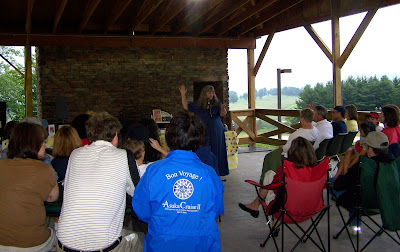
Most were from out-of-state; there were probably a dozen young children in the group of 60 who came to hear stories. Several told me they'd never heard a storyteller before, and came because they were curious.
After the performance, one lady told me that her father was a coal miner, that her uncle and cousin had died in the mines, and that her grandfather was killed during the unionizing attempts in the Farmington coalfields. She said she needed to talk to her father; my stories had raised many questions in her mind.
Each time I've had wonderful, attentive audiences. This year, however, I have to say that this was one of the best audiences I've ever had.
Most were from out-of-state; there were probably a dozen young children in the group of 60 who came to hear stories. Several told me they'd never heard a storyteller before, and came because they were curious.
After the performance, one lady told me that her father was a coal miner, that her uncle and cousin had died in the mines, and that her grandfather was killed during the unionizing attempts in the Farmington coalfields. She said she needed to talk to her father; my stories had raised many questions in her mind.

Another man mentioned that he was amazed at how much he enjoyed the performance. It does my heart good to know that I can awaken memories in people and encourage them to tell stories to their children to share memories. 
I love doing what I do; but when I get this kind of feedback, I know that what I do is worthwhile, that it reconnects people with what's important in life (family, listening to each other, remembering that we're all human and have faults, and laughter).
There are not many jobs in this world that allow us to connect at these levels of commonality. Storytelling may not be a status position, but my goodness do people need it. My only regret is that I am not yet able to devote full-time to sharing stories, songs and laughter with people everywhere. I must bide my time, waiting until we are better situated financially.
My library job pays well, and provides the benefits and security we need. But it does not provide that lift to the soul, or the satisfaction of knowing that I have touched someone's life in a new and meaningful way. So I wait, and chafe, waiting for the time to jump ship, take the plunge or whatever metaphor suits. One day, one day...
4th of July, Ripley style
The 4th of July is always celebrated in a BIG way in Ripley, WV, our county seat. This year my granddaughters Haley and Hannah, along with their father's (my son Derek) girlfriend and her little daughter, were part of the parade. They rode the VFW float that supported the troops overseas (Derek is on his way to Iraq, serving with the 111th Engineers, ANG). I was able to get a few photos of them:
This first one is Haley, as usual being a clown. She and Hannah rode their wheelies alongside the float and threw candy to the crowds along the parade route.

Here's Tiffany and Kaitlyn...with Haley funnyfacing on the side... notice the girl in orange in the background. She's saluting.

Hannah, showing the photo t-shirt Tiffany made for them to wear.

This first one is Haley, as usual being a clown. She and Hannah rode their wheelies alongside the float and threw candy to the crowds along the parade route.
Here's Tiffany and Kaitlyn...with Haley funnyfacing on the side... notice the girl in orange in the background. She's saluting.

Hannah, showing the photo t-shirt Tiffany made for them to wear.

Last photo is Hannah, rolling beside the float.

Thank you, VFW, for supporting the troops, and making my granddaughters' day exciting. They felt part of something, and that's important. And thank you Tiffany, for all you did to make it happen.

Thank you, VFW, for supporting the troops, and making my granddaughters' day exciting. They felt part of something, and that's important. And thank you Tiffany, for all you did to make it happen.
Stories at the River's Edge
Morning on the ridge, July 3, 6:00 am and I am on my way to work. I can never resist trying to photograph a sunrise. This one was much prettier than the photo.


After work, Larry and I drove across the Ohio River to meet with Meigs County storyteller Donna Wilson. We needed to work out the final details for the Stories at the River's Edge storytelling series set to begin next Wednesday July 11. We're ready to go with storytellers Suzi Whaples, Adele Browne, Donna and myself scheduled for one weekly performance each on both sides of the river during July, courtesy of an Ohio River Border Initiative grant.


On the way home, I tried to capture the lights at the Mountaineer Power Plant. The photo is blurry, but I kind of like it anyway.

After work, Larry and I drove across the Ohio River to meet with Meigs County storyteller Donna Wilson. We needed to work out the final details for the Stories at the River's Edge storytelling series set to begin next Wednesday July 11. We're ready to go with storytellers Suzi Whaples, Adele Browne, Donna and myself scheduled for one weekly performance each on both sides of the river during July, courtesy of an Ohio River Border Initiative grant.

What better place to meet than the Wild Horse Cafe, with its patio dining area overlooking the beautiful Ohio River. As we ate, we watched boys swinging from a rope swing on the WV side of the river. It looked like fun!

As the sun set, the river reflected the deep blue of the sky, absolutely a stunning sight.

On the way home, I tried to capture the lights at the Mountaineer Power Plant. The photo is blurry, but I kind of like it anyway.
A long day, but ending it with a friends, telling stories by the river, is about as good as it gets.
Subscribe to:
Posts (Atom)
