So what did I do today? Hmmm...
*attended a meeting of the poetry society. There I discussed the upcoming WV Storytelling Institute and another member told me about a series of ballad chapbooks he published in the 70's. He promised to find them and let me read them.
*mailed out letters and information to ten schools in an area where I will be telling in April.
*contacted another storyteller to float the idea of a ghost stories concert in October.
*worked on the storytelling track for the WV Book Festival (part of my day job)
*agreed to be a performer for WVU Mountaineer Week in November
*got a package from eBay with a beautiful storytelling dress inside. eBay can be a great source for storyteller clothes. Favorite brands I look for: Holy Clothing, Sacred Threads, Donna Jessica and Nothing Matches, to name a few.
*Tonight, I'm checking Storytell, thinking about the discussion of comedy vs anecdote, traditional vs folktale, and checking the Professional Storyteller Forum to see what's up. I'll read a few storytellers' blogs and add this post to mine and then I'll be in bed by midnight, I hope, for another long day tomorrow.
(It would have been better to start this list yesterday, when I stayed home from work because of the snow. I spent a lot of time on storytelling then, but after 13 hours either on the road or at work or at the poetry meeting, there wasn't much extra time today.)
Thursday, February 28, 2008

Catching Snowflakes
I love looking at snowflakes. I used a magnifying glass to enlarge the flakes, then aimed the camera. Not professional but it was fun to try it.
For truly stunning snowflake photos, see this CalTech website. You can also find photos by Wilson "Snowflake" Bentley, the man who first figured out how take pictures of fragile flakes, online and free for downloading. and National Geographic offers more information than you thought existed in an article, with great photos, on their website.
Here are the results of my efforts:

For truly stunning snowflake photos, see this CalTech website. You can also find photos by Wilson "Snowflake" Bentley, the man who first figured out how take pictures of fragile flakes, online and free for downloading. and National Geographic offers more information than you thought existed in an article, with great photos, on their website.
Here are the results of my efforts:


Snow Birds, Snowbirds, First Robins and One Sad Puppy

A leg up:
The feeders were full of visitors, yesterday. This is the newest feeder, and you'll notice it has a leg up on the others! The old shoe last provides support until i can get the feeder located where I want it. The birds seem to be just fine with it where it is, though. It looks like this cardinal is standing in line, waiting for the snowbird to finish.

Red, white and blue:
At the oldest feeder we have, A blue jay makes a crash landing on the snow-covered table while two doves eat, and the cardinal again waits his turn. poor fella! you'd think with his bright plumage he'd be more aggressive!

Peek-a-boo:
That's what it looks like this tufted titmouse is saying as she (or he?) peeks around the corner of a new feeder.
 King of the hill...er, lamp post:
Chickadees are so comical. This little guy waited and waited for me to take his photo. I think they strike me as funny because that black head and neck look so formal and serious.

Poppa on the post:
A cardinal replaces the chickadee on the lamp. Maybe it's warm there? it seems to be a very popular hangout for our birds.

Snowbird on snow:
and on the lamp post! As I said, a hot spot (probably in more ways than one) for our birds.

One sad puppy:
Raven at the porch gate. She got in, of course. Who can resist that look? She can, if necessary, jump right over, but she knows she's not allowed on the porch unless invited so the only time she jumps it is when she feels that we've overlooked her obvious need to be with us.
Tigger, on the other hand, is too old and heavy to jump the gate so he has learned how to jiggle the chain and unlatch it. And we think we're smart!

On the fence:
Birds were lined up all morning, waiting their turn at the feeder or just hanging out to see what everyone else was doing. At one point, I counted 21 birds at this particular feeder--cardinals, sparrows, snowbirds, chickadees, a red-bellied woodpecker, a couple starlings (new to our farm this year), a nuthatch, and a few robins who looked sorely peeved to have arrived in the area on such a wild weather day.
Wednesday, February 27, 2008
Photo poems
I've created several of these myself, without realizing that is what I was doing. A picture inspires a poem, or a poem links itself in my mind to a photo. I didn't realize there were so many people doing the same thing, and that it had a name--actually two names: photopoem or picturepoem. I expect there are other ways such poetry/photography combinations are referred to, but these two make the most sense to me.
First 50, the writing prompt blog, posted the first one on this list. that intrigued me, and I searched for more. Here are a few good ones:
A Day by Emily Dickinson (the one I found at First50. Thanks, Deb!)
The Evening is My Book by Rainer Maria Rilke.
Two not so well-known, but intriguing poets:
Morning Earth Daily Poems by John Caddy.
Wilderness Stones by Bruce and Mary Sue Rosenberger.
First 50, the writing prompt blog, posted the first one on this list. that intrigued me, and I searched for more. Here are a few good ones:
A Day by Emily Dickinson (the one I found at First50. Thanks, Deb!)
The Evening is My Book by Rainer Maria Rilke.
Two not so well-known, but intriguing poets:
Morning Earth Daily Poems by John Caddy.
Wilderness Stones by Bruce and Mary Sue Rosenberger.
Book Review: Story-Telling Poems
Story-Telling Poems: Selected and Arranged for Story-Telling and Reading Aloud and for Children's Own Reading
by Frances Jenkins Olcott
Books for Libraries Press, 1970 (reprint of 1913 Houghton Mifflin edition)
I picked up this book at a library book sale in Ohio. My edition is a 1970 reprint of the original 1913 title and its plain red cover hides the many rich tales inside.
Olcott was a children's librarian at the Carnegie Library, and her other collections of children's stories are well-known to storytellers. All, I believe, are now out-of-print, but many like this title, are available for download on the Internet. I prefer to have the book in my hand to read, but if that's not possible for you there are a variety of ways to view it online, and some look just like the real thing.
The story poems included in this collection were not written by Olcott; she "selected and arranged for story-telling and reading aloud and for the children's own reading" many classic poems and tales. Many are familiar: The Inchcape Rock, The White=Footed Deer, Apple-seed John, Tubal Cain, Paul Revere's Ride. Others are new to me: Goblin Market,The Fairies of the Caldon-Low, and this short Persian fable:
"How old art thou?" said the garrulous gourd,
As o'er the palm-tree's crest it poured
Its spreading leaves and tendrils fine,
and hung a bloom in the morning shine.
"A hundred years!" the palm-tree sighed:
"And I," the saucy gourd replied,
Am at the most a hundred hours,
And overtop thee in the bowers!"
Through all the palm-trees leaves there went
A tremor as of self-content.
"I live my life," it whispering said,
And every year, of all I've known,
A gourd above my head has grown,
And made a boast, like thine today;
Yet here I stand--but where are they?
--Anonymous
While the language will certainly be archaic to today's young audiences, yet there are many of us who still savor the taste of the older rhythms and styles of the past. A storyteller could, as Ms. Olcott did, adapt these poems for more modern telling; perhaps a better option is to tell them as written in this collection, taking time with the words, aiding comprehension through gesture and expression, and allowing for questions and explanation of unfamiliar words and phrases at the end of the telling.
I am intrigued by the notion that she selected these works for children. Certainly today's child's vocabulary would not stretch to these heights. Right and wrong in Olcott's book are easily recognized; today the lines seem more blurred and grayed. Moralistic endings are a given for most of the tales. As storytellers search for material to present for the currently popular character education theme being promoted by many schools, Olcott's collection may offer some fresh material and the opportunity to present classic literature to a new generation.
Will children of today enjoy these poems? I think so; presented well and with a storyteller's flair, I believe there is depth and color to the language and the themes. What child would not enjoy tales of knights, giants, dragons, fairies, and goblins?
(One of the neat things about buying used books is the notes, photos and other miscellenea left inside by past owners. am I the only person who loves to find these items, and wonder about how they came to be in the books?)
by Frances Jenkins Olcott
Books for Libraries Press, 1970 (reprint of 1913 Houghton Mifflin edition)
I picked up this book at a library book sale in Ohio. My edition is a 1970 reprint of the original 1913 title and its plain red cover hides the many rich tales inside.
Olcott was a children's librarian at the Carnegie Library, and her other collections of children's stories are well-known to storytellers. All, I believe, are now out-of-print, but many like this title, are available for download on the Internet. I prefer to have the book in my hand to read, but if that's not possible for you there are a variety of ways to view it online, and some look just like the real thing.
The story poems included in this collection were not written by Olcott; she "selected and arranged for story-telling and reading aloud and for the children's own reading" many classic poems and tales. Many are familiar: The Inchcape Rock, The White=Footed Deer, Apple-seed John, Tubal Cain, Paul Revere's Ride. Others are new to me: Goblin Market,The Fairies of the Caldon-Low, and this short Persian fable:
"How old art thou?" said the garrulous gourd,
As o'er the palm-tree's crest it poured
Its spreading leaves and tendrils fine,
and hung a bloom in the morning shine.
"A hundred years!" the palm-tree sighed:
"And I," the saucy gourd replied,
Am at the most a hundred hours,
And overtop thee in the bowers!"
Through all the palm-trees leaves there went
A tremor as of self-content.
"I live my life," it whispering said,
And every year, of all I've known,
A gourd above my head has grown,
And made a boast, like thine today;
Yet here I stand--but where are they?
--Anonymous
While the language will certainly be archaic to today's young audiences, yet there are many of us who still savor the taste of the older rhythms and styles of the past. A storyteller could, as Ms. Olcott did, adapt these poems for more modern telling; perhaps a better option is to tell them as written in this collection, taking time with the words, aiding comprehension through gesture and expression, and allowing for questions and explanation of unfamiliar words and phrases at the end of the telling.
I am intrigued by the notion that she selected these works for children. Certainly today's child's vocabulary would not stretch to these heights. Right and wrong in Olcott's book are easily recognized; today the lines seem more blurred and grayed. Moralistic endings are a given for most of the tales. As storytellers search for material to present for the currently popular character education theme being promoted by many schools, Olcott's collection may offer some fresh material and the opportunity to present classic literature to a new generation.
Will children of today enjoy these poems? I think so; presented well and with a storyteller's flair, I believe there is depth and color to the language and the themes. What child would not enjoy tales of knights, giants, dragons, fairies, and goblins?
(One of the neat things about buying used books is the notes, photos and other miscellenea left inside by past owners. am I the only person who loves to find these items, and wonder about how they came to be in the books?)
Tuesday, February 26, 2008
Sunday

Sunday drive to Derek's house--on the way there, we spotted these two swans swimming peacefully on the lake that spreads for a good distance beside Gay Road. The Candian goose did not seem a bit perturbed at their presence.

As we left to head home, we were surprised at how much snow had fallen. Hannah pointed to the van parked in the drive. "Look! Wrinkled snow!" she said. And so it was.

Derek's barn. Thank goodness Aaron and Larry got the tin nailed back in place before winter. Derek was worried about that when he left for Iraq--a big windstorm blew the tin loose just before he left. Aaron never lets grass grow under his feet, and he took care of this pretty quickly. Larry's job was basically cheerleader on the ground, I think.
This barn is at least 100 years old and probably older. It's pegged together with wooden pegs instead of nails, and on the front there are stars cut into the peak. It's those little touches, done in a day when there wasn't much time for fun, that always touch my heart. Like little frills cut into a primitive cabinet, or a carefully constructed little washstand that you can see was built with whatever lumber was on hand--someone, probably a man, took the time to add those touches simply for the beauty of it.
 On the way home we passed the place where we'd seen the swans. But now the snow was falling thickly and created a water-colored scene washed with the faint pink of the sun going down somewhere behind the snow. I think this photo shows better if you click on it and see the larger version. It looked surreal to me, just absolutely lovely.
The Way It Was
 Our neighbor's house this past Monday morning--it used to be the only house on the ridge, until we moved up here in 1975.
When we moved up on this ridge
It was so quiet that you could hear a truck coming
A mile or more away--
It was always trucks, no car would dare take on that rutted track--
And all of us would run
to the windows or out on the porch
To wait for it to come in view
And wonder who it was
And where they were going
And why
Might be the truck would turn into our road
we’d run to put on the coffee pot
add another log to the fire
We’d go out to meet them at the end of the walk
And go inside to talk and drink hot coffee
Until it was time for them to go
It might have started snowing
And they would laugh and gun their engine
the truck would slide off the road into the ditch
And we’d run to make more coffee
Add more potatoes to the stew
Get the sleeping bags and extra pillows ready
They would come back in the house
Stamping wet snow from wetter boots
Blaming each other for staying too long
And getting stuck in the drifting snow
But no one really cared
We’d make some popcorn and hot chocolate
And sit by the fire and tell stories
In the morning the snow would have stopped
And everything would be icy white
The tractor would be hard to start, but it always did and
We’d hitch up the blade
And plow the road, pull out the truck
They’d wave and drive up the snowy track
The sound of their truck muffled by cottony snow
We’d stand and listen as they wound their way
Across the ridge and down the hill
Until we couldn’t hear even a whisper
That they had ever been here at all
Monday, February 25, 2008
I wonder why...
I wonder why no one in  the state roads department has figured out that if you use salt on the roads in winter, you are creating one giant salt lick for deer all over the state? It should be no surprise that they're attracted to roadsides--hunters have put out blocks of salt to attract deer for years. I wonder if using salt was the idea of auto body shops and insurance companies?
 the state roads department has figured out that if you use salt on the roads in winter, you are creating one giant salt lick for deer all over the state? It should be no surprise that they're attracted to roadsides--hunters have put out blocks of salt to attract deer for years. I wonder if using salt was the idea of auto body shops and insurance companies?
 According to one source, there were almost 500,000 deer-vehicle accidents annually in 1995. Certainly that number has increased with the deer and auto population. Search online and you will find any number of scholarly research papers about this topic. I've yet to find one that mentions the use of salt as a possible contributing factor.
------------------------------------------------------------------------------------------------

I wonder why blaze orange was chosen as the color for safety and visibility in the woods? According to Terrace L. Waggoner, O.D., in the most common form of color-blindness, "Red, orange, yellow, and yellow-green appear somewhat shifted in hue ("hue" is just another word for "color") towards green, and all appear paler than they do to the normal observer."
(His webpage makes for interesting reading, and give easy to understand explanations for what colorblindness is and how colorblind people see color. You can even take a color test there.)
Between 5 and 8 percent of all men are colorblind, yet men comprise about 84% of the hunters in the woods (Out of five sons, three are colorblind. Two of those three are active hunters).
What those statistics mean is that a fair number of colorblind men are out in the woods in the fall when the leaves are a confusing variety of red, oranges, yellows and greens, and they're carrying highpowered rifles. It's an accident waiting to happen. So who picked blaze orange as a "safe" color?
------------------------------------------------------------------------------------------------
I heard on the news yesterday that a company is devising uniforms for combat troops that have built-in tourniquets. The idea is that an injured soldier will be able to deploy the device quickly, preventing a large loss of blood and possibly saving lives.
I am all for saving soldiers' lives. But what I wonder about is: if all the companies making weapons, and all the people starting wars were to focus all that energy on sustainable peace instead, wouldn't the soldiers benefit a lot more than putting them in harm's way with built-in tourniquets?
I know--I dream. But someone has to.
Enough wondering. Time for bed.
Sunday, February 24, 2008
Hughesnet Woes
I thought it was a great idea. Get satellite internet service and my s-l-o-o-o-w dial-up problems would be over.
Boy was I wrong.
Not only am I paying four times as much for the satellite access as I was for dial-up, the speeds are not nearly what was promised by the company that installed the system, and there is little help available, apparently, from the company.
Downloading--email, internet browsing, etc--is better, I admit that. But uploading? Oh my! It's MUCH worse--how about a speedy 8 kbps tonight?
It's so bad that I cannot upload even one photo. This morning's speed was better (48 kbps) but nowhere near the 200 promised by the website. As a matter of fact, I ran speed tests three times a day for the past three days and the fastest speed was this morning's 48 kbps.
The problem, according to India ("Sam" his name was; the last two with distinctively Indian accents were "Peter" and "Allen") is the weather. That's right. Snow on the dish makes it slow. I can kinda sorta buy that extremely bad weather will impact the system. It makes sense that dense cloud cover and heavy rain or snow can create enough of an obstruction to impact service.
But this morning the sun was shining and there was no snow anywhere. So given the logic presented to me, I should have been experiencing peak speeds. But I was getting only a quarter of that. Go figure.
I think the real problem is that Hughesnet has oversubscribed its service. Too many people on the system slow it down, no matter the weather. The company istelf acknowledges that many users during a 24-hour period impact speeds for all--they instituted a "Fair Use" policy that restricts the amount one user can download in 24 hours. What happens if you download more than your fair share? Slow speeds, service interruptions, just like what I've been experiencing.
The thing is, I haven't used anything like 'at peak' amounts, except for a few instances when grandkids were visiting and madly uploading to their MySpace pages (a good reason to stay away from MySpace--the number of preteens who have pages there. Although the site rules say you must be 18, there is no way to enforce the age limit, so children as young as 8 and 9 have sites. Scary).
Meanwhile, Hughesnet tells me they are investigating, and I should clear the snow from my dish and check the speed when the sun is shining! But the sun rarely shines in February, and I'm not home when it does.
So if you're considering satellite internet, be warned that it will not be all that the sales people tell you. It will be far, far less and you will be sadly disappointed, as I have been, to find that you are paying 4 times the price for service that is only minimally better than dial-up.
Boy was I wrong.
Not only am I paying four times as much for the satellite access as I was for dial-up, the speeds are not nearly what was promised by the company that installed the system, and there is little help available, apparently, from the company.
Downloading--email, internet browsing, etc--is better, I admit that. But uploading? Oh my! It's MUCH worse--how about a speedy 8 kbps tonight?
It's so bad that I cannot upload even one photo. This morning's speed was better (48 kbps) but nowhere near the 200 promised by the website. As a matter of fact, I ran speed tests three times a day for the past three days and the fastest speed was this morning's 48 kbps.
The problem, according to India ("Sam" his name was; the last two with distinctively Indian accents were "Peter" and "Allen") is the weather. That's right. Snow on the dish makes it slow. I can kinda sorta buy that extremely bad weather will impact the system. It makes sense that dense cloud cover and heavy rain or snow can create enough of an obstruction to impact service.
But this morning the sun was shining and there was no snow anywhere. So given the logic presented to me, I should have been experiencing peak speeds. But I was getting only a quarter of that. Go figure.
I think the real problem is that Hughesnet has oversubscribed its service. Too many people on the system slow it down, no matter the weather. The company istelf acknowledges that many users during a 24-hour period impact speeds for all--they instituted a "Fair Use" policy that restricts the amount one user can download in 24 hours. What happens if you download more than your fair share? Slow speeds, service interruptions, just like what I've been experiencing.
The thing is, I haven't used anything like 'at peak' amounts, except for a few instances when grandkids were visiting and madly uploading to their MySpace pages (a good reason to stay away from MySpace--the number of preteens who have pages there. Although the site rules say you must be 18, there is no way to enforce the age limit, so children as young as 8 and 9 have sites. Scary).
Meanwhile, Hughesnet tells me they are investigating, and I should clear the snow from my dish and check the speed when the sun is shining! But the sun rarely shines in February, and I'm not home when it does.
So if you're considering satellite internet, be warned that it will not be all that the sales people tell you. It will be far, far less and you will be sadly disappointed, as I have been, to find that you are paying 4 times the price for service that is only minimally better than dial-up.
My Presidential Candidate
 The way I figure it, he'll show up, scare the heck out of everyone, and disappear, just as he did 40-odd years ago.
Saturday, February 23, 2008
Captive Cattle and the Moveable Mask
 Our travels last weekend:
In the parking lot at the grocery store, this pretty Jersey bull wasn't happy with his situation. His sad bellowing brought us to his side to offer some small consolation in the way of stroking. But his ultimate fate, I fear, was the weekly cattle auction.

At our friends' house, this strange masked creature observed all our activitues as we...

... loaded a large entertainment center to take to a another friend's house. You'll notice the lack of a coat--it was an unusually warm day, follwed by ice and snow soon after. We suffer for such small indulgences!

Yet another captive of the bovine type stared as we trundled along the highway past his pen. Poor fella--look at the mire he's expected to live in.

Over the river (that would be the Ohio River, whcih actully belongs to West Virginia) and through the town (that would be Middleport, Ohio) to Donna's house we traveled...

And there the Mask surfaced one more time, to the surprise of our friend.
A task completed, a journey ended, and one more day of fun, comedy, tragedy and adventure in our lives.
Friday, February 22, 2008
What It Takes to Please Grandchildren
...is not so much:
*dinner ready when they arrive, or eating out at Chinese buffet (what's Chinese about it I've yet to discover)
*baby chicks that they can play with and name
*a trip to Wal-Mart for groceries (go figure)
*singing ballads in the car (and John Denver's "Grandma's Feather Bed")
*sitting around the fireplace, just talking
*a CD player (it was in the cupboard in a box, and I hadn't used it in 4 years. One of those personal ones, just what Hannah (aka Shopper Girl) wanted. We found batteries, the DC adapter, headphones and she was in heaven).
*MySpace time on the computer (this would be Haley) and a chance to email their Dad in Iraq)
If you haven't guessed, Hannah and Haley are back for a weekend with Granny!
*dinner ready when they arrive, or eating out at Chinese buffet (what's Chinese about it I've yet to discover)
*baby chicks that they can play with and name
*a trip to Wal-Mart for groceries (go figure)
*singing ballads in the car (and John Denver's "Grandma's Feather Bed")
*sitting around the fireplace, just talking
*a CD player (it was in the cupboard in a box, and I hadn't used it in 4 years. One of those personal ones, just what Hannah (aka Shopper Girl) wanted. We found batteries, the DC adapter, headphones and she was in heaven).
*MySpace time on the computer (this would be Haley) and a chance to email their Dad in Iraq)
If you haven't guessed, Hannah and Haley are back for a weekend with Granny!
Thursday, February 21, 2008
The Drive Home
 Yesterday was not a good day to be on the road. I was almost to Ripley when the slowing traffic warned me of trouble ahead. The car that rolled on the icy road looks nothing like a car--if you click the photo to enlarge, you will see its flattened form against the bank on the right. I offered prayers but like last week, it did not look good for the occupants of that vehicle.
I snapped this photo as I sat in traffic waiting for the wreck to be cleared. We were there for almost an hour, so I took a photo or two to kill time. I liked the monotones of the gate, snow and sky.

Finally on Joe's Run and it wasn't in great shape either, although the sand truck had run so it wasn't as bad as it might have been. 
A horse ambled up to see where I was going as I passed Dan and Belvie's homeplace. Darkness was falling fast, and I wanted to get home, but I couldn't resist taking his picture.

Belvie's wash house--the root cellar is underneath it. She used to make her apple butter out front of it in her big 30-gallon kettle. She is the one who taught me how to make it, as well as how to make green tomato mincemeat, sausage, lard, and lots of other things. Belvie had all nine of her children at home; that lady was a worker, too, taking care of the farm while Dan worked away "on the roads" for the state roads. Now she lives in a mobile home near one of her sons. I have not seen her in a long time, and when I took this photo I knew I needed to get over to visit her. I have missed having her as a neighbor.


Finally on Joe's Run and it wasn't in great shape either, although the sand truck had run so it wasn't as bad as it might have been.
Which way to go at the forks? Either way takes me home. I opted for the right fork, avoiding the hill that can be tricky in weather like this.

A horse ambled up to see where I was going as I passed Dan and Belvie's homeplace. Darkness was falling fast, and I wanted to get home, but I couldn't resist taking his picture.

Belvie's wash house--the root cellar is underneath it. She used to make her apple butter out front of it in her big 30-gallon kettle. She is the one who taught me how to make it, as well as how to make green tomato mincemeat, sausage, lard, and lots of other things. Belvie had all nine of her children at home; that lady was a worker, too, taking care of the farm while Dan worked away "on the roads" for the state roads. Now she lives in a mobile home near one of her sons. I have not seen her in a long time, and when I took this photo I knew I needed to get over to visit her. I have missed having her as a neighbor.

And at last I was on the ridge as the last rays of the sun color the sky. I turned into the driveway thankful that the drive had been a safe one for me, still worried about the people in the wrecked car, and knowing that while the drive is long and often treacherous in winter, I am blessed with beauty everywhere I look.
A True Story
A story from right here in Jackson County, West Virginia, as told by Delmer Hutton, who was one of our best natural storytellers:
A man lost his milk cow, and couldn't find her anywhere. There was a revival going on at the church so he went on to the tent.When he got there he asked, "Preacher, would you mind to tell them about my lost milk cow? She needs milked because she's been gone two full days now. I'm mighty worried about her."
The preacher said he would--it wasn't an unusual request since everyone in the area would be in the tent and someone was likely to know where the cow was.
The service started and as the preacher preached on and on the old man nodded off. The preacher began to wax eloquent about the importance of faithfulness. He mentioned his own wife, who had left him a few weeks previously, an left their four children behind.
"She's gone, she's gone, I know not where," wailed the preacher. The old man jerked awake at these words, and thinking that the preacher was speaking of his cow, he stood up and said,
"Preacher, you might want to tell them she's only got three tits!"
A man lost his milk cow, and couldn't find her anywhere. There was a revival going on at the church so he went on to the tent.When he got there he asked, "Preacher, would you mind to tell them about my lost milk cow? She needs milked because she's been gone two full days now. I'm mighty worried about her."
The preacher said he would--it wasn't an unusual request since everyone in the area would be in the tent and someone was likely to know where the cow was.
The service started and as the preacher preached on and on the old man nodded off. The preacher began to wax eloquent about the importance of faithfulness. He mentioned his own wife, who had left him a few weeks previously, an left their four children behind.
"She's gone, she's gone, I know not where," wailed the preacher. The old man jerked awake at these words, and thinking that the preacher was speaking of his cow, he stood up and said,
"Preacher, you might want to tell them she's only got three tits!"
Morning on the Ridge

Good morning! The first blush of dawn washes the sky as I drive off to work. I stop to take a quick shot of the house from the top of the hill. We're tucked into the head of a hollow, private, secluded and peaceful.
What you can't see here is the smoke rising from both chimneys on this chilly 8-degree day.

Turning away from the view of the house, I beheld this lovely, lovely moon, hanging like a ripe peach in the frosty air.
I did not turn right and follow the ridge this morning because the hill (Ken Parrish Hill, as we call it after the old gentleman who used to live at its foot) is probably very slippery. Instead, I turned right toward the church, a less treacherous route in bad weather.

The glow of pink edged the entire sky this morning, creating a pastel landscape that reminded me for some reason of the Snow Queen in the Nutcracker.

The graveyard at the church, about a half mile from my house, was blanketed in white silence, and I hoped the dead resting beneath were warmer than the living treading above.
In this graveyard is a grave marked "unknown." I have not yet found anyone who can tell me about the stone or how it came to be there. It's a mystery I need to solve, just to quiet my over-active imagination.
Tuesday, February 19, 2008
Pisces Moon
 The moon was beautiful tonight. Pisces is near, and that's exciting because to me Pisces is one sign of Spring.
I took this picture on the way home, out the window of the car. It came out very strangely. Then I took a few more...

and this is one of the second batch. I played with it on the computer to get this effect, and I sure do like the combination of colors.
This was taken at the top of my driveway.
Peeps, Day 3
 Still growing! They can certainly make a mess with their water, and they eat almost a quart of feed a day.
 So far, no casualties.
Monday, February 18, 2008
Some Birds Have Been Here
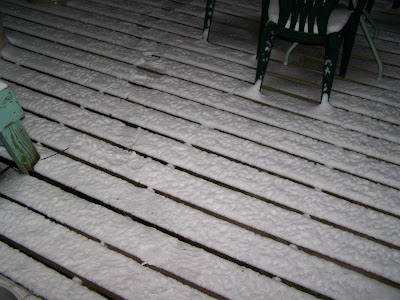
I didn't get to participate in the weekend bird count, but judging by the tracks in the snow on our deck, we had quite a few visitors of the feathered type last Friday.
What I love about the photo below is the soft blur to the left--that's an eastern bluebird beating a hasty retreat when the male cardinal landed on the feeder. I thought I was taking a picture of red, white and blue, but what I got was red, white and blur! If you click on the picture, you can see the bluebird a little more clearly, sort of like a ghost of a bird in flight.

An informal survey of bird visitors to our feeders over the weekend included cardinals both male and female, bluebirds, blue jays, mourning doves, chickadees, nuthatches, juncos, chipping sparrows, downy, pileated, and red-bellied woodpeckers. Nothing exciting or unusual in our flock, but there are so many of them that the air is full of their calls all day.
Sunday, February 17, 2008
Peeps! My Late Christmas Present

The biddies are here! Fifteen fluffballs made the trip from the feed store to the house in a small cardboard box I held on my lap.
I asked for laying hens for Christmas, but we did not find any for sale these past few weeks, so I gave up and decided to raise my own again. We used to do that years ago, and it will be fun to try them again. Thse little ones are all pullets (girls), so I'll be looking for a rooster after they're grown.
What kind of chickens are they? Wyandottes, Rhode Island Reds, and Buff Orpingtons for big brown eggs, Araucanas for green and blue eggs, and a few Leghorns because even though they lay only white eggs, they lay year-round, while the others take a break to molt every so often.

Here is their first home with us--a Christmas tote quickly emptied, a heat lamp put together, some pine bedding, a feeder and a waterer, and a cozy place near the woodstove, in front of the glass door.

It didn't take them long to find the feed!
We'll keep them indoors for a while, then move them out to the chicken coop in a confined spot where we can still keep the heat lamp hooked up for them. In 4-6 months, we should have fresh eggs again.
Saturday, February 16, 2008
Where in the World is Railey Ridge?

The view from the ridge, early in the morning--click on it to get a larger view
Where I live, apparently.
Last week a sneaky person left a red paper tube hanging on my porch. They must have come in the middle of the night, because the tube was not there when we went to bed.
"Your new address is: 909 Railey Ridge Road."
Hunh? Where in the !*%# did the 911 committee get that name?
Years and years ago (at the turn of the century--1899-1900, that century) the old county tax maps had this trail of a road labeled as "Clerc (pronounced Claire) Riley Ridge." It was named for two of the earliest landowners on this hill. That made sense, sort of.
But no one has ever called it that. For many years it was called N***** Ridge (you fill in the n word) Ridge because the only black man still left in this county lived at the far end of the ridge near Rte 21. People didn't think anything of calling it that because there was no one who saw a problem with the word--everyone was white. (Which I find curious because the old county census records show quite a few blacks here in the late 1800's-early 1900's, so where did they all go, and why?)
With the advent of the civil rights movement, people grew less comfortable with the name. The ridge began to show up as "North Hill" in some places, but old-timers still used the earlier name. Probably because of its less-than-politically-correct former name, no formal name was ever used. When the paper published the school bus route each year, it was referred to as "follows ridge road."
We're also referred to as "the ridge between the two forks of Joe's Run." Geographically correct; Joe's Run Rd turns off US Rte 33, following the path of the small creeek called Joe's Run, named for Old Joe Parsons who once had a store at its mouth. (There is a story that during the Civil War, Union troops raided the store and poured all the liquor (probably moonshine) into the creek and set it on fire. The literal fire-water traveled into Big Mill Creek and continued burning for quite a way downstream).
The road meanders about a mile and then the creek, and so the road, forks. Both forks of Joe's Run have their beginnings (or heads) on this ridge.
Our current address, R2 Sandyville, gives little indication of our location either, since Sandyville is 16 miles away in a direction no one who lives up here travels very often--only our mail comes from there. Sandyville is one of the huge generic rural mail areas with a very tiny settlement of homes. In its day, Sandyville was quite a hub of activity, with a flour mill, railroad tracks and several stores, schools and businesses. Now only a few houses remain, and even the post office moved to New Era (pronounced New Ery) about ten years ago, although it continued to be called the Sandyville PO.
Now we suddenly have a name, and not one chosen by anyone who lives here. It's not a bad name, it's just a name with no meaning at all, like subdivisions named "Whispering Pines" when there are no pines in view, or "River Creek" when there is neither (and how do you make sense of that name? Is it a river or a creek? Can't be both).
I suggested a name for the ridge to my neighbors. Since there are only Hinzmans and Holsteins living up here I told them, let's call it Hineyhole Ridge. They pointed out that Derenbergers also lived up here (I forgot about their sister) so I suggested Dernhineyhole Ridge. I doubt the 911 Committee would like that name, however.
We're not alone in our name disconnect. The Right Fork of Joe's Run already sports a new sign: Farmers Drive. The opinion of the residents of that fork can be interpreted from the bullet holes that appeared in the sign a day after it was posted.
So: Railey Ridge Road is supposedly where I now live. I haven't moved, but somehow I feel like a stranger in my own land, traveling a road that has become an unfamiliar name in the map of my life. I suppose I'll get used to it, but I will never like it. It will always be "the ridge road" to me. Or, more precisely "the ridge road" because to me there is no other place in the world quite like the place I call home.
But home will never be Railey Ridge.
Where I live, apparently.
Last week a sneaky person left a red paper tube hanging on my porch. They must have come in the middle of the night, because the tube was not there when we went to bed.
"Your new address is: 909 Railey Ridge Road."
Hunh? Where in the !*%# did the 911 committee get that name?
Years and years ago (at the turn of the century--1899-1900, that century) the old county tax maps had this trail of a road labeled as "Clerc (pronounced Claire) Riley Ridge." It was named for two of the earliest landowners on this hill. That made sense, sort of.
But no one has ever called it that. For many years it was called N***** Ridge (you fill in the n word) Ridge because the only black man still left in this county lived at the far end of the ridge near Rte 21. People didn't think anything of calling it that because there was no one who saw a problem with the word--everyone was white. (Which I find curious because the old county census records show quite a few blacks here in the late 1800's-early 1900's, so where did they all go, and why?)
With the advent of the civil rights movement, people grew less comfortable with the name. The ridge began to show up as "North Hill" in some places, but old-timers still used the earlier name. Probably because of its less-than-politically-correct former name, no formal name was ever used. When the paper published the school bus route each year, it was referred to as "follows ridge road."
We're also referred to as "the ridge between the two forks of Joe's Run." Geographically correct; Joe's Run Rd turns off US Rte 33, following the path of the small creeek called Joe's Run, named for Old Joe Parsons who once had a store at its mouth. (There is a story that during the Civil War, Union troops raided the store and poured all the liquor (probably moonshine) into the creek and set it on fire. The literal fire-water traveled into Big Mill Creek and continued burning for quite a way downstream).
The road meanders about a mile and then the creek, and so the road, forks. Both forks of Joe's Run have their beginnings (or heads) on this ridge.
Our current address, R2 Sandyville, gives little indication of our location either, since Sandyville is 16 miles away in a direction no one who lives up here travels very often--only our mail comes from there. Sandyville is one of the huge generic rural mail areas with a very tiny settlement of homes. In its day, Sandyville was quite a hub of activity, with a flour mill, railroad tracks and several stores, schools and businesses. Now only a few houses remain, and even the post office moved to New Era (pronounced New Ery) about ten years ago, although it continued to be called the Sandyville PO.
Now we suddenly have a name, and not one chosen by anyone who lives here. It's not a bad name, it's just a name with no meaning at all, like subdivisions named "Whispering Pines" when there are no pines in view, or "River Creek" when there is neither (and how do you make sense of that name? Is it a river or a creek? Can't be both).
I suggested a name for the ridge to my neighbors. Since there are only Hinzmans and Holsteins living up here I told them, let's call it Hineyhole Ridge. They pointed out that Derenbergers also lived up here (I forgot about their sister) so I suggested Dernhineyhole Ridge. I doubt the 911 Committee would like that name, however.
We're not alone in our name disconnect. The Right Fork of Joe's Run already sports a new sign: Farmers Drive. The opinion of the residents of that fork can be interpreted from the bullet holes that appeared in the sign a day after it was posted.
So: Railey Ridge Road is supposedly where I now live. I haven't moved, but somehow I feel like a stranger in my own land, traveling a road that has become an unfamiliar name in the map of my life. I suppose I'll get used to it, but I will never like it. It will always be "the ridge road" to me. Or, more precisely "the ridge road" because to me there is no other place in the world quite like the place I call home.
But home will never be Railey Ridge.
Thursday, February 14, 2008
One of 2700

I learned a surprising statistic today. I was one of 2700 women who received an annual valentine from Ted Kooser, the former Poet Laureate. I didn't ask to be on his list. Here's how it happened: I randomly checked out one of his books, Delights and Shadows, at the library.
I was delighted--the poems were so crisp and clear that I read them aloud to my husband for the sheer joy of being able to hear the words and rhythms out loud. I searched online, found Mr. Kooser's email address and wrote to him to tell him how much my husband and I had enjoyed the book.

He wrote back. I was astounded that he'd take the time. And he added me to his valentine list.
I only received two before he discontinued the list this year (he'd been sending the valentines out since 1986, I believe. I was a latecomer.) Tonight NPR aired an interview with him, talking about his valentine poems and the mailing list.
That's when I learned that he'd been mailing 2700 of them every year. That is a lot of stamps, and a lot of caring. How many people do you know who would be willing to send valentines to strangers just to make them happy?
So tonight, here is my valentine for Ted Kooser. I may never meet him in person, but I have read all his books and in those poems have come to know a man I admire and respect very much. Would that there were many more like him in this world.
Thank you, Mr. Kooser. You made a bright place in my life these past two years when I was in sore need of light.
Men I Love
Road construction workers
covered in dust and sweat,
muscles flexing under gray t-shirts.
Men who move the big machines.
Black men in old pickup trucks
and old men in coffee shops,
shopkeepers in aprons
or little boys in cowboy boots.
Men changing diapers,
splitting wood in flannel shirts,
white-shirted boys on dates and
dudes with silver hair.
Men in uniforms of camouflage
coming home to families waiting,
baseball players sliding home
and especially stay-home dads.
Mechanics under rusty hoods,
quiet men who write poetry,
boys coloring with broken crayons,
laughing men and crying men.
Men in aprons barbecuing,
window washers high on scaffolds,
or brick masons in hardhats
who place each brick in place and line.
Teenaged boys with spiky hair
and peach fuzz faces,
Old men playing music
On banjos and autoharps.
Men really, of any kind.
Road construction workers
covered in dust and sweat,
muscles flexing under gray t-shirts.
Men who move the big machines.
Black men in old pickup trucks
and old men in coffee shops,
shopkeepers in aprons
or little boys in cowboy boots.
Men changing diapers,
splitting wood in flannel shirts,
white-shirted boys on dates and
dudes with silver hair.
Men in uniforms of camouflage
coming home to families waiting,
baseball players sliding home
and especially stay-home dads.
Mechanics under rusty hoods,
quiet men who write poetry,
boys coloring with broken crayons,
laughing men and crying men.
Men in aprons barbecuing,
window washers high on scaffolds,
or brick masons in hardhats
who place each brick in place and line.
Teenaged boys with spiky hair
and peach fuzz faces,
Old men playing music
On banjos and autoharps.
Men really, of any kind.
All the men, I love.
Wednesday, February 13, 2008
My Funny Valentine; or, Why I Love My Husband
I've always been attracted to men with blue eyes...
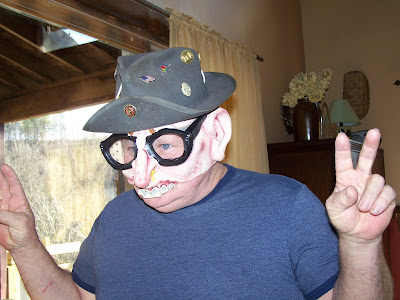
but the most important attribute the man of my dreams must possess:
a sense of humor!

Happy Valentine's day, my funny valentine!
After 22 years, you're still the one who makes me laugh.
Subscribe to:
Posts (Atom)
