I'm almost ready for my workshop this weekend at the first-ever Mountain State Storytelling Institute at Fairmont State University.
This is a new workshop for me. I had a choice: storytelling with puppets or a ballad workshop. I decided I needed a challenge and chose to do the ballad one. There were times in the past few months I sorely regretted my choice, but now that the research and planning is done, I'm glad I decided to do it.
Because I learned so much in the process. I've listened to variations of ballads that came from the British Isles and Ireland to the Appalachian mountains, discovered singers I like, learned about ballad-singing families, read arguments about the sources of some ballads and the theories about what makes a ballad and what makes a folk song. And a lot more.
There is so much more to learn. Ballad scholarship goes back centuries, and today there are hundreds of learned people out there with vast knowledge of the topic. I'm a piker by comparison. But I am fascinated and will continue to study and learn as long as I can sing, probably.
The reason ballads draw me is two-fold: first, ballads tell stories, and I'm a storyteller. I'm intrigued by the storylines, the drama, and the imagery of ballads. Second, the melodies are generally easy for me to sing. My vocal range seems well-suited to these old songs; they feel comfortable in my mouth.
This weekend I hope I can share my love of ballads with those who take my workshop. We'll explore variations, learn a little history and I hope there will be a few singers in the group willing to share their favorites with us.
The dread is gone. Excitement and anticipation have replaced it!
Monday, March 31, 2008

The Bottle Bush Begins to Bloom
 All the way from Idaho and my friend Batsy (she of the very-deep-snows) came this lovely blue bottle for my blue bottle bush.
I have six bottles now. I haven't been able to get out to the junk shops to search for more, but perhaps as yard sale season hits I'll find some that way. I'd like to start the bush with 10 or 12 bottles, preferably not all wine bottles because that would look...well...it could give the wrong impression to visitors who don't know us well.

Batsy's package contained a surprise--this lovely tiny teapot. What a little treasure, so perfect for Spring.
If it wasn't so delicate it would go into my storybag (maybe for the story of the old lady who lived in a vinegar bottle, or ??? There are possibilities in stories for a charming tiny teapot).
I think it will live on my kitchen windowsill, where I can see it and be reminded of the good friend far away who sent it to me.
Sunday, March 30, 2008
Auction!
 Yesterday at the height of the sale at the Jackson County Farm. In the far right distance you can see the large equipment sale in progress; center is the miscellaneous sale (and boy was it miscellaneous!). I took the picture from the Sheep Barn where small tools and other miscellaneous was being sold.
In the sheep barn the auctioneer is surrounded by bidders as his helpers hold up the current item for sale--in this case a set of made-in-China drill bits that ended up selling for around $3. Note the see of Carhartt and jeans. Standard uniform for the day.
 Aaron poses with one of the stacking forks I was interested in--an updated American Gothic. I didn't get the forks--the price went well above what I, cheapskate that I am, was willing to pay.
 A stacking fork is a pitchfork used for building haystacks. We used to have two or three of these but what became of them I don't know. We built a haystack a couple of times. The technique is surprisingly tricky. I'll have to write a post sometime to explain how to do it, and how it felt to stick one of these forks in your leg.

Larry loading the truck with one of my purchases--a leather collar for a work horse. This one is fairly large and in good shape. A little neatsfoot oil will bring it to life again.

In the back of the truck, some of our other purchases:
The small pitcher pump on the left ($12.50), two one-man crosscut saws ($20) to add to the log cabin building tools we're collecting; the horse collar and hames in the corner behind the tire ($25), a wooden handled scythe ($7) and two boxes of hand tools ($9) for my little house toolbox that mysteriously loses tools and no one knows where they go.
Two other purchases not shown: a stout prybar ($15) and 2 log chains ($10).

One of the best and perhaps most surprising purchases: a string of mine lights. These are what deep mines string back through the tunnels to light them. They're very portable and easily hooked up--just plug them in to an outlet. We plan to use them in the crawlspace under the house. At $30, these were a steal.
 Larry's favorite purchase was the small digging hoe ($5). What will he use it for? Digging ramps this spring, of course. It's almost time for that annual ritual. It will work well for digging sassafras roots too--another spring tonic in the mountains. Here the hoe is resting on my Peerless Victor wook cook stove--not currently in use because the insurance company made us disconnect it to get fire insurance. We hope to re-connect it this year. I cooked on this stove in winters when I was home all day, and also whenever the power went off. There are tricks to cooking on a wood stove that I hope I still remember when we get it working again.)
All in all, it was a great day. There is nothing I love more than looking at tools and antiques. I like to think about who might have used them, the palces the items have been and the work that was so necessary to the households of that time. Some items I bring home to use; others are for display, to remember and honor the work of those long past.
Saturday, March 29, 2008
Two Sure Signs of Spring
 It's March! That means it's time for the annual FFA (Future Farmers of America) Equipment Auction.
Even with temps in the 30's, people arrived early to check out the items for sale. The way the auction works: people bring items to be sold. The FFA provides auctioneers and support staff. A portion of all sales goes to the sponsoring FFA.
Three or four sale rings operate simultaneously so it's hard to figure out when to be where. This year, there seemed to be four: lawn equipment, tractors and machinery, big items out in the field and another for small items in the barn.
Last year's sale was awesome. This year? Not as many items for sale. Still, the weather was clear although chilly, and after 3 days of rain no one could plow or garden anyway.

Lots of stuff! An important part of attending auctions is identifying what you're interested in quickly, and watching for those items to come on the block. A difficult part of auctions is that there is so much stuff! It's just another form of recycling, actually. Here is one of the sale rings, in the Sheep Barn at the County Farm.
(What did we buy? I'll put that in another post.)
 When we got home, I spotted a patch of bright yellow along our driveway.
What was it? Another sign that Spring is definitely here.

Coltsfoot, one of the earliest of the Spring flowers, brightened the side of the drive.
Now we need only hear the whippoorwill to know Spring has arrived in full.
Waiting for the Great Flood?

High on a ridge between Jackson and Putnam counties, West Virginia, there sits this sternwheeler, waiting for high tide.
When it comes, we'd better all be right with our souls, because water this deep would flood most of the earth!
The Rain Stopped
And the leak was only a shingle blown up, with water maple seed thingies stuck under it. Thank goodness. A quick cleanup, put the shingle back in place and all is well.
If only all life's problems were so simply repaired.
If only all life's problems were so simply repaired.
Friday, March 28, 2008
Waiting for Spring

Spotted on my road trip last week, an old Ford tractor waits for Spring in the shelter of an old barn.
(Rt 34, between Red House and Kenna)
Ultimate Recycle
 Chickens need calcium to make eggs with strong shells.
Chickens need grit in their craws to grind their food for digestion.
Chickens lay eggs with shells high in calcium.
Chicken egg shells can be crushed to provide grit for the craw.
So there it is: the ultimate recycle.
From the chicken to the table and back to the chicken.
The shells need a little processing. Giving "raw" shells to them can cause chickens to peck at fresh-laid eggs in the coop. That's not good. The reason they will do this is that with raw shells, there are bits of egg white still clinging to the shell and the chickens can develop a taste for it.
To avoid this problem, bake the shells at a low temperature for about 15 minutes. The baking will make the shells more brittle and will completely cook any remaining egg in the shell.

Once the shells have been baked they can be crushed easily into little pieces and fed to the hens.
They love it! I like it because the shells get used and my chickens are happy.
A win-win situation.
Thursday, March 27, 2008
The rain came
Last night, after we finished digging, plowing and planting. It was lovely to hear it pattering on the roof, knowing we'd finished what we needed to get done.
Lovely until this morning, that is, when I heard it pattering on the wood stove. I looked up and--oh no--a leak!
This evening's outlook suddenly changed. Instead of backing up to the fireplace drinking hot tea, Larry will be on the roof trying to find the source of the leak. I really, really, really hope it's something simple like a shingle blown out of place.
Lovely until this morning, that is, when I heard it pattering on the wood stove. I looked up and--oh no--a leak!
This evening's outlook suddenly changed. Instead of backing up to the fireplace drinking hot tea, Larry will be on the roof trying to find the source of the leak. I really, really, really hope it's something simple like a shingle blown out of place.
Simply Digging Spring

It didn't rain yesterday. The wind blew hard, and the ground dried. It was time.
Baby watched...(no, she's not a woolly pig, she's a cocker, but all grown out for winter. She must stay outside because I'm allergic to her, but she compensates with a heavy coat and a warm sleeping place)...

The daffodils nodded...

While we dug. I used old technology to dig up my small kitchen garden near the house...

...while Larry used newer tools to dig up the potato-and-corn garden close to the piglot. The tractor is actually (gulp) 40 years old, a 1968 Massey Ferguson 135 that we bought in 1980. We paid $3900 for it then. What's it's value now? Around these parts, it's $4000. It's had a few overhauls and new tires, but it runs better than when we bought it.

While we dug. I used old technology to dig up my small kitchen garden near the house...

...while Larry used newer tools to dig up the potato-and-corn garden close to the piglot. The tractor is actually (gulp) 40 years old, a 1968 Massey Ferguson 135 that we bought in 1980. We paid $3900 for it then. What's it's value now? Around these parts, it's $4000. It's had a few overhauls and new tires, but it runs better than when we bought it.

Finished! and heading to the barn. Actually, he headed to the kitchen garden to plant more lettuce in the cold frame...

I finished at about the same time, and planted a row of peas after raking the soil level.
We went inside to celebrate with a glass of wine and a nice fire. Later in the evening the rain came, gently hitting the roof above us.
Perfect timing.
Wednesday, March 26, 2008
Three Little Piggies

It was so much fun having two pigs, we added another, so now we officially have the three little pigs.
Here they are, in their house of straw.
Even with the cold temperatures we've had this week, the pigs are toasty warm in their little hut. Larry covered the top of it with a large tarp that hangs over the entrances, so the wind is blocked. The pigs often burrow so deep in the straw that all that is visible is their snouts.
This breed of pig is called Blue Butt, which probably makes them the butt of many jokes (ouch).

Hannah got a surprise when she visited the pigs--she found herself on the business end at a time of business. Her face says it all--eeewwww!
We've raised pigs off and on over the years, and my favorite breed has always been the Hampshire. Hamps are black and white belted pigs. We've also raised Durocs and Yorkshires; I liked the Yorks but they seem to have a higher percentage of fat to meat in my experience. Durocs are feisty and we had a lot of trouble with escaped hogs with them. It may have just been the ones we had, but if you have ever chased hogs in the woods in the dark you know it isn't fun.
The Blue Butts are a cross between Hampshires and Yorkshires, and are claimed to have hybrid vigor. Although the hair stays white, the skin underneath will develop "blue" or black markings in the rump and often in the face areas.
My favorite book for dealing with livestock is Veterinary Guide for Animal Owners. (For best prices on this book, go to bestbuys). It's been around for a long time, but the information is useful and succinct.
These two online sources of information about raising pigs on a small farm were the best I located:
These two online sources of information about raising pigs on a small farm were the best I located:
Tuesday, March 25, 2008
The Boastful Turtle
There was once a turtle who talked all the time. He talked mostly about himself. The other creatures of the earth avoided him as much as possible. Who wants to listen to a braggart?
One day the turtle saw a goose flying above him.
“How I would love to fly,” he said, “like the geese. It must be wonderful to be up so high and see the world from that height.”
He could think of nothing else but flying. At last he met a goose on the ground and he hurried (as fast as he could-he was a turtle, after all) over to her and said, "Teach me how to fly."
"You're a turtle! Anyway, I can’t right now," the goose answered. "My flock is migrating for the summer and I must join them."
"I want to fly!" the turtle cried. "I want to fly HIGH!"
"We’ll have to ask my flock," the gentle goose said.
You know what the flock said.
“Turtles can’t fly,” one goose said. "Whoever heard of a flying turtle!" another goose laughed.
"I want to fly!" the turtle cried. "I want to fly HIGH!"
“We can’t carry you. You have no wings, so how can you fly? asked the largest goose.
"I want to fly!" the turtle cried. "I want to fly HIGH!"
The geese got so tired of his pestering that they came up with a plan. The geese decided that if two of them would hold a stick in their bills, the turtle could bit onto the stick and they could carry him with them, up into the air.
"Remember, you must not open your mouth while we are flying!" they reminded the turtle. The geese flew up into the air their strong wings.
"I am flying!" the turtle thought to himself. "Down on the ground I can see everyone looking at me. How wonderful this is! How wonderful I am!"
He opened his mouth to tell the geese to fly higher still.
"I want to fly!" the turtle cried. " I want to fly HIGH!"
And so of course his mouth came off the stick, and he fell down, down, down to the earth. His beautiful shell cracked all over. He crawled away into the mud at the edge of a pond in embarrassment, and there he stayed until his poor shell healed. But to this day, turtle has a cracked shell, and he has never tried to fly again. And he has never tried to speak again either!
Attributed to several cultures, including East Indian and Tagalog. Versions in the Jataka Tales and the Panchatantra, along with many other story collections. Adapted by Granny Sue
One day the turtle saw a goose flying above him.
“How I would love to fly,” he said, “like the geese. It must be wonderful to be up so high and see the world from that height.”
He could think of nothing else but flying. At last he met a goose on the ground and he hurried (as fast as he could-he was a turtle, after all) over to her and said, "Teach me how to fly."
"You're a turtle! Anyway, I can’t right now," the goose answered. "My flock is migrating for the summer and I must join them."
"I want to fly!" the turtle cried. "I want to fly HIGH!"
"We’ll have to ask my flock," the gentle goose said.
You know what the flock said.
“Turtles can’t fly,” one goose said. "Whoever heard of a flying turtle!" another goose laughed.
"I want to fly!" the turtle cried. "I want to fly HIGH!"
“We can’t carry you. You have no wings, so how can you fly? asked the largest goose.
"I want to fly!" the turtle cried. "I want to fly HIGH!"
The geese got so tired of his pestering that they came up with a plan. The geese decided that if two of them would hold a stick in their bills, the turtle could bit onto the stick and they could carry him with them, up into the air.
"Remember, you must not open your mouth while we are flying!" they reminded the turtle. The geese flew up into the air their strong wings.
"I am flying!" the turtle thought to himself. "Down on the ground I can see everyone looking at me. How wonderful this is! How wonderful I am!"
He opened his mouth to tell the geese to fly higher still.
"I want to fly!" the turtle cried. " I want to fly HIGH!"
And so of course his mouth came off the stick, and he fell down, down, down to the earth. His beautiful shell cracked all over. He crawled away into the mud at the edge of a pond in embarrassment, and there he stayed until his poor shell healed. But to this day, turtle has a cracked shell, and he has never tried to fly again. And he has never tried to speak again either!
Attributed to several cultures, including East Indian and Tagalog. Versions in the Jataka Tales and the Panchatantra, along with many other story collections. Adapted by Granny Sue
Monday, March 24, 2008
Surfing Chickens
 Up close and personal! The leghorns are the most intrepid of the flock so far. They will approach without fear, and they love to peck at my rings.
Granddaughter Hannah with a new friend. Hannah is also fearless. Pigs and chickens faze her not at all. She gets right in there with them. She and Haley have named a few of the hens and can actually tell them apart. That's more than I can do.

The heat lamp makes a cozy glow in the coop. That's a good thing since today was blowing snow flurries and cold, cold, cold.
I did a little websurfing and found these online places to learn more:
How to raise a flock of hens in your own backyard. Help from other folks, information, links and lots more.
Want to know more about the many breeds of chickens? Go here. There are many there I have never heard of. Apparently, however, my Wyandottes might be Silver-Laced Wyandottes. Who knew?
You can find more general information about raising chickens on this site.
The more you learn, the more you want to learn, but why not go for the ultimate learning experience:
A chicken videocam! Watch the drama unfold before your very eyes! Oh the heartbreak, the egos, the greed and deception. All for you on the ChickenCam.
If the cam doesn't strike you as funny, maybe these chicken jokes will.
Or how about Chicken tractors, anyone? (this is not a joke, really)
One place to get baby chicks: McMurray's hatchery. I bought from them years ago and it was nice to find that they are still in business. I think I prefer buying my chicks at the feed store, though. Less stress on them, or at least on me.
Sunday, March 23, 2008
Home Sweet Home, if You're a Hen

I have more pics but hughesnet was being slow again last night (will it never end?) and only one would download.
Here are the girls in their new home in the coop. As you can see, they'd already knocked over their chickie feeder.
We set up the larger feeder for them instead. Almost like they were saying 'you've got to be kidding, that thing's for babies.'
With the weather turned chilly again, we put the heat lamp on for them, and kept their old box in the coop as a familiar place to huddle if they get cold. It will be nice to see the weather turn warm for keeps, but that's a few weeks off.
The coop has solid plywood walls up 4 feet, then oak planks that have small gaps betwen them for air flow on the top 3 feet. There is a trapdoor under the roost for easy clean-out. Last year at the FFA auction we bought a replacement set of galvanized nest boxes--the ones I was using were about 50 years old and had rusted out.
We also have a hanging feeder for them that holds 25 pounds of feed at a time, and a 5-gallon waterer with a warming base so that the water will not freeze in winter. There is a timer that we use on the lights when the chickens are older to be sure they get the required amount of light to lay: 14 hours.
Larry did a thorough cleaning after the old hens left, washing down all equipment and walls with bleach water, and tossing lime on the floor (and apparently some on the walls!).
Chickens need grit for their craw so they can digest their feed. We give them a little pan of wood ash and sprinkle it in the coop too, keep it smelling fresh. Wood ash is good in the chicken yard too, if you keep your hes penned as we do. Our pen is about 8' x 20' long, 6' high with chicken wire over the top to discourage hawks. Every varmint, it seems, wants to get into a chicken house!
We also save egg shells and toast them, then give them back to the chickens. You can buy oyster shell and use that instead--the calcium in both helps make the shells harder when the hens are laying, and provides some grit too.
A Place Forgotten
 Traveling home from storytelling at Scott Teays Elementary on Friday (a wonderful school, great audience) I decided to take the slow road home, Rte 34 across Divide Ridge. The ridge was so named because it divides the waters between the Kanawha and the Ohio rivers in this part of West Virginia.
At the top of a hill, this muddy track lured me. There was no mailbox, but I spied a stone wall, much overgrown. An old homesite?

As it turned out, it was a final homesite--a graveyard for the most part abandoned. A few graves, like these, were being cared for, but the rest of the cemetery was a tangle of vines and weeds too thick to even be able to tell if there were other stones under them.
The name on one of these stones was Gonzalez, and I wondered at that. In this predominantly Scots-Irish-English state, a Hispanic name, although not so rare anymore, would have been unusual in the days this graveyard was established.
Or perhaps not--that got me wondering about the heritage and history of this particular area around Red House. Were there Hispanics here many years ago? Why? What trade did they bring? In some places in the states, there were communities of Italian, Spanish, German, Swiss, even Russian, Chinese and Croatian. In all these cases, the immigrants brought a specific trade--tile-making, ceramics, tin, glassblowing, railroads, steel-making and coal mining. So what did this Gonzalez bring to Red House hill? A question without a quick answer, but offering many possibilities for the writer and storyteller.

In the woods below the graves, wildling daffodils brightened the drab woods that still show only hints of green. There was one lone daffodil blooming in the cemetery itself, but these escapees were blooming profusely.

One of the many overgrown stairways leading from the dirt lane (used to be gravel, I could see bits of it here and there) into the graveyard. I admired the craftsmanship of the stoneworker who constructed the walls. Was it a CCC project? Possibly, since they did many such community projects. Or was it one of the Italian stonemasons who were responsible for so many fine walls and buildings in West Virginia? Was Gonzalez a stonemason, perhaps?

Far below, the mighty Kanawha River winds its way through the valley. The river was actually the reason I found the graveyard. I was looking for a place to take a clear shot, without trees and bushes in the way. I didn't find one; instead I found a forgotten place of peace and rest.

These stones were below the road, and obviously well maintained. Someone still visits here to mow and renew the flowers of remembrance. The name on one of these stones was Ice. Those resting in these graves have a lovely spot, shaded by the pines and overlooking a deep valley.
I left the graveyard regretfully. I want someone to come back and care for this place with its circular drive, stone walls and stairwells and rampant daffodils. I want the families to come back, to remember their ancestors, to care for the past. I was but a stranger passing through and yet the place spoke to me.
High on a hill, hidden behind weeds and brush, lies the heritage of many people. Where are they now? Why do they not come here to clean the graves, take time to remember?
Saturday, March 22, 2008
Saturday Morning Daffodils
 I cheated a little. I brought in a few almost-open buds and by morning they were full open and sweetly scenting the whole house.
Ah, spring!
The End-of-the-World-Turn

That's what we call this curve in our road: the end of the world turn. Because as you approach, it seems that the road simply drops off the edge of the world.
Blind curve? Oh yeah. I've had a few close calls here but forntuately there is just enough room on the right side of the road to get out of the way of anyone coming in the left.
I have not yet met the school bus coming around the curve because I know, like everyone else who lives up here, exactly what time the bus is running and I don't go that way until he's gone. seeing the bus on our road is quite a sight, really. I should post a photo of it sometime--it's shoulder to shoulder on the road,because there is no extra space. He travels in almost all weather except snow that's over 2 inches. His is a job I would not want.
Of course, it helps to know another vehicle is coming. That's easy at night--watch for lights. During the day there is no way to know so drivers hug their side of the road and are prepared for quick manuevering.
Strangers? They're on their own. What are they doing up here anyway?
Friday, March 21, 2008
Why I Like My Diet

When your son comes home from the military and looks like this, (a little sunburned, but look at those muscles!)
and is a natural foods/exercise evangelist,
you do this:
you go on a diet.
Tommy wrote a diet for Larry and me. We've been pretty good about staying on it for the past 4 weeks. Larry has lost almost 30 pounds and feels great.
Me? Well, the results aren't as wonderful, but I've lost 10 pounds and I can tell the difference in how my clothes fit. Best part: it came off the belly region first. That never has happened before on any diet I've been on.

Next best part: we like the food. It's what we've always eaten, with some modifications. What's changed is:
a) portions
b) time of day for certain foods
c) fewer carbs
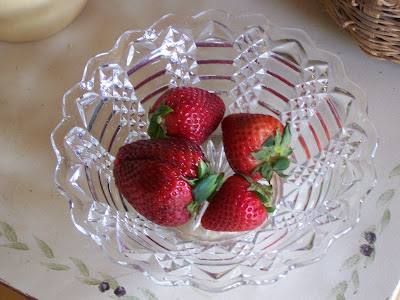
And yes, strawberries are on the diet! I felt guilty about buying them at this time of year before, but not now--I'm on a diet.
Tommy plans to go to college to be a dietician and exercise therapist. We may end up being one of his best case studies. I'll post updates--good and bad--as we go along. I'm motivated: my 40th high school class reunion is next year!
Thursday, March 20, 2008
Talking about Old Books
Imagine this: I was shopping at a used book store about 7 years ago. I ended up with a pile of books, total cost over $100. There was one additional title I wanted. I flipped through the pages--there were many stains throughout. But the book was old, published in 1864. Reluctantly I put it aside.
The shop owner saw me waivering and said, "You've bought so many, i'll throw that one in for free." Was he kidding?
No.
I grabbed my bag of treasures, thanked him and left.
A few days ago I saw the book on my shelf. Seaside and Fireside Fairies, translated from the German by George Blum and Louis Wahl. I idly looked it up on Abebooks. Whoa! This little freebie was worth...what? $350.00?
Okay, my copy isn't in great shape. The cover is separating at the spine, there is some foxing and the odd blue stains throughout, the cover is bumped on all edges. I look on Google. An Amazon listing has it for $175.00, with the following notes: Good with numerous small flaws. A marvelous book and now Rare. Binding and text block are quite good. There is wear to cover with fraying, front hinge is broken, small chip to ffep, some spots throughout. 1864 pon. Red and black title page. A collection listed in all the sources for "important" early Fairy Tales. Beautifully written. 15 tales which include: The Kalabater Sprite, The Fox King, The Amber Witch, The Ghostly Light on the Shore, The Magic Drum. 292 pages.
So how often does this happen? Is every old book valuable? It depends.
One of the things I've been doing at work lately is searching the value of old books that have been donated to the library. It's fun, kind of like a scavenger hunt. Some books that look valuable are worth no more than a dollar; others that seem unimportant may be worth $30-$300.
What's the difference? What makes one book valuable and another not so much? I am not the person to answer that definitively, but I've made a few observations:
*anything published before 1920 needs to be looked at. Anything published before 1900 definitely needs to be searched.
*wartime books (World War II) often have surprisingly low values. Why? Perhaps it is the low quality of paper and binding used during those years. What I find when I look these up is that their value is often under $2.00.
*Books with good quality covers (leather, embossed, fancy detail, good fabric) often demand higher prices. These are usually well-made--crafted really. Decorators are buying books like this simply for display purposes. But often the books are rare, limited edition printings, and that adds value.
*Books with gilt edges to the pages or gilt title lettering, color illustrations usually have a higher value. They look nice and are probably higher quality.
*Books with limited print runs. The fewer published, the more valuable. I have a set called The Ocean of Story that was published in 1924. Mine is set 32 of 1500; ten volumes with gilt-letter spines and uncut pages. Even with library markings, the set values for between $400 and $1500.
*Topics that are specialized and limited in scope or likely audience. A book of political campaign buttons that was donated to our sale had a surprisingly high value. So did a volume of poetry by the "New York" poets. Some older books of china markings were not so valuable--perhaps the impact of the internet?
*High quality art books. You can feel the quality when you pick them up--they're heavy, the stitching that holds the pages together almost looks hand-done, and the paper is heavy. Even in less-than-perfect condition, these volumes can command a good price.
*Local history and authors, older the copyright the better. Self-published, recent titles are not worth much at all; but self-published back in 1920? Worth a look.
That's just a bit of what I have learned as I've worked on this project. I will be handing off responsibility soon, but what I have learned will stand me in good stead as I continue to build my personal collection.
And I now know the meanings of foxing, ex librus, bumped, duodecimo, and BOMC. If you want to learn this secret language, Abooksearch.com defines all these and more.
For a lot more, in-depth information, Your Old Books offers answers to many questions such as "what makes a book rare? are all old books rare? how can I get my books appraised? and much more.
Where do I look for a book's value? Abebooks is the best place I've found online to get information quickly. I type in the title (or use the advanced search) and a list of books for sale pops up. From that list and the descriptions of the books' condition, I can estimate the value of the book in question.
So if you have a few old books, why not look them up? You might, as I did, get a very pleasant surprise.
The shop owner saw me waivering and said, "You've bought so many, i'll throw that one in for free." Was he kidding?
No.
I grabbed my bag of treasures, thanked him and left.
A few days ago I saw the book on my shelf. Seaside and Fireside Fairies, translated from the German by George Blum and Louis Wahl. I idly looked it up on Abebooks. Whoa! This little freebie was worth...what? $350.00?
Okay, my copy isn't in great shape. The cover is separating at the spine, there is some foxing and the odd blue stains throughout, the cover is bumped on all edges. I look on Google. An Amazon listing has it for $175.00, with the following notes: Good with numerous small flaws. A marvelous book and now Rare. Binding and text block are quite good. There is wear to cover with fraying, front hinge is broken, small chip to ffep, some spots throughout. 1864 pon. Red and black title page. A collection listed in all the sources for "important" early Fairy Tales. Beautifully written. 15 tales which include: The Kalabater Sprite, The Fox King, The Amber Witch, The Ghostly Light on the Shore, The Magic Drum. 292 pages.
So how often does this happen? Is every old book valuable? It depends.
One of the things I've been doing at work lately is searching the value of old books that have been donated to the library. It's fun, kind of like a scavenger hunt. Some books that look valuable are worth no more than a dollar; others that seem unimportant may be worth $30-$300.
What's the difference? What makes one book valuable and another not so much? I am not the person to answer that definitively, but I've made a few observations:
*anything published before 1920 needs to be looked at. Anything published before 1900 definitely needs to be searched.
*wartime books (World War II) often have surprisingly low values. Why? Perhaps it is the low quality of paper and binding used during those years. What I find when I look these up is that their value is often under $2.00.
*Books with good quality covers (leather, embossed, fancy detail, good fabric) often demand higher prices. These are usually well-made--crafted really. Decorators are buying books like this simply for display purposes. But often the books are rare, limited edition printings, and that adds value.
*Books with gilt edges to the pages or gilt title lettering, color illustrations usually have a higher value. They look nice and are probably higher quality.
*Books with limited print runs. The fewer published, the more valuable. I have a set called The Ocean of Story that was published in 1924. Mine is set 32 of 1500; ten volumes with gilt-letter spines and uncut pages. Even with library markings, the set values for between $400 and $1500.
*Topics that are specialized and limited in scope or likely audience. A book of political campaign buttons that was donated to our sale had a surprisingly high value. So did a volume of poetry by the "New York" poets. Some older books of china markings were not so valuable--perhaps the impact of the internet?
*High quality art books. You can feel the quality when you pick them up--they're heavy, the stitching that holds the pages together almost looks hand-done, and the paper is heavy. Even in less-than-perfect condition, these volumes can command a good price.
*Local history and authors, older the copyright the better. Self-published, recent titles are not worth much at all; but self-published back in 1920? Worth a look.
That's just a bit of what I have learned as I've worked on this project. I will be handing off responsibility soon, but what I have learned will stand me in good stead as I continue to build my personal collection.
And I now know the meanings of foxing, ex librus, bumped, duodecimo, and BOMC. If you want to learn this secret language, Abooksearch.com defines all these and more.
For a lot more, in-depth information, Your Old Books offers answers to many questions such as "what makes a book rare? are all old books rare? how can I get my books appraised? and much more.
Where do I look for a book's value? Abebooks is the best place I've found online to get information quickly. I type in the title (or use the advanced search) and a list of books for sale pops up. From that list and the descriptions of the books' condition, I can estimate the value of the book in question.
So if you have a few old books, why not look them up? You might, as I did, get a very pleasant surprise.
Wednesday, March 19, 2008
Too Terrible to Imagine

What is there to say to a mother who has lost her son?
And what to say to the mother who lost two?
I have no words to express it. There are no words.
How many have been lost in your state? Go here to find out.
Tuesday, March 18, 2008
More Pig Tales


Music: a song collected by folklorist John Quincy Wolff that was part of a play-party game called Pig in the Parlor. In this same collection from the Ozarks is a fine banjo tune called Piggie in the Pen. The songs included in this collection are online and available for listening.
If you want to try something really different, try Song of Pig on YouTube by Chinese pop star Xiang Xiang . Wikipedia has the lyrics in both Chinese and English. I have to admit, I love it!
A less "clean" pig song is the Famous Pig Song about a fellow who has had too much to drink, and finds himself in strange company. Even weirder than the Famous Pig Song, is...are you ready... Pot-bellied Pigs singing Christmas carols. I kid you not.
Wikipedia lists many cultural references to pigs, and I was surprised when I read them to realize how many we use on a regular basis: in a pig's eye,for example, or when pigs fly.How about pigging out, or being a hog, or happy as a pig in mud? Lots more where those came from.
Who knew that pigs were Celts? Find Celtic mythology and lore about the wild boar at Trees for Life.
We all know the story of the Three Little Pigs, but there are several variants of the Disneyfied version most of us are familiar with at the Pitt e-text site. How about The Three Little Goslings, for example, or the Wolf and the Seven Young Kids?
The Pee Little Thrigs can be found online in many places and variations--try to tell it if you dare! I like this version best. The story is often attributed to the late Archie Campbell, and it's a great example of spoonerisms. Information about William Spooner, the father of spoonerisms, who coined many a twisted phrase in his lifetime, can be found at Fun With Words. I like to tell Rindercella, another well-known spoonerism story.
For librarians, teachers and daycare folks the Best Kids Book Site has a long list of children's picture books about pigs, craft activities, stories, songs, fingerplays and more.
Okay, reckon I'm pigged out. Hope I didn't boar you.
Spring Signs

Finally the crocus is blooming (crocii? What's the plural?). Usually this little patch blooms in February and gets buried in snow. They are lovely this year, the colors brilliant.
I only have the purple ones, but I remember that my mother used to have masses of them in purple, lavender, gold, white, and purple and white striped. Their life is a little harder in the mountains where winters are tough and chipmunks abundant.

Larry has pruned the grapes in readiness for the new growth. Seems impossible that they can be cut back so far and still have grapes, but they actually bear more when they've been pruned. These are Concord. The white Niagara also do well in our soil.

And at last, after a few days of rain and dreariness, the sun came out on Sunday! It shines through the branches of the yellow apple tree in the yard that is in bad need of pruning but probably won't get it this year.
This is my applesauce tree, a wilding that sprouted under my porch and continued to thrive after I moved it to a better location. No sugar is needed for applesauce made from this tree.

The daffodils are tentatively putting up buds. They are always in bloom by Easter no matter when the holiday falls. Many people here call them "Easter flowers" because of their habit of blooming at that time. My husband is one of those.
I expect, if the weather stays as warm as it's been the past few days, that these will be opening up by the end of the week. Just in time for the start of Spring--and a very early Easter!
Monday, March 17, 2008
A Pig Tale


The pigs made it home--literally across the river (Ohio) and through the woods to the piglot at our house.
They traveled well in the dog crate, covered with a tarp to keep them warm in the back of the truck. The sun was bright but the air was chilly!

Out of the truck and onto the tractor for the rest of the trip.
I can only wonder what the pigs must have thought of their ride.
They aren't talking so I can only guess.

They settled in quickly, rooting around the lot fo acorns and other treats. The pigs were raised in a barn so the outside world is new to them. They took right to it, grubbing around
and exploring their new space. 

Fetch, girl! A stick-carrying pig? You saw it here first!

Sunday, March 16, 2008
Remembering Dan
I always think about Dan in the springtime. Dan was our neighbor down the road, a man who’d lived on Joe’s Run all his life, who had worked hard and farmed land that many might have thought too hard or too poor to be worth the trouble. He was a master gardener before that became a class you took with the extension agent, and a master at working with horses and cattle.
I know Dan, like many of the folks around here, thought we were a little strange when we moved to Joe’s Run in the 1970’s. We didn’t have family here, we didn’t know anybody on the holler, we paid cash for our land, we drove a van with pictures on the side, and my husband had long hair pulled back in a ponytail.
Our neighbors were courteous and helpful. They helped fix fence when we tried to use the 50-year-old wire around our place to hold horses and cattle. They looked surprised when we brought in milk goats but kept their thoughts to themselves. Dan helped us with our first butchering and we worked with his family in haying time.
Dan was special to me. His hearing was getting bad and he moved stiffly, as if so many years of work had worn away all his joints. But he could garden, and he loved to come up and look at what I was growing. I always tried different things, heady with having the space and the good soil needed to grow almost anything I wanted to grow. He looked in amazement at my snow peas that had purple blooms, the peppers that ripened to a beautiful gold, the lemon cucumbers that looked like round yellow balls, the purple-podded beans, red potatoes, pink radishes, broom corn and Indian corn and herbs of all kinds. He loved it all. To Dan, if you could grow a garden, you had to be all right.
I miss him these Spring days. I know he lived a good and long life, surrounded by family that loved him and the land he knew so well and farmed so lovingly. But I wish he could see my gardens these days, the flowers that finally took hold, the lettuce that was ready by Easter this year, the tomato plants from our greenhouse that had blooms on them when we planted them. I wish he could be here to see it. I know just how he’d do—he’d look around, not say much, his eyes shining, mouth curved in a little smile as if he’s just heard a good joke. He might reach down and pick a piece of lettuce to chew on, but I know he’d never taste a snow pea. Eat a pea pod? Whoever heard of such a thing!
I know Dan, like many of the folks around here, thought we were a little strange when we moved to Joe’s Run in the 1970’s. We didn’t have family here, we didn’t know anybody on the holler, we paid cash for our land, we drove a van with pictures on the side, and my husband had long hair pulled back in a ponytail.
Our neighbors were courteous and helpful. They helped fix fence when we tried to use the 50-year-old wire around our place to hold horses and cattle. They looked surprised when we brought in milk goats but kept their thoughts to themselves. Dan helped us with our first butchering and we worked with his family in haying time.
Dan was special to me. His hearing was getting bad and he moved stiffly, as if so many years of work had worn away all his joints. But he could garden, and he loved to come up and look at what I was growing. I always tried different things, heady with having the space and the good soil needed to grow almost anything I wanted to grow. He looked in amazement at my snow peas that had purple blooms, the peppers that ripened to a beautiful gold, the lemon cucumbers that looked like round yellow balls, the purple-podded beans, red potatoes, pink radishes, broom corn and Indian corn and herbs of all kinds. He loved it all. To Dan, if you could grow a garden, you had to be all right.
I miss him these Spring days. I know he lived a good and long life, surrounded by family that loved him and the land he knew so well and farmed so lovingly. But I wish he could see my gardens these days, the flowers that finally took hold, the lettuce that was ready by Easter this year, the tomato plants from our greenhouse that had blooms on them when we planted them. I wish he could be here to see it. I know just how he’d do—he’d look around, not say much, his eyes shining, mouth curved in a little smile as if he’s just heard a good joke. He might reach down and pick a piece of lettuce to chew on, but I know he’d never taste a snow pea. Eat a pea pod? Whoever heard of such a thing!
Allegheny Echoes Fundraising Concert
 What an evening! The Allegheny Echoes organizers and presenters schedule a few fundraising concerts every year to fund scholarships for the annual Allegheny Echoes Workshops, held in Marlinton, WV. (This year's workshops will be held June 22-28).
Jake Krack on fiddle, unknown bass player. Jake has been winning contests for half his young life, I think, and he's extraordinary.

The Echoes group includes some of the finest musicians and writers the state has to offer, and they pour their energy into the workshop week, helping others learn to play, sing and write. (See my blogs from June last year.)But there is truly no way to capture the energy and excitement of Echoes on paper or film. You just have to be there.)
Kim Johnson on banjo

Pete Kosky, who writes his own politically incorrect ballads and accompanies himself on guitar, had us laughing until the tears rolled down our cheeks.
Subscribe to:
Posts (Atom)
